


When Muslim Teens Rebel: Causes & Solutions | Islamic Parenting Guide
When Muslim Teens Rebel: Causes & Solutions | Islamic Parenting Guide
Publisher:
Amana Publications
Author:
Dr. Mohamed R. Beshir
Language:
English
Binding:
Soft Cover
Pages: 64
Size: 15x23cm
Couldn't load pickup availability


Collapsible content
Description of islamic Book
When Muslim Teens Rebel: Causes & Solutions | Islamic Parenting Guide
When Muslim Teens Rebel: Causes and Solutions by Dr. Mohamed R. Beshir is a practical Islamic parenting resource that helps parents understand and address teenage rebellion. The book explores the meaning and causes of rebellion, including factors that can uniquely affect Muslim teenagers growing up in modern and Western environments. It explains common signs of rebellious behavior and offers a comprehensive approach to prevention and resolution. Drawing on the example of the Prophet Muhammad ﷺ in dealing with young people, the book highlights the important roles of parents and the wider Muslim community. It aims to help parents raise confident, strong, and responsible Muslim youth who can positively contribute to their families, communities, and society.
From Author:
The objective of the book is to help parents save their teens from the negative impact of popular teen culture and succeed in raising them as strong, confident personalities who can contribute positively to their community and to the North American society at large. The book starts by explaining what is meant by rebellion, and discussing if it is inevitable in the life of a Muslim Teen. It then covers three basic ideas. The first idea deals with the causes of teen rebellion in general and additional factors that contribute to Muslim teen rebellion in particular. The second main idea covers the signs of this rebellion and how it manifests itself in the behavior of our teens. The third and most important part of the book deals with a comprehensive solution consisting of three components, the most significant of which is the Prophet's (pbuh) example in dealing with youth, then the role that parents can play complemented with the community's involvement. The proposed comprehensive solution cited in this book will be of great benefit to various communities in general and to Muslim teens and youth in particular.
Page:01
When Muslim Teens rebel
Causes and Solutions
Dr. Mohamed R. Beshir
amana publications
Page:02
Contents
Acknowledgment
How This Book Came To Be
IS REBELLION AN INEVITABLE PART OF THE MUSLIM TEEN'S LIFE? 1
CAUSES OF TEEN REBELLION
Introduction 4
Teens in General 4
The nature of the adolescent stage
Peer Pressure 5
Generation and Culture Gap 6
Current TV, movie, and video game culture 6
Muslim Teens in Particular 7
Being part of a visible minority 7
Torn between two cultures 7
Popular teen culture 7
Islamic values 8
Need to belong and need for approval 9
Pressures on Muslim Families 9
Lack of knowledge of Islamic Parenting skills
on the parents' part 10
SIGNS OF REBELLION
When teens change their names or choose nicknames
that disguise their Muslim identity 14
When teens insist on wearing what is "in", no matter
how it conflicts with Islamic rulings of how to dress 14
Page:03
Is Rebellion an inevitable part of the Muslim Teen's Life?
The way we answer the question of whether or not rebellion is
an inevitable part of the life of a Muslim teen all depends on
the way we define rebellion. If we define rebellion as the assertion of any sort of independence on the teen's part, then the answer to this question will no doubt be yes. But if we define rebellion more comprehensively, then we get a different, and might I say, more favourable
answer.
Before tackling this issue, I think it's important to note that we, as Muslim parents, should not be opposed to our children being independ- ent. Seeking independence is a normal trend and is perfectly natural for this stage of human development. By instilling in teens the desire for independence, Allah SWT is preparing them for the next stage of their life. They are undergoing a transition between childhood and adulthood. As such parents should not oppose it. Nor should parents resent the ability of their children to integrate well into their society, whether it be a majority Muslim society or a majority non-Muslim society. What we should be opposed to is our children following the norms and customs of their society blindly, and without regard for or reference to the teachings of the Quran and Sunnah. This would be a tragedy indeed. This would be called full assimilation, not integration. Our role as parents is to help our children intelligently integrate into their society. As Muslims we know that "Wisdom and good practices are the goal of a believer, wherever s/he find them s/he is the most deserving of using them." So if our children can learn to combine the best of both worlds as they say, by adopting the good of a culture and rejecting the bad, and of course, always abiding by the teachings of the Quran and Sunnah, then we will have done our job as parents.
Page:04
When Muslim Teens Rebel: Causes and Solutions
Signs of Rebellion
There are various signs of rebellion that parents should be on the lookout for, some more serious than others. If you notice your child doing some or all of the following things, it is a good indication that your child is trying to rebel and disconnect him or herself from the Muslim identity. Of course, some teens may exhibit some of the following behaviours within moderation and still be proud of their Islamic identity. But generally, the following behaviours by teens should serve as a red flag that something is wrong.
When teens change their names or choose nicknames that disguise their Muslim identity. So if Ahmed starts asking people to call him Ed and Samir starts going by Sam, this could be a sign of more to come.
When teens insist on wearing what is "in", no matter how it con- flicts with Islamic rulings of how to dress.
This applies to both girls and boys, though it may be more obvious with girls. Even if your daughter is not ready to don the hijab, modesty should still prevail and she should still know that there are limits. This means that she should still be encouraged to wear clothing that is not revealing or tight so that she can gradually work her way to wearing the hijab sometime in the future insha Allah.
Things to watch for with boys: the messages on their T-shirts, the shorts they wear, how much time they spend gelling their hair, wanting to dye their hair, or pierce their ears or wear gold jewellery etc. These days, the t-shirt industry is booming with the production of basic t-shirts that display certain images or messages on them. Some of these t-shirts are funny, others are downright wrong. Unfortunately, the ones selling the fastest are those that display rude or inappropriate messages, often containing swear words and references to sexuality. By wearing these types of clothing
Page:05
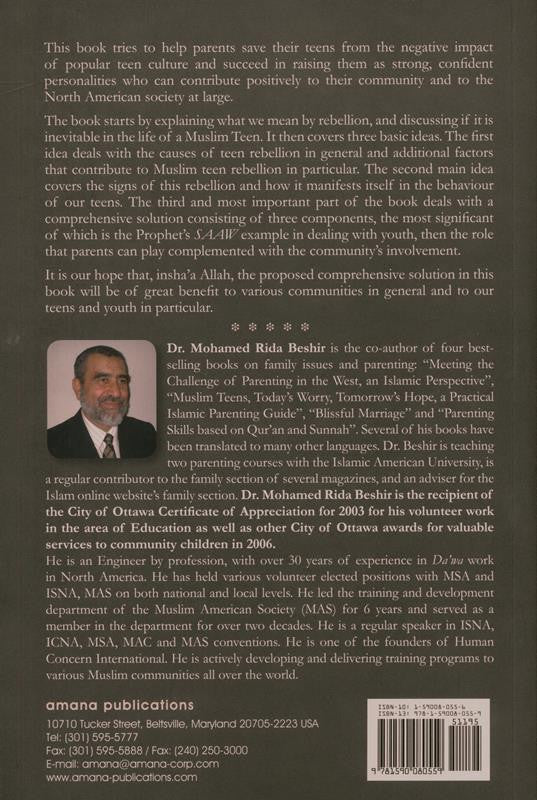
This book tries to help parents save their teens from the negative impact of popular teen culture and succeed in raising them as strong, confident personalities who can contribute positively to their community and to the North American society at large.
The book starts by explaining what we mean by rebellion, and discussing if it is inevitable in the life of a Muslim Teen. It then covers three basic ideas. The first idea deals with the causes of teen rebellion in general and additional factors that contribute to Muslim teen rebellion in particular. The second main idea covers the signs of this rebellion and how it manifests itself in the behaviour of our teens. The third and most important part of the book deals with a comprehensive solution consisting of three components, the most significant of which is the Prophet's SAAW example in dealing with youth, then the role that parents can play complemented with the community's involvement.
It is our hope that, insha'a Allah, the proposed comprehensive solution in this book will be of great benefit to various communities in general and to our teens and youth in particular.
Dr. Mohamed Rida Beshir is the co-author of four best- selling books on family issues and parenting: "Meeting the Challenge of Parenting in the West, an Islamic Perspective", "Muslim Teens, Today's Worry, Tomorrow's Hope, a Practical Islamic Parenting Guide", "Blissful Marriage" and "Parenting Skills based on Qur'an and Sunnah". Several of his books have been translated to many other languages. Dr. Beshir is teaching two parenting courses with the Islamic American University, is
a regular contributor to the family section of several magazines, and an adviser for the Islam online website's family section. Dr. Mohamed Rida Beshir is the recipient of the City of Ottawa Certificate of Appreciation for 2003 for his volunteer work in the area of Education as well as other City of Ottawa awards for valuable services to community children in 2006.
He is an Engineer by profession, with over 30 years of experience in Da'wa work in North America. He has held various volunteer elected positions with MSA and ISNA, MAS on both national and local levels. He led the training and development department of the Muslim American Society (MAS) for 6 years and served as a member in the department for over two decades. He is a regular speaker in ISNA, ICNA, MSA, MAC and MAS conventions. He is one of the founders of Human Concern International. He is actively developing and delivering training programs to various Muslim communities all over the world.
Publisher
Amana Publications
Author
- Dr. Mohamed R. Beshir
Shipping and Delivery
We dispatch orders directly from our UK and USA warehouses, offering multiple shipping options to suit your needs. We proudly ship worldwide.
UK Deliveries (from UK warehouse):
Standard shipping typically arrives within 3–4 working days. Expedited delivery takes 2–3 working days. We aim to dispatch orders the same day or next working day, with next-day delivery options available where applicable.
USA Deliveries (from USA warehouse):
Orders usually arrive within 4–7 working days.
Europe (shipped from UK):
Standard delivery takes approximately 6–10 working days, with expedited services available in 3–5 working days.
Canada:
Estimated delivery time is 5–10 working days.
Worldwide Shipping:
International orders generally arrive within 5–20 working days, depending on destination and shipping method selected.
For precise delivery timelines based on your location, please contact us by email and our team will provide detailed information tailored to your address.
Sample Pages - Content
Page:01
When Muslim Teens rebel
Causes and Solutions
Dr. Mohamed R. Beshir
amana publications
Page:02
Contents
Acknowledgment
How This Book Came To Be
IS REBELLION AN INEVITABLE PART OF THE MUSLIM TEEN'S LIFE? 1
CAUSES OF TEEN REBELLION
Introduction 4
Teens in General 4
The nature of the adolescent stage
Peer Pressure 5
Generation and Culture Gap 6
Current TV, movie, and video game culture 6
Muslim Teens in Particular 7
Being part of a visible minority 7
Torn between two cultures 7
Popular teen culture 7
Islamic values 8
Need to belong and need for approval 9
Pressures on Muslim Families 9
Lack of knowledge of Islamic Parenting skills
on the parents' part 10
SIGNS OF REBELLION
When teens change their names or choose nicknames
that disguise their Muslim identity 14
When teens insist on wearing what is "in", no matter
how it conflicts with Islamic rulings of how to dress 14
Page:03
Is Rebellion an inevitable part of the Muslim Teen's Life?
The way we answer the question of whether or not rebellion is
an inevitable part of the life of a Muslim teen all depends on
the way we define rebellion. If we define rebellion as the assertion of any sort of independence on the teen's part, then the answer to this question will no doubt be yes. But if we define rebellion more comprehensively, then we get a different, and might I say, more favourable
answer.
Before tackling this issue, I think it's important to note that we, as Muslim parents, should not be opposed to our children being independ- ent. Seeking independence is a normal trend and is perfectly natural for this stage of human development. By instilling in teens the desire for independence, Allah SWT is preparing them for the next stage of their life. They are undergoing a transition between childhood and adulthood. As such parents should not oppose it. Nor should parents resent the ability of their children to integrate well into their society, whether it be a majority Muslim society or a majority non-Muslim society. What we should be opposed to is our children following the norms and customs of their society blindly, and without regard for or reference to the teachings of the Quran and Sunnah. This would be a tragedy indeed. This would be called full assimilation, not integration. Our role as parents is to help our children intelligently integrate into their society. As Muslims we know that "Wisdom and good practices are the goal of a believer, wherever s/he find them s/he is the most deserving of using them." So if our children can learn to combine the best of both worlds as they say, by adopting the good of a culture and rejecting the bad, and of course, always abiding by the teachings of the Quran and Sunnah, then we will have done our job as parents.
Page:04
When Muslim Teens Rebel: Causes and Solutions
Signs of Rebellion
There are various signs of rebellion that parents should be on the lookout for, some more serious than others. If you notice your child doing some or all of the following things, it is a good indication that your child is trying to rebel and disconnect him or herself from the Muslim identity. Of course, some teens may exhibit some of the following behaviours within moderation and still be proud of their Islamic identity. But generally, the following behaviours by teens should serve as a red flag that something is wrong.
When teens change their names or choose nicknames that disguise their Muslim identity. So if Ahmed starts asking people to call him Ed and Samir starts going by Sam, this could be a sign of more to come.
When teens insist on wearing what is "in", no matter how it con- flicts with Islamic rulings of how to dress.
This applies to both girls and boys, though it may be more obvious with girls. Even if your daughter is not ready to don the hijab, modesty should still prevail and she should still know that there are limits. This means that she should still be encouraged to wear clothing that is not revealing or tight so that she can gradually work her way to wearing the hijab sometime in the future insha Allah.
Things to watch for with boys: the messages on their T-shirts, the shorts they wear, how much time they spend gelling their hair, wanting to dye their hair, or pierce their ears or wear gold jewellery etc. These days, the t-shirt industry is booming with the production of basic t-shirts that display certain images or messages on them. Some of these t-shirts are funny, others are downright wrong. Unfortunately, the ones selling the fastest are those that display rude or inappropriate messages, often containing swear words and references to sexuality. By wearing these types of clothing
Page:05
This book tries to help parents save their teens from the negative impact of popular teen culture and succeed in raising them as strong, confident personalities who can contribute positively to their community and to the North American society at large.
The book starts by explaining what we mean by rebellion, and discussing if it is inevitable in the life of a Muslim Teen. It then covers three basic ideas. The first idea deals with the causes of teen rebellion in general and additional factors that contribute to Muslim teen rebellion in particular. The second main idea covers the signs of this rebellion and how it manifests itself in the behaviour of our teens. The third and most important part of the book deals with a comprehensive solution consisting of three components, the most significant of which is the Prophet's SAAW example in dealing with youth, then the role that parents can play complemented with the community's involvement.
It is our hope that, insha'a Allah, the proposed comprehensive solution in this book will be of great benefit to various communities in general and to our teens and youth in particular.
Dr. Mohamed Rida Beshir is the co-author of four best- selling books on family issues and parenting: "Meeting the Challenge of Parenting in the West, an Islamic Perspective", "Muslim Teens, Today's Worry, Tomorrow's Hope, a Practical Islamic Parenting Guide", "Blissful Marriage" and "Parenting Skills based on Qur'an and Sunnah". Several of his books have been translated to many other languages. Dr. Beshir is teaching two parenting courses with the Islamic American University, is
a regular contributor to the family section of several magazines, and an adviser for the Islam online website's family section. Dr. Mohamed Rida Beshir is the recipient of the City of Ottawa Certificate of Appreciation for 2003 for his volunteer work in the area of Education as well as other City of Ottawa awards for valuable services to community children in 2006.
He is an Engineer by profession, with over 30 years of experience in Da'wa work in North America. He has held various volunteer elected positions with MSA and ISNA, MAS on both national and local levels. He led the training and development department of the Muslim American Society (MAS) for 6 years and served as a member in the department for over two decades. He is a regular speaker in ISNA, ICNA, MSA, MAC and MAS conventions. He is one of the founders of Human Concern International. He is actively developing and delivering training programs to various Muslim communities all over the world.
Who is Dr. Mohamed R. Beshir?
Dr. Mohamed R. Beshir is an Islamic author, educator, and community leader known for his work on Islamic parenting, family life, youth development, marriage, and Muslim identity. Together with his wife, Dr. Ekram Beshir, he has written extensively on helping Muslim families raise confident, well-balanced children while maintaining strong Islamic values.
Dr. Beshir is particularly recognized for his contributions to Islamic parenting literature, addressing challenges faced by Muslim parents in contemporary societies. His books provide practical guidance on understanding children and teenagers, developing strong personalities, building healthy parent-child relationships, and creating an Islamic family environment.