


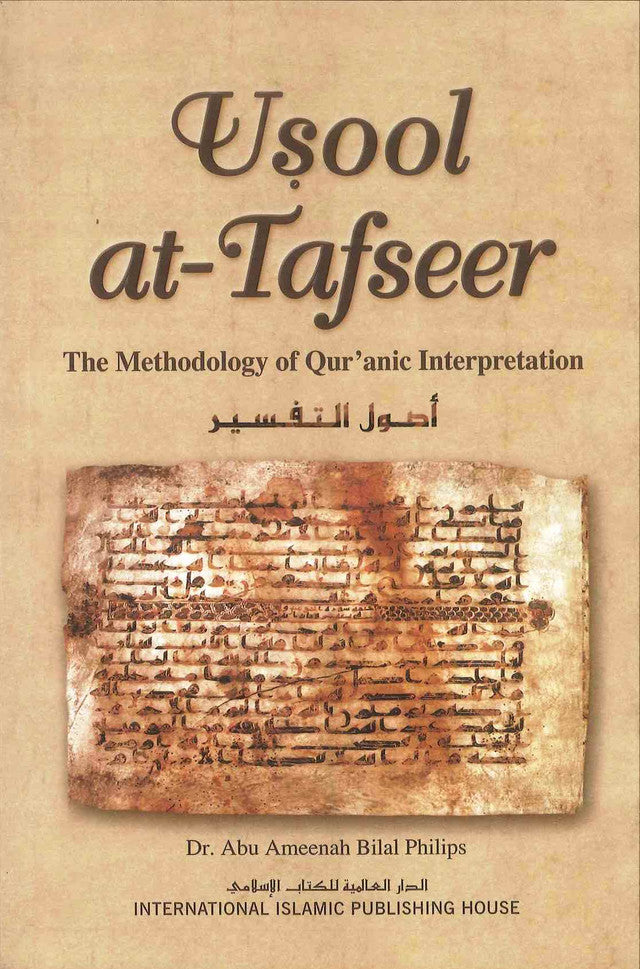
Usool at Tafseer The Methodology of Qur'anic Interpretation
Usool at Tafseer The Methodology of Qur'anic Interpretation
Publisher:
IIPH (International Islamic Publishing House)
Language:
English
Binding:
Hard Cover
Pages: 347
Size: 11x21
Couldn't load pickup availability
Collapsible content
Description of islamic Book
Usool at Tafseer The Methodology of Qur'anic Interpretation
Page:01
Usool at-Tafseer
The Methodology of Qur'anic Interpretation
أصول التفسير
Dr. Abu Ameenah Bilal Philips
الدار العالمية للكتاب الإسلامي
Page:02
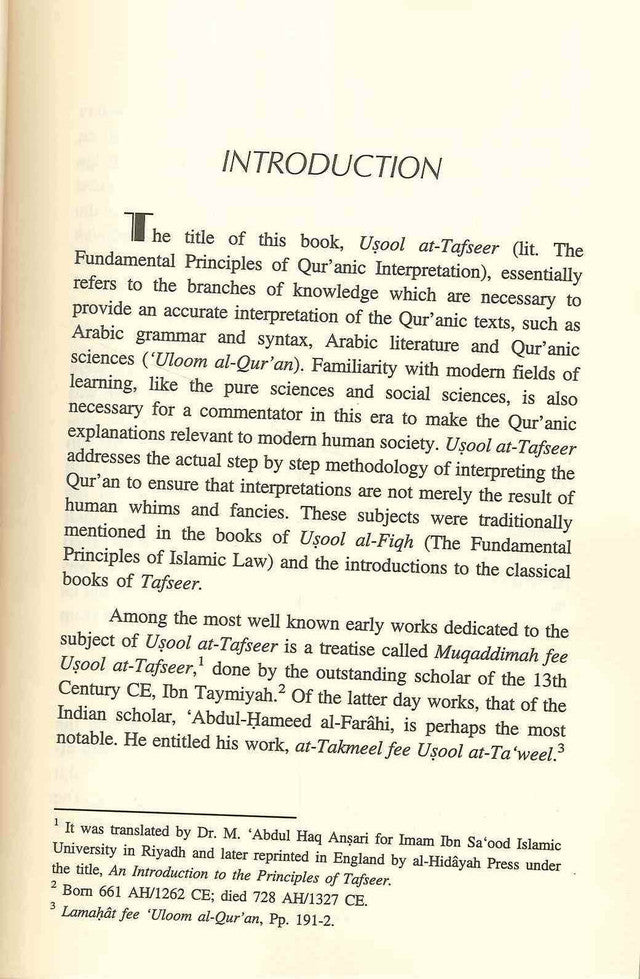
INTRODUCTION
The title of this book, Usool at-Tafseer (lit. The Fundamental Principles of Qur'anic Interpretation), essentially refers to the branches of knowledge which are necessary to provide an accurate interpretation of the Qur'anic texts, such as Arabic grammar and syntax, Arabic literature and Qur'anic sciences ('Uloom al-Qur'an). Familiarity with modern fields of learning, like the pure sciences and social sciences, is also necessary for a commentator in this era to make the Qur'anic explanations relevant to modern human society. Usool at-Tafseer addresses the actual step by step methodology of interpreting the Qur'an to ensure that interpretations are not merely the result of human whims and fancies. These subjects were traditionally mentioned in the books of Usool al-Fiqh (The Fundamental Principles of Islamic Law) and the introductions to the classical books of Tafseer.
Among the most well known early works dedicated to the subject of Usool at-Tafseer is a treatise called Muqaddimah fee Usool at-Tafseer, done by the outstanding scholar of the 13th Century CE, Ibn Taymiyah Of the latter day works, that of the Indian scholar, 'Abdul-Hameed al-Farâhi, is perhaps the most notable. He entitled his work, at-Takmeel fee Usool at-Ta'weel
it was translated by Dr. M. 'Abdul Haq Ansari for Imam Ibn Sa'ood Islamic University in Riyadh and later reprinted in England by al-Hidayah Press under the title, An Introduction to the Principles of Tafseer.
Bom 661 AH/1262 CE; died 728 AH/1327 CE.
Page:03
Usool at-Tafseer
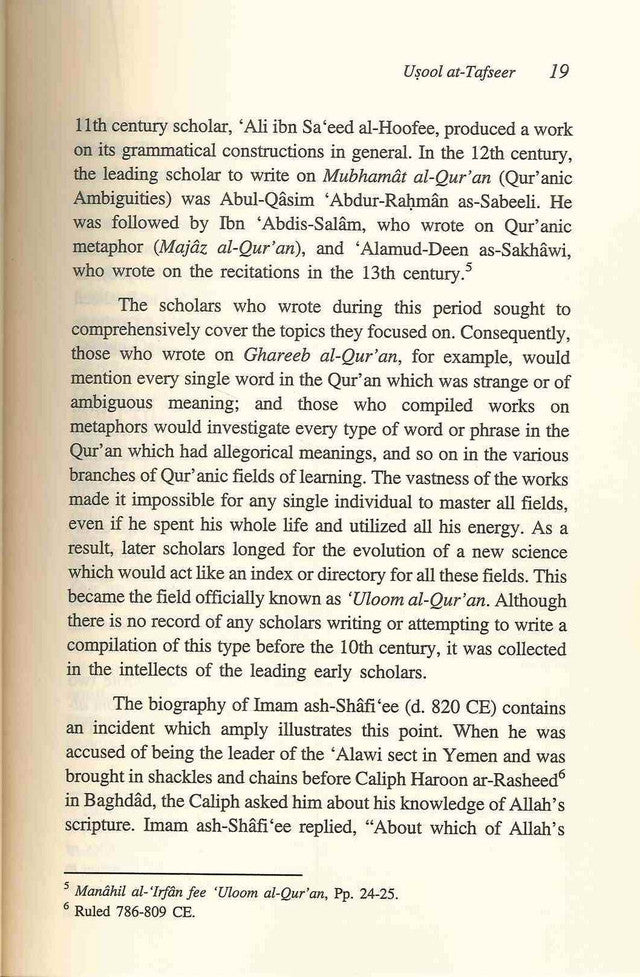
11th century scholar, 'Ali ibn Sa'eed al-Hoofee, produced a work on its grammatical constructions in general. In the 12th century, the leading scholar to write on Mubhamât al-Qur'an (Qur'anic Ambiguities) was Abul-Qâsim 'Abdur-Rahmân as-Sabeeli. He was followed by Ibn 'Abdis-Salâm, who wrote on Qur'anic metaphor (Majâz al-Qur'an), and 'Alamud-Deen as-Sakhawi, who wrote on the recitations in the 13th century
The scholars who wrote during this period sought to comprehensively cover the topics they focused on. Consequently, those who wrote on Ghareeb al-Qur'an, for example, would mention every single word in the Qur'an which was strange or of ambiguous meaning; and those who compiled works on metaphors would investigate every type of word or phrase in the Qur'an which had allegorical meanings, and so on in the various branches of Qur'anic fields of learning. The vastness of the works made it impossible for any single individual to master all fields, even if he spent his whole life and utilized all his energy. As a result, later scholars longed for the evolution of a new science which would act like an index or directory for all these fields. This became the field officially known as 'Uloom al-Qur'an. Although there is no record of any scholars writing or attempting to write a compilation of this type before the 10th century, it was collected in the intellects of the leading early scholars.
The biography of Imam ash-Shâfi'ee (d. 820 CE) contains an incident which amply illustrates this point. When he was accused of being the leader of the 'Alawi sect in Yemen and was brought in shackles and chains before Caliph Haroon ar-Rasheed in Baghdâd, the Caliph asked him about his knowledge of Allah's scripture. Imam ash-Shâfi'ee replied, "About which of Allah's
Manâhil al-'Irfan fee 'Uloom al-Qur'an,
Page:04
Usool at-Tafseer
The Meg of Qur'
السير التفسير
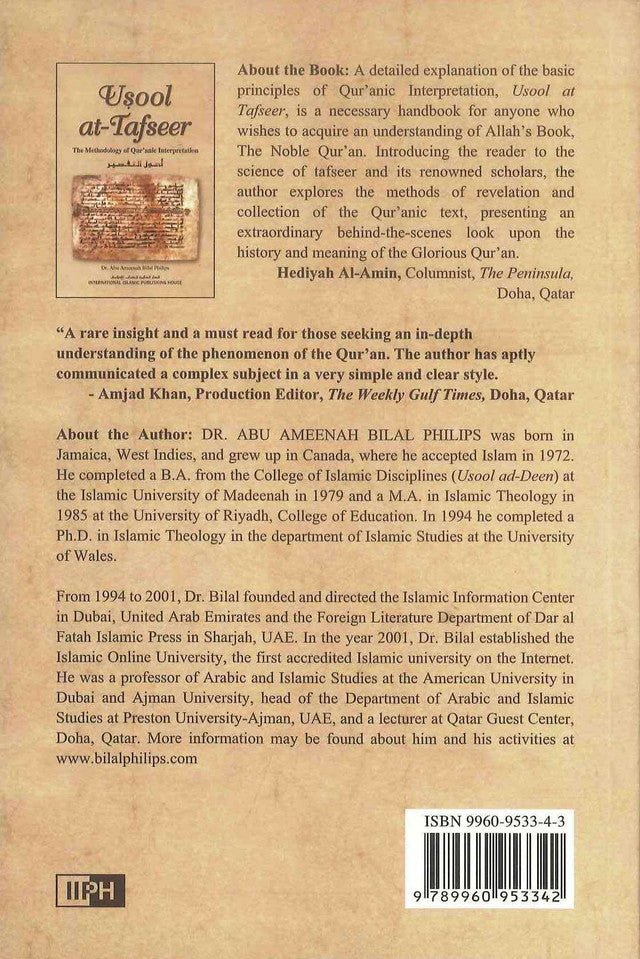
About the Book: A detailed explanation of the basic principles of Qur'anic Interpretation, Usool at Tafseer, is a necessary handbook for anyone who wishes to acquire an understanding of Allah's Book, The Noble Qur'an. Introducing the reader to the science of tafseer and its renowned scholars, the author explores the methods of revelation and collection of the Qur'anic text, presenting an extraordinary behind-the-scenes look upon the history and meaning of the Glorious Qur'an.
Hediyah Al-Amin, Columnist, The Peninsula, Doha, Qatar
"A rare insight and a must read for those seeking an in-depth- understanding of the phenomenon of the Qur'an. The author has aptly communicated a complex subject in a very simple and clear style.
- Amjad Khan, Production Editor, The Weekly Gulf Times, Doha, Qatar
About the Author: DR. ABU AMEENAH BILAL PHILIPS was born in Jamaica, West Indies, and grew up in Canada, where he accepted Islam in 1972. He completed a B.A. from the College of Islamic Disciplines (Usool ad-Deen) at the Islamic University of Madeenah in 1979 and a M.A. in Islamic Theology in 1985 at the University of Riyadh, College of Education. In 1994 he completed a Ph.D. in Islamic Theology in the department of Islamic Studies at the University of Wales.
From 1994 to 2001, Dr. Bilal founded and directed the Islamic Information Center in Dubai, United Arab Emirates and the Foreign Literature Department of Dar al Fatah Islamic Press in Sharjah, UAE. In the year 2001, Dr. Bilal established the Islamic Online University, the first accredited Islamic university on the Internet. He was a professor of Arabic and Islamic Studies at the American University in Dubai and Ajman University, head of the Department of Arabic and Islamic Studies at Preston University-Ajman, UAE, and a lecturer at Qatar Guest Center, Doha, Qatar.
Publisher
IIPH (International Islamic Publishing House)
Author
Shipping and Delivery
We dispatch orders directly from our UK and USA warehouses, offering multiple shipping options to suit your needs. We proudly ship worldwide.
UK Deliveries (from UK warehouse):
Standard shipping typically arrives within 3–4 working days. Expedited delivery takes 2–3 working days. We aim to dispatch orders the same day or next working day, with next-day delivery options available where applicable.
USA Deliveries (from USA warehouse):
Orders usually arrive within 4–7 working days.
Europe (shipped from UK):
Standard delivery takes approximately 6–10 working days, with expedited services available in 3–5 working days.
Canada:
Estimated delivery time is 5–10 working days.
Worldwide Shipping:
International orders generally arrive within 5–20 working days, depending on destination and shipping method selected.
For precise delivery timelines based on your location, please contact us by email and our team will provide detailed information tailored to your address.
Sample Pages - Content
Page:01
Usool at-Tafseer
The Methodology of Qur'anic Interpretation
أصول التفسير
Dr. Abu Ameenah Bilal Philips
الدار العالمية للكتاب الإسلامي
Page:02
INTRODUCTION
The title of this book, Usool at-Tafseer (lit. The Fundamental Principles of Qur'anic Interpretation), essentially refers to the branches of knowledge which are necessary to provide an accurate interpretation of the Qur'anic texts, such as Arabic grammar and syntax, Arabic literature and Qur'anic sciences ('Uloom al-Qur'an). Familiarity with modern fields of learning, like the pure sciences and social sciences, is also necessary for a commentator in this era to make the Qur'anic explanations relevant to modern human society. Usool at-Tafseer addresses the actual step by step methodology of interpreting the Qur'an to ensure that interpretations are not merely the result of human whims and fancies. These subjects were traditionally mentioned in the books of Usool al-Fiqh (The Fundamental Principles of Islamic Law) and the introductions to the classical books of Tafseer.
Among the most well known early works dedicated to the subject of Usool at-Tafseer is a treatise called Muqaddimah fee Usool at-Tafseer, done by the outstanding scholar of the 13th Century CE, Ibn Taymiyah Of the latter day works, that of the Indian scholar, 'Abdul-Hameed al-Farâhi, is perhaps the most notable. He entitled his work, at-Takmeel fee Usool at-Ta'weel
it was translated by Dr. M. 'Abdul Haq Ansari for Imam Ibn Sa'ood Islamic University in Riyadh and later reprinted in England by al-Hidayah Press under the title, An Introduction to the Principles of Tafseer.
Bom 661 AH/1262 CE; died 728 AH/1327 CE.
Page:03
Usool at-Tafseer
11th century scholar, 'Ali ibn Sa'eed al-Hoofee, produced a work on its grammatical constructions in general. In the 12th century, the leading scholar to write on Mubhamât al-Qur'an (Qur'anic Ambiguities) was Abul-Qâsim 'Abdur-Rahmân as-Sabeeli. He was followed by Ibn 'Abdis-Salâm, who wrote on Qur'anic metaphor (Majâz al-Qur'an), and 'Alamud-Deen as-Sakhawi, who wrote on the recitations in the 13th century
The scholars who wrote during this period sought to comprehensively cover the topics they focused on. Consequently, those who wrote on Ghareeb al-Qur'an, for example, would mention every single word in the Qur'an which was strange or of ambiguous meaning; and those who compiled works on metaphors would investigate every type of word or phrase in the Qur'an which had allegorical meanings, and so on in the various branches of Qur'anic fields of learning. The vastness of the works made it impossible for any single individual to master all fields, even if he spent his whole life and utilized all his energy. As a result, later scholars longed for the evolution of a new science which would act like an index or directory for all these fields. This became the field officially known as 'Uloom al-Qur'an. Although there is no record of any scholars writing or attempting to write a compilation of this type before the 10th century, it was collected in the intellects of the leading early scholars.
The biography of Imam ash-Shâfi'ee (d. 820 CE) contains an incident which amply illustrates this point. When he was accused of being the leader of the 'Alawi sect in Yemen and was brought in shackles and chains before Caliph Haroon ar-Rasheed in Baghdâd, the Caliph asked him about his knowledge of Allah's scripture. Imam ash-Shâfi'ee replied, "About which of Allah's
Manâhil al-'Irfan fee 'Uloom al-Qur'an,
Page:04
Usool at-Tafseer
The Meg of Qur'
السير التفسير
About the Book: A detailed explanation of the basic principles of Qur'anic Interpretation, Usool at Tafseer, is a necessary handbook for anyone who wishes to acquire an understanding of Allah's Book, The Noble Qur'an. Introducing the reader to the science of tafseer and its renowned scholars, the author explores the methods of revelation and collection of the Qur'anic text, presenting an extraordinary behind-the-scenes look upon the history and meaning of the Glorious Qur'an.
Hediyah Al-Amin, Columnist, The Peninsula, Doha, Qatar
"A rare insight and a must read for those seeking an in-depth- understanding of the phenomenon of the Qur'an. The author has aptly communicated a complex subject in a very simple and clear style.
- Amjad Khan, Production Editor, The Weekly Gulf Times, Doha, Qatar
About the Author: DR. ABU AMEENAH BILAL PHILIPS was born in Jamaica, West Indies, and grew up in Canada, where he accepted Islam in 1972. He completed a B.A. from the College of Islamic Disciplines (Usool ad-Deen) at the Islamic University of Madeenah in 1979 and a M.A. in Islamic Theology in 1985 at the University of Riyadh, College of Education. In 1994 he completed a Ph.D. in Islamic Theology in the department of Islamic Studies at the University of Wales.
From 1994 to 2001, Dr. Bilal founded and directed the Islamic Information Center in Dubai, United Arab Emirates and the Foreign Literature Department of Dar al Fatah Islamic Press in Sharjah, UAE. In the year 2001, Dr. Bilal established the Islamic Online University, the first accredited Islamic university on the Internet. He was a professor of Arabic and Islamic Studies at the American University in Dubai and Ajman University, head of the Department of Arabic and Islamic Studies at Preston University-Ajman, UAE, and a lecturer at Qatar Guest Center, Doha, Qatar.