


The Rituals of Hajj and Umrah by Imam Ibn Taymiyyah | Complete Islamic Pilgrimage Guide
The Rituals of Hajj and Umrah by Imam Ibn Taymiyyah | Complete Islamic Pilgrimage Guide
Publisher:
AhleDhikr Publications
Author:
Imam Ibn Taymiyyah
Language:
English
Binding:
Soft Cover
Pages: 160
Size: 15 × 21 cm
Couldn't load pickup availability


Collapsible content
Description of islamic Book
The Rituals of Hajj and Umrah by Imam Ibn Taymiyyah | Complete Islamic Pilgrimage Guide
The Rituals of Hajj and Umrah by Imam Ibn Taymiyyah is a comprehensive Islamic guide explaining the sacred rites and obligations of Hajj and Umrah according to the Qur’an and Sunnah. This valuable work is based on Ibn Taymiyyah’s famous Manasik and includes detailed commentary by Shaykh Nasir al-Shithree, along with additional scholarly benefits from respected contemporary scholars. The book covers essential topics such as Ihram, Tawaf, Sa’i, Mina, Arafat, Muzdalifah, and the etiquettes and rulings related to pilgrimage. Written in a clear and accessible style, it serves as an excellent resource for first-time pilgrims, students of Islamic knowledge, and anyone seeking to perform Hajj or Umrah correctly and sincerely. An essential companion for every Muslim preparing for the blessed journey to Makkah and Madinah.
From Author:
The Rituals of Hajj & Umrah by Imam Ibn Taymiyyah, The Rituals of Hajj & Umrah by Shaykh al-Islam Ibn Taymiyyah and explanation by Shaykh Nasir al Shithree (KSA
)From the 9th year of the Islamic calendar, the hajj pilgrimage was made a pillar of Al Islam. It was towards the end of the message of the prophet Muhammed that droves of people entered into islam and performed this hajj with him, yet only a few years before they were the same people who were driven out of their homes and oppressed.
This sense of urgency in fulfilling one of these major acts of worship has carried on throughout the ages, and from this stems the importance that the scholars of Islam have placed in explaining the fifth pillar of Islam. This book is a translation of the summary of Ibn Taymiyyahs famous Manasik by Shaykh Husayn Aal Shaykh with detailed commentary from Shaykh Nasir al Shithree who also wrote a short introduction to the translation. The book also features additional benefits from other well-known scholars such as Shaykh Abdul-Karim al Khudayr.
Content:
What the Book Covers
The book discusses:
- The definition and importance of Hajj and Umrah
- Meeqaat and entering Ihraam
- Types of Hajj rituals
- Talbiyyah and recommended acts during Ihraam
- Prohibited acts during Ihraam
- Tawaaf and Sa’ee rulings
- The days of Mina, ‘Arafah, and Muzdalifah
- Sacrifice and pelting the Jamaraat
- Visiting Masjid an-Nabawi and other places in Madinah
Key Features - Based on authentic Islamic evidences
- Clear and organized chapter structure
- Includes explanations from contemporary scholars
- Suitable for students, pilgrims, and general readers
- A practical companion for Hajj and Umrah journeys
Why Read This Book
This work allows readers to learn the sacred pilgrimage rituals directly from the teachings and explanations of Ibn Taymiyyah, whose scholarship continues to benefit Muslims worldwide. It serves as an essential handbook for anyone preparing for Hajj or Umrah and wishing to follow the Sunnah accurately.
Page:01
مختصر منسك لشيخ الإسلام ابن تيمية
The Rituals of Hajj & Umrah
By Shaykh Al-Islam
Ibn Taymiyyah
Page:02
THE RITUALS OF HAJJ AND UMRAH[1]
INTRODUCTION FROM THE ABRIDGER
الله الرحمن الرحيم بسم
Verily all praises are due to Allaah, We praise Him, seek His Protection, His Guidance and His Forgiveness. We seek protection and refuge from Allaah from the evils of ourselves and our actions. Whoever Allaah guides none can misguide and whoever Allaah allows to go astray none can guide. And I bear witness that Muhammad is the slave of Allaah and His Messenger, may the Peace and Blessings of Allaah be upon him, his family and his companions and May He grant them peace in abundance.
To begin:
Previously, Allaah gave me success in editing the book "The Rituals (of al-Hajj and al-'Umrah)' by Shaykh al-Islaam Ibn
Praise be to Allaah, the Lord of the Creation, I praise Him and I thank Him for the Favours upon me, and I bear witness that there is no god worthy of worship except Allaah Alone without any partners and I bear witness that Muhammad is His Slave and Messenger. To Proceed: We will read from the book of Shaykh al-Islaam Ibn at-Tayimyyah, Ahmad bin Abdul-Haleem bin Abdus-Salaam, from the scholars of this Ummah whom which the Ummah have benefitted by until today, whose books are being used and benefitted from, from the scholars of this Ummah and its general folk. So I ask Allaah to accept this from us and you and to make our deeds for His Glorious Face Alone.
Page:03
Doing the 'Umrah from at-Tan'eem or Whilst One is in Makkah
Chapter 5: The Manner of Forming the Intention for Ihraam and Doing the Talbiyyah
Chapter 9: What the Person Doing Hajj Does on the Day of at-Tarwiyyah and the Day of 'Arafah
Forming the Intention for Ihraam. At-Talbiyyah
Fear of Not Completing the Hajj or 'Umrah because of an Anticipated Problem
The Day of at-Tarwiyyah..
The Day of 'Arafah
Taking a Bath during the Hajj.
Climbing the Mount in 'Arafah.
Avoiding 'Sexual Relations, Committing Sin and Disputes During the Hajj'
Chapter 6: Recommended Acts during Ihraam
Chapter 10: Moving from 'Arafah to Mash'ar al-Haram
Travelling.
Lighting up the Mash'ar (Muzdalifah Area).
Clothing One Wears During the Hajj.
Praying in Muzdalifah.
One Can Tie a Knot in His Clothing Whilst Wearing the Ihraam.. Seeking Shade Whilst in Ihraam
Staying in Muzdalifah
Stopping the Talbiyyah..
The Ihraam of the Woman.
Three Views on Doing at-Talbiyyah
Chapter 7: What is Prohibited During Ihraam
Chapter 11: The Rituals of the Day of Sacrifice.
Killing What May Cause Harm in the Sanctuary
Having Intercourse and What Leads to It
Expiation for Doing what is Forbidden. The Time to Give the Expiation
Pelting the Jamarah al-'Aqabah.
The Hadiy and Fasting for Those Doing al-Qiraan and at-Tamattu'. At-Tawaaf and as-Sa'ee after Leaving 'Arafah.
Chapter 12: Staying in Minaa and Pelting the Jamaraat.
Chapter 8: Entering into Makkah, Masjid al-Haraam and the Rulings of at-Tawaaf and
Sa'e.
Entering Makkah and Masjid al-Haraam
Chapter 13: Praying Salaah during the Rituals.
'Eid and Jumu'ah Prayers During the Rituals
At-Tawaaf
Tawaaf al-Wadaa' and Clinging on to the Multazam.
Ar-Raml and al-Idtibaa'
Supplications Whilst Doing the Tawaaf, the Two Units of Prayer after at-Tawaaf and Drinking Zam Zam.
The Dua'a that Has Been Attributed to Ibn 'Abbaas During the Tawaaf al- Wadaa'
Entering the Ka'bah
Purification Whilst Making at-Tawaaf.
At-Tawaaf for Those who have Excuses
The Tawaaf of the Woman on her Menses
Sa'ee between as-Safaa and al-Marwah.
Chapter 14: Visiting Masjid an-Nabawee and the Other Areas of al-Madeenah al-
Nabawiyyah
The Mannerisms of Visiting al-Madeenah.. Visiting Masjid Qubaa'
Page:04
Translator's Introduction.
Commentator's Introduction.
Introduction from the Abridger
CONTENTS
Chapter 1: The Definition of al-Hajj, its Rulings and Regarding one's Ability in
Carrying it out..
The definition of al-Hajj in the Arabic language
The Shariah (legislated) meaning of al-Hajj. The Ruling of al-Hajj and al-'Umrah.
Ability
Chapter 2: The Start of the Rituals and the Meeqaat.
Starting the Rituals.
The Mawaaqeet have Five Different Locations... Dhu al-Hulayfah..
Al-Juhfah..
The Remaining Mawaaqeet...
Chapter 3: The Types of Hajj Rituals and a Discussion on the Best One
The Types of Rituals of Hajj.
The Best One from the Three
Chapter 4: The 'Umrah
The 'Umrah of the Prophet..
(1) The 'Umrah of al-Hudaybiyyah.
(2) The 'Umrah of al-Qadeeyah. (3) The 'Umrah of al-Ja'raanah. (4) The Final Time he did 'Umrah
Page:05
The Rituals of Hajj & Umrah Shaykh Al-Islam Ibn Taymiyyah
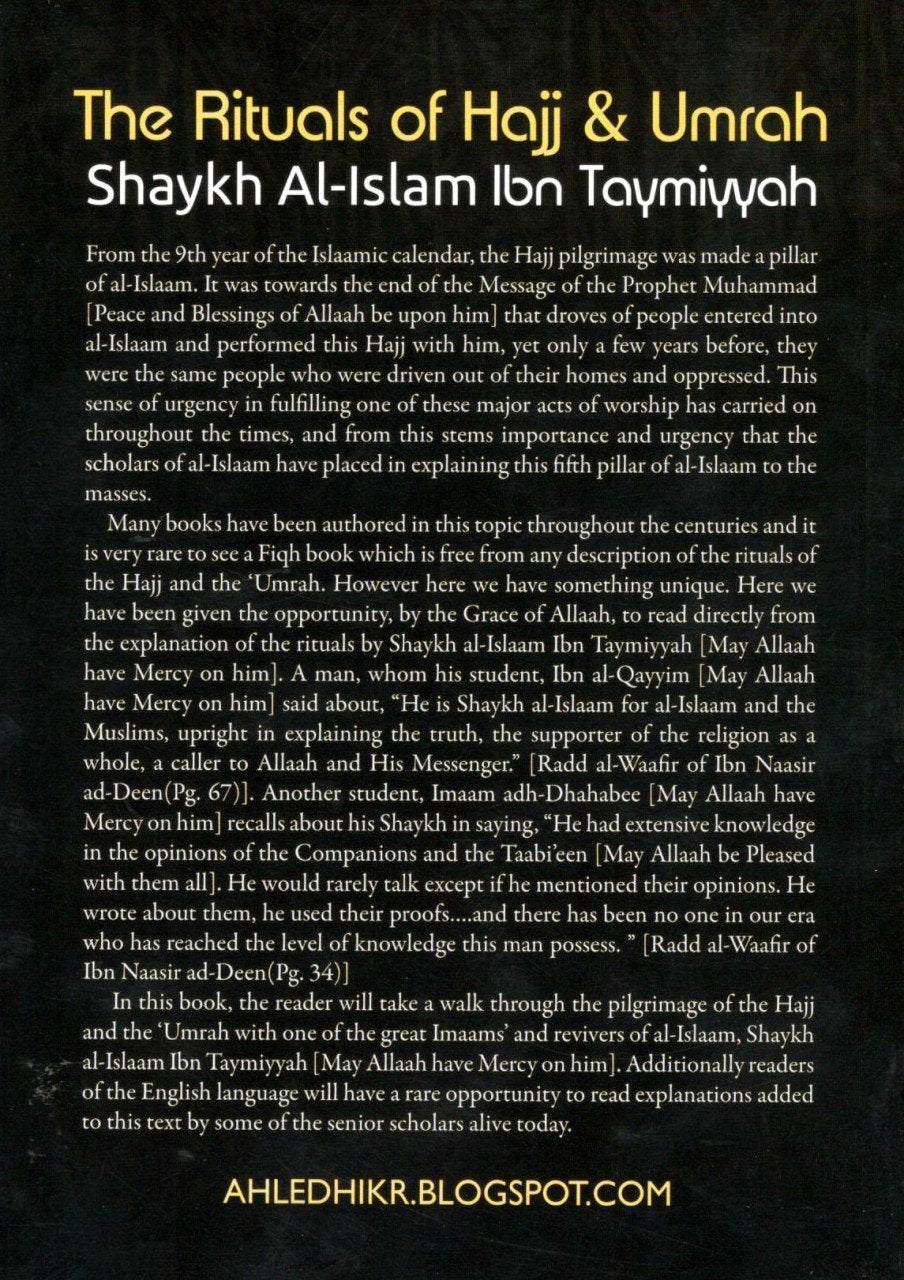
From the 9th year of the Islaamic calendar, the Hajj pilgrimage was made a pillar of al-Islaam. It was towards the end of the Message of the Prophet Muhammad [Peace and Blessings of Allaah be upon him] that droves of people entered into al-Islaam and performed this Hajj with him, yet only a few years before, they were the same people who were driven out of their homes and oppressed. This sense of urgency in fulfilling one of these major acts of worship has carried on throughout the times, and from this stems importance and urgency that the scholars of al-Islaam have placed in explaining this fifth pillar of al-Islaam to the
masses.
Many books have been authored in this topic throughout the centuries and it is very rare to see a Fiqh book which is free from any description of the rituals of the Hajj and the 'Umrah. However here we have something unique. Here we have been given the opportunity, by the Grace of Allaah, to read directly from the explanation of the rituals by Shaykh al-Islaam Ibn Taymiyyah [May Allaah have Mercy on him]. A man, whom his student, Ibn al-Qayyim [May Allaah have Mercy on him] said about, "He is Shaykh al-Islaam for al-Islaam and the Muslims, upright in explaining the truth, the supporter of the religion as a whole, a caller to Allaah and His Messenger." [Radd al-Waafir of Ibn Naasir ad-Deen (Pg. 67)]. Another student, Imaam adh-Dhahabee [May Allaah have Mercy on him] recalls about his Shaykh in saying, "He had extensive knowledge in the opinions of the Companions and the Taabi'een [May Allaah be Pleased with them all]. He would rarely talk except if he mentioned their opinions. He wrote about them, he used their proofs......and there has been no one in our era who has reached the level of knowledge this man possess." [Radd al-Waafir of Ibn Naasir ad-Deen(Pg. 34)]
In this book, the reader will take a walk through the pilgrimage of the Hajj and the 'Umrah with one of the great Imaams' and revivers of al-Islaam, Shaykh al-Islaam Ibn Taymiyyah [May Allaah have Mercy on him]. Additionally readers of the English language will have a rare opportunity to read explanations added to this text by some of the senior scholars alive today.
Publisher
AhleDhikr Publications
Author
- Imam Ibn Taymiyyah
Shipping and Delivery
We dispatch orders directly from our UK and USA warehouses, offering multiple shipping options to suit your needs. We proudly ship worldwide.
UK Deliveries (from UK warehouse):
Standard shipping typically arrives within 3–4 working days. Expedited delivery takes 2–3 working days. We aim to dispatch orders the same day or next working day, with next-day delivery options available where applicable.
USA Deliveries (from USA warehouse):
Orders usually arrive within 4–7 working days.
Europe (shipped from UK):
Standard delivery takes approximately 6–10 working days, with expedited services available in 3–5 working days.
Canada:
Estimated delivery time is 5–10 working days.
Worldwide Shipping:
International orders generally arrive within 5–20 working days, depending on destination and shipping method selected.
For precise delivery timelines based on your location, please contact us by email and our team will provide detailed information tailored to your address.
Sample Pages - Content
Page:01
مختصر منسك لشيخ الإسلام ابن تيمية
The Rituals of Hajj & Umrah
By Shaykh Al-Islam
Ibn Taymiyyah
Page:02
THE RITUALS OF HAJJ AND UMRAH[1]
INTRODUCTION FROM THE ABRIDGER
الله الرحمن الرحيم بسم
Verily all praises are due to Allaah, We praise Him, seek His Protection, His Guidance and His Forgiveness. We seek protection and refuge from Allaah from the evils of ourselves and our actions. Whoever Allaah guides none can misguide and whoever Allaah allows to go astray none can guide. And I bear witness that Muhammad is the slave of Allaah and His Messenger, may the Peace and Blessings of Allaah be upon him, his family and his companions and May He grant them peace in abundance.
To begin:
Previously, Allaah gave me success in editing the book "The Rituals (of al-Hajj and al-'Umrah)' by Shaykh al-Islaam Ibn
Praise be to Allaah, the Lord of the Creation, I praise Him and I thank Him for the Favours upon me, and I bear witness that there is no god worthy of worship except Allaah Alone without any partners and I bear witness that Muhammad is His Slave and Messenger. To Proceed: We will read from the book of Shaykh al-Islaam Ibn at-Tayimyyah, Ahmad bin Abdul-Haleem bin Abdus-Salaam, from the scholars of this Ummah whom which the Ummah have benefitted by until today, whose books are being used and benefitted from, from the scholars of this Ummah and its general folk. So I ask Allaah to accept this from us and you and to make our deeds for His Glorious Face Alone.
Page:03
Doing the 'Umrah from at-Tan'eem or Whilst One is in Makkah
Chapter 5: The Manner of Forming the Intention for Ihraam and Doing the Talbiyyah
Chapter 9: What the Person Doing Hajj Does on the Day of at-Tarwiyyah and the Day of 'Arafah
Forming the Intention for Ihraam. At-Talbiyyah
Fear of Not Completing the Hajj or 'Umrah because of an Anticipated Problem
The Day of at-Tarwiyyah..
The Day of 'Arafah
Taking a Bath during the Hajj.
Climbing the Mount in 'Arafah.
Avoiding 'Sexual Relations, Committing Sin and Disputes During the Hajj'
Chapter 6: Recommended Acts during Ihraam
Chapter 10: Moving from 'Arafah to Mash'ar al-Haram
Travelling.
Lighting up the Mash'ar (Muzdalifah Area).
Clothing One Wears During the Hajj.
Praying in Muzdalifah.
One Can Tie a Knot in His Clothing Whilst Wearing the Ihraam.. Seeking Shade Whilst in Ihraam
Staying in Muzdalifah
Stopping the Talbiyyah..
The Ihraam of the Woman.
Three Views on Doing at-Talbiyyah
Chapter 7: What is Prohibited During Ihraam
Chapter 11: The Rituals of the Day of Sacrifice.
Killing What May Cause Harm in the Sanctuary
Having Intercourse and What Leads to It
Expiation for Doing what is Forbidden. The Time to Give the Expiation
Pelting the Jamarah al-'Aqabah.
The Hadiy and Fasting for Those Doing al-Qiraan and at-Tamattu'. At-Tawaaf and as-Sa'ee after Leaving 'Arafah.
Chapter 12: Staying in Minaa and Pelting the Jamaraat.
Chapter 8: Entering into Makkah, Masjid al-Haraam and the Rulings of at-Tawaaf and
Sa'e.
Entering Makkah and Masjid al-Haraam
Chapter 13: Praying Salaah during the Rituals.
'Eid and Jumu'ah Prayers During the Rituals
At-Tawaaf
Tawaaf al-Wadaa' and Clinging on to the Multazam.
Ar-Raml and al-Idtibaa'
Supplications Whilst Doing the Tawaaf, the Two Units of Prayer after at-Tawaaf and Drinking Zam Zam.
The Dua'a that Has Been Attributed to Ibn 'Abbaas During the Tawaaf al- Wadaa'
Entering the Ka'bah
Purification Whilst Making at-Tawaaf.
At-Tawaaf for Those who have Excuses
The Tawaaf of the Woman on her Menses
Sa'ee between as-Safaa and al-Marwah.
Chapter 14: Visiting Masjid an-Nabawee and the Other Areas of al-Madeenah al-
Nabawiyyah
The Mannerisms of Visiting al-Madeenah.. Visiting Masjid Qubaa'
Page:04
Translator's Introduction.
Commentator's Introduction.
Introduction from the Abridger
CONTENTS
Chapter 1: The Definition of al-Hajj, its Rulings and Regarding one's Ability in
Carrying it out..
The definition of al-Hajj in the Arabic language
The Shariah (legislated) meaning of al-Hajj. The Ruling of al-Hajj and al-'Umrah.
Ability
Chapter 2: The Start of the Rituals and the Meeqaat.
Starting the Rituals.
The Mawaaqeet have Five Different Locations... Dhu al-Hulayfah..
Al-Juhfah..
The Remaining Mawaaqeet...
Chapter 3: The Types of Hajj Rituals and a Discussion on the Best One
The Types of Rituals of Hajj.
The Best One from the Three
Chapter 4: The 'Umrah
The 'Umrah of the Prophet..
(1) The 'Umrah of al-Hudaybiyyah.
(2) The 'Umrah of al-Qadeeyah. (3) The 'Umrah of al-Ja'raanah. (4) The Final Time he did 'Umrah
Page:05
The Rituals of Hajj & Umrah Shaykh Al-Islam Ibn Taymiyyah
From the 9th year of the Islaamic calendar, the Hajj pilgrimage was made a pillar of al-Islaam. It was towards the end of the Message of the Prophet Muhammad [Peace and Blessings of Allaah be upon him] that droves of people entered into al-Islaam and performed this Hajj with him, yet only a few years before, they were the same people who were driven out of their homes and oppressed. This sense of urgency in fulfilling one of these major acts of worship has carried on throughout the times, and from this stems importance and urgency that the scholars of al-Islaam have placed in explaining this fifth pillar of al-Islaam to the
masses.
Many books have been authored in this topic throughout the centuries and it is very rare to see a Fiqh book which is free from any description of the rituals of the Hajj and the 'Umrah. However here we have something unique. Here we have been given the opportunity, by the Grace of Allaah, to read directly from the explanation of the rituals by Shaykh al-Islaam Ibn Taymiyyah [May Allaah have Mercy on him]. A man, whom his student, Ibn al-Qayyim [May Allaah have Mercy on him] said about, "He is Shaykh al-Islaam for al-Islaam and the Muslims, upright in explaining the truth, the supporter of the religion as a whole, a caller to Allaah and His Messenger." [Radd al-Waafir of Ibn Naasir ad-Deen (Pg. 67)]. Another student, Imaam adh-Dhahabee [May Allaah have Mercy on him] recalls about his Shaykh in saying, "He had extensive knowledge in the opinions of the Companions and the Taabi'een [May Allaah be Pleased with them all]. He would rarely talk except if he mentioned their opinions. He wrote about them, he used their proofs......and there has been no one in our era who has reached the level of knowledge this man possess." [Radd al-Waafir of Ibn Naasir ad-Deen(Pg. 34)]
In this book, the reader will take a walk through the pilgrimage of the Hajj and the 'Umrah with one of the great Imaams' and revivers of al-Islaam, Shaykh al-Islaam Ibn Taymiyyah [May Allaah have Mercy on him]. Additionally readers of the English language will have a rare opportunity to read explanations added to this text by some of the senior scholars alive today.
Who is Imam Ibn Taymiyyah?
Imam Ibn Taymiyyah (1263–1328 CE) was one of the most influential Islamic scholars in history, known for his strong emphasis on returning Islamic teachings to their original sources: the Qur’an and Sunnah.
Born in Harran (present-day Turkey) and later educated in Damascus (Syria), he became a leading scholar in Islamic theology (ʿaqīdah), law (fiqh), Hadith, and Qur’anic interpretation. He belonged to the Hanbali school of thought, but his independent reasoning often went beyond strict school boundaries.
He is especially known for:
Advocating a direct, text-based understanding of Islam
Criticizing practices he considered innovations (bidʿah), such as excessive saint veneration
Writing extensive works on creed, law, and comparative theology
Engaging in debates with philosophers, theologians, and other religious groups
Because of his strong opinions, he was imprisoned multiple times in Cairo and Damascus. He died in prison in Damascus in 1328 CE. Despite opposition during his life, his writings later became highly influential in Islamic reform movements.
He authored a very large number of works—estimated between 300 to 700 writings, including fatwas, theological treatises, and legal texts.
Some of his most well-known works include:
Majmu‘ al-Fatawa (Collected Legal Opinions)
Minhaj al-Sunnah an-Nabawiyyah
Al-Aqidah al-Wasitiyyah
Dar’ Ta‘arud al-‘Aql wa al-Naql