


The Mercy in the Difference of the Four Sunni Schools of Islamic Law | Unity Through Jurisprudential Diversity
The Mercy in the Difference of the Four Sunni Schools of Islamic Law | Unity Through Jurisprudential Diversity
Publisher:
Dar al Taqwa
Author:
Al Qadi Al safadi
Language:
English
Binding:
Soft Cover
Pages: 230
Size: 15x21 Cm
Couldn't load pickup availability


Collapsible content
Description of islamic Book
The Mercy in the Difference of the Four Sunni Schools of Islamic Law | Unity Through Jurisprudential Diversity
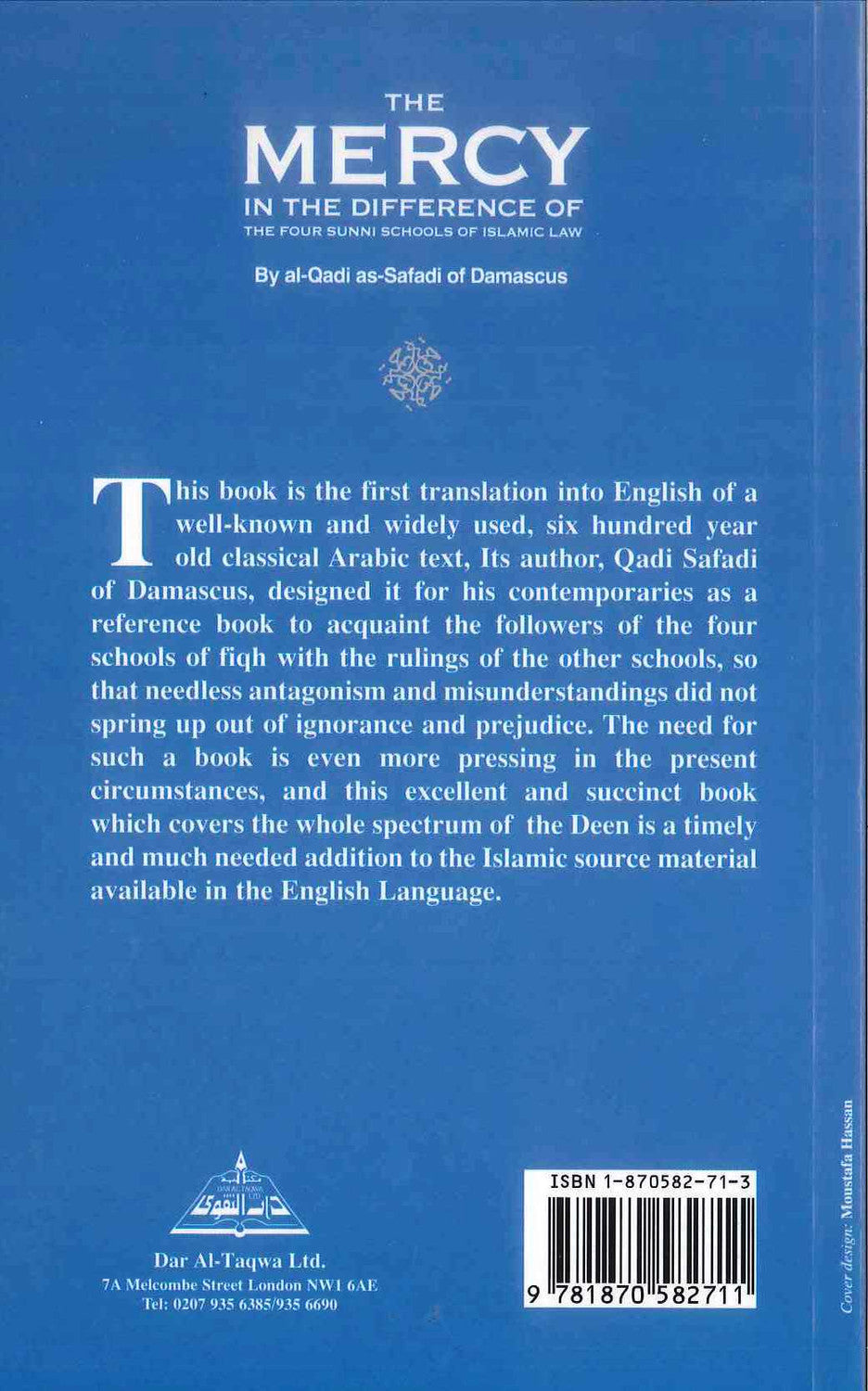
The Mercy in the Difference of the Four Sunni Schools of Islamic Law is a classical text originally written by Al-Qadi Muhammad ibn ‘Abd al-Rahmān As-Safadi of Damascus. The book was composed to educate followers of the four major Sunni schools (madāhib) about the legal rulings and reasoning within the other schools, so as to prevent needless antagonism and misunderstanding.Safadi highlights the wisdom, flexibility, and compassion in the diversity of fiqh (Islamic jurisprudence), presenting each school’s opinions on major acts of worship (like prayer, zakat, fasting, and hajj), personal law (marriage, divorce, inheritance), and social-legal matters (transactions, crime), to show how the differences were always part of a broader merciful legal tradition.
Author Description
Al-Qadi Muhammad ibn ‘Abd al-Rahmān As-Safadi (d. 784 AH / 1382 CE) was a learned judge and scholar in Damascus. His work has been respected for centuries for promoting understanding across the Sunni legal schools and for reducing sectarian tensions by clarifying how each school reasons.
Publisher
Dar al Taqwa
Author
- Al Qadi Al safadi
Shipping and Delivery
We dispatch orders directly from our UK and USA warehouses, offering multiple shipping options to suit your needs. We proudly ship worldwide.
UK Deliveries (from UK warehouse):
Standard shipping typically arrives within 3–4 working days. Expedited delivery takes 2–3 working days. We aim to dispatch orders the same day or next working day, with next-day delivery options available where applicable.
USA Deliveries (from USA warehouse):
Orders usually arrive within 4–7 working days.
Europe (shipped from UK):
Standard delivery takes approximately 6–10 working days, with expedited services available in 3–5 working days.
Canada:
Estimated delivery time is 5–10 working days.
Worldwide Shipping:
International orders generally arrive within 5–20 working days, depending on destination and shipping method selected.
For precise delivery timelines based on your location, please contact us by email and our team will provide detailed information tailored to your address.
Sample Pages - Content
Who is Al Qadi Al safadi?
Safadi writes with a spirit of unity and scholarship: rather than insisting one school is “right,” he shows how each school’s method contributes to the richness of Islamic law. His approach is both deeply rooted in classical jurisprudence and practically oriented toward social harmony.