The Men of Madina Volume 1 Book – Biography of Sahabah & Tabi’un by Muhammad Ibn Sa’d
The Men of Madina Volume 1 by Muhammad Ibn Sa'd is a remarkable translation from his classical work Kitab at-Tabaqat al-Kabir. This volume presents detailed biographies of the Companions (Sahabah), Tabi’un, and early scholars from Madinah and beyond. It offers deep insight into their character, knowledge, and contributions to the early Muslim community. The book highlights how these righteous generations responded to challenges such as trials and civil unrest, making it highly relevant for modern readers. Translated by Aisha Bewley, this work is an essential resource for anyone seeking authentic Islamic history and inspiration from the lives of the early Muslims.
From Author:
This is a translation of volume seven of Ibn Sa’d’s Kitab at-Tabaqat al-Kabir. The Tabaqat is a great store of information which gives the reader a vivid taste and feel for the character of the people of Madina and their extraordinary personalities. This translation deals with the Companions, Tabi’un and subsequent generations of the people of knowledge in Basra, Baghdad, Khurasan, Syria and Egypt. It is of particular interest since it demonstrates the attitude and action of the Companions and the Tabi’un when confronted by the dangers of civil war. It is extremely important in the modern age as we can learn a great deal from how the early Muslims dealt with this trial.
Content:
Biographies of Early Muslims
This work presents detailed biographies of early Muslims across key Islamic centers such as:
Basra
Baghdad
Khurasan
Syria
Egypt
The content is carefully organized by location and generation, making it easy to follow the development of Islamic society.
Generational Structure
Each region includes:
Companions (Sahabah)
Tabi'un (First generation after Companions)
Later generations (Second, third, and beyond)
This structure allows readers to clearly trace:
The spread of Islamic knowledge
The growth of scholarship across regions
Importance of Early Islamic History
Unlike many books that focus only on the life of Prophet Muhammad or modern issues, this work highlights a crucial period that teaches:
How Muslims dealt with fitna (conflicts and trials)
The practical application of Islamic teachings in real life
Understanding Fitna (Trials)
A central lesson from the book:
Early Muslims experienced serious internal conflicts and civil wars
Their responses offer:
Wisdom
Guidance
Lessons for handling modern challenges
Why This Book Matters
One of the earliest and most authentic historical records
Focuses on real lives, not just theory
Demonstrates:
Strong character
Deep scholarship
Sound decision-making during crises
Page no:1
The Men of Madina
Volume I
Muhammad Ibn Sa'd
Page no:2
بسم الله الرحمن الرحيم
Introduction
The Kitab at-Tabaqat by Abu 'Abdullah Muhammad ibn Sa'd is one of the earliest collections of biographical details of the early Muslims, extending from the Prophet, may Allah bless him and grant him peace, to Ibn Sa'd's own time (he lived from 148/764 to 230/845 or 236/770). Volume 8, which deals exclusively with women, was published as The Women of Madina. This present translation covers Volume 7, which deals with the Companions, Tabi'un and subsequent generations of the people of knowledge in Basra, Baghdad, Khurasan, Syria and Egypt. The people of Kufa are found in Volume 6 and the people of Madina in Volume 5, as yet untranslated.
The Companions are mentioned first in each locality, and then the next generation, the Tabi'un, and then the following generations. The scope of Ibn Sa'd covers the time of the Rashidun khalifs, the Umayyads and the 'Abbasids, and so some brief comments about Islamic history are necessary in order to put the events and individu- als mentioned into perspective, and to make the events and com- ments described more comprehensible, particularly in view of the fact that not much material is available on the Umayyad period!
Books on Islam tend to concentrate on either the Prophet, peace be upon him, and the major Companions, or to deal with the prob- lems of modern times. Why, it might be asked, is it so important to learn about the lives of the Muslims during the first two centuries after the Prophet's death, a period of history which is so often ignored?
Perhaps the most important lesson we can take from this early period is the attitude and action of the Companions and the Tabi'un when confronted by that most dangerous of trials - fitna or civil war. In Arabic, fitna means 'civil strife, discord, sedition, temptation, trial'. It is used to refer to those disagreements in the community which develop into factions and then into outright armed conflict. This is extremely important because we continue to be constantly confronted by fitna wherever we turn. We can learn a great deal from how the early Muslims dealt with it.
Page no :3
Contents
Introduction
Map
Chapter One: The Companions of the Prophet Muhammad in Basra
The First Generation (Tabi'un)
The Second Generation
The Third Generation
The Fourth Generation
The Fifth Generation
The Sixth Generation
The Seventh Generation
The Eighth Generation
The Fuqaha' and Hadith Scholars in Wasit
The Companions in Mada'in
The Fuqaha' and Hadith Scholars in Mada'in
The Fuqaha' and Hadith Scholars in Baghdad
The Companions in Khurasan
Those in Khurasan after them
The Fuqaha' and Hadith Scholars in Rayy
The Fuqaha' in Hamadan
The Hadith Scholars in Anbar
Page no:4
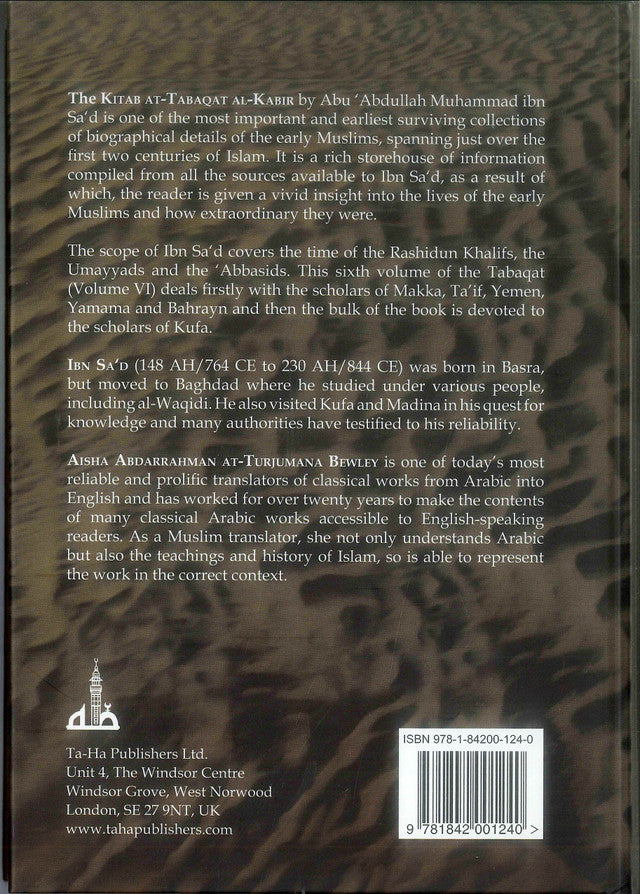
The KITAB AT-TABAQAT AL-KABIR by Abu 'Abdullah Muhammad ibn Sa'd is one of the most important and earliest surviving collections of biographical details of the early Muslims, spanning just over the first two centuries of Islam. It is a rich storehouse of information compiled from all the sources available to Ibn Sa'd, as a result of which, the reader is given a vivid insight into the lives of the early Muslims and how extraordinary they were.
The scope of Ibn Sa'd covers the time of the Rashidun Khalifs, the Umayyads and the 'Abbasids. This sixth volume of the Tabaqat (Volume VI) deals firstly with the scholars of Makka, Ta'if, Yemen, Yamama and Bahrayn and then the bulk of the book is devoted to the scholars of Kufa.
IBN SA'D (148 AH/764 CE to 230 AH/844 CE) was born in Basra, but moved to Baghdad where he studied under various people, including al-Waqidi. He also visited Kufa and Madina in his quest for knowledge and many authorities have testified to his reliability.
AISHA ABDARRAHMAN AT-TURJUMANA BEWLEY is one of today's most reliable and prolific translators of classical works from Arabic into English and has worked for over twenty years to make the contents of many classical Arabic works accessible to English-speaking readers. As a Muslim translator, she not only understands Arabic but also the teachings and history of Islam, so is able to represent the work in the correct context.