


The Fundamentals of Tawheed (Islamic Monotheism)
The Fundamentals of Tawheed (Islamic Monotheism)
Publisher:
Al Hidaayah Publishing
Author:
Dr. Abu Ameenah Bilal Philips
Language:
English
Binding:
Soft Cover
Pages: 192
Size: 15x21cm
Couldn't load pickup availability
Collapsible content
Description of islamic Book
The Fundamentals of Tawheed by Abu Ameenah Bilal Phillips is a clear and comprehensive guide to Islamic monotheism. This essential Aqeedah book explains the true concept of Tawheed, warning against shirk, and providing Muslims with authentic knowledge of worship according to the Qur’an and Sunnah.
From Author:
Abu Ameenah Bilal Phillips is a Canadian-born Islamic scholar and author known for his clear writings on Tawheed and Islamic creed.
Content:
Categories of Tawheed
The book explains the three main categories of Tawheed:
Tawheed ar-Ruboobeeyah — maintaining the unity of Allah’s Lordship.
Tawheed al-Asmaa was-Sifaat — maintaining the unity of Allah’s Names and Attributes.
Tawheed al-'Ebaadah — maintaining the unity of worship.
Categories of Shirk
It examines how Tawheed can be compromised through Shirk, including Shirk in Lordship, Names and Attributes, and worship. It also discusses major and minor Shirk and different forms associated with each category.
Allah’s Covenant with Adam
The book explores the concepts of Fitrah, the pre-creation covenant, the Barzakh, and the covenant with Adam, providing insight into humanity’s relationship with Allah.
Charms & Omens
A dedicated section discusses charms, their Islamic ruling, omens, and Fa'l (good omens), helping readers understand beliefs and practices that may affect their Tawheed.
Clear & Accessible Presentation
Classical theological concepts are presented in a simple, fluid English style, making the book suitable for readers seeking a stronger foundation in Islamic monotheism and a clearer understanding of the dangers of Shirk.
Page:01
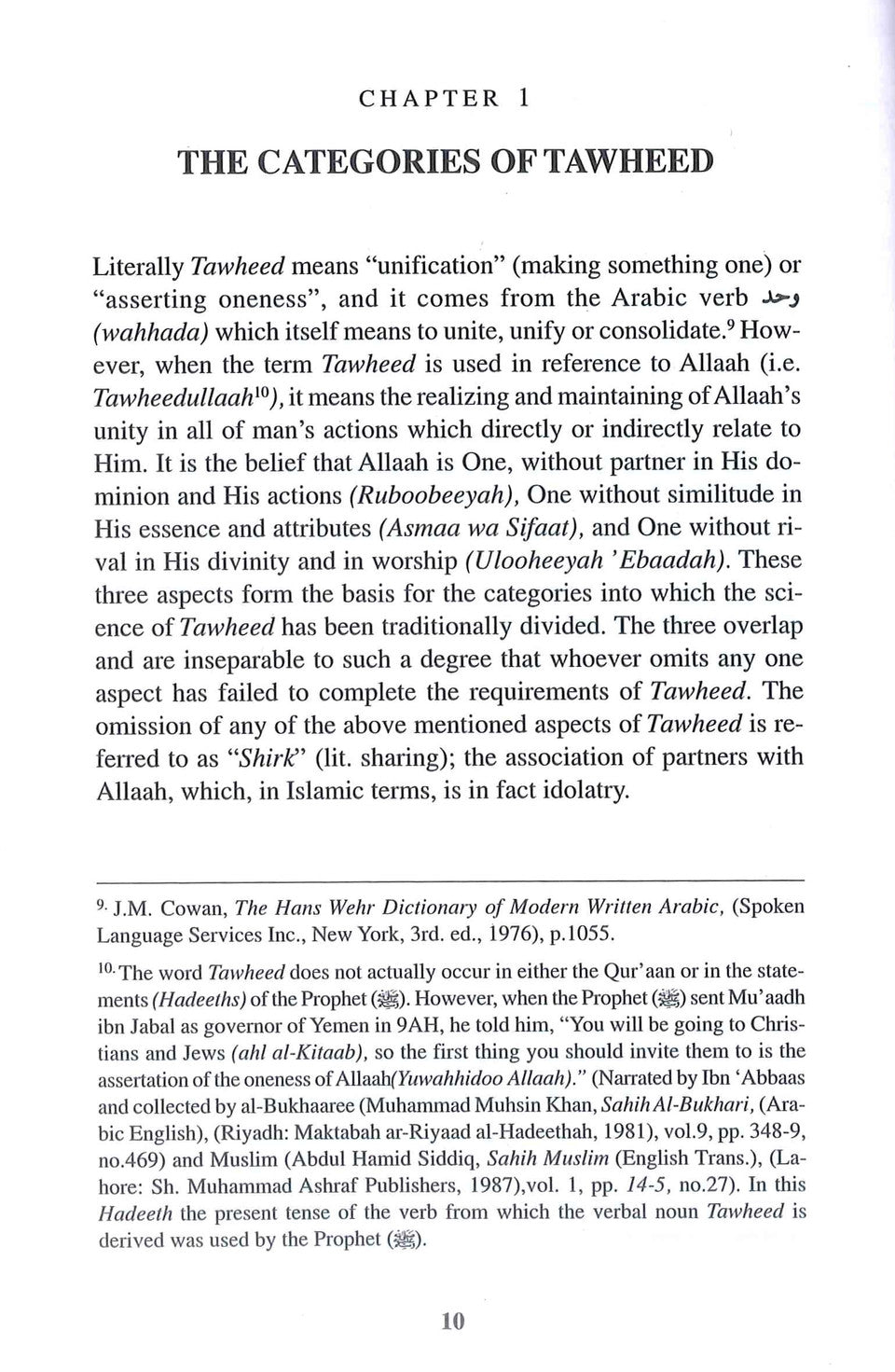
CHAPTER 1
THE CATEGORIES OF TAWHEED
Literally Tawheed means "unification" (making something one) or "asserting oneness", and it comes from the Arabic verb (wahhada) which itself means to unite, unify or consolidate.' How- ever, when the term Tawheed is used in reference to Allaah (i.e. Tawheedullaah10), it means the realizing and maintaining of Allaah's unity in all of man's actions which directly or indirectly relate to Him. It is the belief that Allaah is One, without partner in His do- minion and His actions (Ruboobeeyah), One without similitude in His essence and attributes (Asmaa wa Sifaat), and One without ri- val in His divinity and in worship (Ulooheeyah 'Ebaadah). These three aspects form the basis for the categories into which the sci- ence of Tawheed has been traditionally divided. The three overlap and are inseparable to such a degree that whoever omits any one aspect has failed to complete the requirements of Tawheed. The omission of any of the above mentioned aspects of Tawheed is re- ferred to as "Shirk" (lit. sharing); the association of partners with Allaah, which, in Islamic terms, is in fact idolatry.
9. J.M. Cowan, The Hans Wehr Dictionary of Modern Written Arabic, (Spoken Language Services Inc., New York, 3rd. ed., 1976), p. 1055.
10. The word Tawheed does not actually occur in either the Qur'aan or in the state- ments (Hadeeths) of the Prophet (). However, when the Prophet () sent Mu'aadh ibn Jabal as governor of Yemen in 9AH, he told him, "You will be going to Chris- tians and Jews (ahl al-Kitaab), so the first thing you should invite them to is the assertation of the oneness of Allaah(Yuwahhidoo Allaah)." (Narrated by Ibn 'Abbaas and collected by al-Bukhaaree (Muhammad Muhsin Khan, Sahih Al-Bukhari, (Ara- bic English), (Riyadh: Maktabah ar-Riyaad al-Hadeethah, 1981), vol.9, pp. 348-9, no.469) and Muslim (Abdul Hamid Siddiq, Sahih Muslim (English Trans.), (La- hore: Sh. Muhammad Ashraf Publishers, 1987), vol. 1, pp. 14-5, no.27). In this Hadeeth the present tense of the verb from which the verbal noun Tawheed is derived was used by the Prophet ().
Page:02
'Foreword.
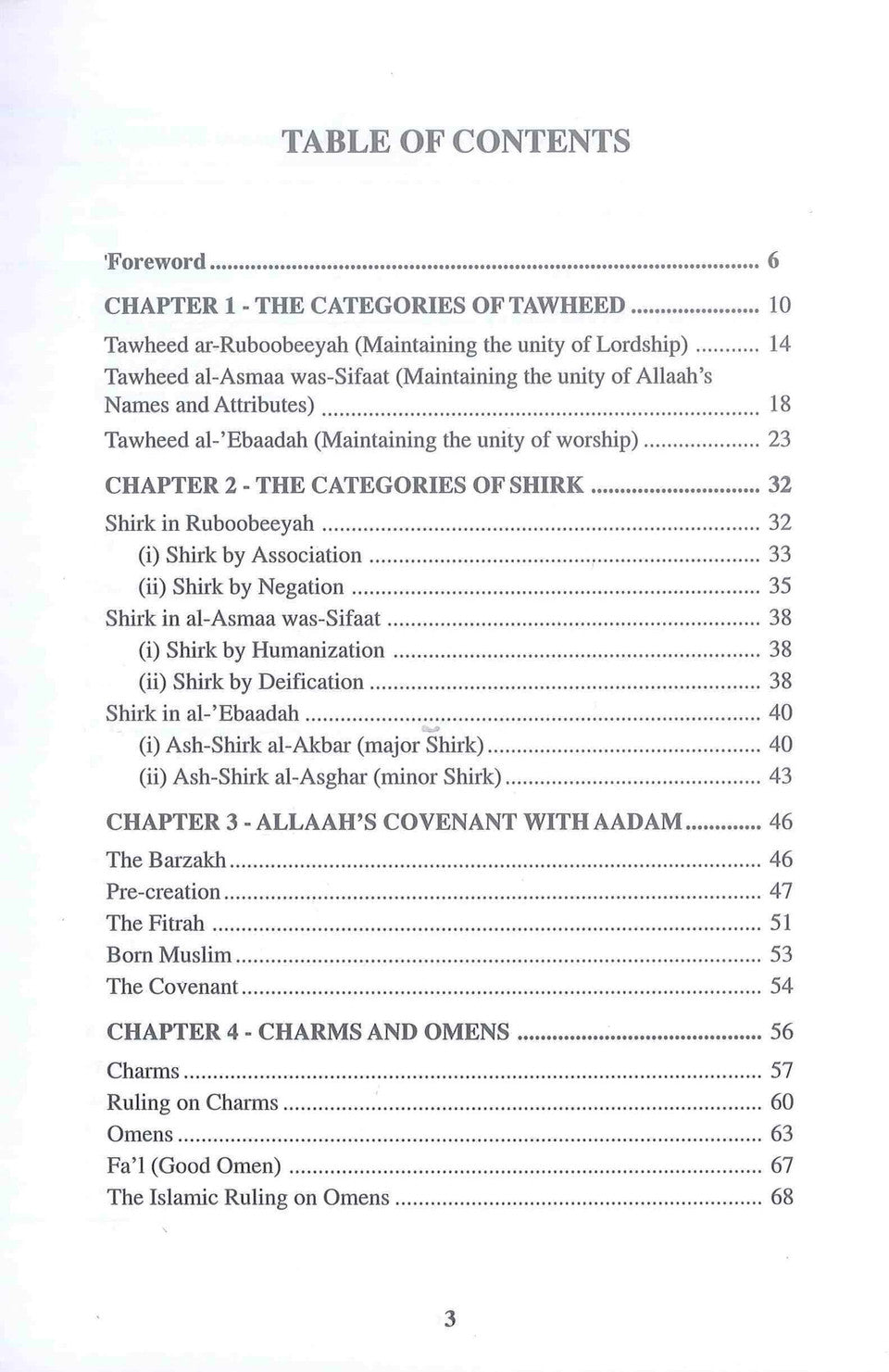
TABLE OF CONTENTS
CHAPTER 1 - THE CATEGORIES OF TAWHEED
Tawheed ar-Ruboobeeyah (Maintaining the unity of Lordship). Tawheed al-Asmaa was-Sifaat (Maintaining the unity of Allaah's Names and Attributes)
Tawheed al-'Ebaadah (Maintaining the unity of worship).
CHAPTER 2 - THE CATEGORIES OF SHIRK
Shirk in Ruboobeeyah
(i) Shirk by Association
(ii) Shirk by Negation
Shirk in al-Asmaa was-Sifaat (i) Shirk by Humanization (ii) Shirk by Deification Shirk in al-'Ebaadah
(i) Ash-Shirk al-Akbar (major Shirk).
(ii) Ash-Shirk al-Asghar (minor Shirk).
CHAPTER 3- ALLAAH'S COVENANT WITH AADAM.
The Barzakh.
Pre-creation.
The Fitrah
Born Muslim
The Covenant.
CHAPTER 4 - CHARMS AND OMENS
Charms
Ruling on Charms.
Omens
Fa'l (Good Omen)
The Islamic Ruling on Omens
Page:03
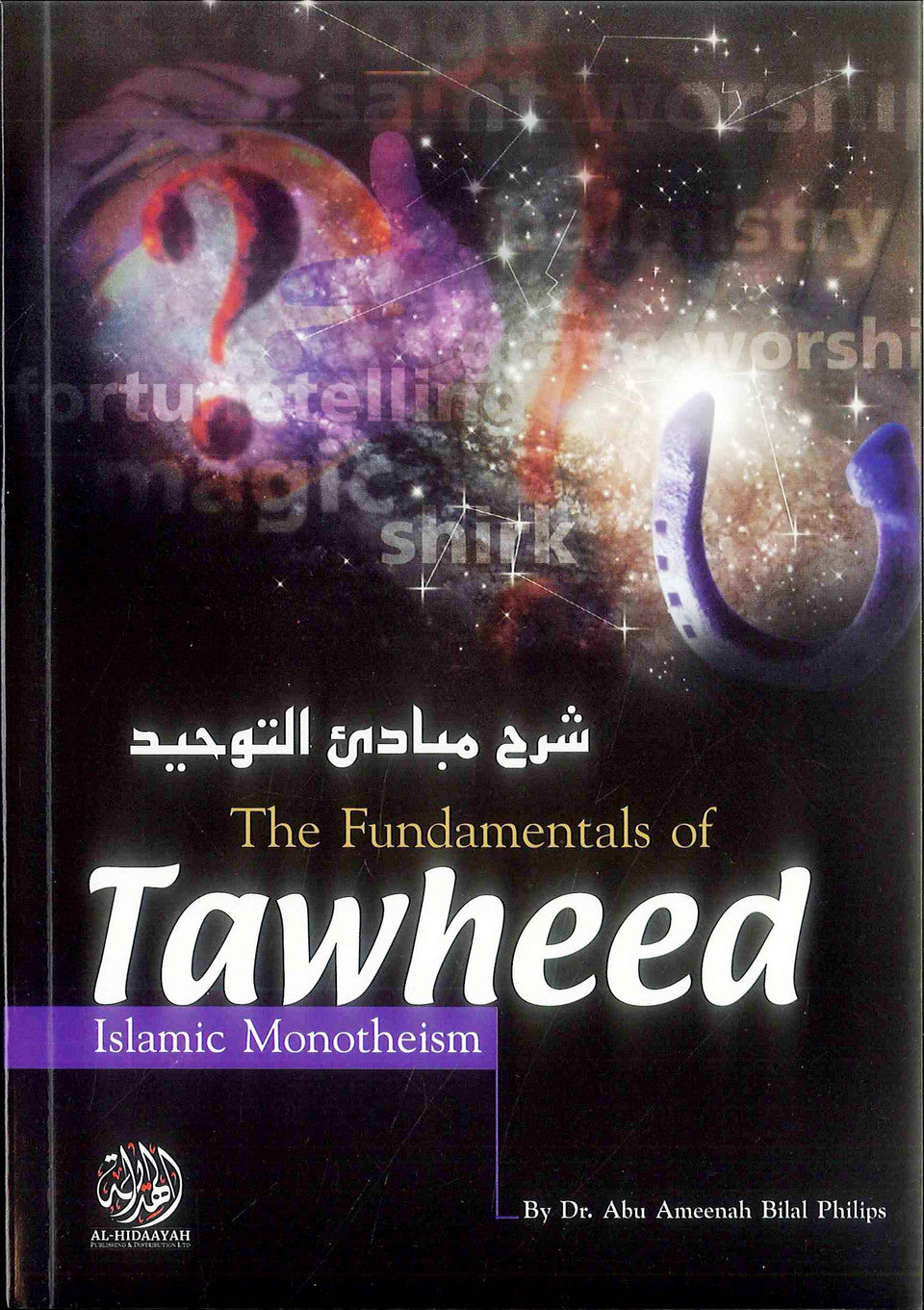
fortunetelling magic shirk
ustry worshi
شرح مبادئ التوحيد
The Fundamentals of
Tawheed
Islamic Monotheism
AL-HIDAAYAH
PUBLISHING & DISTRIBUTION LTD
By Dr. Abu Ameenah Bilal Philips
Page:04
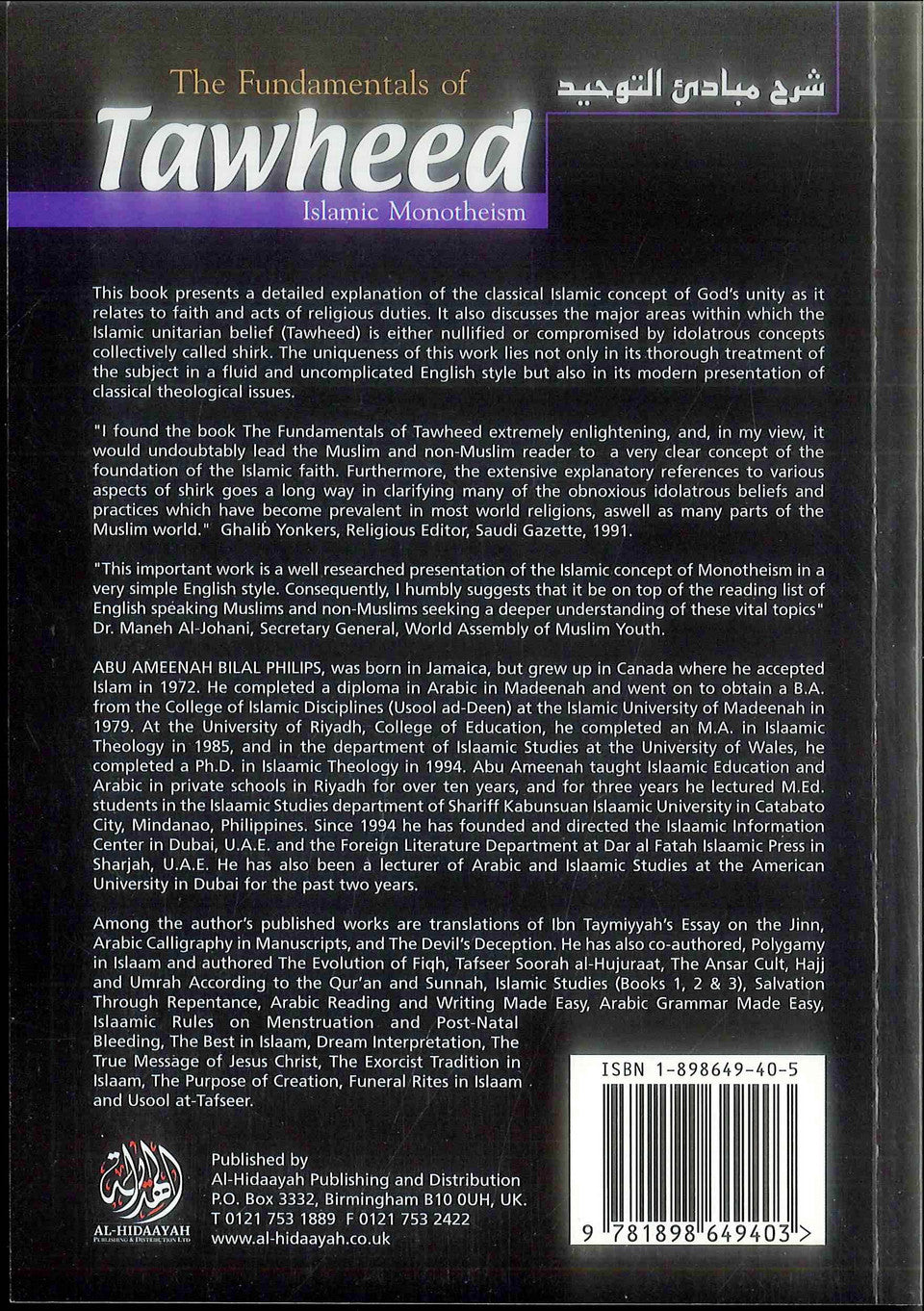
The Fundamentals of
Tawheed
Islamic Monotheism
شرح مبادئ التوحيد
This book presents a detailed explanation of the classical Islamic concept of God's unity as it relates to faith and acts of religious duties. It also discusses the major areas within which the Islamic unitarian belief (Tawheed) is either nullified or compromised by idolatrous concepts collectively called shirk. The uniqueness of this work lies not only in its thorough treatment of the subject in a fluid and uncomplicated English style but also in its modern presentation of classical theological issues.
"I found the book The Fundamentals of Tawheed extremely enlightening, and, in my view, it would undoubtably lead the Muslim and non-Muslim reader to a very clear concept of the foundation of the Islamic faith. Furthermore, the extensive explanatory references to various aspects of shirk goes a long way in clarifying many of the obnoxious idolatrous beliefs and practices which have become prevalent in most world religions, aswell as many parts of the Muslim world." Ghalib Yonkers, Religious Editor, Saudi Gazette, 1991.
"This important work is a well researched presentation of the Islamic concept of Monotheism in a very simple English style. Consequently, I humbly suggests that it be on top of the reading list of English speaking Muslims and non-Muslims seeking a deeper understanding of these vital topics" Dr. Maneh Al-Johani, Secretary General, World Assembly of Muslim Youth.
ABU AMEENAH BILAL PHILIPS, was born in Jamaica, but grew up in Canada where he accepted Islam in 1972. He completed a diploma in Arabic in Madeenah and went on to obtain a B.A. from the College of Islamic Disciplines (Usool ad-Deen) at the Islamic University of Madeenah in 1979. At the University of Riyadh, College of Education, he completed an M.A. in Islaamic Theology in 1985, and in the department of Islaamic Studies at the University of Wales, he completed a Ph.D. in Islaamic Theology in 1994. Abu Ameenah taught Islaamic Education and Arabic in private schools in Riyadh for over ten years, and for three years he lectured M.Ed. students in the Islaamic Studies department of Shariff Kabunsuan Islaamic University in Catabato City, Mindanao, Philippines. Since 1994 he has founded and directed the Islaamic Information Center in Dubai, U.A.E. and the Foreign Literature Department at Dar al Fatah Islaamic Press in Sharjah, U.A.E. He has also been a lecturer of Arabic and Islaamic Studies at the American University in Dubai for the past two years.
Among the author's published works are translations of Ibn Taymiyyah's Essay on the Jinn, Arabic Calligraphy in Manuscripts, and The Devil's Deception. He has also co-authored, Polygamy in Islaam and authored The Evolution of Fiqh, Tafseer Soorah al-Hujuraat, The Ansar Cult, Hajj and Umrah According to the Qur'an and Sunnah, Islamic Studies (Books 1, 2 & 3), Salvation Through Repentance, Arabic Reading and Writing Made Easy, Arabic Grammar Made Easy, Islaamic Rules on Menstruation and Post-Natal Bleeding, The Best in Islaam, Dream Interpretation, The True Message of Jesus Christ, The Exorcist Tradition in Islaam, The Purpose of Creation, Funeral Rites in Islaam and Usool at-Tafseer.
Publisher
Al Hidaayah Publishing
Author
- Dr. Abu Ameenah Bilal Philips
Shipping and Delivery
We dispatch orders directly from our UK and USA warehouses, offering multiple shipping options to suit your needs. We proudly ship worldwide.
UK Deliveries (from UK warehouse):
Standard shipping typically arrives within 3–4 working days. Expedited delivery takes 2–3 working days. We aim to dispatch orders the same day or next working day, with next-day delivery options available where applicable.
USA Deliveries (from USA warehouse):
Orders usually arrive within 4–7 working days.
Europe (shipped from UK):
Standard delivery takes approximately 6–10 working days, with expedited services available in 3–5 working days.
Canada:
Estimated delivery time is 5–10 working days.
Worldwide Shipping:
International orders generally arrive within 5–20 working days, depending on destination and shipping method selected.
For precise delivery timelines based on your location, please contact us by email and our team will provide detailed information tailored to your address.
Sample Pages - Content
Page:01
CHAPTER 1
THE CATEGORIES OF TAWHEED
Literally Tawheed means "unification" (making something one) or "asserting oneness", and it comes from the Arabic verb (wahhada) which itself means to unite, unify or consolidate.' How- ever, when the term Tawheed is used in reference to Allaah (i.e. Tawheedullaah10), it means the realizing and maintaining of Allaah's unity in all of man's actions which directly or indirectly relate to Him. It is the belief that Allaah is One, without partner in His do- minion and His actions (Ruboobeeyah), One without similitude in His essence and attributes (Asmaa wa Sifaat), and One without ri- val in His divinity and in worship (Ulooheeyah 'Ebaadah). These three aspects form the basis for the categories into which the sci- ence of Tawheed has been traditionally divided. The three overlap and are inseparable to such a degree that whoever omits any one aspect has failed to complete the requirements of Tawheed. The omission of any of the above mentioned aspects of Tawheed is re- ferred to as "Shirk" (lit. sharing); the association of partners with Allaah, which, in Islamic terms, is in fact idolatry.
9. J.M. Cowan, The Hans Wehr Dictionary of Modern Written Arabic, (Spoken Language Services Inc., New York, 3rd. ed., 1976), p. 1055.
10. The word Tawheed does not actually occur in either the Qur'aan or in the state- ments (Hadeeths) of the Prophet (). However, when the Prophet () sent Mu'aadh ibn Jabal as governor of Yemen in 9AH, he told him, "You will be going to Chris- tians and Jews (ahl al-Kitaab), so the first thing you should invite them to is the assertation of the oneness of Allaah(Yuwahhidoo Allaah)." (Narrated by Ibn 'Abbaas and collected by al-Bukhaaree (Muhammad Muhsin Khan, Sahih Al-Bukhari, (Ara- bic English), (Riyadh: Maktabah ar-Riyaad al-Hadeethah, 1981), vol.9, pp. 348-9, no.469) and Muslim (Abdul Hamid Siddiq, Sahih Muslim (English Trans.), (La- hore: Sh. Muhammad Ashraf Publishers, 1987), vol. 1, pp. 14-5, no.27). In this Hadeeth the present tense of the verb from which the verbal noun Tawheed is derived was used by the Prophet ().
Page:02
'Foreword.
TABLE OF CONTENTS
CHAPTER 1 - THE CATEGORIES OF TAWHEED
Tawheed ar-Ruboobeeyah (Maintaining the unity of Lordship). Tawheed al-Asmaa was-Sifaat (Maintaining the unity of Allaah's Names and Attributes)
Tawheed al-'Ebaadah (Maintaining the unity of worship).
CHAPTER 2 - THE CATEGORIES OF SHIRK
Shirk in Ruboobeeyah
(i) Shirk by Association
(ii) Shirk by Negation
Shirk in al-Asmaa was-Sifaat (i) Shirk by Humanization (ii) Shirk by Deification Shirk in al-'Ebaadah
(i) Ash-Shirk al-Akbar (major Shirk).
(ii) Ash-Shirk al-Asghar (minor Shirk).
CHAPTER 3- ALLAAH'S COVENANT WITH AADAM.
The Barzakh.
Pre-creation.
The Fitrah
Born Muslim
The Covenant.
CHAPTER 4 - CHARMS AND OMENS
Charms
Ruling on Charms.
Omens
Fa'l (Good Omen)
The Islamic Ruling on Omens
Page:03
fortunetelling magic shirk
ustry worshi
شرح مبادئ التوحيد
The Fundamentals of
Tawheed
Islamic Monotheism
AL-HIDAAYAH
PUBLISHING & DISTRIBUTION LTD
By Dr. Abu Ameenah Bilal Philips
Page:04
The Fundamentals of
Tawheed
Islamic Monotheism
شرح مبادئ التوحيد
This book presents a detailed explanation of the classical Islamic concept of God's unity as it relates to faith and acts of religious duties. It also discusses the major areas within which the Islamic unitarian belief (Tawheed) is either nullified or compromised by idolatrous concepts collectively called shirk. The uniqueness of this work lies not only in its thorough treatment of the subject in a fluid and uncomplicated English style but also in its modern presentation of classical theological issues.
"I found the book The Fundamentals of Tawheed extremely enlightening, and, in my view, it would undoubtably lead the Muslim and non-Muslim reader to a very clear concept of the foundation of the Islamic faith. Furthermore, the extensive explanatory references to various aspects of shirk goes a long way in clarifying many of the obnoxious idolatrous beliefs and practices which have become prevalent in most world religions, aswell as many parts of the Muslim world." Ghalib Yonkers, Religious Editor, Saudi Gazette, 1991.
"This important work is a well researched presentation of the Islamic concept of Monotheism in a very simple English style. Consequently, I humbly suggests that it be on top of the reading list of English speaking Muslims and non-Muslims seeking a deeper understanding of these vital topics" Dr. Maneh Al-Johani, Secretary General, World Assembly of Muslim Youth.
ABU AMEENAH BILAL PHILIPS, was born in Jamaica, but grew up in Canada where he accepted Islam in 1972. He completed a diploma in Arabic in Madeenah and went on to obtain a B.A. from the College of Islamic Disciplines (Usool ad-Deen) at the Islamic University of Madeenah in 1979. At the University of Riyadh, College of Education, he completed an M.A. in Islaamic Theology in 1985, and in the department of Islaamic Studies at the University of Wales, he completed a Ph.D. in Islaamic Theology in 1994. Abu Ameenah taught Islaamic Education and Arabic in private schools in Riyadh for over ten years, and for three years he lectured M.Ed. students in the Islaamic Studies department of Shariff Kabunsuan Islaamic University in Catabato City, Mindanao, Philippines. Since 1994 he has founded and directed the Islaamic Information Center in Dubai, U.A.E. and the Foreign Literature Department at Dar al Fatah Islaamic Press in Sharjah, U.A.E. He has also been a lecturer of Arabic and Islaamic Studies at the American University in Dubai for the past two years.
Among the author's published works are translations of Ibn Taymiyyah's Essay on the Jinn, Arabic Calligraphy in Manuscripts, and The Devil's Deception. He has also co-authored, Polygamy in Islaam and authored The Evolution of Fiqh, Tafseer Soorah al-Hujuraat, The Ansar Cult, Hajj and Umrah According to the Qur'an and Sunnah, Islamic Studies (Books 1, 2 & 3), Salvation Through Repentance, Arabic Reading and Writing Made Easy, Arabic Grammar Made Easy, Islaamic Rules on Menstruation and Post-Natal Bleeding, The Best in Islaam, Dream Interpretation, The True Message of Jesus Christ, The Exorcist Tradition in Islaam, The Purpose of Creation, Funeral Rites in Islaam and Usool at-Tafseer.
Who is Dr Abu Ameenah Bilal Philips?
Dr. Abu Ameenah Bilal Philips is a Jamaican-born Islamic scholar, teacher, and author who embraced Islam in the early 1970s. He studied in Saudi Arabia and the University of Madinah, later completing his PhD in Islamic Theology at the University of Wales. Founder of the Islamic Online University, he has written and translated numerous books that simplify complex Islamic topics, covering areas such as Tawheed, Fiqh, comparative religion, and contemporary issues. Known for his clarity and accessibility, he has become a leading voice in delivering authentic Islamic knowledge to English-speaking audiences worldwide.