


Tayseer Al-Lateef Al-Mannan – Commentary on Selected Qur’anic Topics
Tayseer Al-Lateef Al-Mannan – Commentary on Selected Qur’anic Topics
Publisher:
IIPH (International Islamic Publishing House)
Author:
Abdur-Rahman Nasir as-Sadi
Language:
English
Binding:
Hard Cover
Pages: 687
Size: 22x16x4cm
Couldn't load pickup availability


Collapsible content
Description of islamic Book
Tayseer Al-Lateef Al-Mannan – Commentary on Selected Qur’anic Topics
Tayseer Al-Lateef Al-Mannan: A Commentary on a Selection of Qur’anic Topics is a valuable scholarly work that presents selected themes from the Qur’an in a clear and accessible format. Based on classical Tafsir methodology, the book focuses on key subjects such as Tawheed (Islamic monotheism), beliefs (Aqeedah), moral values, manners, acts of worship, and Islamic rulings. Instead of a verse-by-verse explanation, it gathers related Qur’anic verses under important thematic topics, making it easier for readers to reflect on the divine message and understand its practical application in daily life. This structured approach helps strengthen both knowledge and spirituality. Ideal for students of knowledge and general readers alike, this book serves as a concise yet insightful guide to Qur’anic sciences. Published by Darussalam, it is an excellent addition to any Islamic library for deeper understanding of the Qur’an.
From Author:
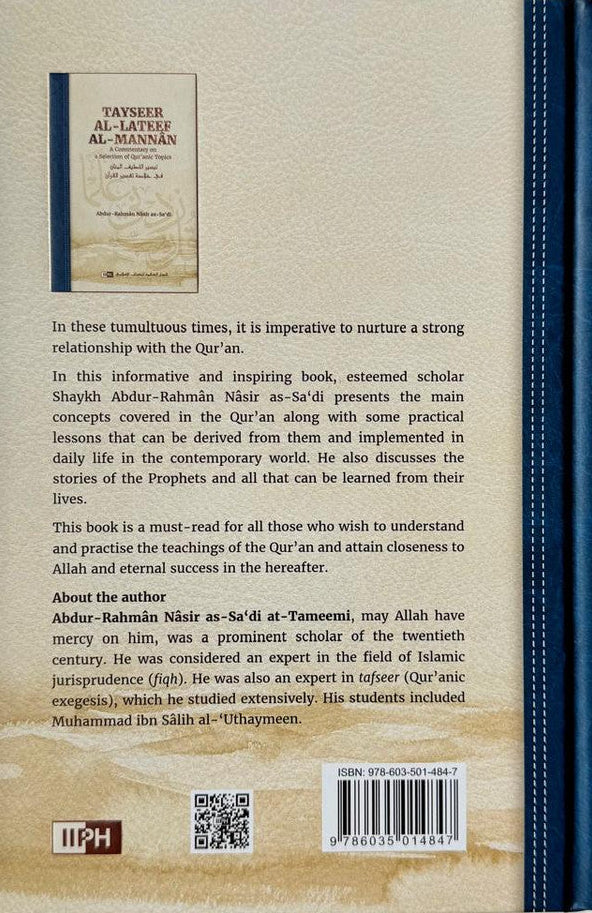
In these tumultuous times, it is imperative to nurture a strong relationship with the Qur'an.
In this informative and inspiring book, esteemed scholar Shaykh Abdur-Rahmân Nâsir as-Sa'di presents the main concepts covered in the Qur'an along with some practical lessons that can be derived from them and implemented in daily life in the contemporary world. He also discusses the stories of the Prophets and all that can be learned from their lives.
This book is a must-read for all those who wish to understand and practise the teachings of the Qur'an and attain closeness to Allah and eternal success in the hereafter.
About the author
Abdur-Rahmân Nâsir as-Sa'di at-Tameemi, may Allah have mercy on him, was a prominent scholar of the twentieth century. He was considered an expert in the field of Islamic jurisprudence (fiqh). He was also an expert in tafseer (Qur'anic exegesis), which he studied extensively. His students included Muhammad ibn Sâlih al-'Uthaymeen.
Content:
Tayseer al-Lateef al-Mannân is a comprehensive and insightful guide to understanding the core themes of the Qur’an. It presents essential beliefs, acts of worship, and moral teachings in a clear and structured manner.
Core Topics Covered
The book explores Tawheed (Islamic monotheism), the Names and Attributes of Allah, and explanations of key chapters such as Soorat al-Fatihah and Soorat al-Ikhlas. It also discusses belief in angels, the hereafter, and divine scriptures, alongside powerful verses like Ayat al-Kursi.
Practical Guidance
It includes rulings on prayer, zakat, marriage, divorce, inheritance, and financial dealings, offering practical lessons for daily life.
Stories & Lessons
The lives of Prophets such as Adam, Nuh, Ibrahim, Musa, and others are highlighted, providing valuable spiritual and moral insights.
Why Read This Book
This book is ideal for readers seeking a concise yet comprehensive understanding of the Qur’an and its application in modern life.
Page:01
Contents
Pronunciation and Transliteration Chart
Arabic honorific symbols..
Hadith grade terms
About the Word 'Lord'.
Publisher's Note
Introduction
How the Qur'an Is Described as
Concise and Comprehensive
Tawheed, Beliefs and Usool.
1. Soorat al-Fâtihah - Content and meaning
2. Belief in Allah and in His
Messengers and His Books
3. Ayat al-Kursi - Intercession and who it is for.
4. The way to know that there is no god worthy of worship except Him
Knowledge is based on information.
6. Names and attributes of Allah
7. Soorat al-Ikhlâș - Affirmation of divine oneness
8. Allah is unique in His oneness and divinity..
9. Signs in the universe...
10. Allah's grace to humanity:
Sending Muhammad ()
11. Refuting the disbelievers' specious
arguments against the Prophet
Page:02
Contents
attab (Translator)
his book may be produced or nic or mechanical, including storage and retrieval system,
Pronunciation and Transliteration Chart
Arabic honorific symbols
Hadith grade terms
About the Word 'Lord'
Publisher's Note.
Introduction
How the Qur'an Is Described as
Concise and Comprehensive.
Tawheed, Beliefs and Usool.
1. Soorat al-Fâtihah - Content and meaning
2. Belief in Allah and in His
Messengers and His Books.
book via the Internet or via
f the Publisher is illegal and electronic editions, and do not ghted materials. Your support
House (IIPH) audi Arabia es@iiph.com
3. Ayat al-Kursi - Intercession and who it is for. 4. The way to know that there is no
god worthy of worship except Him>> 5. Knowledge is based on information.
6. Names and attributes of Allah (3)
7. Soorat al-Ikhlâş - Affirmation of divine oneness.
8. Allah is unique in His oneness and divinity.
9. Signs in the universe...
10. Allah's grace to humanity:
Sending Muhammad ()
11. Refuting the disbelievers' specious
arguments against the Prophet ()
Page:03
Tayseer al-Lateef al-Mannân
Verses which mention together
12. The sign of the pen and the exalted
character of the Prophet ().
13. Obligation of believing in the
hereafter and description thereof
14. Obligation of believing in the angels and refutation of those who disbelieve in them...
The Benefits and Good Outcomes That Result from Having Strong Faith in These Sublime Beliefs Some Verses Which Enjoin Fulfilling One's Duty Towards Allah and Towards Other People Be gracious, enjoin what is right
Minor Rulings on Prayer and Zakat, and Other Similar Issues
Contents
Marriage and Related Rulings
Women who are prohibited
due to ties through marriage.
Women who are prohibited due to ties of blood.
Women who are prohibited due to ties through breastfeeding
Categories of women and discipline of a misbehaving wife
Appointing arbitrators from the spouses' families in the event of discord
Rulings on Divorce and Iddah.
A woman's 'iddah may vary according to her condition.
Verses about Eela', Dhihâr and Li'ân.
establishing prayer and giving zakat
Benefits of giving zakat and the eight categories who are entitled to it.
Verses on Hudood Punishments.
Purification with Water and Tayammum
Oaths and the Like.
Verses on Food and Hunting.
Explanation of full ablution (ghusl),
Judging and Ruling in Fundamental and Minor Issues.
how it is done and the reasons for it.
What Allah Has Told Us in His Book of the
Stories of the Prophets with Their Peoples.
Friday Prayer, Prayer Whilst Travelling, and the Adhân
The story of Adam (), the father of humanity.
Prayer when travelling in the event of fear.
The story of Nooh ()
Fasting and Related Matters
The story of Hood ()
Hajj and Related Matters.
The story of Şâliḥ ()
The story of Ibrâheem al-Khaleel (),
Jihad and Related Matters..
the Close Friend of the Most Gracious.
Sales and Other Kinds of Transactions
The story of Loot ().
The evils of riba (usury), gambling and ambiguity
The story of Shu'ayb ().
The verse on debt and lessons therein
The story of Moosâ () and Hâroon ()
Choosing the right person for the job.
The story of Yoonus ()
The story of Dâwood () and Sulaymân
Verses on Inheritance
Page:04
Verses on inheritance
left] no children, and the parents are the [only] heirs, the mother has a third, but if the deceased left siblings, the mother has a sixth. [The distribution in all cases is] after the payment of bequests and debts. With regard to your parents and your children, you do not know which of them is going to benefit you more. [These fixed shares] are ordained by Allah; and Allah is All-Knowing, Most Wise. Your share of your wives' estate is a half, if they leave no child; but if they leave a child, you have a fourth, after payment of bequests and debts. Their share of your estate is a fourth, if you leave no child; but if you leave a child, they have an eighth of the estate, after payment of bequests and debts. If a man or woman leaves neither ascendants nor descendants, but has left a brother or a sister, each one of the two has a sixth; but if they are more than two, they share in a third, after payment of bequests and debts, without prejudice to the rights of the heirs. This is an instruction from Allah; and Allah is All-Knowing, Most Forbearing. These are the limits [set by] Allah. Whoever obeys Allah and His Messenger, [Allah] will admit him to gardens...) (an- Nisa' 4: 11-13)
يَسْتَفْتُونَكَ قُلِ اللَّهُ يُفْتِيكُمْ فِي الْكَلَلَةِ إِنِ امْرُوا هَلَكَ لَيْسَ لَهُ وَلَدٌ وَلَهُ
ا يكُمُ اللَّهُ فِي أَوَلَدِ كُمْ لِلذَّكَرِ مِثْلُ حَظِّ الْأُنثَيَيْنِ فَإِن كُنَ نِسَاءَ فَوْقَ التي فَلَهُنَّ ثُلُنَا مَا تَرَكَ وَإِن كَانَتْ وَجِدَةً فَلَهَا النِّصْفُ وَلِأَبَوَيْهِ لِكُلِّ وَاحِدٍ ها السُّدُسُ مِمَّا تَرَكَ إِن كَانَ لَهُ وَلَدٌ فَإِن لَّمْ يَكُن لَّهُ وَلَدٌ وَوَرِثَهُ أَبَوَاهُ فَلِأُمِّهِ ال إن كَانَ لَهُ إِخْوَةٌ فَلِأُمِّهِ السُّدُسُ مِنْ بَعْدِ وَصِيَّةٍ يُوصِي بِهَا أَوْ دَيْنِ ءَابَاؤُكُمْ باؤُكُمْ لَا تَدْرُونَ أَيُّهُمْ أَقْرَبُ لَكُمْ نَفْعًا فَرِيضَةً مِّنَ اللَّهِ إِنَّ اللَّهَ كَانَ عَلِيمًا ا * وَلَكُمْ نِصْفُ مَا تَرَكَ أَزْوَاجُكُمْ إِن لَّمْ يَكُن لَّهُنَّ له فإن كَانَ لَهُنَّ وَلَدٌ فَلَكُمُ الرُّبُعُ مِمَّا تَرَكْنَ مِنْ بَعْدِ وَصِيَّةٍ بين بِهَا أَوْ دَيْنِ وَلَهُنَّ الرُّبُعُ مِمَّا تَرَكْتُمْ إِن لَّمْ يَكُن لَّكُمْ
به فإن كَانَ لَكُمْ وَلَدٌ فَلَهُنَّ الثُّمُنُ مِمَّا تَرَكْمُ مِنْ بَعْدِ وَصِيَّةِ أُخت فَلَهَا نِصْفُ مَا تَرَكَ وَهُوَ يَرِثُهَا إِن لَّمْ يَكُن لَّمَا وَلَدٌ فَإِن كَانَتَا اثْنَتَيْنِ وفُونَ بِهَا أَوْ دَيْنِ وَإِن كَانَ رَجُلٌ يُورَثُ كَلَلَةٌ أَوِ امْرَأَةٌ وَلَهُ أَخٌ أَوْ فَلَهُمَا الثُّلُثَانِ بِمَا تَرَكَ وَإِن كَانُوا إِخْوَةً رِجَالًا وَنِسَاءَ فَلِلذَّكَرِ مِثْلُ حَظِّ الْأُنثَيَيْنِ مايكل وَاحِدٍ مِّنْهُمَا السُّدُسُ فَإِن كَانُوا أَكْثَرَ مِن ذَلِكَ فَهُمْ شُرَكَاءُ يُبَيِّنُ اللَّهُ لَكُمْ أَن تَضِلُّوا وَاللَّهُ بِكُلِّ شَيْءٍ عَلِيمٌ ) (سورة النساء: ١٧٦) اللي مِن بَعْدِ وَصِيَّةٍ يُوصَى بِهَا أَوْ دَيْنِ غَيْرَ مُضَارٍ وَصِيَّةً مِّنَ اللَّهِ وَاللَّهُ بو جليد تِلْكَ حُدُودُ اللَّهِ وَمَن يُطِعِ اللَّهَ وَرَسُولَهُ يُدْخِلْهُ منت (سورة النساء: ۱۱-۱۳)
Allah instructs you concerning [the inheritance of your childes to the male, a portion equal to that of two females; if there are o daughters, more than two, their share is two-thirds of the estur there is only one [daughter], her share is a half. For parents, asid share of the estate goes to each, if the deceased left children; if(
They ask you for a ruling. Say: Allah gives you a ruling concerning those who die leaving neither ascendants nor descendants. If it is a man that dies, leaving a sister but no child [or surviving parent], she will have half of the estate. If [the deceased] is a woman who left no child [or surviving parent], her brother will have the [entire] estate. If there are two sisters [or more], they will have two-thirds of the estate [between them]. If there are brothers and sisters, [they will share the estate] each male having a portion equal to that of two females.
Page:05
TAYSEER AL-LATEEF AL-MANNAN
في حاسة تفسر القران اور العالية العمال جل
In these tumultuous times, it is imperative to nurture a strong relationship with the Qur'an.
In this informative and inspiring book, esteemed scholar Shaykh Abdur-Rahmân Nâsir as-Sa'di presents the main concepts covered in the Qur'an along with some practical lessons that can be derived from them and implemented in daily life in the contemporary world. He also discusses the stories of the Prophets and all that can be learned from their lives.
This book is a must-read for all those who wish to understand and practise the teachings of the Qur'an and attain closeness to Allah and eternal success in the hereafter.
About the author
Abdur-Rahmân Nâsir as-Sa'di at-Tameemi, may Allah have mercy on him, was a prominent scholar of the twentieth century. He was considered an expert in the field of Islamic jurisprudence (fiqh). He was also an expert in tafseer (Qur'anic) exegesis), which he studied extensively. His students included. Muhammad ibn Sâlih al-'Uthaymeen.
Publisher
IIPH (International Islamic Publishing House)
Author
- Abdur-Rahman Nasir as-Sadi
Shipping and Delivery
We dispatch orders directly from our UK and USA warehouses, offering multiple shipping options to suit your needs. We proudly ship worldwide.
UK Deliveries (from UK warehouse):
Standard shipping typically arrives within 3–4 working days. Expedited delivery takes 2–3 working days. We aim to dispatch orders the same day or next working day, with next-day delivery options available where applicable.
USA Deliveries (from USA warehouse):
Orders usually arrive within 4–7 working days.
Europe (shipped from UK):
Standard delivery takes approximately 6–10 working days, with expedited services available in 3–5 working days.
Canada:
Estimated delivery time is 5–10 working days.
Worldwide Shipping:
International orders generally arrive within 5–20 working days, depending on destination and shipping method selected.
For precise delivery timelines based on your location, please contact us by email and our team will provide detailed information tailored to your address.
Sample Pages - Content
Page:01
Contents
Pronunciation and Transliteration Chart
Arabic honorific symbols..
Hadith grade terms
About the Word 'Lord'.
Publisher's Note
Introduction
How the Qur'an Is Described as
Concise and Comprehensive
Tawheed, Beliefs and Usool.
1. Soorat al-Fâtihah - Content and meaning
2. Belief in Allah and in His
Messengers and His Books
3. Ayat al-Kursi - Intercession and who it is for.
4. The way to know that there is no god worthy of worship except Him
Knowledge is based on information.
6. Names and attributes of Allah
7. Soorat al-Ikhlâș - Affirmation of divine oneness
8. Allah is unique in His oneness and divinity..
9. Signs in the universe...
10. Allah's grace to humanity:
Sending Muhammad ()
11. Refuting the disbelievers' specious
arguments against the Prophet
Page:02
Contents
attab (Translator)
his book may be produced or nic or mechanical, including storage and retrieval system,
Pronunciation and Transliteration Chart
Arabic honorific symbols
Hadith grade terms
About the Word 'Lord'
Publisher's Note.
Introduction
How the Qur'an Is Described as
Concise and Comprehensive.
Tawheed, Beliefs and Usool.
1. Soorat al-Fâtihah - Content and meaning
2. Belief in Allah and in His
Messengers and His Books.
book via the Internet or via
f the Publisher is illegal and electronic editions, and do not ghted materials. Your support
House (IIPH) audi Arabia es@iiph.com
3. Ayat al-Kursi - Intercession and who it is for. 4. The way to know that there is no
god worthy of worship except Him>> 5. Knowledge is based on information.
6. Names and attributes of Allah (3)
7. Soorat al-Ikhlâş - Affirmation of divine oneness.
8. Allah is unique in His oneness and divinity.
9. Signs in the universe...
10. Allah's grace to humanity:
Sending Muhammad ()
11. Refuting the disbelievers' specious
arguments against the Prophet ()
Page:03
Tayseer al-Lateef al-Mannân
Verses which mention together
12. The sign of the pen and the exalted
character of the Prophet ().
13. Obligation of believing in the
hereafter and description thereof
14. Obligation of believing in the angels and refutation of those who disbelieve in them...
The Benefits and Good Outcomes That Result from Having Strong Faith in These Sublime Beliefs Some Verses Which Enjoin Fulfilling One's Duty Towards Allah and Towards Other People Be gracious, enjoin what is right
Minor Rulings on Prayer and Zakat, and Other Similar Issues
Contents
Marriage and Related Rulings
Women who are prohibited
due to ties through marriage.
Women who are prohibited due to ties of blood.
Women who are prohibited due to ties through breastfeeding
Categories of women and discipline of a misbehaving wife
Appointing arbitrators from the spouses' families in the event of discord
Rulings on Divorce and Iddah.
A woman's 'iddah may vary according to her condition.
Verses about Eela', Dhihâr and Li'ân.
establishing prayer and giving zakat
Benefits of giving zakat and the eight categories who are entitled to it.
Verses on Hudood Punishments.
Purification with Water and Tayammum
Oaths and the Like.
Verses on Food and Hunting.
Explanation of full ablution (ghusl),
Judging and Ruling in Fundamental and Minor Issues.
how it is done and the reasons for it.
What Allah Has Told Us in His Book of the
Stories of the Prophets with Their Peoples.
Friday Prayer, Prayer Whilst Travelling, and the Adhân
The story of Adam (), the father of humanity.
Prayer when travelling in the event of fear.
The story of Nooh ()
Fasting and Related Matters
The story of Hood ()
Hajj and Related Matters.
The story of Şâliḥ ()
The story of Ibrâheem al-Khaleel (),
Jihad and Related Matters..
the Close Friend of the Most Gracious.
Sales and Other Kinds of Transactions
The story of Loot ().
The evils of riba (usury), gambling and ambiguity
The story of Shu'ayb ().
The verse on debt and lessons therein
The story of Moosâ () and Hâroon ()
Choosing the right person for the job.
The story of Yoonus ()
The story of Dâwood () and Sulaymân
Verses on Inheritance
Page:04
Verses on inheritance
left] no children, and the parents are the [only] heirs, the mother has a third, but if the deceased left siblings, the mother has a sixth. [The distribution in all cases is] after the payment of bequests and debts. With regard to your parents and your children, you do not know which of them is going to benefit you more. [These fixed shares] are ordained by Allah; and Allah is All-Knowing, Most Wise. Your share of your wives' estate is a half, if they leave no child; but if they leave a child, you have a fourth, after payment of bequests and debts. Their share of your estate is a fourth, if you leave no child; but if you leave a child, they have an eighth of the estate, after payment of bequests and debts. If a man or woman leaves neither ascendants nor descendants, but has left a brother or a sister, each one of the two has a sixth; but if they are more than two, they share in a third, after payment of bequests and debts, without prejudice to the rights of the heirs. This is an instruction from Allah; and Allah is All-Knowing, Most Forbearing. These are the limits [set by] Allah. Whoever obeys Allah and His Messenger, [Allah] will admit him to gardens...) (an- Nisa' 4: 11-13)
يَسْتَفْتُونَكَ قُلِ اللَّهُ يُفْتِيكُمْ فِي الْكَلَلَةِ إِنِ امْرُوا هَلَكَ لَيْسَ لَهُ وَلَدٌ وَلَهُ
ا يكُمُ اللَّهُ فِي أَوَلَدِ كُمْ لِلذَّكَرِ مِثْلُ حَظِّ الْأُنثَيَيْنِ فَإِن كُنَ نِسَاءَ فَوْقَ التي فَلَهُنَّ ثُلُنَا مَا تَرَكَ وَإِن كَانَتْ وَجِدَةً فَلَهَا النِّصْفُ وَلِأَبَوَيْهِ لِكُلِّ وَاحِدٍ ها السُّدُسُ مِمَّا تَرَكَ إِن كَانَ لَهُ وَلَدٌ فَإِن لَّمْ يَكُن لَّهُ وَلَدٌ وَوَرِثَهُ أَبَوَاهُ فَلِأُمِّهِ ال إن كَانَ لَهُ إِخْوَةٌ فَلِأُمِّهِ السُّدُسُ مِنْ بَعْدِ وَصِيَّةٍ يُوصِي بِهَا أَوْ دَيْنِ ءَابَاؤُكُمْ باؤُكُمْ لَا تَدْرُونَ أَيُّهُمْ أَقْرَبُ لَكُمْ نَفْعًا فَرِيضَةً مِّنَ اللَّهِ إِنَّ اللَّهَ كَانَ عَلِيمًا ا * وَلَكُمْ نِصْفُ مَا تَرَكَ أَزْوَاجُكُمْ إِن لَّمْ يَكُن لَّهُنَّ له فإن كَانَ لَهُنَّ وَلَدٌ فَلَكُمُ الرُّبُعُ مِمَّا تَرَكْنَ مِنْ بَعْدِ وَصِيَّةٍ بين بِهَا أَوْ دَيْنِ وَلَهُنَّ الرُّبُعُ مِمَّا تَرَكْتُمْ إِن لَّمْ يَكُن لَّكُمْ
به فإن كَانَ لَكُمْ وَلَدٌ فَلَهُنَّ الثُّمُنُ مِمَّا تَرَكْمُ مِنْ بَعْدِ وَصِيَّةِ أُخت فَلَهَا نِصْفُ مَا تَرَكَ وَهُوَ يَرِثُهَا إِن لَّمْ يَكُن لَّمَا وَلَدٌ فَإِن كَانَتَا اثْنَتَيْنِ وفُونَ بِهَا أَوْ دَيْنِ وَإِن كَانَ رَجُلٌ يُورَثُ كَلَلَةٌ أَوِ امْرَأَةٌ وَلَهُ أَخٌ أَوْ فَلَهُمَا الثُّلُثَانِ بِمَا تَرَكَ وَإِن كَانُوا إِخْوَةً رِجَالًا وَنِسَاءَ فَلِلذَّكَرِ مِثْلُ حَظِّ الْأُنثَيَيْنِ مايكل وَاحِدٍ مِّنْهُمَا السُّدُسُ فَإِن كَانُوا أَكْثَرَ مِن ذَلِكَ فَهُمْ شُرَكَاءُ يُبَيِّنُ اللَّهُ لَكُمْ أَن تَضِلُّوا وَاللَّهُ بِكُلِّ شَيْءٍ عَلِيمٌ ) (سورة النساء: ١٧٦) اللي مِن بَعْدِ وَصِيَّةٍ يُوصَى بِهَا أَوْ دَيْنِ غَيْرَ مُضَارٍ وَصِيَّةً مِّنَ اللَّهِ وَاللَّهُ بو جليد تِلْكَ حُدُودُ اللَّهِ وَمَن يُطِعِ اللَّهَ وَرَسُولَهُ يُدْخِلْهُ منت (سورة النساء: ۱۱-۱۳)
Allah instructs you concerning [the inheritance of your childes to the male, a portion equal to that of two females; if there are o daughters, more than two, their share is two-thirds of the estur there is only one [daughter], her share is a half. For parents, asid share of the estate goes to each, if the deceased left children; if(
They ask you for a ruling. Say: Allah gives you a ruling concerning those who die leaving neither ascendants nor descendants. If it is a man that dies, leaving a sister but no child [or surviving parent], she will have half of the estate. If [the deceased] is a woman who left no child [or surviving parent], her brother will have the [entire] estate. If there are two sisters [or more], they will have two-thirds of the estate [between them]. If there are brothers and sisters, [they will share the estate] each male having a portion equal to that of two females.
Page:05
TAYSEER AL-LATEEF AL-MANNAN
في حاسة تفسر القران اور العالية العمال جل
In these tumultuous times, it is imperative to nurture a strong relationship with the Qur'an.
In this informative and inspiring book, esteemed scholar Shaykh Abdur-Rahmân Nâsir as-Sa'di presents the main concepts covered in the Qur'an along with some practical lessons that can be derived from them and implemented in daily life in the contemporary world. He also discusses the stories of the Prophets and all that can be learned from their lives.
This book is a must-read for all those who wish to understand and practise the teachings of the Qur'an and attain closeness to Allah and eternal success in the hereafter.
About the author
Abdur-Rahmân Nâsir as-Sa'di at-Tameemi, may Allah have mercy on him, was a prominent scholar of the twentieth century. He was considered an expert in the field of Islamic jurisprudence (fiqh). He was also an expert in tafseer (Qur'anic) exegesis), which he studied extensively. His students included. Muhammad ibn Sâlih al-'Uthaymeen.
Who is Abdur-Rahman Nasir as-Sadi?
Shaykh Abdur-Rahman Nasir as-Sa'di was a respected Islamic scholar known for clear explanations of Islamic belief and Qur’anic teachings. In The Tree of Faith, he presents a concise and authentic explanation of Iman and Islamic creed, helping readers understand the foundations of faith and how to nurture strong belief through the teachings of the Qur’an and Sunnah.