


Seven Steps to Moral Intelligence | Imam Ghazali Teachings and Islamic Character Development
Seven Steps to Moral Intelligence | Imam Ghazali Teachings and Islamic Character Development
Publisher:
Kube Publishing
Author:
Musharraf Hussain
Language:
English
Binding:
Soft Cover
Pages: 128
Size: 16x22cm
Couldn't load pickup availability


Collapsible content
Description of islamic Book
Seven Steps to Moral Intelligence | Imam Ghazali Teachings and Islamic Character Development is a thoughtful guide inspired by the teachings of the great Islamic scholar Imam Abu Hamid Al-Ghazali. The book explores how individuals can develop strong moral awareness and ethical behavior through Islamic principles.
Drawing from Imam Ghazali teachings, the author outlines seven essential steps that help readers cultivate virtues such as honesty, humility, patience, and self-discipline. These steps are designed to guide individuals toward developing moral intelligence in Islam, which combines spiritual awareness with ethical decision-making.
From Author:
Page:01
BASED ON IMAM GHAZALI'S TEACHINGS
7 Steps to Moral Intelligence
Musharraf Hussain
Page:02
Preface
1.The Meaning and Scope of Morality
2. Moral Virtues of the Messenger
3. The Divine Attributes
4. Moral Vices
5.Seven Steps to Moral Intelligence
6. Ghazali's Moral Intelligence
Select Bibliography
Page:03
Seven Steps to Moral Intelligence
a virtue to someone on the basis of a single act that he or she does.
Take a person whose dealings are honest and who does not cheat. If such acts are done simply because hon- esty is the best policy, or because of a fear of being caught out, rather than recognising that to do other wise would be dishonest, then these are not the acts of an honest person. An honest person cannot be iden tified simply as one who, for example, always tells the truth, nor even as one who always tells the truth because it is the truth, for one can have the virtue of honesty without being tactless or indiscreet. Furthermore, to possess such a disposition fully is to have perfect virtue, which is rare. So possessing a virtue is a matter of degree between those who may be described as truly virtuous and those who lack it completely.
Moral character is a principle of human nature which is real, effective, purposeful and meaningful. Moral character is like a lighthouse, a permanent source of illumination and guidance. The moral principles that govern human growth and happiness are woven into the fabric of every civilised society. And these moral principles comprise the foundations of every sound family and viable social institution.
The reality of moral principles becomes obvious to anyone who thinks deeply and examines the cycles of social history. These principles appear time and time again, and the degree to which society recognises and lives in harmony with them moves it towards either unity and stability or disintegration and discord.
These moral principles are universal. All authentic religious traditions teach honesty, compassion, justice,
The Meaning and Scope of Morality
To be truthful in word, action
Compassion To have pity on deserving people and help remove their difficult
Courage
To give others what is due to them and ensu their rights are Opport
Integrity, sincerity and Dishonesty
Respect co-operation friendship, pity love and benevolence
Trust and sense of
equality fraternity and Cruelty respect Self-reliance
Cowardice
difficulties and to responsibility and freedom strive to achieve
To bear ties Perseverance, fortitude Ange calmly without
complaining difficulties
Forgiveness Surrendering one's Co-operation and
Gratitude give freely and Friendship, loyalty benefit of others
To recognize one's
and to serve thes without attracting
attention seeking approval To be thankful for
the good that has been done
and cheerfulness Gentleness came
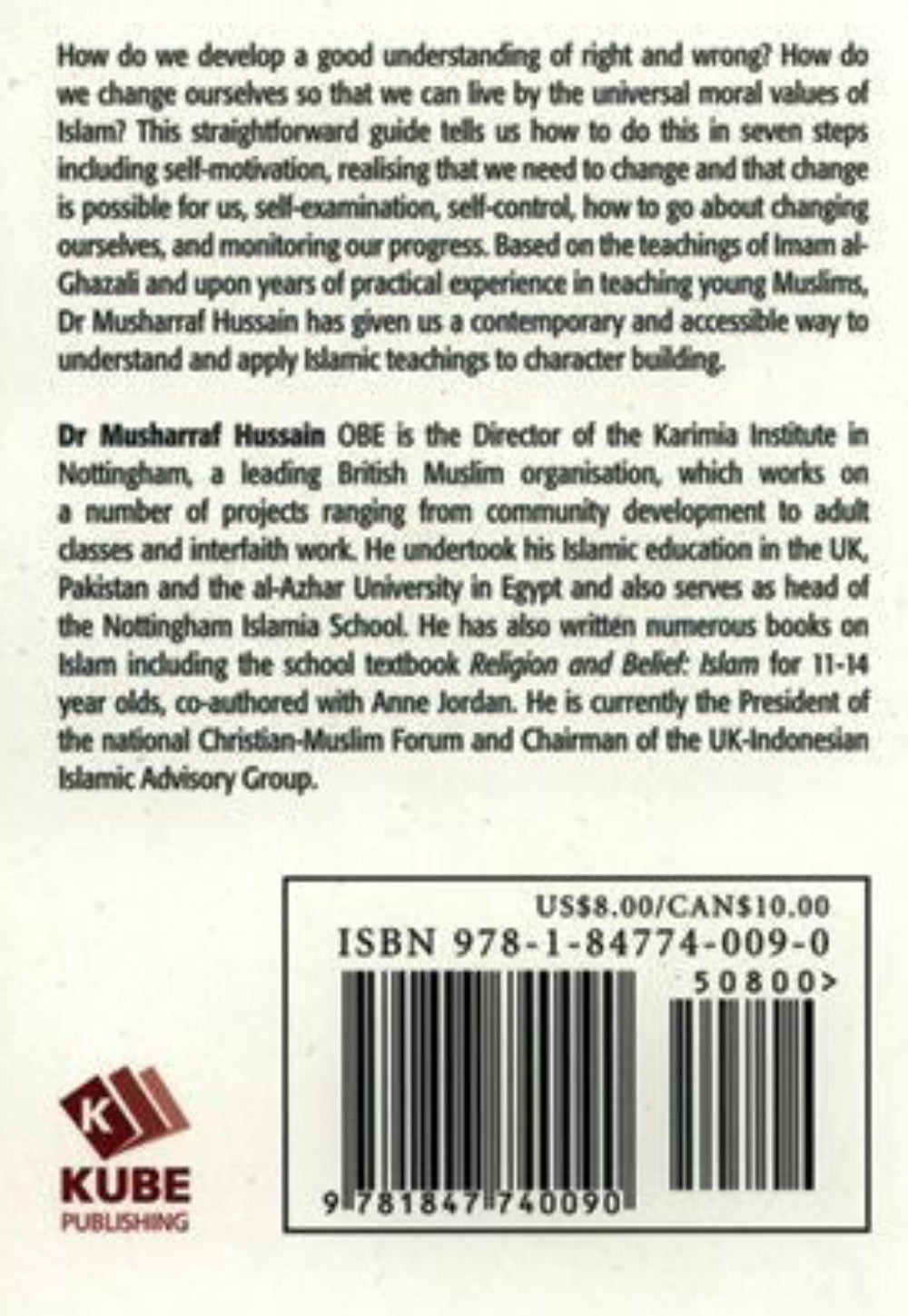
ArroganceHow do we develop a good understanding of right and wrong? How do we change ourselves so that we can live by the universal moral values of Islam? This straightforward guide tells us how to do this in seven steps including self-motivation, realising that we need to change and that change is possible for us, self-examination, self-control, how to go about changing ourselves, and monitoring our progress. Based on the teachings of Imam al- Ghazali and upon years of practical experience in teaching young Muslims, Dr Musharraf Hussain has given us a contemporary and accessible way to understand and apply Islamic teachings to character building.
Dr Musharraf Hussain OBE is the Director of the Karimia Institute in Nottingham, a leading British Muslim organisation, which works on a number of projects ranging from community development to adult classes and interfaith work. He undertook his Islamic education in the UK, Pakistan and the al-Azhar University in Egypt and also serves as head of the Nottingham Islamia School. He has also written numerous books on Islam including the school textbook Religion and Belief: Islam for 11-14 year olds, co-authored with Anne Jordan. He is currently the President of the national Christian-Muslim Forum and Chairman of the UK-Indonesian Islamic Advisory Group.
Publisher
Kube Publishing
Author
- Musharraf Hussain
Shipping and Delivery
We dispatch orders directly from our UK and USA warehouses, offering multiple shipping options to suit your needs. We proudly ship worldwide.
UK Deliveries (from UK warehouse):
Standard shipping typically arrives within 3–4 working days. Expedited delivery takes 2–3 working days. We aim to dispatch orders the same day or next working day, with next-day delivery options available where applicable.
USA Deliveries (from USA warehouse):
Orders usually arrive within 4–7 working days.
Europe (shipped from UK):
Standard delivery takes approximately 6–10 working days, with expedited services available in 3–5 working days.
Canada:
Estimated delivery time is 5–10 working days.
Worldwide Shipping:
International orders generally arrive within 5–20 working days, depending on destination and shipping method selected.
For precise delivery timelines based on your location, please contact us by email and our team will provide detailed information tailored to your address.
Sample Pages - Content
Page:01
BASED ON IMAM GHAZALI'S TEACHINGS
7 Steps to Moral Intelligence
Musharraf Hussain
Page:02
Preface
1.The Meaning and Scope of Morality
2. Moral Virtues of the Messenger
3. The Divine Attributes
4. Moral Vices
5.Seven Steps to Moral Intelligence
6. Ghazali's Moral Intelligence
Select Bibliography
Page:03
Seven Steps to Moral Intelligence
a virtue to someone on the basis of a single act that he or she does.
Take a person whose dealings are honest and who does not cheat. If such acts are done simply because hon- esty is the best policy, or because of a fear of being caught out, rather than recognising that to do other wise would be dishonest, then these are not the acts of an honest person. An honest person cannot be iden tified simply as one who, for example, always tells the truth, nor even as one who always tells the truth because it is the truth, for one can have the virtue of honesty without being tactless or indiscreet. Furthermore, to possess such a disposition fully is to have perfect virtue, which is rare. So possessing a virtue is a matter of degree between those who may be described as truly virtuous and those who lack it completely.
Moral character is a principle of human nature which is real, effective, purposeful and meaningful. Moral character is like a lighthouse, a permanent source of illumination and guidance. The moral principles that govern human growth and happiness are woven into the fabric of every civilised society. And these moral principles comprise the foundations of every sound family and viable social institution.
The reality of moral principles becomes obvious to anyone who thinks deeply and examines the cycles of social history. These principles appear time and time again, and the degree to which society recognises and lives in harmony with them moves it towards either unity and stability or disintegration and discord.
These moral principles are universal. All authentic religious traditions teach honesty, compassion, justice,
The Meaning and Scope of Morality
To be truthful in word, action
Compassion To have pity on deserving people and help remove their difficult
Courage
To give others what is due to them and ensu their rights are Opport
Integrity, sincerity and Dishonesty
Respect co-operation friendship, pity love and benevolence
Trust and sense of
equality fraternity and Cruelty respect Self-reliance
Cowardice
difficulties and to responsibility and freedom strive to achieve
To bear ties Perseverance, fortitude Ange calmly without
complaining difficulties
Forgiveness Surrendering one's Co-operation and
Gratitude give freely and Friendship, loyalty benefit of others
To recognize one's
and to serve thes without attracting
attention seeking approval To be thankful for
the good that has been done
and cheerfulness Gentleness came
ArroganceHow do we develop a good understanding of right and wrong? How do we change ourselves so that we can live by the universal moral values of Islam? This straightforward guide tells us how to do this in seven steps including self-motivation, realising that we need to change and that change is possible for us, self-examination, self-control, how to go about changing ourselves, and monitoring our progress. Based on the teachings of Imam al- Ghazali and upon years of practical experience in teaching young Muslims, Dr Musharraf Hussain has given us a contemporary and accessible way to understand and apply Islamic teachings to character building.
Dr Musharraf Hussain OBE is the Director of the Karimia Institute in Nottingham, a leading British Muslim organisation, which works on a number of projects ranging from community development to adult classes and interfaith work. He undertook his Islamic education in the UK, Pakistan and the al-Azhar University in Egypt and also serves as head of the Nottingham Islamia School. He has also written numerous books on Islam including the school textbook Religion and Belief: Islam for 11-14 year olds, co-authored with Anne Jordan. He is currently the President of the national Christian-Muslim Forum and Chairman of the UK-Indonesian Islamic Advisory Group.
Who is Muhammad Musharraf Hussain?
Muhammad Musharraf Hussain is an author who brings scholarly insight into Islamic teachings, focusing on their application to health and healing. His work bridges traditional Islamic knowledge with modern perspectives, making this book a comprehensive guide for those interested in Prophetic medicine and wellness.