


Patience and Gratitude Book | Islamic Spiritual Growth Guide by Ibn Qayyim
Patience and Gratitude Book | Islamic Spiritual Growth Guide by Ibn Qayyim
Publisher:
Ta Ha Publisher
Author:
Nasiruddin Al-Khattab
Language:
English
Binding:
Soft Cover
Pages: 83
Size: 15x21 Cm
Couldn't load pickup availability


Collapsible content
Description of islamic Book
Patience and Gratitude Book | Islamic Spiritual Growth Guide by Ibn Qayyim
Patience and Gratitude by Ibn Qayyim al-Jawziyyah is a timeless Islamic classic that explores two essential virtues: sabr (patience) and shukr (gratitude). This abridged English translation presents deep spiritual insights in a practical and easy-to-understand manner, helping readers apply these qualities in their daily lives. Written over six centuries ago, the teachings remain highly relevant today, guiding believers on how to handle hardships with patience and appreciate blessings with gratitude. The book highlights how these two qualities are interconnected and essential for strengthening faith and achieving inner peace.
Ideal for anyone seeking personal development through Islamic teachings.
From Author:
Patience and Gratitude is an abridged translation of in the Arab world but which has been inaccessible to English-speaking of sabr (patience, fortitude) and its counterpart, shukr(gratitude), in a practical fashion which shows how these important spiritual values may be incorporated into everyday life. Although written over six centuries ago, Ibn Qayyim al-Jawziyyah's words are still relevant-perhaps more so than ever-today. Ibn Qayyim al-Jawziyyah _1292-1350 CE) was a Muslim Scholar who lived in Damascus, Syria. He studied first under his own father, the qayyim (attendant of the school of al-jawziyyah, and then under the great scholar Ibn Taymiyyah. He compiled and authored many books, including the famous Zad al-Ma'ad(The Provision of the hereafter), and was contemporary of other leading scholars such as Ibn Kathir, Ibn Rajab, and others.
Content:
1. Definition of Patience (Sabr)
Linguistic and spiritual meanings of patience
Controlling emotions, speech, and actions during hardship
2. Scholarly Views on Patience
Patience as self-discipline and strong character
Staying close to Allah and accepting trials calmly
Avoiding complaints and seeking Allah’s help
3. Categories of Patience
Obligatory (wajib) patience
Encouraged (mandub) patience
Forbidden, disliked, and permissible patience
4. Good vs. Bad Patience
True patience aligned with Qur’an and Sunnah
Difference between sincere endurance and harmful suppression
5. Types of People in Patience
The patience of noble vs. ignoble individuals
How intention and faith shape patience
6. Ways to Strengthen Patience
Gaining knowledge
Practicing righteous actions
Strengthening faith and self-control
7. Importance of Patience in Life
Needed in worship, avoiding sin, and facing trials
Essential in both ease and hardship
8. The Most Difficult Forms of Patience
Resisting sinful desires (especially speech and actions)
Maintaining discipline in challenging situations
9. Patience in the Qur’an
Emphasis on sabr throughout Islamic teachings
Rewards and virtues promised to the patient
Page:01
CHAPTER I
The Definition of Patience
Sabr is an Arabic word which comes from a root meaning to detain, refrain and stop. There is an expression in Arabic, "so-and-so was killed sabran", which means that he was captured and detained until he died. In the spiritual sense, patience means to stop ourselves from despairing and panicking, to stop our tongues from complaining, and to stop our hands from striking our faces and tearing our clothes at times of grief and stress.
What scholars have said about patience
Some scholars have defined patience as a good human characteristic or a positive psychological attitude, by virtue of which we refrain from doing that which is not good. Human beings cannot live a proper, healthy life without patience.
Abu 'Uthman said, "The one who has patience is the one who has trained himself to handle difficulties." Amr ibn 'Uthman al-Makki said, "Patience means to keep close to Allah and to accept calmly the trials He sends, without complaining or feeling sad." Al-Khawwas said, "Patience means to adhere to the rules of the Qur'an and Sunnah." Another scholar said, "Patience means to refrain from complaining." 'Ali ibn Abi Talib said, "Patience means to seek Allah's help."
Is it better to have patience at a time of difficulty,
or to be in a situation which does not require patience? Abu Muhammad al-Hariri said, "Patience means not seeing any difference between times of ease and times of hardship, and being content at all times." I (Ibn Qayyim) say this is too difficult, and we are not instructed to be like this. Allah has created us in such a way that we feel the difference between times of ease and times of hardship
Page:03
CHAPTER 3: Five Categories of Patience Obligatory (wajib) patience Encouraged (mandub) patience Forbidden (mahdhur) patience
Disliked (makruh) patience
Permissible (mubah) patience
CHAPTER 4: Good Patience and Bad Patience
Emulating the attributes of Allah
No contradiction between patience and complaining to Allah
CHAPTER 5: The Patience of Noble People and the Patience of Ignoble People
CHAPTER 6: Ways of Strengthening Patience
Knowledge
Action
Strengthening the motive of reason and religion
CHAPTER 7: Man Cannot Do Without Patience
Patience at the time of adversity is easier than at the time of ease
Patience in worship
Patience in abstaining from committing wrong actions
Patience in adversity and in situations beyond man's control Patience in situations which are started by choice, but whose consequences get out of hand
CHAPTER 8: What is the Most Difficult Type of Patience? Patience in abstaining from wrong actions of speech and sexual wrong actions
CHAPTER 9: Patience in the Qur'an
Page:04
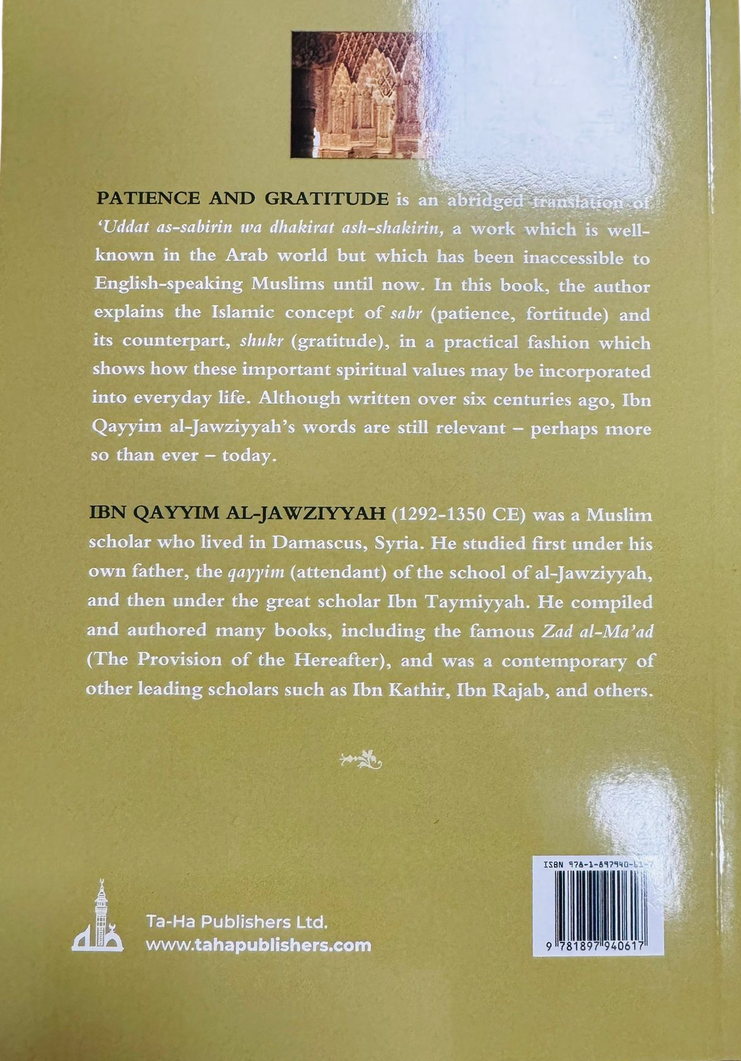
PATIENCE AND GRATITUDE is an abridged translation of "Uddat as-sabirin wa dhakirat ash-shakirin, a work which is well- known in the Arab world but which has been inaccessible to English-speaking Muslims until now. In this book, the author explains the Islamic concept of sabr (patience, fortitude) and its counterpart, shukr (gratitude), in a practical fashion which shows how these important spiritual values may be incorporated into everyday life. Although written over six centuries ago, Ibn Qayyim al-Jawziyyah's words are still relevant perhaps more
so than ever today.
IBN QAYYIM AL-JAWZIYYAH (1292-1350 CE) was a Muslim scholar who lived in Damascus, Syria. He studied first under his own father, the qayyim (attendant) of the school of al-Jawziyyah, and then under the great scholar Ibn Taymiyyah. He compiled and authored many books, including the famous Zad al-Ma'ad (The Provision of the Hereafter), and was a contemporary of other leading scholars such as Ibn Kathir, Ibn Rajab, and others.
Publisher
Ta Ha Publisher
Author
- Nasiruddin Al-Khattab
Shipping and Delivery
We dispatch orders directly from our UK and USA warehouses, offering multiple shipping options to suit your needs. We proudly ship worldwide.
UK Deliveries (from UK warehouse):
Standard shipping typically arrives within 3–4 working days. Expedited delivery takes 2–3 working days. We aim to dispatch orders the same day or next working day, with next-day delivery options available where applicable.
USA Deliveries (from USA warehouse):
Orders usually arrive within 4–7 working days.
Europe (shipped from UK):
Standard delivery takes approximately 6–10 working days, with expedited services available in 3–5 working days.
Canada:
Estimated delivery time is 5–10 working days.
Worldwide Shipping:
International orders generally arrive within 5–20 working days, depending on destination and shipping method selected.
For precise delivery timelines based on your location, please contact us by email and our team will provide detailed information tailored to your address.
Sample Pages - Content
Page:01
CHAPTER I
The Definition of Patience
Sabr is an Arabic word which comes from a root meaning to detain, refrain and stop. There is an expression in Arabic, "so-and-so was killed sabran", which means that he was captured and detained until he died. In the spiritual sense, patience means to stop ourselves from despairing and panicking, to stop our tongues from complaining, and to stop our hands from striking our faces and tearing our clothes at times of grief and stress.
What scholars have said about patience
Some scholars have defined patience as a good human characteristic or a positive psychological attitude, by virtue of which we refrain from doing that which is not good. Human beings cannot live a proper, healthy life without patience.
Abu 'Uthman said, "The one who has patience is the one who has trained himself to handle difficulties." Amr ibn 'Uthman al-Makki said, "Patience means to keep close to Allah and to accept calmly the trials He sends, without complaining or feeling sad." Al-Khawwas said, "Patience means to adhere to the rules of the Qur'an and Sunnah." Another scholar said, "Patience means to refrain from complaining." 'Ali ibn Abi Talib said, "Patience means to seek Allah's help."
Is it better to have patience at a time of difficulty,
or to be in a situation which does not require patience? Abu Muhammad al-Hariri said, "Patience means not seeing any difference between times of ease and times of hardship, and being content at all times." I (Ibn Qayyim) say this is too difficult, and we are not instructed to be like this. Allah has created us in such a way that we feel the difference between times of ease and times of hardship
Page:03
CHAPTER 3: Five Categories of Patience Obligatory (wajib) patience Encouraged (mandub) patience Forbidden (mahdhur) patience
Disliked (makruh) patience
Permissible (mubah) patience
CHAPTER 4: Good Patience and Bad Patience
Emulating the attributes of Allah
No contradiction between patience and complaining to Allah
CHAPTER 5: The Patience of Noble People and the Patience of Ignoble People
CHAPTER 6: Ways of Strengthening Patience
Knowledge
Action
Strengthening the motive of reason and religion
CHAPTER 7: Man Cannot Do Without Patience
Patience at the time of adversity is easier than at the time of ease
Patience in worship
Patience in abstaining from committing wrong actions
Patience in adversity and in situations beyond man's control Patience in situations which are started by choice, but whose consequences get out of hand
CHAPTER 8: What is the Most Difficult Type of Patience? Patience in abstaining from wrong actions of speech and sexual wrong actions
CHAPTER 9: Patience in the Qur'an
Page:04
PATIENCE AND GRATITUDE is an abridged translation of "Uddat as-sabirin wa dhakirat ash-shakirin, a work which is well- known in the Arab world but which has been inaccessible to English-speaking Muslims until now. In this book, the author explains the Islamic concept of sabr (patience, fortitude) and its counterpart, shukr (gratitude), in a practical fashion which shows how these important spiritual values may be incorporated into everyday life. Although written over six centuries ago, Ibn Qayyim al-Jawziyyah's words are still relevant perhaps more
so than ever today.
IBN QAYYIM AL-JAWZIYYAH (1292-1350 CE) was a Muslim scholar who lived in Damascus, Syria. He studied first under his own father, the qayyim (attendant) of the school of al-Jawziyyah, and then under the great scholar Ibn Taymiyyah. He compiled and authored many books, including the famous Zad al-Ma'ad (The Provision of the Hereafter), and was a contemporary of other leading scholars such as Ibn Kathir, Ibn Rajab, and others.
Who is Nasiruddin Al-Khattab?
Nasiruddin al-Khattab is a prominent Islamic translator and writer known for rendering classical Islamic texts into clear and accessible English. His works focus on Qur'anic exegesis, Hadith, and Islamic jurisprudence, helping English-speaking audiences engage deeply with authentic Islamic knowledge