


Maxims of Fiqh (Al-Qawaid Al-Fiqhiyyah) – Islamic Legal Principles & Fiqh Guide
Maxims of Fiqh (Al-Qawaid Al-Fiqhiyyah) – Islamic Legal Principles & Fiqh Guide
Publisher:
Dar Makkah International Publishing
Author:
Shaykh Abdur Rahman Bin Nasir As Sa’di
Language:
English
Binding:
Hard Cover
Pages: 52
Size: 20x13cm
Couldn't load pickup availability
Collapsible content
Description of islamic Book
“Maxims of Fiqh (Al-Qawaid Al-Fiqhiyyah)” is an informative Islamic book that explains the foundational legal principles used in Islamic jurisprudence. These fiqh maxims help scholars understand, organize, and apply Islamic rulings in different situations according to the Quran, Sunnah, and established principles of Islamic law.
The book discusses important legal maxims that form the basis of many rulings in worship, transactions, personal conduct, and social matters. It explains how these principles provide flexibility, balance, and consistency within Islamic jurisprudence while helping readers understand the wisdom behind Islamic rulings.
Why You Should Read This Book
This book helps readers understand the foundational principles of Islamic jurisprudence and how scholars apply fiqh rulings in daily life.
These pages from Maxims of Fiqh (Al-Qawa'id Al-Fiqhiyyah) by Shaykh Abdur-Rahman bin Nasir As-Sa'di introduce important principles of Islamic jurisprudence and legal maxims. The content explains how Islamic rulings are based on intentions, ease, necessity, certainty, customs, and prevention of harm. It also discusses practical fiqh principles related to worship, daily life, and Islamic law in a clear and educational format.
Pg: 01
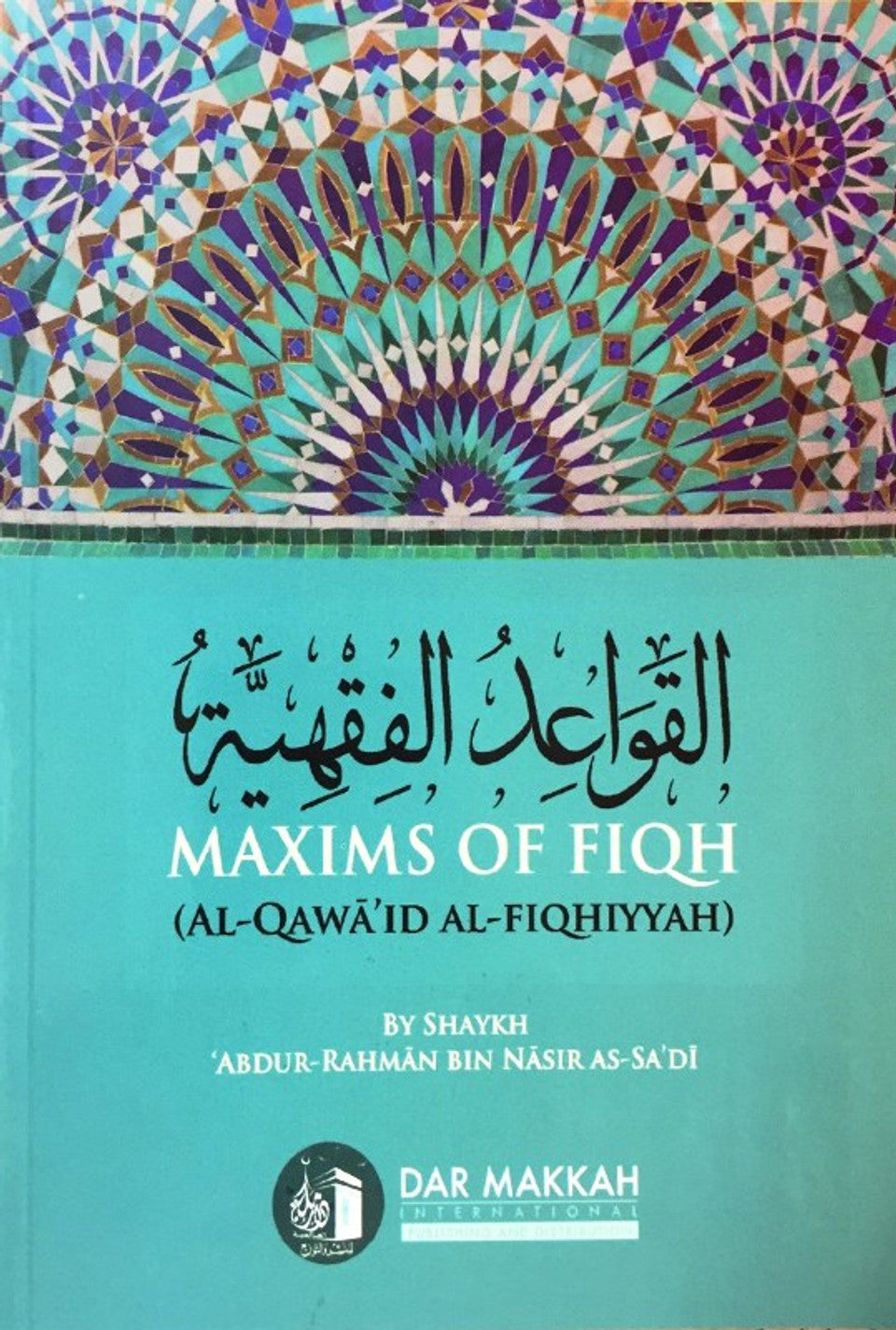
القواعد الفقهيةMAXIMS OF FIQH (AL-QAWA'ID AL-FIQHIYYAH)BY SHAYKH ABDUR-RAHMAN BIN NASIR AS-SADIDAR MAKKAHINTERNATIONAL
Pg: 02
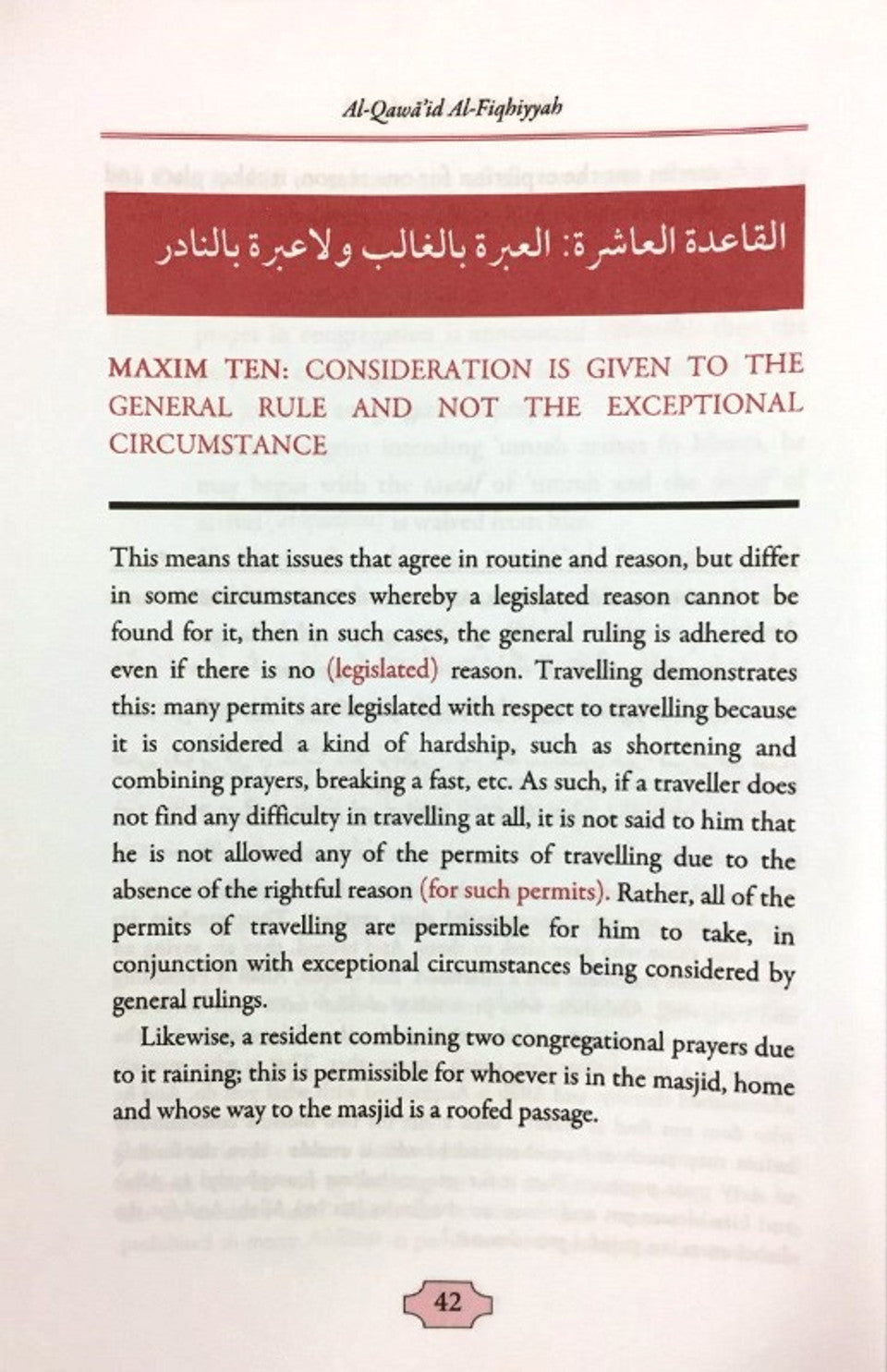
Al-Qawa'id Al-Fiqhiyyahالقاعدة العاشرة: العبرة بالغالب ولا عبرة بالنادرMAXIM TEN: CONSIDERATION IS GIVEN TO THE GENERAL RULE AND NOT THE EXCEPTIONAL CIRCUMSTANCEThis means that issues that agree in routine and reason, but differ in some circumstances whereby a legislated reason cannot be found for it, then in such cases, the general ruling is adhered to even if there is no (legislated) reason. Travelling demonstrates this: many permits are legislated with respect to travelling because it is considered a kind of hardship, such as shortening and combining prayers, breaking a fast, etc. As such, if a traveller does not find any difficulty in travelling at all, it is not said to him that he is not allowed any of the permits of travelling due to the absence of the rightful reason (for such permits). Rather, all of the permits of travelling are permissible for him to take, in conjunction with exceptional circumstances being considered by general rulings.Likewise, a resident combining two congregational prayers due to it raining; this is permissible for whoever is in the masjid, home and whose way to the masjid is a roofed passage.42
Pg: o3
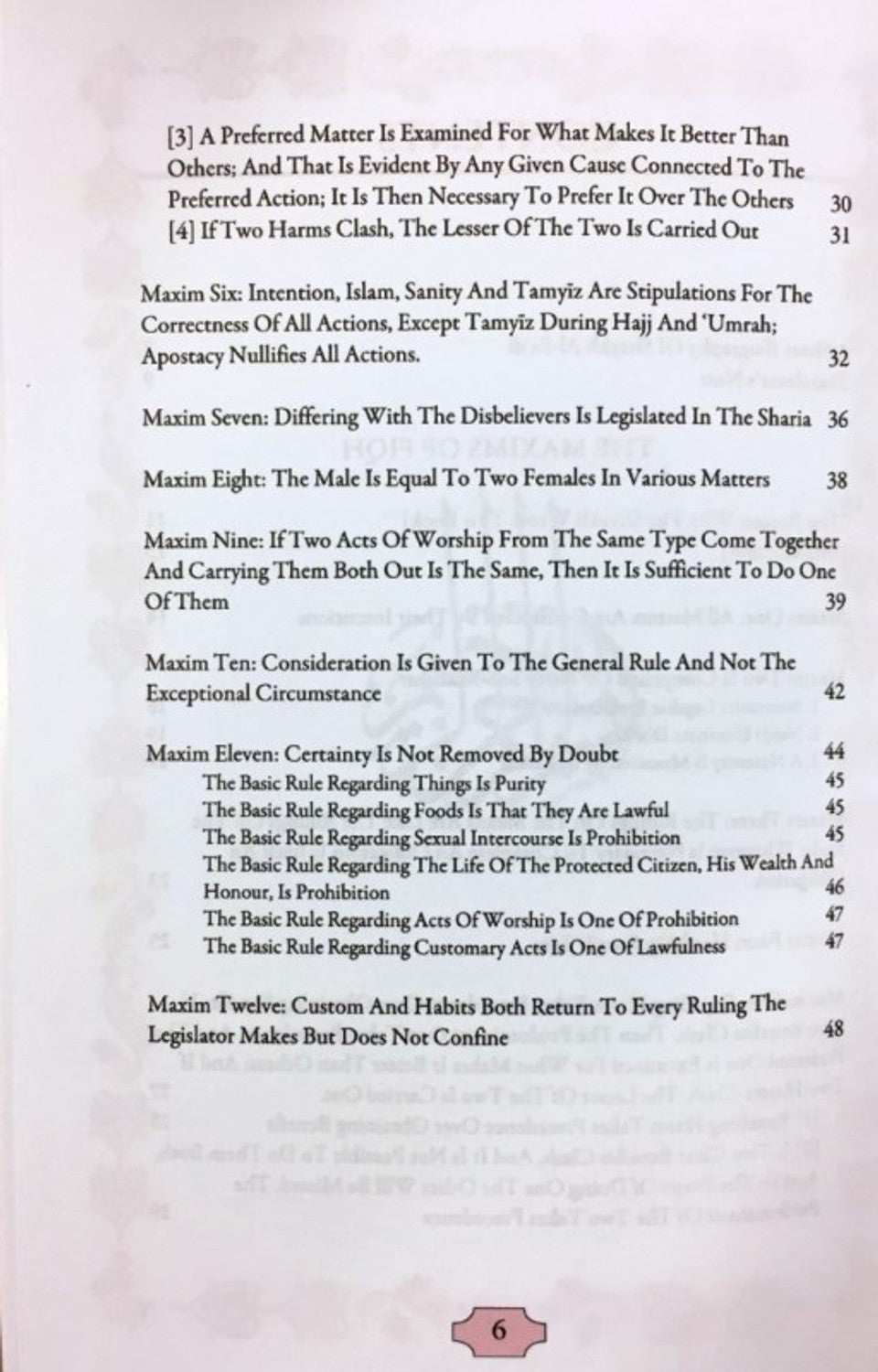
[3] A Preferred Matter Is Examined For What Makes It Better Than Others; And That Is Evident By Any Given Cause Connected To The Preferred Action; It Is Then Necessary To Prefer It Over The Others [4] If Two Harms Clash, The Lesser Of The Two Is Carried OutMaxim Six: Intention, Islam, Sanity And Tamyiz Are Stipulations For The Correctness Of All Actions, Except Tamyiz During Hajj And 'Umrah; Apostacy Nullifies All Actions.303132Maxim Seven: Differing With The Disbelievers Is Legislated In The Sharia 36Maxim Eight: The Male Is Equal To Two Females In Various Matters38Maxim Nine: If Two Acts Of Worship From The Same Type Come Together And Carrying Them Both Out Is The Same, Then It Is Sufficient To Do One Of Them39Maxim Ten: Consideration Is Given To The General Rule And Not The Exceptional Circumstance42Maxim Eleven: Certainty Is Not Removed By Doubt The Basic Rule Regarding Things Is Purity4445The Basic Rule Regarding Foods Is That They Are Lawful45The Basic Rule Regarding Sexual Intercourse Is Prohibition45The Basic Rule Regarding The Life Of The Protected Citizen, His Wealth And Honour, Is ProhibitionThe Basic Rule Regarding Acts Of Worship Is One Of Prohibition The Basic Rule Regarding Customary Acts Is One Of LawfulnessMaxim Twelve: Custom And Habits Both Return To Every Ruling The Legislator Makes But Does Not Confine
Pg:04
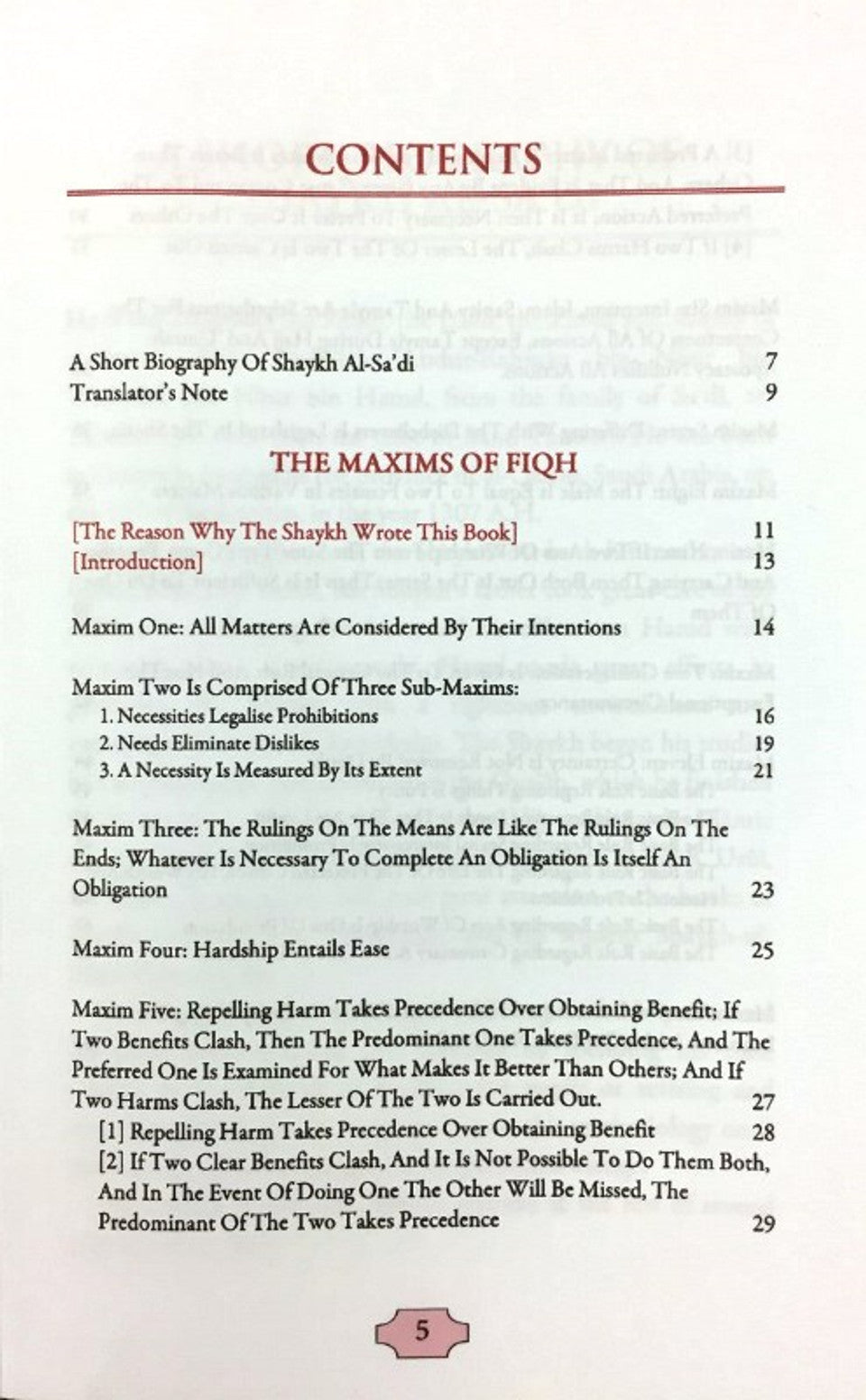
CONTENTSA Short Biography Of Shaykh Al-Sa'di Translator's NoteTHE MAXIMS OF FIQH[The Reason Why The Shaykh Wrote This Book][Introduction]Maxim One: All Matters Are Considered By Their IntentionsMaxim Two Is Comprised Of Three Sub-Maxims:1. Necessities Legalise Prohibitions2. Needs Eliminate Dislikes3. A Necessity Is Measured By Its ExtentMaxim Three: The Rulings On The Means Are Like The Rulings On The Ends; Whatever Is Necessary To Complete An Obligation Is Itself An ObligationMaxim Four: Hardship Entails EaseMaxim Five: Repelling Harm Takes Precedence Over Obtaining Benefit; If Two Benefits Clash, Then The Predominant One Takes Precedence, And The Preferred One Is Examined For What Makes It Better Than Others; And If Two Harms Clash, The Lesser Of The Two Is Carried Out. [1] Repelling Harm Takes Precedence Over Obtaining Benefit[2] If Two Clear Benefits Clash, And It Is Not Possible To Do Them Both, And In The Event Of Doing One The Other Will Be Missed, The Predominant Of The Two Takes Precedence
Publisher
Dar Makkah International Publishing
Author
- Shaykh Abdur Rahman Bin Nasir As Sa’di
Shipping and Delivery
We dispatch orders directly from our UK and USA warehouses, offering multiple shipping options to suit your needs. We proudly ship worldwide.
UK Deliveries (from UK warehouse):
Standard shipping typically arrives within 3–4 working days. Expedited delivery takes 2–3 working days. We aim to dispatch orders the same day or next working day, with next-day delivery options available where applicable.
USA Deliveries (from USA warehouse):
Orders usually arrive within 4–7 working days.
Europe (shipped from UK):
Standard delivery takes approximately 6–10 working days, with expedited services available in 3–5 working days.
Canada:
Estimated delivery time is 5–10 working days.
Worldwide Shipping:
International orders generally arrive within 5–20 working days, depending on destination and shipping method selected.
For precise delivery timelines based on your location, please contact us by email and our team will provide detailed information tailored to your address.
Sample Pages - Content
Pg: 01
القواعد الفقهيةMAXIMS OF FIQH (AL-QAWA'ID AL-FIQHIYYAH)BY SHAYKH ABDUR-RAHMAN BIN NASIR AS-SADIDAR MAKKAHINTERNATIONAL
Pg: 02
Al-Qawa'id Al-Fiqhiyyahالقاعدة العاشرة: العبرة بالغالب ولا عبرة بالنادرMAXIM TEN: CONSIDERATION IS GIVEN TO THE GENERAL RULE AND NOT THE EXCEPTIONAL CIRCUMSTANCEThis means that issues that agree in routine and reason, but differ in some circumstances whereby a legislated reason cannot be found for it, then in such cases, the general ruling is adhered to even if there is no (legislated) reason. Travelling demonstrates this: many permits are legislated with respect to travelling because it is considered a kind of hardship, such as shortening and combining prayers, breaking a fast, etc. As such, if a traveller does not find any difficulty in travelling at all, it is not said to him that he is not allowed any of the permits of travelling due to the absence of the rightful reason (for such permits). Rather, all of the permits of travelling are permissible for him to take, in conjunction with exceptional circumstances being considered by general rulings.Likewise, a resident combining two congregational prayers due to it raining; this is permissible for whoever is in the masjid, home and whose way to the masjid is a roofed passage.42
Pg: o3
[3] A Preferred Matter Is Examined For What Makes It Better Than Others; And That Is Evident By Any Given Cause Connected To The Preferred Action; It Is Then Necessary To Prefer It Over The Others [4] If Two Harms Clash, The Lesser Of The Two Is Carried OutMaxim Six: Intention, Islam, Sanity And Tamyiz Are Stipulations For The Correctness Of All Actions, Except Tamyiz During Hajj And 'Umrah; Apostacy Nullifies All Actions.303132Maxim Seven: Differing With The Disbelievers Is Legislated In The Sharia 36Maxim Eight: The Male Is Equal To Two Females In Various Matters38Maxim Nine: If Two Acts Of Worship From The Same Type Come Together And Carrying Them Both Out Is The Same, Then It Is Sufficient To Do One Of Them39Maxim Ten: Consideration Is Given To The General Rule And Not The Exceptional Circumstance42Maxim Eleven: Certainty Is Not Removed By Doubt The Basic Rule Regarding Things Is Purity4445The Basic Rule Regarding Foods Is That They Are Lawful45The Basic Rule Regarding Sexual Intercourse Is Prohibition45The Basic Rule Regarding The Life Of The Protected Citizen, His Wealth And Honour, Is ProhibitionThe Basic Rule Regarding Acts Of Worship Is One Of Prohibition The Basic Rule Regarding Customary Acts Is One Of LawfulnessMaxim Twelve: Custom And Habits Both Return To Every Ruling The Legislator Makes But Does Not Confine
Pg:04
CONTENTSA Short Biography Of Shaykh Al-Sa'di Translator's NoteTHE MAXIMS OF FIQH[The Reason Why The Shaykh Wrote This Book][Introduction]Maxim One: All Matters Are Considered By Their IntentionsMaxim Two Is Comprised Of Three Sub-Maxims:1. Necessities Legalise Prohibitions2. Needs Eliminate Dislikes3. A Necessity Is Measured By Its ExtentMaxim Three: The Rulings On The Means Are Like The Rulings On The Ends; Whatever Is Necessary To Complete An Obligation Is Itself An ObligationMaxim Four: Hardship Entails EaseMaxim Five: Repelling Harm Takes Precedence Over Obtaining Benefit; If Two Benefits Clash, Then The Predominant One Takes Precedence, And The Preferred One Is Examined For What Makes It Better Than Others; And If Two Harms Clash, The Lesser Of The Two Is Carried Out. [1] Repelling Harm Takes Precedence Over Obtaining Benefit[2] If Two Clear Benefits Clash, And It Is Not Possible To Do Them Both, And In The Event Of Doing One The Other Will Be Missed, The Predominant Of The Two Takes Precedence
Who is Abdul Rehman Bin Nasir As-Sadi?
Shaykh Abdul Rahman bin Nasir al-Sa'di (1889–1956) was a prominent Saudi scholar, theologian, and jurist known for his expertise in Quranic exegesis and Islamic jurisprudence. His most famous work, Tafsir al-Sa'di (Taysir al-Karim al-Rahman fi Tafsir Kalam al-Mannan), is a widely accessible and concise commentary on the Quran, noted for its clarity and emphasis on simplicity. Al-Sa'di focused on making Islamic teachings understandable and practical for everyday Muslims, advocating for a balanced and straightforward approach to faith and worship based on the Quran and Sunnah. His teachings continue to be valued for their relevance and depth in Islamic studies.