
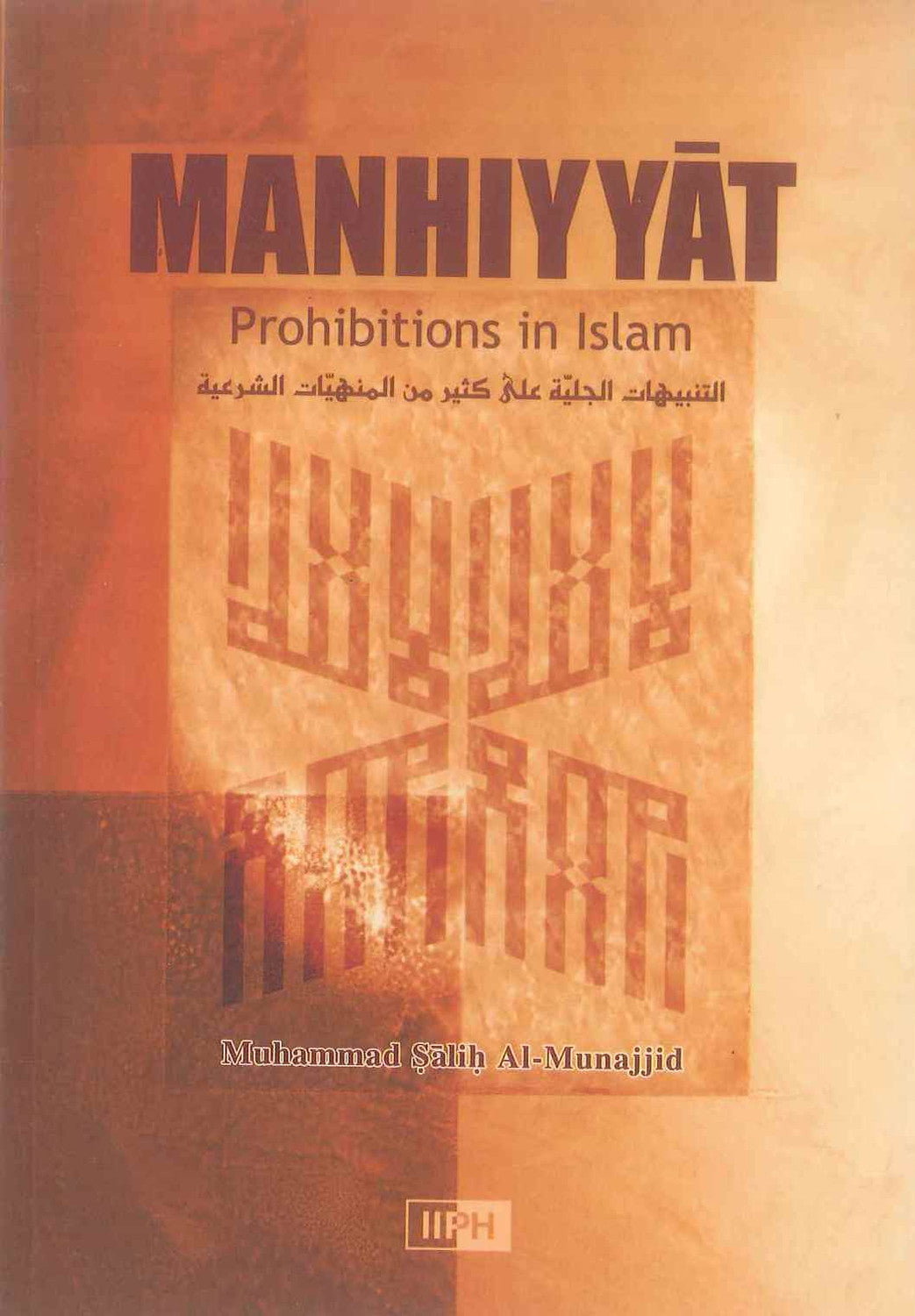
Manhiyyat | Prohibitions in Islam
Manhiyyat | Prohibitions in Islam
Publisher:
IIPH (International Islamic Publishing House)
Language:
English
Binding:
Hard Cover
Pages: 168
Size: 16x22cm
Couldn't load pickup availability
Collapsible content
Description of islamic Book
Manhiyyat | Prohibitions in Islam
Manhiyyat | Prohibitions in Islam is a focused and insightful exploration of the acts that are clearly forbidden in Islamic teachings, based on the Qur’an and authentic Hadith. This work serves as a valuable guide for Muslims who wish to align their lives more closely with Islamic ethics and law by understanding what Islam explicitly prohibits. The author explains the wisdom behind these prohibitions, showing how they are meant to protect faith, character, society, and the well-being of individuals. Topics range from major sins like shirk (associating partners with Allah) and theft to more subtle issues like gossip, arrogance, and wasting time. The book does not merely list prohibitions but provides context, evidence, and the underlying principles that guide Islamic moral and legal boundaries. Written in a clear and structured style, this work encourages self-awareness and personal reform by highlighting what to avoid in order to live a spiritually sound and socially responsible life. It is an essential resource for anyone seeking a deeper understanding of Islamic conduct and a reminder that the path to righteousness includes not just doing good, but also abstaining from what is harmful or sinful
PAGE NO :1
Prohibitions in Islam
A1-Munajjid
PAGE NO :2
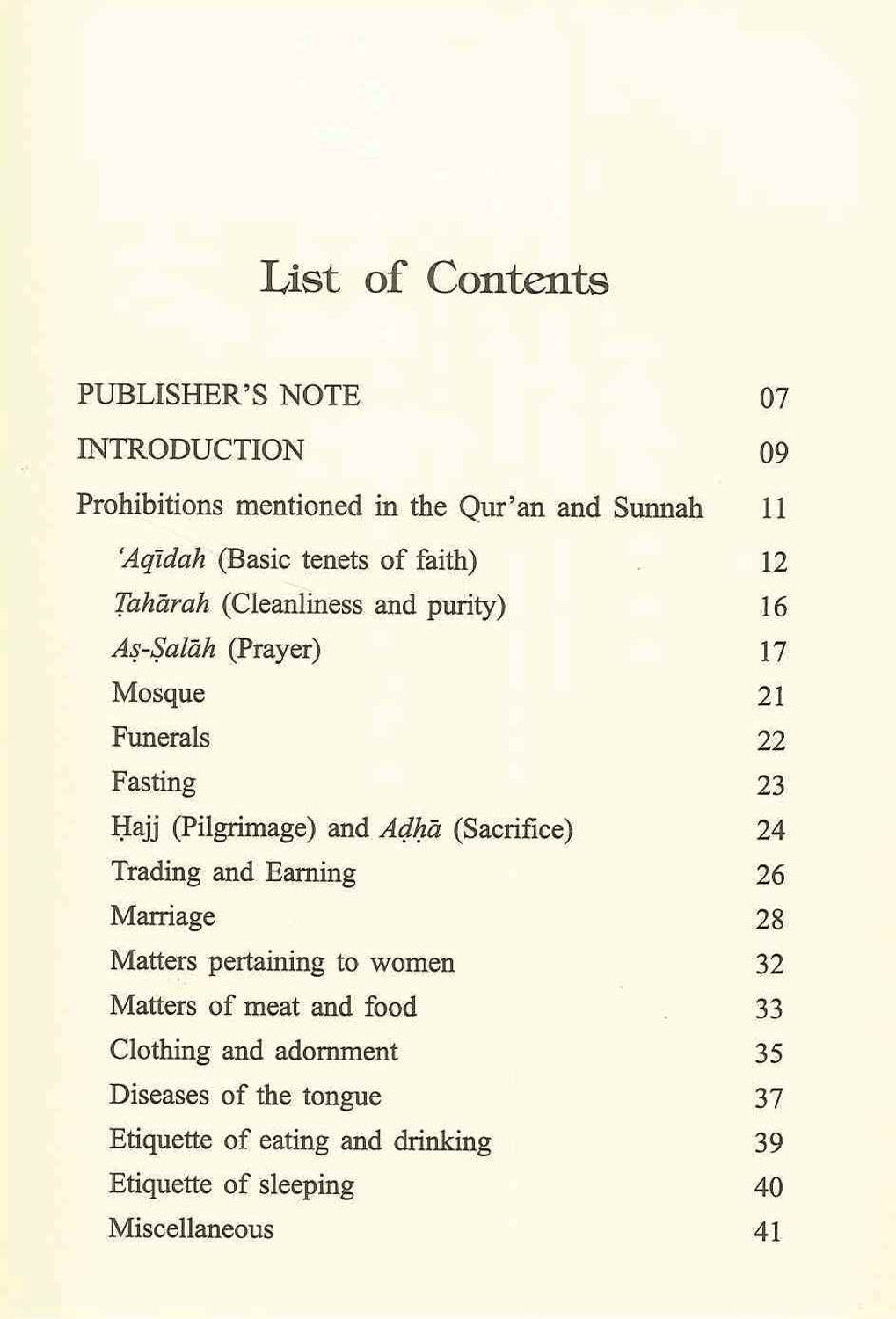
List of Contents
PUBLISHER'S NOTE
INTRODUCTION
Prohibitions mentioned in the Qur'an and Sunnah
CAqidah (Basic tenets of faith)
Taharah (Cleanliness and purity)
A-y-Salah (Prayer)
Mosque
Funerals
Fasting
Hajj (Pilgrimage) and Adliä (Sacrifice)
Trading and Earning
Marriage
Matters pertaining to women
Matters of meat and food
Clothing and adornment
Diseases of the tongue
Etiquette of eating and drinking
Etiquette of sleeping
Miscellaneous
PAGE NO :3
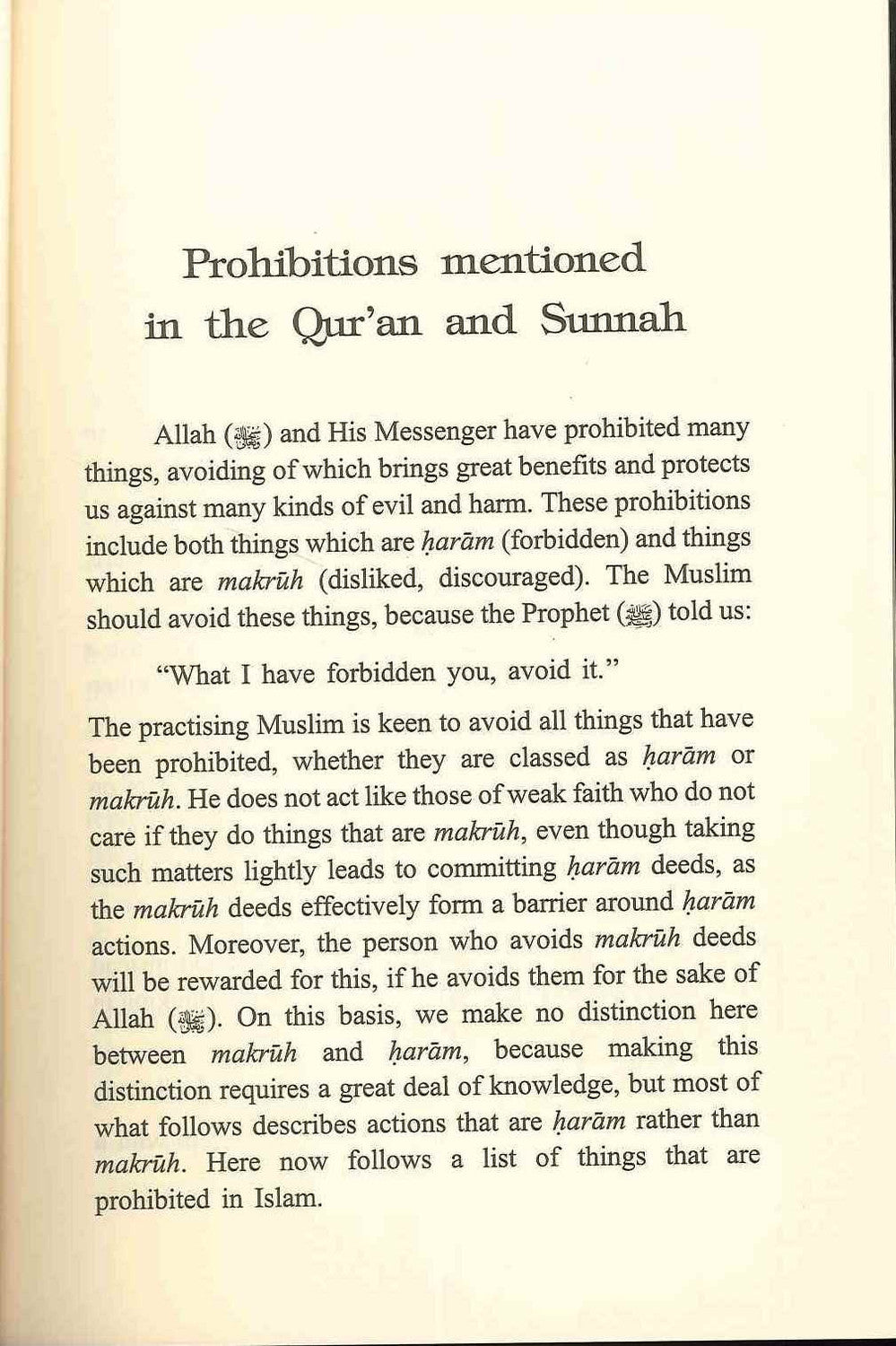
Prohibitions mentioned in the Qur'an and Sunnah
Allah () and His Messenger have prohibited many things, avoiding of which brings great benefits and protects us against many kinds of evil and harm. These prohibitions include both things which are haram (forbidden) and things which are makruh (disliked, discouraged). The Muslim should avoid these things, because the Prophet () told us:
"What I have forbidden you, avoid it."
The practising Muslim is keen to avoid all things that have been prohibited, whether they are classed as haram or makruh. He does not act like those of weak faith who do not care if they do things that are makruh, even though taking such matters lightly leads to committing haram deeds, as the makruh deeds effectively form a barrier around harām actions. Moreover, the person who avoids makrüh deeds will be rewarded for this, if he avoids them for the sake of Allah (). On this basis, we make no distinction here between makrüh and haram, because making this distinction requires a great deal of knowledge, but most of what follows describes actions that are haram rather than makruh. Here now follows a list of things that are prohibited in Islam.
PAGE NO :4
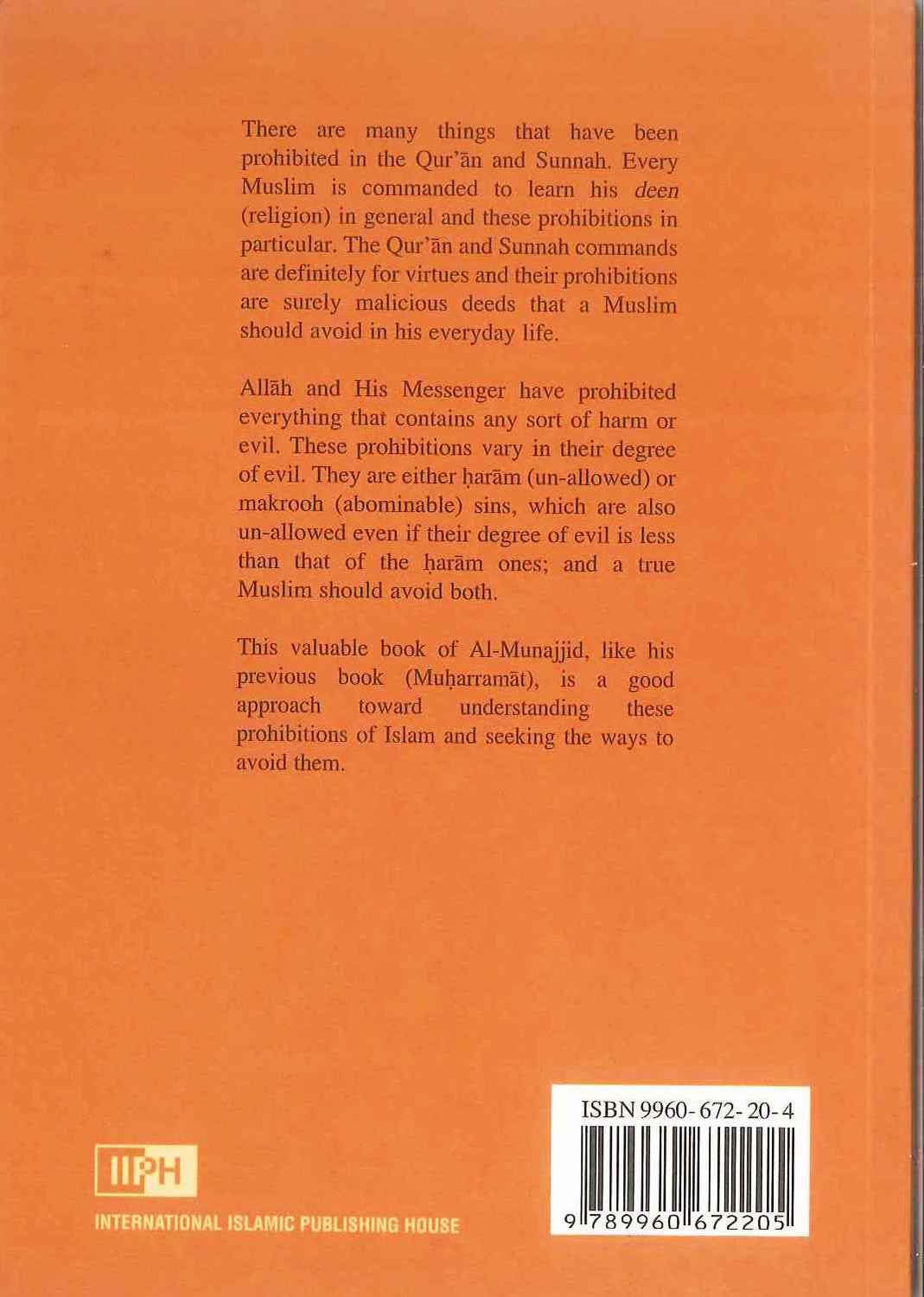
Thc,ue are many things Ihat have been
prohibited in the Quean and Sunnah. Every
Muslim is commanded (0 ICam his deen
(religion) in general and these prohibitions in
particular, The Qur'an and Sunnah commands
definitely t'or virtues and their pohibitions
are surely malicious deeds that a Muslim
should avoid in his everyday lile.
Allih and His Messenger have prohibited
everything that contains any sort of harm or
evil. These prohibitions vary in their degree
of evil, They are either haram (un-allowed) or
makrooh (abominable) sins, which are also
un-alloweci even if their degree of evil is less
than of the haram ones; and a true
Muslim should avoid both.
This hook of A1-Munajjid, like his
previous book (Mubarramäl), is a good
approach toward understanding these
prohibitions of Islam and seeking the ways to
avoid them-
ISLAMIC PUBLISHING HOUSE
Publisher
IIPH (International Islamic Publishing House)
Author
Shipping and Delivery
We dispatch orders directly from our UK and USA warehouses, offering multiple shipping options to suit your needs. We proudly ship worldwide.
UK Deliveries (from UK warehouse):
Standard shipping typically arrives within 3–4 working days. Expedited delivery takes 2–3 working days. We aim to dispatch orders the same day or next working day, with next-day delivery options available where applicable.
USA Deliveries (from USA warehouse):
Orders usually arrive within 4–7 working days.
Europe (shipped from UK):
Standard delivery takes approximately 6–10 working days, with expedited services available in 3–5 working days.
Canada:
Estimated delivery time is 5–10 working days.
Worldwide Shipping:
International orders generally arrive within 5–20 working days, depending on destination and shipping method selected.
For precise delivery timelines based on your location, please contact us by email and our team will provide detailed information tailored to your address.
Sample Pages - Content
PAGE NO :1
Prohibitions in Islam
A1-Munajjid
PAGE NO :2
List of Contents
PUBLISHER'S NOTE
INTRODUCTION
Prohibitions mentioned in the Qur'an and Sunnah
CAqidah (Basic tenets of faith)
Taharah (Cleanliness and purity)
A-y-Salah (Prayer)
Mosque
Funerals
Fasting
Hajj (Pilgrimage) and Adliä (Sacrifice)
Trading and Earning
Marriage
Matters pertaining to women
Matters of meat and food
Clothing and adornment
Diseases of the tongue
Etiquette of eating and drinking
Etiquette of sleeping
Miscellaneous
PAGE NO :3
Prohibitions mentioned in the Qur'an and Sunnah
Allah () and His Messenger have prohibited many things, avoiding of which brings great benefits and protects us against many kinds of evil and harm. These prohibitions include both things which are haram (forbidden) and things which are makruh (disliked, discouraged). The Muslim should avoid these things, because the Prophet () told us:
"What I have forbidden you, avoid it."
The practising Muslim is keen to avoid all things that have been prohibited, whether they are classed as haram or makruh. He does not act like those of weak faith who do not care if they do things that are makruh, even though taking such matters lightly leads to committing haram deeds, as the makruh deeds effectively form a barrier around harām actions. Moreover, the person who avoids makrüh deeds will be rewarded for this, if he avoids them for the sake of Allah (). On this basis, we make no distinction here between makrüh and haram, because making this distinction requires a great deal of knowledge, but most of what follows describes actions that are haram rather than makruh. Here now follows a list of things that are prohibited in Islam.
PAGE NO :4
Thc,ue are many things Ihat have been
prohibited in the Quean and Sunnah. Every
Muslim is commanded (0 ICam his deen
(religion) in general and these prohibitions in
particular, The Qur'an and Sunnah commands
definitely t'or virtues and their pohibitions
are surely malicious deeds that a Muslim
should avoid in his everyday lile.
Allih and His Messenger have prohibited
everything that contains any sort of harm or
evil. These prohibitions vary in their degree
of evil, They are either haram (un-allowed) or
makrooh (abominable) sins, which are also
un-alloweci even if their degree of evil is less
than of the haram ones; and a true
Muslim should avoid both.
This hook of A1-Munajjid, like his
previous book (Mubarramäl), is a good
approach toward understanding these
prohibitions of Islam and seeking the ways to
avoid them-
ISLAMIC PUBLISHING HOUSE
Who is Muhammad Salih al-Munajjid?
Muhammad Salih al-Munajjid is a prominent Islamic scholar, author, and preacher from Saudi Arabia, widely recognized for his contributions to contemporary Islamic education and online da'wah efforts.