


1
/
of
7
Islamic Manners – A Complete Guide to Muslim Etiquette and Good Character
Islamic Manners – A Complete Guide to Muslim Etiquette and Good Character
No reviews
Publisher:
Claritas Books
Author:
Shaykh Abd al-Fattah Abu Ghuddah
Language:
English
Binding:
Soft Cover
Pages: 101
Size: 14x22cm
Regular price
$13.99 USD
Regular price
Sale price
$13.99 USD
Unit price
/
per
Shipping calculated at checkout.
Couldn't load pickup availability


Collapsible content
Description of islamic Book
Islamic Manners – A Complete Guide to Muslim Etiquette and Good Character
Islamic Manners by Shaykh Abd al-Fattah Abu Ghuddah is a practical guide to proper Islamic etiquette and character. The book explains essential manners in daily life including social interactions, visiting others, conversation etiquette, and eating manners based on Islamic teachings.
From Author:
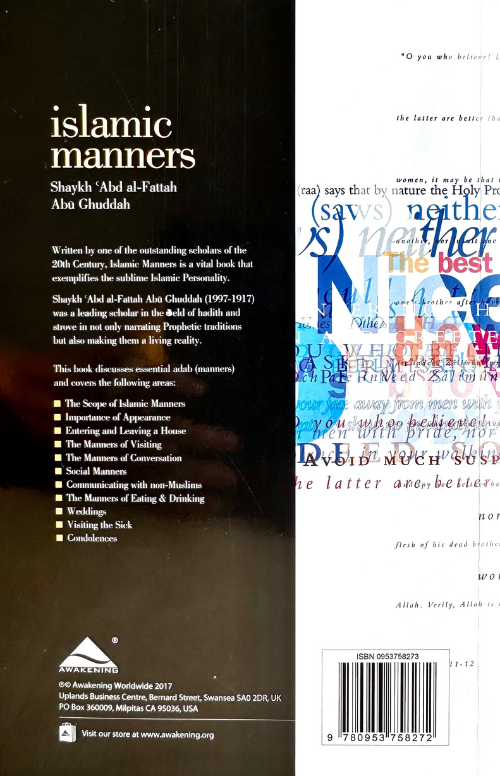
Written by one of the outstanding scholars of the 20th Century, Islamic Manners is a vital book that exemplifies the sublime Islamic personality. Shaykh Abd al-Fattah Abu Ghuddah (1917-1997) was a leading scholar in the field of hadith and strove in not only narrating Prophetic traditions but also making them a living reality. This book discusses essential adab (manners) and covers the following areas: The Scope of Islamic Manners, Importance of Appearance, Entering and Leaving a House, The Manners of Visiting, The Manners of Conversation, Social Manners, Communicating with non-Muslims, The Manners of Eating, Weddings, Visiting the Sick, Condolences.
Islamic Manners
Islamic Manners by Shaykh 'Abd al-Fattah Abu Ghuddah is a valuable guide to the etiquette and character that Islam teaches Muslims to observe in every area of life. Based on selected authentic and good ahadith, the book presents practical guidance for developing a refined Islamic personality and strengthening relationships within society.
The Scope of Islamic Manners
Islamic etiquette covers every aspect of life, from major social interactions to everyday activities. The book explains how these manners apply to men and women, young and old, and how practicing them contributes to a balanced and harmonious Muslim society.
The Importance of Appearance
Good manners also include maintaining a clean, dignified, and presentable appearance. The book highlights the Islamic emphasis on cleanliness, personal grooming, and appropriate presentation as part of a believer's character.
Entering and Leaving a House
Readers learn the proper Islamic etiquette related to entering and leaving homes, including respecting privacy, seeking permission, and maintaining consideration for others.
Manners of Visiting and Conversation
The book provides guidance on visiting others and communicating respectfully. It covers appropriate speech, avoiding offensive language, respecting privacy, and developing thoughtful and courteous interactions.
Social Manners
Islamic Manners explores the principles that help create respectful and peaceful relationships. It addresses issues such as avoiding mockery, insults, suspicion, backbiting, and inappropriate behavior while encouraging kindness and good character.
Communicating with Non-Muslims
The book also discusses appropriate manners when interacting with non-Muslims, providing guidance for respectful and dignified communication while maintaining Islamic principles.
Eating, Drinking, and Weddings
Practical Islamic etiquette is explained for everyday activities such as eating and drinking, as well as important occasions such as marriage and weddings. These teachings help Muslims incorporate Islamic manners into both ordinary and special moments.
Visiting the Sick and Offering Condolences
The book presents guidance on visiting those who are ill and offering condolences to people experiencing loss. These practices emphasize compassion, empathy, and support for fellow Muslims.
Authentic Islamic Guidance
The author collected selected texts on Islamic manners, with the cited hadiths being sahih (authentic) or hasan (good). The purpose is to remind Muslims of the importance of practicing these teachings and making them a living part of their character.
Page 01
scoff at another group, it may be that
up, it may be the
or let (some) women scoff at other
no one
NOT
nd no one therein
And if you find no one therein, still.,
etter than the former, nor defame one
neither talked indecently nor did he listen to indecent talk.
ted indecent
names. How bad it, to insult
er did he listen to
ced indeedy nor did he
FEL ENest manners
Allah. Verilyante One WW's acad
whosoever does not repentuh oth
Speakce and Clearly
IS
dors Rett H
DER
walk in insorer Get Permission Before Entering the ones of Others a fogant
itons Ande 17 "And Boyour
COURSEED SOME INDEED
shrewofile In Mse of like to eat the
о
1
H
VOIDINvo
face jaway from wer with pride, you walk insolence through the earth Vertly, Allah Likes
ne) women scoff at other
ate it (so hate backbiting).
may be that the latter a
ccepts repentance, Most Merciful.
O you who believe
ter are better than
go back,
are
etter than
unul permit.
Land Alla
S
ARE
islamic
manners
Shaykh 'Abd al-Fattah Abu Ghuddah
is N
Page 02
PUBLISHED BY THE PRESS SYNDICATE OF AWAKENING PUBLICATIONS Uplands Business Centre, Bernard Street, Swansea, SA2 oDR, United Kingdom
AWAKENING PUBLICATIONS
Uplands Business Centre, Bernard Street, Swansea, SA2 0DR, United Kingdom P.O. Box 360009, Milpitas, CA 95036, United States of America
Awakening Publications 2017
This book is in copyright. Subject to statutory exception and to the provisions of relevant collective licensing agreements, no reproduc- tion of any part may take place without the written permission of Awakening Publications.
First edition: May 2001 / Rabi' al-Awwal 1422 Second edition: June 2003 / Rabi' al-Awwal 1424 Third edition: July 2007 / Rajab 1428
Fourth edition: January 2017/ Jumada al-Awwal
Printed by Mega Printing in Turkey
Typeset in Bembo 11/14 [CP]
A catalogue record for this book is available from the British Library
Library of Congress cataloging in publication data
ISLAMIC MANNERS
by Shaykh Abd al-Fattah Abu Ghuddah translated by Muhammad Zahid Abu Ghuddah edited by S.M.Hasan al-Banna p. cm.
Includes bibliographical references
1. Islam - General - Sociology. 1. Title.
Special thanks to
Wassim, Ayman, Hiba, Attia, Abdul Basit, Alia, Muazzem, Nadim, and Jilani
Page 03
CONTENTS
Foreword
Translator's Introduction
Preface
One: Two: Three:
The Scope of Islamic Manners The Importance of Appearance
Four:
Manners of Visiting
Five:
Six:
Entering and Leaving a House
Manners of Conversation
Social Manners
Seven:
Communicating with Non-Muslims
Eight:
Manners of Eating
Nine:
Wedding Manners
Ten:
Visiting the Sick
Eleven:
Twelve
Manners of Traveling Condolences
Appendix: Author's Biography Notes
Page 04
ISLAMIC MANNERS
lived most of his life. This book will enable you to gain insight- ful glimpses to his personality and manners and his dedication to share it with his Muslim brothers and sisters and see them apply-
ing it to all aspects of their lives.
Although this is the first translation of this book, there were writers who wrote on this subject using the Arabic edition exten- sively with total disregard to intellectual rights. This translation is an extended version of the first Arabic edition; about one third of it is new material from my father's notes and additions. The ahadith cited are annotated, and the Arabic names were written based, with some modifications based on the Chicago Manual of Style.
I would like to thank those who reviewed the translation and shared their valuable comments, notably sister Heba Attia and brother Abdul Basit Khan. May Allah reward them. I would. appreciate hearing from the readers their comments and sugges- tions. I also call upon the friends of my father, may Allah bless his soul, to share with us stories, anecdotes, photos, tapes and video- tapes so that it may be included in a forthcoming book fully dedi- cated to his great life.
I pray to Allah for the best of rewards for our Prophet, his heirs-the scholars of Islam-and those who follow their path to happiness and salvation in this life and in the Hereafter. Ameen.
Muhammad Zahid Abu Ghuddah December 2000, Toronto, Canada
PREFACE
The best of praise and glory is to Allah, the Lord of the uni- verse. May the best of prayers and peace be on Allah's Messenger Muhammad, his family, his Companions and his pious followers who follow his guidance and etiquette. O Allah! Guide us to fol- low them in what we say and what we do until we leave this life. This is a small book on the manners of Islam in which I have collected selected texts on this important subject. The hadiths cited in this book are either şahih [authentic] or hasan [good].
I wrote this book because I have seen many of my beloved brothers and sisters disregard these manners and misinterpret them. In compiling it, I hope to remind them of these manners. I do not claim to be better or less in need of practicing these man- ners; but it is the duty of enjoining good and forbidding evil and observing the commands of Allah: And remind [them], for a reminder benefits the believers (Quran, 51:55).
May Allah enable all of us to benefit from good reminders and make this of benefit to my readers and myself. May Allah protect us and be our guide in this life and in the Hereafter.
Shaykh Abd al-Fattah Abu Ghuddah
I Muharram 1412, Riyadh, Saudi Arabia
Page 05
ISLAMIC MANNERS
establish Islam in all spheres of society. He would often say, "I do not care when I am killed as a Muslim, whichever side takes a
wound for Allah."
Shaykh Abu Ghuddah chose to write on this topic because he observed many people disregarding these essential adab or mis- interpreting them. It is thus indeed an honour for Awakening Publications to publish such a book, on such a topic and written by such a person.
S. M. Hasan Al-Banna May 2001, London
TRANSLATOR'S INTRODUCTION
The best of praise is for Allah and the complete prayers for His Messenger Muhammad, the merciful gift of Allah to humanity. This book exemplifies the character of the author, my respected father. In his manners and style, he was as perfect as humans could be in following the example of the Prophet & whom Allah por- trayed in the Quran, Truly, you have the best of manners (Quran. 68:4).
My father was a very discerning observer noticing the slight- est faux pas in manners and style, and he enjoyed a fine aesthetic sense of putting every item, whether a sofa or a pair of shoes in its right place. May Allah bless him. He was very keen to instil these graceful manners in those around him: his children, his grandchil- dren and his students. Appearance was not less important for him despite his extreme humbleness. You could not find a fault with his trimmed and combed beard and moustache, clipped nails, crisp clean clothes and spotless shining shoes. When you approach him. you enjoy the fragrance of his favourite scent, specially formu- lated for him by a faithful perfumer in Aleppo, the city that loved him beyond imagination.
This book was dear to his heart because he felt that Muslims possess a great wealth in manners and styles manifest in the life of our Prophet and the lives of his Companions, as well as the lives of the great Muslim scholars with whose biographies he
Page 06
Chapter One
THE SCOPE OF ISLAMIC MANNERS
اور
The religion of Islam has rules of etiquette and manners covering every aspect of life. These are applicable for the whole society: the old and the young, men and women. We must not forget that the Prophet said, "Women are the counterparts of Hence, what is required of men, in adhering to Islamic manners, is likewise required of women; for together they form the Muslim society and through them Islam is introduced and identified.
men.
These manners cover even minor acts, such as entering or exit- ing a bathroom, posture while sitting and cleaning oneself. At the time of the Prophet, one of the polytheists mockingly said to Salman al-Fārisī, "Your prophet has taught you everything, even the manners of going to the toilet." Salman answered, "Yes, the Prophet forbade us from facing the qibla (direction of Ka'ba) when urinating or relieving ourselves." Salman continued, "The Prophet asked us not to use the right hand when cleaning our- selves and to use at least three stones for cleaning."
Islam advocates these etiquette and stresses it so as to perfect the Islamic personality and to bring about harmony among peo- ple. There is no doubt that embodying such manners and virtues enhances personal style and qualities, refines the character and brings us closer to the hearts and minds of others. Also, it makes life easier as we know what to do and what to expect from others. The following manners and etiquette are central to Islam, its purposes and its aims. Calling it "etiquette" by no means implies
I
Page 07
"O you who believe! Lei
islamic
manners
Shaykh 'Abd al-Fattah Abu Ghuddah
Written by one of the outstanding scholars of the 20th Century, Islamic Manners is a vital book that exemplifies the sublime Islamic Personality.
Shaykh 'Abd al-Fattah Abu Ghuddah (1997-1917) was a leading scholar in the eld of hadith and strove in not only narrating Prophetic traditions but also making them a living reality.
This book discusses essential adab (manners) and covers the following areas:
The Scope of Islamic Manners Importance of Appearance Entering and Leaving a House The Manners of Visiting
The Manners of Conversation Social Manners
Communicating with non-Muslims
The Manners of Eating & Drinking Weddings
Visiting the Sick
Condolences
the latter are better than
women, it may be that the
(raa) says that by nature the Holy Prop
(saws) neither is neither.
es
the
The best
U WHI
one'
H
ch Pa Red Ba
after h
your face away from men with ous whoo
pride, nor
ar
Der Voron VOID MUCH
Dvb
he latter amery boe beter back
nor
flesh of his dead brother?
AWAKENING
Awakening Worldwide
Uplands Business Centre, Bernard Street, Swansea SAO 2DR, UK
PO Box 360009, Milpitas CA 95036, USA
Visit our store at www.awakening.org
woni
Allah. Verily, Allah is th
Publisher
Claritas Books
Author
- Shaykh Abd al-Fattah Abu Ghuddah
Shipping and Delivery
We dispatch orders directly from our UK and USA warehouses, offering multiple shipping options to suit your needs. We proudly ship worldwide.
UK Deliveries (from UK warehouse):
Standard shipping typically arrives within 3–4 working days. Expedited delivery takes 2–3 working days. We aim to dispatch orders the same day or next working day, with next-day delivery options available where applicable.
USA Deliveries (from USA warehouse):
Orders usually arrive within 4–7 working days.
Europe (shipped from UK):
Standard delivery takes approximately 6–10 working days, with expedited services available in 3–5 working days.
Canada:
Estimated delivery time is 5–10 working days.
Worldwide Shipping:
International orders generally arrive within 5–20 working days, depending on destination and shipping method selected.
For precise delivery timelines based on your location, please contact us by email and our team will provide detailed information tailored to your address.
Sample Pages - Content
Page 01
scoff at another group, it may be that
up, it may be the
or let (some) women scoff at other
no one
NOT
nd no one therein
And if you find no one therein, still.,
etter than the former, nor defame one
neither talked indecently nor did he listen to indecent talk.
ted indecent
names. How bad it, to insult
er did he listen to
ced indeedy nor did he
FEL ENest manners
Allah. Verilyante One WW's acad
whosoever does not repentuh oth
Speakce and Clearly
IS
dors Rett H
DER
walk in insorer Get Permission Before Entering the ones of Others a fogant
itons Ande 17 "And Boyour
COURSEED SOME INDEED
shrewofile In Mse of like to eat the
о
1
H
VOIDINvo
face jaway from wer with pride, you walk insolence through the earth Vertly, Allah Likes
ne) women scoff at other
ate it (so hate backbiting).
may be that the latter a
ccepts repentance, Most Merciful.
O you who believe
ter are better than
go back,
are
etter than
unul permit.
Land Alla
S
ARE
islamic
manners
Shaykh 'Abd al-Fattah Abu Ghuddah
is N
Page 02
PUBLISHED BY THE PRESS SYNDICATE OF AWAKENING PUBLICATIONS Uplands Business Centre, Bernard Street, Swansea, SA2 oDR, United Kingdom
AWAKENING PUBLICATIONS
Uplands Business Centre, Bernard Street, Swansea, SA2 0DR, United Kingdom P.O. Box 360009, Milpitas, CA 95036, United States of America
Awakening Publications 2017
This book is in copyright. Subject to statutory exception and to the provisions of relevant collective licensing agreements, no reproduc- tion of any part may take place without the written permission of Awakening Publications.
First edition: May 2001 / Rabi' al-Awwal 1422 Second edition: June 2003 / Rabi' al-Awwal 1424 Third edition: July 2007 / Rajab 1428
Fourth edition: January 2017/ Jumada al-Awwal
Printed by Mega Printing in Turkey
Typeset in Bembo 11/14 [CP]
A catalogue record for this book is available from the British Library
Library of Congress cataloging in publication data
ISLAMIC MANNERS
by Shaykh Abd al-Fattah Abu Ghuddah translated by Muhammad Zahid Abu Ghuddah edited by S.M.Hasan al-Banna p. cm.
Includes bibliographical references
1. Islam - General - Sociology. 1. Title.
Special thanks to
Wassim, Ayman, Hiba, Attia, Abdul Basit, Alia, Muazzem, Nadim, and Jilani
Page 03
CONTENTS
Foreword
Translator's Introduction
Preface
One: Two: Three:
The Scope of Islamic Manners The Importance of Appearance
Four:
Manners of Visiting
Five:
Six:
Entering and Leaving a House
Manners of Conversation
Social Manners
Seven:
Communicating with Non-Muslims
Eight:
Manners of Eating
Nine:
Wedding Manners
Ten:
Visiting the Sick
Eleven:
Twelve
Manners of Traveling Condolences
Appendix: Author's Biography Notes
Page 04
ISLAMIC MANNERS
lived most of his life. This book will enable you to gain insight- ful glimpses to his personality and manners and his dedication to share it with his Muslim brothers and sisters and see them apply-
ing it to all aspects of their lives.
Although this is the first translation of this book, there were writers who wrote on this subject using the Arabic edition exten- sively with total disregard to intellectual rights. This translation is an extended version of the first Arabic edition; about one third of it is new material from my father's notes and additions. The ahadith cited are annotated, and the Arabic names were written based, with some modifications based on the Chicago Manual of Style.
I would like to thank those who reviewed the translation and shared their valuable comments, notably sister Heba Attia and brother Abdul Basit Khan. May Allah reward them. I would. appreciate hearing from the readers their comments and sugges- tions. I also call upon the friends of my father, may Allah bless his soul, to share with us stories, anecdotes, photos, tapes and video- tapes so that it may be included in a forthcoming book fully dedi- cated to his great life.
I pray to Allah for the best of rewards for our Prophet, his heirs-the scholars of Islam-and those who follow their path to happiness and salvation in this life and in the Hereafter. Ameen.
Muhammad Zahid Abu Ghuddah December 2000, Toronto, Canada
PREFACE
The best of praise and glory is to Allah, the Lord of the uni- verse. May the best of prayers and peace be on Allah's Messenger Muhammad, his family, his Companions and his pious followers who follow his guidance and etiquette. O Allah! Guide us to fol- low them in what we say and what we do until we leave this life. This is a small book on the manners of Islam in which I have collected selected texts on this important subject. The hadiths cited in this book are either şahih [authentic] or hasan [good].
I wrote this book because I have seen many of my beloved brothers and sisters disregard these manners and misinterpret them. In compiling it, I hope to remind them of these manners. I do not claim to be better or less in need of practicing these man- ners; but it is the duty of enjoining good and forbidding evil and observing the commands of Allah: And remind [them], for a reminder benefits the believers (Quran, 51:55).
May Allah enable all of us to benefit from good reminders and make this of benefit to my readers and myself. May Allah protect us and be our guide in this life and in the Hereafter.
Shaykh Abd al-Fattah Abu Ghuddah
I Muharram 1412, Riyadh, Saudi Arabia
Page 05
ISLAMIC MANNERS
establish Islam in all spheres of society. He would often say, "I do not care when I am killed as a Muslim, whichever side takes a
wound for Allah."
Shaykh Abu Ghuddah chose to write on this topic because he observed many people disregarding these essential adab or mis- interpreting them. It is thus indeed an honour for Awakening Publications to publish such a book, on such a topic and written by such a person.
S. M. Hasan Al-Banna May 2001, London
TRANSLATOR'S INTRODUCTION
The best of praise is for Allah and the complete prayers for His Messenger Muhammad, the merciful gift of Allah to humanity. This book exemplifies the character of the author, my respected father. In his manners and style, he was as perfect as humans could be in following the example of the Prophet & whom Allah por- trayed in the Quran, Truly, you have the best of manners (Quran. 68:4).
My father was a very discerning observer noticing the slight- est faux pas in manners and style, and he enjoyed a fine aesthetic sense of putting every item, whether a sofa or a pair of shoes in its right place. May Allah bless him. He was very keen to instil these graceful manners in those around him: his children, his grandchil- dren and his students. Appearance was not less important for him despite his extreme humbleness. You could not find a fault with his trimmed and combed beard and moustache, clipped nails, crisp clean clothes and spotless shining shoes. When you approach him. you enjoy the fragrance of his favourite scent, specially formu- lated for him by a faithful perfumer in Aleppo, the city that loved him beyond imagination.
This book was dear to his heart because he felt that Muslims possess a great wealth in manners and styles manifest in the life of our Prophet and the lives of his Companions, as well as the lives of the great Muslim scholars with whose biographies he
Page 06
Chapter One
THE SCOPE OF ISLAMIC MANNERS
اور
The religion of Islam has rules of etiquette and manners covering every aspect of life. These are applicable for the whole society: the old and the young, men and women. We must not forget that the Prophet said, "Women are the counterparts of Hence, what is required of men, in adhering to Islamic manners, is likewise required of women; for together they form the Muslim society and through them Islam is introduced and identified.
men.
These manners cover even minor acts, such as entering or exit- ing a bathroom, posture while sitting and cleaning oneself. At the time of the Prophet, one of the polytheists mockingly said to Salman al-Fārisī, "Your prophet has taught you everything, even the manners of going to the toilet." Salman answered, "Yes, the Prophet forbade us from facing the qibla (direction of Ka'ba) when urinating or relieving ourselves." Salman continued, "The Prophet asked us not to use the right hand when cleaning our- selves and to use at least three stones for cleaning."
Islam advocates these etiquette and stresses it so as to perfect the Islamic personality and to bring about harmony among peo- ple. There is no doubt that embodying such manners and virtues enhances personal style and qualities, refines the character and brings us closer to the hearts and minds of others. Also, it makes life easier as we know what to do and what to expect from others. The following manners and etiquette are central to Islam, its purposes and its aims. Calling it "etiquette" by no means implies
I
Page 07
"O you who believe! Lei
islamic
manners
Shaykh 'Abd al-Fattah Abu Ghuddah
Written by one of the outstanding scholars of the 20th Century, Islamic Manners is a vital book that exemplifies the sublime Islamic Personality.
Shaykh 'Abd al-Fattah Abu Ghuddah (1997-1917) was a leading scholar in the eld of hadith and strove in not only narrating Prophetic traditions but also making them a living reality.
This book discusses essential adab (manners) and covers the following areas:
The Scope of Islamic Manners Importance of Appearance Entering and Leaving a House The Manners of Visiting
The Manners of Conversation Social Manners
Communicating with non-Muslims
The Manners of Eating & Drinking Weddings
Visiting the Sick
Condolences
the latter are better than
women, it may be that the
(raa) says that by nature the Holy Prop
(saws) neither is neither.
es
the
The best
U WHI
one'
H
ch Pa Red Ba
after h
your face away from men with ous whoo
pride, nor
ar
Der Voron VOID MUCH
Dvb
he latter amery boe beter back
nor
flesh of his dead brother?
AWAKENING
Awakening Worldwide
Uplands Business Centre, Bernard Street, Swansea SAO 2DR, UK
PO Box 360009, Milpitas CA 95036, USA
Visit our store at www.awakening.org
woni
Allah. Verily, Allah is th
Who is Shaykh Abd Al-Fattah Abu Ghuddah?
Dr. S. Dawood Shah is known for his scholarly work on Seerah (the life and example of Prophet Muhammad ﷺ) and Islamic studies. In this book, he presents the educational aspects of the Prophet’s life with clarity and relevance to readers today.
Customers helping others by Reviews - جزاك اللهُ خيراً
4.94 ★ (49)
Verified