


In Defence of the Four Imams – Islamic Fiqh Book by bn Taymiyah
In Defence of the Four Imams – Islamic Fiqh Book by bn Taymiyah
Publisher:
Claritas Books
Author:
Shaykh-Ul-Islam Ibn Taymiyah
Language:
English
Binding:
Soft Cover
Pages: 164
Size: 14x21cm
Couldn't load pickup availability


Collapsible content
Description of islamic Book
In Defence of the Four Imams – Islamic Fiqh Book by bn Taymiyah
In Defence of the Four Imams is an insightful Islamic fiqh book explaining the differences among the four major schools of Islamic law. This Islamic jurisprudence guide clarifies why scholars differed while remaining faithful to authentic teachings. A useful madhab reference book for students and readers seeking deeper understanding of Islamic scholarship.
From Author:
Page 01
IN DEFENCE OF THE FOUR IMAMS
IBN TAYMIYAH
Page 02
Contents
TRANSLATOR'S INTRODUCTION
INTRODUCTION
THE FIRST CAUSE
He was unaware of the hadith
THE SECOND CAUSE
He was aware of the hadith, but it wasn't sound in his vie
THE THIRD CAUSE
He believes the hadith presented by those differing with him is weak
THE FOURTH CAUSE
He Stipulates Conditions for the Reports of Reliable Narrators that are different from other scholars
THE FIFTH CAUSE
He knew the hadith, considered it to be genuine, but forgot it
THE SIXTH CAUSE
He did not know what the hadith meant
THE SEVENTH CAUSE
He believes that his opponent misconstrues the hadith
Page 03
The First Cause
He was unaware of the hadith
Whomever the hadith hasn't reached isn't burdened to know what it necessitates. And if it hasn't reached him-while he has taken a view about that issue that accords with the out- ward meaning of a verse, [or] with another hadith, [or] in accord with legal analogy (qiyas), or in accord with the rule of presumption (istishab)—it (i.e. the view) might agree with that hadith at times, and it might contradict it at others. This cause is the major reason for most statements of the Salaf that conflicted with some of the hadiths. For surely none of the Imams encompassed knowledge of all of the hadiths of Allah's messenger.
And the Prophetused to relate [teachings], offer legal opinions (yufti), give legal verdicts (yaqdi), or he would do something and someone who was present would hear or see him, and then those-or one of them-would proclaim that [thing] to whoever they would run into [later]. Then the knowledge of that would reach whomever Allah willed of the scholars from the Sahabah, the Tabi'in, and those after them. Then in another sitting he might relate [a teaching], offer a
Page 04
IN DEFENCE OF THE FOUR IMAMS
IBN TAYMIYAH
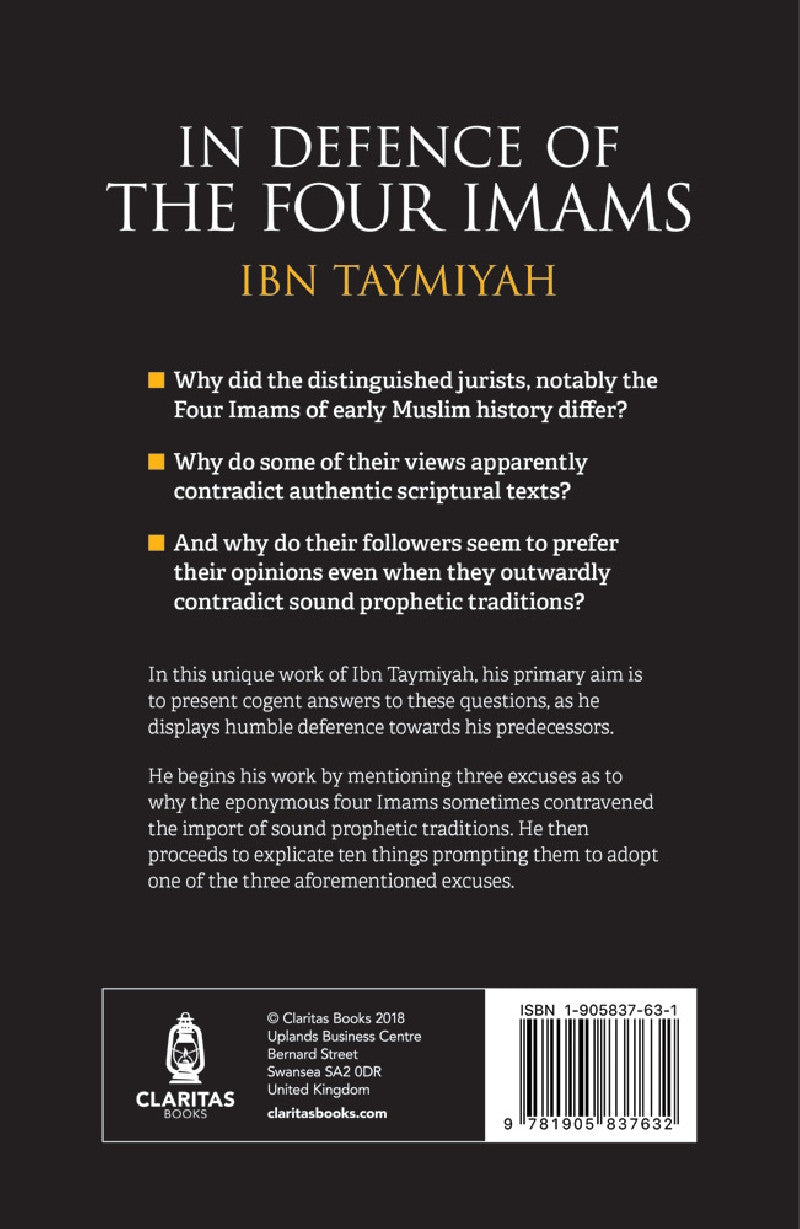
I Why did the distinguished jurists, notably the Four Imams of early Muslim history differ?
Why do some of their views apparently contradict authentic scriptural texts?
And why do their followers seem to prefer their opinions even when they outwardly contradict sound prophetic traditions?
In this unique work of Ibn Taymiyah, his primary aim is to present cogent answers to these questions, as he displays humble deference towards his predecessors.
He begins his work by mentioning three excuses as to why the eponymous four Imams sometimes contravened the import of sound prophetic traditions. He then proceeds to explicate ten things prompting them to adopt one of the three aforementioned excuses.
Publisher
Claritas Books
Author
- Shaykh-Ul-Islam Ibn Taymiyah
Shipping and Delivery
We dispatch orders directly from our UK and USA warehouses, offering multiple shipping options to suit your needs. We proudly ship worldwide.
UK Deliveries (from UK warehouse):
Standard shipping typically arrives within 3–4 working days. Expedited delivery takes 2–3 working days. We aim to dispatch orders the same day or next working day, with next-day delivery options available where applicable.
USA Deliveries (from USA warehouse):
Orders usually arrive within 4–7 working days.
Europe (shipped from UK):
Standard delivery takes approximately 6–10 working days, with expedited services available in 3–5 working days.
Canada:
Estimated delivery time is 5–10 working days.
Worldwide Shipping:
International orders generally arrive within 5–20 working days, depending on destination and shipping method selected.
For precise delivery timelines based on your location, please contact us by email and our team will provide detailed information tailored to your address.
Sample Pages - Content
Page 01
IN DEFENCE OF THE FOUR IMAMS
IBN TAYMIYAH
Page 02
Contents
TRANSLATOR'S INTRODUCTION
INTRODUCTION
THE FIRST CAUSE
He was unaware of the hadith
THE SECOND CAUSE
He was aware of the hadith, but it wasn't sound in his vie
THE THIRD CAUSE
He believes the hadith presented by those differing with him is weak
THE FOURTH CAUSE
He Stipulates Conditions for the Reports of Reliable Narrators that are different from other scholars
THE FIFTH CAUSE
He knew the hadith, considered it to be genuine, but forgot it
THE SIXTH CAUSE
He did not know what the hadith meant
THE SEVENTH CAUSE
He believes that his opponent misconstrues the hadith
Page 03
The First Cause
He was unaware of the hadith
Whomever the hadith hasn't reached isn't burdened to know what it necessitates. And if it hasn't reached him-while he has taken a view about that issue that accords with the out- ward meaning of a verse, [or] with another hadith, [or] in accord with legal analogy (qiyas), or in accord with the rule of presumption (istishab)—it (i.e. the view) might agree with that hadith at times, and it might contradict it at others. This cause is the major reason for most statements of the Salaf that conflicted with some of the hadiths. For surely none of the Imams encompassed knowledge of all of the hadiths of Allah's messenger.
And the Prophetused to relate [teachings], offer legal opinions (yufti), give legal verdicts (yaqdi), or he would do something and someone who was present would hear or see him, and then those-or one of them-would proclaim that [thing] to whoever they would run into [later]. Then the knowledge of that would reach whomever Allah willed of the scholars from the Sahabah, the Tabi'in, and those after them. Then in another sitting he might relate [a teaching], offer a
Page 04
IN DEFENCE OF THE FOUR IMAMS
IBN TAYMIYAH
I Why did the distinguished jurists, notably the Four Imams of early Muslim history differ?
Why do some of their views apparently contradict authentic scriptural texts?
And why do their followers seem to prefer their opinions even when they outwardly contradict sound prophetic traditions?
In this unique work of Ibn Taymiyah, his primary aim is to present cogent answers to these questions, as he displays humble deference towards his predecessors.
He begins his work by mentioning three excuses as to why the eponymous four Imams sometimes contravened the import of sound prophetic traditions. He then proceeds to explicate ten things prompting them to adopt one of the three aforementioned excuses.
Who is Shaykh-Ul-Islam Ibn Taymiyah?
Shaykh-ul-Islam Ibn Taymiyyah (661–728 AH / 1263–1328 CE) was one of the most influential Islamic scholars in history and a leading authority in Aqeedah, Fiqh, Tafsir, and Hadith. He was renowned for his deep knowledge of the Qur’an and Sunnah, his strong commitment to reviving authentic Islamic teachings, and his firm stance against innovations and deviations in belief and practice.