


Ibn Qayyim al-Jawziyya on the Invocation of God – The Power of Dhikr
Ibn Qayyim al-Jawziyya on the Invocation of God – The Power of Dhikr
Publisher:
Islamic Texts Society
Author:
Ibn Qayyim al-Jawziyya
Language:
English
Binding:
Paper back
Pages: 202
Size: 5.9 × 8.7 in15x22cm
Couldn't load pickup availability


Collapsible content
Description of islamic Book
Ibn Qayyim al-Jawziyya on the Invocation of God – The Power of Dhikr
Ibn Qayyim al-Jawziyya on the Invocation of God is the English translation of Imam Ibn al-Qayyim's renowned work Al-Wabil al-Sayyib, a profound treatise on the virtues and benefits of remembering Allah (dhikr). The author discusses nearly one hundred benefits of dhikr and explores themes such as purification of the heart, sincerity in worship, the nature of the soul, prayer, fasting, charity, and spiritual development. Through powerful reflections rooted in the Qur'an and Sunnah, Ibn al-Qayyim demonstrates how the remembrance of Allah transforms the believer's heart and strengthens faith. The book also offers valuable insight into the spiritual teachings of Ibn al-Qayyim and his teacher, Shaykh al-Islam Ibn Taymiyyah. It remains one of the most influential works on Islamic spirituality and self-purification.
From Author:
In describing al-Wabil al-Sayyib, here translated into English for the first time as Ibn Qayyim al-Jawziyya on the Invocation of God, the author says, ‘We have mentioned [in it] nearly one hundred benefits of remembrance of God [dhikr], and the secrets of remembrance… This is a book of great usefulness.’ Written in the fourteenth century by the renowned theologian Ibn Qayyim al-Jawziyya, this treatise movingly details the many blessings of the remembrance of God. Through discussions of the ego, the nature of the body, the ephemerality of the world, the degrees of prayer, fasting, charity, and the purification of the heart, this beautifully written work is a genuine contribution to Muslim spirituality. What makes Ibn Qayyim al-Jawziyya on the Invocation of God of great interest is that it illustrates the spiritual life of Ibn Qayyim and of his teacher, the Hanbalite reformer Ibn Taymiyya (1263AH/1328AD). This book is a spiritual book, and it goes a long way towards making a hard, cruel and oblivious heart become lenient, compassionate, kind and merciful Muslim World Book Review
Content:
The Power of Dhikr (Remembrance of Allah)
The book highlights the central role of Dhikr in a believer's life, explaining how constant remembrance strengthens faith, purifies the heart, and protects a person from the whispers of Shaytan.
Commentary on the Hadith of Al-Harith Al-Ash'ari
A detailed explanation of the famous hadith in which Allah commanded Prophet Yahya (John), peace be upon him, with five essential commands. Ibn al-Qayyim extracts profound lessons regarding Tawheed, prayer, charity, fasting, and remembrance of Allah.
Protection from Shaytan
The author demonstrates how sincere remembrance acts as a spiritual shield, guarding the believer against temptation, doubts, sins, and the plots of the enemy.
Remembrance and Supplication
The book explores the relationship between Dhikr and Du'a, showing that remembrance of Allah is among the greatest acts of worship and often precedes accepted supplications. It discusses the etiquette of supplication, including praising Allah and sending blessings upon the Prophet ﷺ before making requests.
Purification of the Heart
Ibn al-Qayyim explains how remembrance revives dead hearts, removes spiritual diseases, increases sincerity, and brings contentment and peace to the soul.
Virtues and Benefits of Dhikr
The author enumerates numerous benefits of remembering Allah, including earning divine pleasure, receiving mercy, attaining forgiveness, increasing blessings, and drawing closer to Allah.
Page:01
Ibn Qayyim al-Jawziyya
THE INVOCATION OF GOD Al-Wabil al-Sayyib min al-Kalim al-Tayyib
الوابل الصيب مِنَ الكلم الطيب
Translated by
MICHAEL ABDURRAHMAN FITZGERALD
& MOULAY YOUSSEF SLITINE
Page:02
PART TWO
A Commentary on the Hadith of al-Harith al-Ash'ari
Now, during this brief sojourn, God Almighty endows His ser- vant with power, armour and helpers. He makes clear to him how he may protect himself from his Foe or free himself if taken captive. Imam Ahmad ibn Hanbal and Tirmidhi have narrated a ḥadīth from al-Harith al-Ash'arī that the Prophet said:
'Verily, God, Glorified and Exalted, commanded John [Yahya] Son of Zakariya with five words to act upon and to enjoin upon the Children of Israel; but he put it off. Then Jesus [Isā], may God grant him peace, said to him, "God, Most High, has commanded you with five words to act upon and to enjoin upon the Children of Israel. Either you command them, or I shall." To this John replied, "I fear that if you precede me, I shall be swallowed up by the earth and be punished."
He gathered the people together in Jerusalem and they filled the mosque. He sat at the top of a wall and said: "Verily, God, Blessed and Exalted, has commanded me with five words to act upon and to call on you to act upon it. The first of them is that you worship God and associate none with Him. For verily, the one who associates partners with God is like the man who buys a serv- ant with his own wealth, be it gold or silver, and says to him, 'This is my house and this is the work I have for you. So do it and render to me its fruits.' But the servant does it and renders the fruits to another. Which of you would be pleased with such a servant? [Second,] He enjoins prayer upon you. When you pray, do
Page:03
THE INVOCATION OF GOD
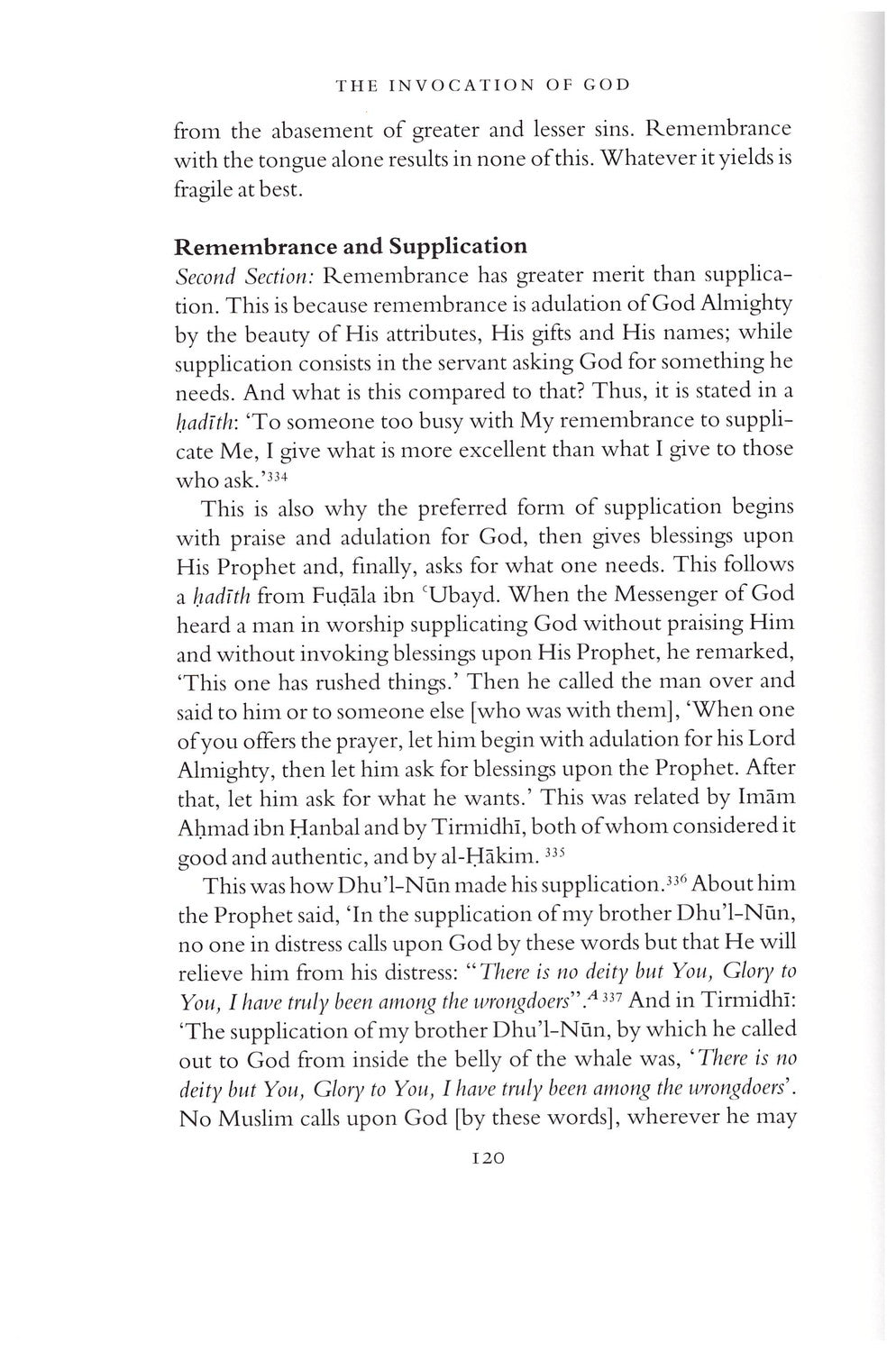
from the abasement of greater and lesser sins. Remembrance with the tongue alone results in none of this. Whatever it yields is fragile at best.
Remembrance and Supplication
Second Section: Remembrance has greater merit than supplica- tion. This is because remembrance is adulation of God Almighty by the beauty of His attributes, His gifts and His names; while supplication consists in the servant asking God for something he needs. And what is this compared to that? Thus, it is stated in a ḥadīth: 'To someone too busy with My remembrance to suppli- cate Me, I give what is more excellent than what I give to those who ask. '334
This is also why the preferred form of supplication begins with praise and adulation for God, then gives blessings upon His Prophet and, finally, asks for what one needs. This follows a ḥadīth from Fuḍāla ibn 'Ubayd. When the Messenger of God heard a man in worship supplicating God without praising Him and without invoking blessings upon His Prophet, he remarked, 'This one has rushed things.' Then he called the man over and said to him or to someone else [who was with them], 'When one of you offers the prayer, let him begin with adulation for his Lord Almighty, then let him ask for blessings upon the Prophet. After that, let him ask for what he wants.' This was related by Imām Aḥmad ibn Hanbal and by Tirmidhi, both of whom considered it good and authentic, and by al-Hakim. 335
This was how Dhu'l-Nun made his supplication.336 About him the Prophet said, 'In the supplication of my brother Dhu'l-Nūn, no one in distress calls upon God by these words but that He will relieve him from his distress: "There is no deity but You, Glory to You, I have truly been among the wrongdoers" A 337 And in Tirmidhi: 'The supplication of my brother Dhu'l-Nun, by which he called out to God from inside the belly of the whale was, 'There is no deity but You, Glory to You, I have truly been among the wrongdoers'. No Muslim calls upon God [by these words], wherever he may
Publisher
Islamic Texts Society
Author
- Ibn Qayyim al-Jawziyya
Shipping and Delivery
We dispatch orders directly from our UK and USA warehouses, offering multiple shipping options to suit your needs. We proudly ship worldwide.
UK Deliveries (from UK warehouse):
Standard shipping typically arrives within 3–4 working days. Expedited delivery takes 2–3 working days. We aim to dispatch orders the same day or next working day, with next-day delivery options available where applicable.
USA Deliveries (from USA warehouse):
Orders usually arrive within 4–7 working days.
Europe (shipped from UK):
Standard delivery takes approximately 6–10 working days, with expedited services available in 3–5 working days.
Canada:
Estimated delivery time is 5–10 working days.
Worldwide Shipping:
International orders generally arrive within 5–20 working days, depending on destination and shipping method selected.
For precise delivery timelines based on your location, please contact us by email and our team will provide detailed information tailored to your address.
Sample Pages - Content
Page:01
Ibn Qayyim al-Jawziyya
THE INVOCATION OF GOD Al-Wabil al-Sayyib min al-Kalim al-Tayyib
الوابل الصيب مِنَ الكلم الطيب
Translated by
MICHAEL ABDURRAHMAN FITZGERALD
& MOULAY YOUSSEF SLITINE
Page:02
PART TWO
A Commentary on the Hadith of al-Harith al-Ash'ari
Now, during this brief sojourn, God Almighty endows His ser- vant with power, armour and helpers. He makes clear to him how he may protect himself from his Foe or free himself if taken captive. Imam Ahmad ibn Hanbal and Tirmidhi have narrated a ḥadīth from al-Harith al-Ash'arī that the Prophet said:
'Verily, God, Glorified and Exalted, commanded John [Yahya] Son of Zakariya with five words to act upon and to enjoin upon the Children of Israel; but he put it off. Then Jesus [Isā], may God grant him peace, said to him, "God, Most High, has commanded you with five words to act upon and to enjoin upon the Children of Israel. Either you command them, or I shall." To this John replied, "I fear that if you precede me, I shall be swallowed up by the earth and be punished."
He gathered the people together in Jerusalem and they filled the mosque. He sat at the top of a wall and said: "Verily, God, Blessed and Exalted, has commanded me with five words to act upon and to call on you to act upon it. The first of them is that you worship God and associate none with Him. For verily, the one who associates partners with God is like the man who buys a serv- ant with his own wealth, be it gold or silver, and says to him, 'This is my house and this is the work I have for you. So do it and render to me its fruits.' But the servant does it and renders the fruits to another. Which of you would be pleased with such a servant? [Second,] He enjoins prayer upon you. When you pray, do
Page:03
THE INVOCATION OF GOD
from the abasement of greater and lesser sins. Remembrance with the tongue alone results in none of this. Whatever it yields is fragile at best.
Remembrance and Supplication
Second Section: Remembrance has greater merit than supplica- tion. This is because remembrance is adulation of God Almighty by the beauty of His attributes, His gifts and His names; while supplication consists in the servant asking God for something he needs. And what is this compared to that? Thus, it is stated in a ḥadīth: 'To someone too busy with My remembrance to suppli- cate Me, I give what is more excellent than what I give to those who ask. '334
This is also why the preferred form of supplication begins with praise and adulation for God, then gives blessings upon His Prophet and, finally, asks for what one needs. This follows a ḥadīth from Fuḍāla ibn 'Ubayd. When the Messenger of God heard a man in worship supplicating God without praising Him and without invoking blessings upon His Prophet, he remarked, 'This one has rushed things.' Then he called the man over and said to him or to someone else [who was with them], 'When one of you offers the prayer, let him begin with adulation for his Lord Almighty, then let him ask for blessings upon the Prophet. After that, let him ask for what he wants.' This was related by Imām Aḥmad ibn Hanbal and by Tirmidhi, both of whom considered it good and authentic, and by al-Hakim. 335
This was how Dhu'l-Nun made his supplication.336 About him the Prophet said, 'In the supplication of my brother Dhu'l-Nūn, no one in distress calls upon God by these words but that He will relieve him from his distress: "There is no deity but You, Glory to You, I have truly been among the wrongdoers" A 337 And in Tirmidhi: 'The supplication of my brother Dhu'l-Nun, by which he called out to God from inside the belly of the whale was, 'There is no deity but You, Glory to You, I have truly been among the wrongdoers'. No Muslim calls upon God [by these words], wherever he may
Who is Ibn Qayyim Al - Jawziyyah?
Ibn Qayyim al-Jawziyyah , whose full name is Muhammad ibn Abi Bakr ibn Ayyub ibn Sa'd al-Zarʿi al-Dimashqi, was a renowned 14th-century Islamic scholar, jurist, theologian, and spiritual guide from Damascus. He is best known for his close association with Ibn Taymiyyah, under whom he studied and whose reformist ideas he supported and developed further.