


First Steps to Understanding Arabic | Beginner's Guide to Learning Arabic
First Steps to Understanding Arabic | Beginner's Guide to Learning Arabic
Publisher:
Al-Qalam Publications
Author:
Hashim Mohamed
Language:
English
Binding:
Soft Cover
Pages: 605
Size: 14x26 cm
Couldn't load pickup availability


Collapsible content
Description of islamic Book
First Steps to Understanding Arabic is an accessible and practical introduction to the Arabic language, created specifically for beginners who wish to develop a strong linguistic foundation. Whether your goal is to understand the Qur'an, enhance Islamic studies, or simply learn one of the world's most influential languages, this book offers a structured pathway to success.
The book introduces learners to essential Arabic vocabulary, sentence structures, pronunciation principles, and fundamental grammar rules. Lessons are presented in a clear and organized format, making complex language concepts easier to understand and apply. Step-by-step explanations help students gradually build their reading and comprehension skills while reinforcing previously learned material.
From Author:
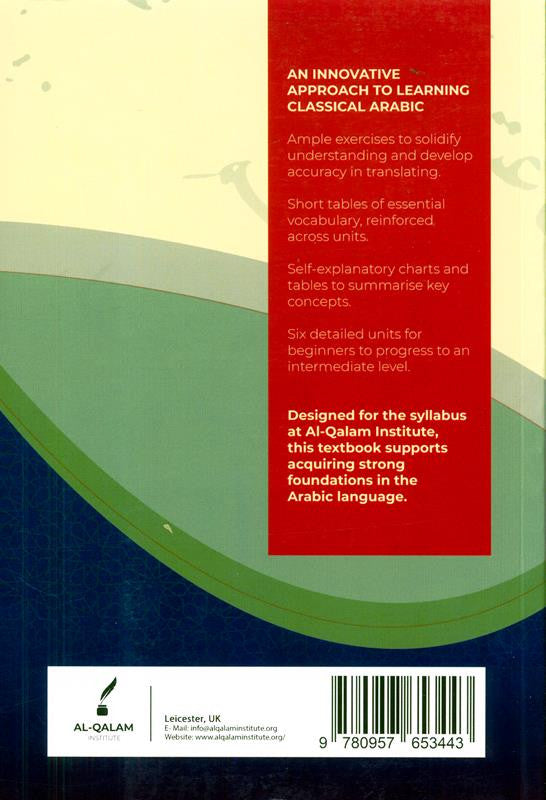
AN INNOVATIVE
APROACH TO LEARNING
CLASSICAL ARABIC
Ample exercises to solidify understanding and develop accuracy in translating.
Short tables of essential vocabulary, reinforced across units.
Self explanatory charts and tables to summarise key concepts.
Six detailed units for beginners to progress to an intermediate level.
Designed for the syllabus at Al-Qalam Institute, this textbook supports acquiring strong foundations in the Arabic language.
Content:
Build a Strong Foundation in Classical Arabic
Mastering Classical Arabic becomes easier with a structured approach that takes you step by step from basic words to sentence construction. Al-Qalam Institute’s Arabic textbook is designed especially for beginners who want to develop a strong and practical foundation in the Arabic language and gradually progress toward an intermediate level.
What You’ll Learn
The book introduces the essential building blocks of Arabic grammar in a clear and organized way, including:
Nouns (الأسماء): Learn definite and indefinite nouns, gender, number, and I‘rab.
Verbs (الأفعال): Understand tense, I‘rab, affirmative and negative forms, gender, and voice.
Particles (الحروف): Explore I‘rab and governance.
Masdar (المصدر): Develop a better understanding of Arabic word formation.
Adjectives: Learn how adjectives function and agree with nouns.
Sentences: Progress from individual words to understanding Arabic sentence structures, including الجملة الاسمية.
Learn Through Practice
The textbook includes ample exercises to strengthen understanding and improve accuracy in translation. Essential vocabulary is reinforced through short, practical tables, helping students gradually expand their Arabic word bank.
Clear Charts & Summaries
Self-explanatory charts and tables make complex grammatical concepts easier to understand and remember. Each unit is organized to help learners review important rules and concepts efficiently.
From Beginner to Intermediate
With six detailed units, this textbook provides a progressive learning journey for students starting with the fundamentals and moving toward an intermediate level of Classical Arabic.
Why Choose This Book?
Beginner-friendly and systematically organized
Focuses on Classical Arabic grammar
Includes exercises for practical learning
Uses clear charts and tables for easy revision
Builds vocabulary throughout the course
Covers essential Arabic grammatical concepts
Designed according to the Al-Qalam Institute syllabus
Suitable for students seeking a strong foundation in Arabic
Start Your Classical Arabic Journey
Whether you are beginning your study of Arabic or looking to strengthen your grammatical foundation, this book provides a structured and engaging pathway to understanding the language. Learn the essential rules, practice your skills, expand your vocabulary, and progress confidently toward reading and understanding Classical Arabic.
Page:01
Contents
Contents
Foreward.
UNIT 1.
Introduction: Words.
Part 1: Nouns
Characteristic 1: Definite and Indefinite.
Characteristic 2: Gender.
Characteristic 3: Number
Characteristic 4: Irab......
Part 2: Verbs
Characteristic 1: Tense
Characteristic 2: Irab.
Characteristic 3: Affirmative - Negative
Characteristic 4: Gender
Characteristic 5: Voice
Part 3: Particle.
Characteristic 1: Irab.
Characteristic 2: Governance.
Supplement
. مصدر
Adjectives
Summary.....
Key Terms
Vocabulary.
UNIT 2 Section 1.
Introduction: Sentences..
........... الْجُمْلَةُ الاسْمِيَّةُ :1 Part
Page:02
Part 1: Nouns
Nouns have four important characteristics. These are:
1. Definite - Indefinite
2. Gender
3. Number
4. I'rab
DING is a mnemonic for remembering these characteristics.
Definite
Definite - Indefinite
I 'rab Number
Gender
Characteristic 1: Definite and Indefinite
A definite noun is either:
1. A proper noun (name) e.g. Muhammad. 2. A noun with the before it e.g. the pen.
The Ji at the beginning of an Arabic noun is equivalent to the word the in English.
In Arabic, a definite noun is called.
الرَّسُوْلُ
the messenger
محمد
Muhammad
Adding Ji to a Noun
When Ji is added to a noun, sometimes the is pronounced, and
sometimes it is not.
الرَّجُلُ
الْمَاءُ
حُرُوفٌ قَمَرِيَّةٌ The letters before which the is pronounced are called
moon letters; letters which resemble the moon. Just as other stars
are seen next to the moon, the is pronounced next to these letters.
The letters before which the is not pronounced are called
, sun letters; letters which resemble the sun. Just as other stars are not seen next to the sun, the Y is not pronounced next
Page:03
AL-QALAM INSTITUTE
AN INNOVATIVE
APPROACH TO LEARNING CLASSICAL ARABIC
Ample exercises to solidify understanding and develop accuracy in translating.
Short tables of essential vocabulary, reinforced. across units.
Self-explanatory charts and tables to summarise key concepts.
Six detailed units for
beginners to progress to an intermediate level.
Designed for the syllabus at Al-Qalam Institute, this textbook supports acquiring strong foundations in the Arabic language.
Publisher
Al-Qalam Publications
Author
- Hashim Mohamed
Shipping and Delivery
We dispatch orders directly from our UK and USA warehouses, offering multiple shipping options to suit your needs. We proudly ship worldwide.
UK Deliveries (from UK warehouse):
Standard shipping typically arrives within 3–4 working days. Expedited delivery takes 2–3 working days. We aim to dispatch orders the same day or next working day, with next-day delivery options available where applicable.
USA Deliveries (from USA warehouse):
Orders usually arrive within 4–7 working days.
Europe (shipped from UK):
Standard delivery takes approximately 6–10 working days, with expedited services available in 3–5 working days.
Canada:
Estimated delivery time is 5–10 working days.
Worldwide Shipping:
International orders generally arrive within 5–20 working days, depending on destination and shipping method selected.
For precise delivery timelines based on your location, please contact us by email and our team will provide detailed information tailored to your address.
Sample Pages - Content
Page:01
Contents
Contents
Foreward.
UNIT 1.
Introduction: Words.
Part 1: Nouns
Characteristic 1: Definite and Indefinite.
Characteristic 2: Gender.
Characteristic 3: Number
Characteristic 4: Irab......
Part 2: Verbs
Characteristic 1: Tense
Characteristic 2: Irab.
Characteristic 3: Affirmative - Negative
Characteristic 4: Gender
Characteristic 5: Voice
Part 3: Particle.
Characteristic 1: Irab.
Characteristic 2: Governance.
Supplement
. مصدر
Adjectives
Summary.....
Key Terms
Vocabulary.
UNIT 2 Section 1.
Introduction: Sentences..
........... الْجُمْلَةُ الاسْمِيَّةُ :1 Part
Page:02
Part 1: Nouns
Nouns have four important characteristics. These are:
1. Definite - Indefinite
2. Gender
3. Number
4. I'rab
DING is a mnemonic for remembering these characteristics.
Definite
Definite - Indefinite
I 'rab Number
Gender
Characteristic 1: Definite and Indefinite
A definite noun is either:
1. A proper noun (name) e.g. Muhammad. 2. A noun with the before it e.g. the pen.
The Ji at the beginning of an Arabic noun is equivalent to the word the in English.
In Arabic, a definite noun is called.
الرَّسُوْلُ
the messenger
محمد
Muhammad
Adding Ji to a Noun
When Ji is added to a noun, sometimes the is pronounced, and
sometimes it is not.
الرَّجُلُ
الْمَاءُ
حُرُوفٌ قَمَرِيَّةٌ The letters before which the is pronounced are called
moon letters; letters which resemble the moon. Just as other stars
are seen next to the moon, the is pronounced next to these letters.
The letters before which the is not pronounced are called
, sun letters; letters which resemble the sun. Just as other stars are not seen next to the sun, the Y is not pronounced next
Page:03
AL-QALAM INSTITUTE
AN INNOVATIVE
APPROACH TO LEARNING CLASSICAL ARABIC
Ample exercises to solidify understanding and develop accuracy in translating.
Short tables of essential vocabulary, reinforced. across units.
Self-explanatory charts and tables to summarise key concepts.
Six detailed units for
beginners to progress to an intermediate level.
Designed for the syllabus at Al-Qalam Institute, this textbook supports acquiring strong foundations in the Arabic language.
Who is Hashim Mohamed?
Hashim Mohamed is an author known for his innovative approach to teaching Arabic grammar and morphology to English-speaking learners. In First Steps to Understanding Sarf, he combines pedagogical clarity with practical exercises to demystify the science of ṣarf, helping students transition from novice to confident readers of classical Arabic. His structured, example-based approach makes this book a valuable resource for beginners and intermediate learners alike.