


Fiqh of Menstruation Simplified: Beginner's Guide for Muslim Women (Hanafi Fiqh)
Fiqh of Menstruation Simplified: Beginner's Guide for Muslim Women (Hanafi Fiqh)
Publisher:
Inspired Muslim Women
Author:
Naielah Ackbarali
Language:
English
Binding:
Paper back
Pages: 92
Size: 6 × 9 in15x22cm
Couldn't load pickup availability


Collapsible content
Description of islamic Book
Fiqh of Menstruation Simplified: Beginner's Guide for Muslim Women (Hanafi Fiqh)
Fiqh of Menstruation Simplified: A Beginner's Guide for Muslim Women is an accessible introduction to the Islamic rulings related to menstruation (hayd), postnatal bleeding (nifas), and abnormal bleeding (istihadah). Written by Naielah Ackbarali, this concise guide presents essential Hanafi fiqh rulings in an easy-to-understand format suitable for beginners, converts, teenagers, and Islamic school students. The book includes practical examples, diagrams, summary charts, frequently asked questions, and key-point icons to help readers confidently apply these rulings in daily life. Enriched with inspirational Islamic content and stories from the female Companions, it serves as a valuable resource for Muslim women seeking clarity regarding worship, purification, fasting, and prayer during menstruation.
From Author:
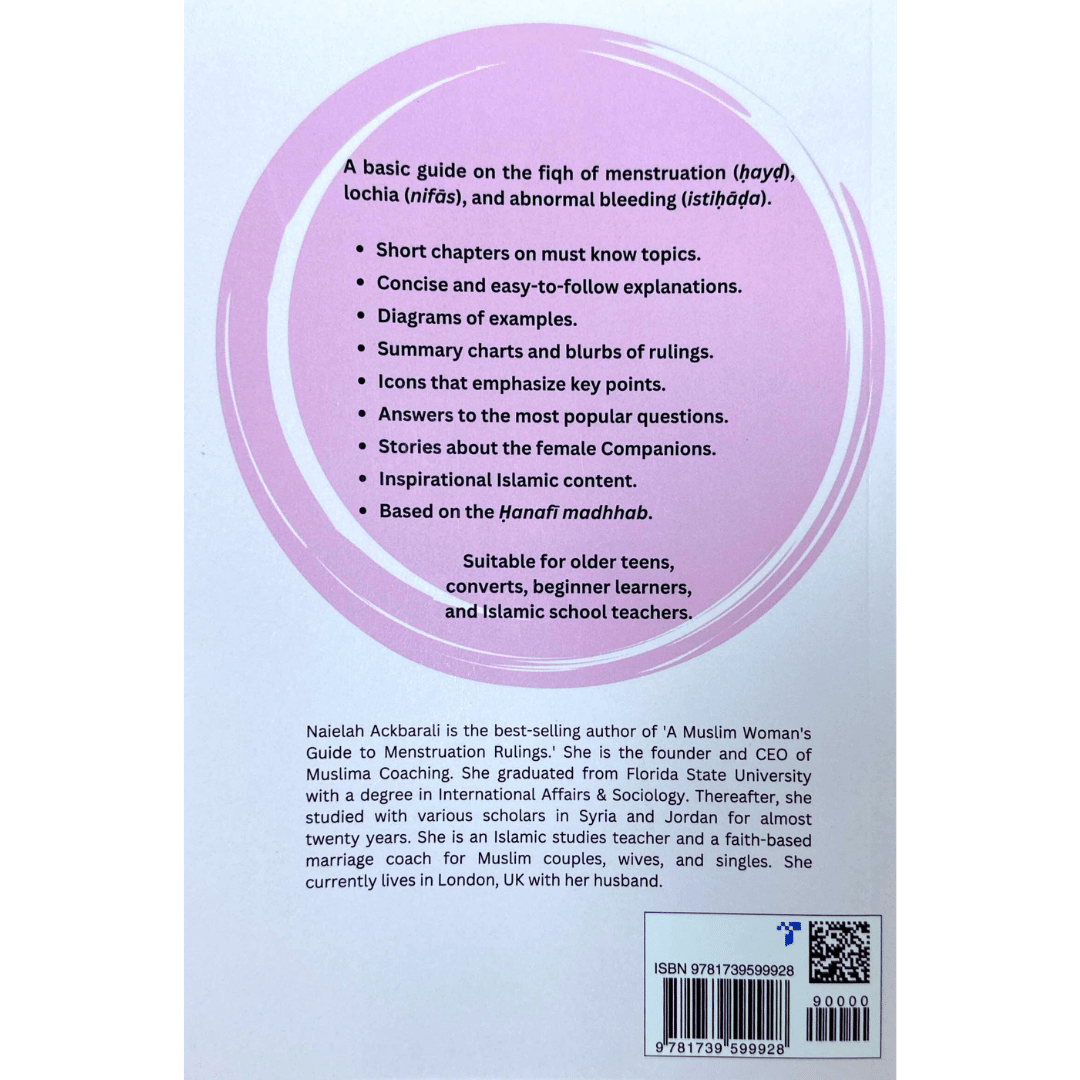
A basic guide on the fiqh of menstruation (hayd), lochia (nifas), and abnormal bleeding (istihada).
-Short chapters on must know topics.
-Concise and easy-to-follow explanations.
-Diagrams of examples.
-Summary charts and blurbs of rulings.
-Icons that emphasize key points.
-Answers to the most popular questions.
-Stories about the female Companions.
-Inspirational Islamic content.
-Based on the Ḥanafī madhhab.
Suitable for older teens, converts, beginner learners, and Islamic school teachers.
Content:
1. Understanding Menstruation in Islam
Introduction to the Islamic perspective on menstruation.
The wisdom and purpose behind menstruation.
Real-life examples to simplify complex rulings.
2. Menstruation Made Easy
Simplified explanation of menstrual rulings.
Understanding minimum and maximum menstrual durations.
Determining valid menstrual and purity periods.
Recognizing different types of bleeding.
3. Knowing Your Body
Female anatomy explained in an educational and respectful manner.
Understanding menstrual cycles and bodily changes.
Guidance for recording and tracking bleeding patterns.
4. Ritual Purity and Worship
Detailed explanation of ritual purity (ṭahārah).
Difference between ritual purity and physical cleanliness.
Understanding major and minor ritual impurity.
5. Complete Guide to Ghusl
Step-by-step explanation of the obligatory ghusl.
Requirements for a valid ghusl.
Common mistakes and practical considerations.
Purification after menstruation and lochia.
6. Abnormal Bleeding and Women's Health
Explanation of abnormal bleeding (istiḥāḍa).
How to determine prayer and fasting obligations.
Establishing habits and managing irregular cycles.
7. Pregnancy and Lochia
Islamic rulings related to pregnancy.
Simplified discussion of postnatal bleeding (nifās).
Guidance for worship during maternity-related bleeding.
8. Menopause and Later Life
Understanding menstruation after age fifty.
Menopause-related rulings explained.
Practical examples and case studies.
9. Hajj, Fasting, and Prayer Issues
Menstruation during Ramadan.
Making up missed fasts.
Hajj rulings for menstruating women.
Prayer obligations during menstruation and abnormal bleeding.
10. Frequently Asked Questions
The book answers many common questions, including:
What if I never recorded my bleeding?
Which forms of intimacy are permitted during menstruation?
Can I touch a translation of the Qur'an?
Can I use a Qur'an app while not in a state of purity?
Does vaginal discharge affect wudu?
Why must missed Ramadan fasts be made up but not prayers?
Page:01
ENGLISH TRANSLATION
Allah bless him and give him peace. Peace be upon him.
May Allah be pleased with her.
radiya 'Llahu 'anhum radiya Llahu 'anhã radiya 'Llahu 'anhu
May Allah be pleased with them.
May Allah be pleased with him.
Getting Started
Introduction
The Islamic Perspective
1. Aisha's Hajj
2. The Right Mindset
3. Prohibitions & Permissions
4. Female Anatomy
Menstruation Made Easy
5. Menses Simplified
6. Possible Days Of Menses
7. The Kursuf
8. Knowing Your Body Ritual Purity
9. The Ghusl
10. The Ghusl Time
11. Sound Purity Simplified
12. Abnormal Bleeding
13. Praying While Bleeding Maternity Matters
14. Pregnancy
15. Lochia Simplified
Concluding Topics
16. Menopause
17. Popular Questions
Page:02
Q1: What if I never recorded my bleeding?
Q2: Which types of touching are allowed between spouses during menses and lochia?
Q3: Can I touch a translation of the Qur'an?
Introduction
Q4: Can I touch my phone when a Qur'an app is open?
Q5: Can I recite the Qur'an for tajwid classes?
Q6: Does arousal fluid break wudu?
Q7: Is green discharge a color of blood?
Q8: Is yellow discharge a color of blood?
Q9: Does normal vaginal discharge break wudu?
Q10: Do I continue to fast during Ramaḍān if my menses starts while I am fasting?
"Indeed, We created humans in the best form." (at-Tin, 95:4)
Q11: Why do I make up the fasts missed for Ramaḍān and not my obligatory prayers?
Q12: Which hajj rites can a menstruating woman perform?
Q13: What if my bleeding starts before 15 days (360 hours) of purity is reached?
Q14: What is the ruling for blood after a miscarriage? 83 Q15: Why am I experiencing abnormal bleeding?
Appendix
About The Author
Recommended Readings
Bibliography
Allah Most High is the best of Creators. He fashioned women to menstruate, and through this blessing they can possibly give birth to children and be honored with continuing the lifeline of this ummah. The journey of menstruation itself is a progression of physical stages that facilitate the noble act of childbearing.
When a woman first reaches puberty, menstrual blood makes an abrupt entrance into her life. A young girl could be met with the challenges of hormonal fluctuations and physical development. She may experience tiredness, mood swings, headaches, and pelvic pain - possibly as a preparation for the road of responsibility that lies ahead.
As she enters the childbearing years of her twenties and thirties, her cycles may become more regular and routine, or they may never settle into an expected pattern, which can present challenges for some.
Once she approaches her forties and fifties, her body will undergo another stage of transformation as she welcomes the end of her period woes with menopause.
A woman's aging process is like a blossoming flower. She starts as a seed that roots herself into the ground. As time passes, she grows into a stem and begins to bud. Flower petals eventually appear as she matures and blooms, which beautify her unique shape, color,
Page:03
Allah Says...
Today I have perfected your religion for you and have completed My favor upon you and chosen Islam as the way for you.
(al-Ma'ida, 5:3)
Say (O Prophet): "If you really love Allah, then follow me, and Allāh shall love you and forgive your sins. Allah is Most-Forgiving, Most-Merciful.
(Ali Imran, 3:31)
They ask you about menstruation. Say: "It is an impurity. So, keep away from women during menstruation, and do not have intercourse with them until they are purified. When they purify themselves, then you may approach them in the manner specified by Allah. Verily Allah loves those who always turn to Him in repentance and those who purify themselves.
(al-Baqara, 2:222)
1. Aisha's Hajj
It was the tenth year after the hijra, the last year of the Prophet Muḥammad's life. Yet, no one knew that his demise was to come. The Prophet intended to undertake hajj during this year. It
was the only hajj that the Prophet performed after it became compulsory. Less than three months later, he would suddenly fall sick and pass away.
Thousands of the Companions came from various parts of the Arabian Peninsula to complete the hajj with the Prophet. As for his wives, all of them accompanied him to Makkah during his final pilgrimage.
The Prophet and his Companions left Madīna when there were only five days remaining of the month of Dhul Qada. They entered into a state of pilgrim sanctity (iḥrām) just a few miles outside of Madīna at Dhul Hulayfah, which is known as Masjid ash-Shajara in today's times.
The Prophet ordered those with him to intend what they wanted. There are different intentions that a pilgrim can make for hajj. A pilgrim can intend to do hajj only (ifrad), or a hajj and an umra together with the same intention (qiran), or an umra by itself and a hajj by itself (tamattu). The Prophet's beloved wife Lady 'A'isha intended to do the latter type, which is an umra and a hajj with separate intentions.
The Companions were so excited to perform the hajj. They chanted the talbiya throughout their trip down to Makkah. One can only dream of how elated their spirits were and the immense honor that they must have felt to be part of the Prophet's pilgrimage.
Page:04
Figh of Menstruation Simplified
In Diagram 16.1, a woman who has reached menopause at 55 lunar years sees two months free of blood and then she bleeds for four
days.
The blood is red, and it reaches the menstrual minimum of three days (72 hours). It was also preceded by a purity span of at least 15
days (360 hours).
Therefore, the blood is ruled as menstruation, even though she is 55 lunar years old.
Diagram 16.1-Red Blood After 55 Lunar Years
55 LUNAR YEARS
TWO MONTHS OF PURITY BLOOD STARTS MENSES RED
A woman will undergo many physical changes as she continues to age, but her aging should not hold her back from doing what it takes to please Allah Most High. Age is just a number; what matters the most is how much she blossomed in her life for Allah Most High.
Popular Questions
"My Lord! Increase me in knowledge!" (Tāhā, 20:114)
Q1: What if I never recorded my bleeding?
Start now. If you are experiencing abnormal bleeding, then make a reasoned judgement about when you last saw a sound blood and contact a teacher. If this is not possible, you can try taking hormonal medication to regulate your bleeding and establish a habit.
Q2: Which types of touching are allowed between spouses during menses and lochia?
In addition to not having sexual intercourse, it is not permitted for a husband to directly touch the skin between his wife's navel to knees during menstruation or lochia.
It is permitted for her husband to touch the prohibited area over a barrier. For example, the wife places a sheet over this part of her body, or she wears leggings. As for skin-to-skin contact with other areas of her body, such as the chest, back, arms, and calves, it is permissible. So is kissing, hugging, and the like.
Q3: Can I touch a translation of the Qur'an?
It is not permitted to touch a translation of the Qur'an, even if the Arabic script is not contained within it.
Page:05
Purity Defined
RITUAL STATES
Ritual Purity: A state achieved after ablution (wudu), the purificatory shower (ghusl), or dry ablution (tayammum). It
permits a person to pray.
Minor Ritual Impurity: A state that necessitates wudu, like after sleeping, urinating, or flatulence.
◆ Major Ritual Impurity: A state that necessitates a ghusl like after engaging in sexual intercourse or ejaculating (janāba) - as well as women in menstruation and lochia.
PHYSICAL OBJECTS
Pure (tahir): Free from all traces of physical impurity. ◆ Filthy (najis): Soiled with a physical impurity, like blood, urine, feces, semen, and vomit.
FIQH OF MENSTRUATION Purity: The state free of menstruation or lochia.
Sound Purity: A purity span that can be taken as a habit. Unsound Purity: A purity span that cannot be used a habit The Ghusl
"Verily Allah loves those who always turn to Him in repentance and those who purify themselves." (al-Baqara, 2:222)
The obligatory actions of the ghusl are the actions that must be performed for the ghusl to be ruled as valid.
They are to rinse the nose, the mouth, and the entire body with water at least once. Water must reach every part of the outer body that is possible to rinse without undue hardship.
The ghusl is achieved with the use of water. There is no requirement to use soap, shampoo, or conditioner.
During the ghusl a woman must:
Rinse the inside of the nose, the inside of the mouth, and the entire outer body with water at least once.
Ensure that water reaches all of her hair, underneath the skin
of the clitoral hood, the external orifice of the genitals, and the skin underneath the eyebrows.
Wet the inside of the belly button and the inside of any hole that is not sealed, like earring holes.
In the Hanafi madhhab, making the intention to perform the ghusl is not obligatory, but rather it is a sunna action.
Publisher
Inspired Muslim Women
Author
- Naielah Ackbarali
Shipping and Delivery
We dispatch orders directly from our UK and USA warehouses, offering multiple shipping options to suit your needs. We proudly ship worldwide.
UK Deliveries (from UK warehouse):
Standard shipping typically arrives within 3–4 working days. Expedited delivery takes 2–3 working days. We aim to dispatch orders the same day or next working day, with next-day delivery options available where applicable.
USA Deliveries (from USA warehouse):
Orders usually arrive within 4–7 working days.
Europe (shipped from UK):
Standard delivery takes approximately 6–10 working days, with expedited services available in 3–5 working days.
Canada:
Estimated delivery time is 5–10 working days.
Worldwide Shipping:
International orders generally arrive within 5–20 working days, depending on destination and shipping method selected.
For precise delivery timelines based on your location, please contact us by email and our team will provide detailed information tailored to your address.
Sample Pages - Content
Page:01
ENGLISH TRANSLATION
Allah bless him and give him peace. Peace be upon him.
May Allah be pleased with her.
radiya 'Llahu 'anhum radiya Llahu 'anhã radiya 'Llahu 'anhu
May Allah be pleased with them.
May Allah be pleased with him.
Getting Started
Introduction
The Islamic Perspective
1. Aisha's Hajj
2. The Right Mindset
3. Prohibitions & Permissions
4. Female Anatomy
Menstruation Made Easy
5. Menses Simplified
6. Possible Days Of Menses
7. The Kursuf
8. Knowing Your Body Ritual Purity
9. The Ghusl
10. The Ghusl Time
11. Sound Purity Simplified
12. Abnormal Bleeding
13. Praying While Bleeding Maternity Matters
14. Pregnancy
15. Lochia Simplified
Concluding Topics
16. Menopause
17. Popular Questions
Page:02
Q1: What if I never recorded my bleeding?
Q2: Which types of touching are allowed between spouses during menses and lochia?
Q3: Can I touch a translation of the Qur'an?
Introduction
Q4: Can I touch my phone when a Qur'an app is open?
Q5: Can I recite the Qur'an for tajwid classes?
Q6: Does arousal fluid break wudu?
Q7: Is green discharge a color of blood?
Q8: Is yellow discharge a color of blood?
Q9: Does normal vaginal discharge break wudu?
Q10: Do I continue to fast during Ramaḍān if my menses starts while I am fasting?
"Indeed, We created humans in the best form." (at-Tin, 95:4)
Q11: Why do I make up the fasts missed for Ramaḍān and not my obligatory prayers?
Q12: Which hajj rites can a menstruating woman perform?
Q13: What if my bleeding starts before 15 days (360 hours) of purity is reached?
Q14: What is the ruling for blood after a miscarriage? 83 Q15: Why am I experiencing abnormal bleeding?
Appendix
About The Author
Recommended Readings
Bibliography
Allah Most High is the best of Creators. He fashioned women to menstruate, and through this blessing they can possibly give birth to children and be honored with continuing the lifeline of this ummah. The journey of menstruation itself is a progression of physical stages that facilitate the noble act of childbearing.
When a woman first reaches puberty, menstrual blood makes an abrupt entrance into her life. A young girl could be met with the challenges of hormonal fluctuations and physical development. She may experience tiredness, mood swings, headaches, and pelvic pain - possibly as a preparation for the road of responsibility that lies ahead.
As she enters the childbearing years of her twenties and thirties, her cycles may become more regular and routine, or they may never settle into an expected pattern, which can present challenges for some.
Once she approaches her forties and fifties, her body will undergo another stage of transformation as she welcomes the end of her period woes with menopause.
A woman's aging process is like a blossoming flower. She starts as a seed that roots herself into the ground. As time passes, she grows into a stem and begins to bud. Flower petals eventually appear as she matures and blooms, which beautify her unique shape, color,
Page:03
Allah Says...
Today I have perfected your religion for you and have completed My favor upon you and chosen Islam as the way for you.
(al-Ma'ida, 5:3)
Say (O Prophet): "If you really love Allah, then follow me, and Allāh shall love you and forgive your sins. Allah is Most-Forgiving, Most-Merciful.
(Ali Imran, 3:31)
They ask you about menstruation. Say: "It is an impurity. So, keep away from women during menstruation, and do not have intercourse with them until they are purified. When they purify themselves, then you may approach them in the manner specified by Allah. Verily Allah loves those who always turn to Him in repentance and those who purify themselves.
(al-Baqara, 2:222)
1. Aisha's Hajj
It was the tenth year after the hijra, the last year of the Prophet Muḥammad's life. Yet, no one knew that his demise was to come. The Prophet intended to undertake hajj during this year. It
was the only hajj that the Prophet performed after it became compulsory. Less than three months later, he would suddenly fall sick and pass away.
Thousands of the Companions came from various parts of the Arabian Peninsula to complete the hajj with the Prophet. As for his wives, all of them accompanied him to Makkah during his final pilgrimage.
The Prophet and his Companions left Madīna when there were only five days remaining of the month of Dhul Qada. They entered into a state of pilgrim sanctity (iḥrām) just a few miles outside of Madīna at Dhul Hulayfah, which is known as Masjid ash-Shajara in today's times.
The Prophet ordered those with him to intend what they wanted. There are different intentions that a pilgrim can make for hajj. A pilgrim can intend to do hajj only (ifrad), or a hajj and an umra together with the same intention (qiran), or an umra by itself and a hajj by itself (tamattu). The Prophet's beloved wife Lady 'A'isha intended to do the latter type, which is an umra and a hajj with separate intentions.
The Companions were so excited to perform the hajj. They chanted the talbiya throughout their trip down to Makkah. One can only dream of how elated their spirits were and the immense honor that they must have felt to be part of the Prophet's pilgrimage.
Page:04
Figh of Menstruation Simplified
In Diagram 16.1, a woman who has reached menopause at 55 lunar years sees two months free of blood and then she bleeds for four
days.
The blood is red, and it reaches the menstrual minimum of three days (72 hours). It was also preceded by a purity span of at least 15
days (360 hours).
Therefore, the blood is ruled as menstruation, even though she is 55 lunar years old.
Diagram 16.1-Red Blood After 55 Lunar Years
55 LUNAR YEARS
TWO MONTHS OF PURITY BLOOD STARTS MENSES RED
A woman will undergo many physical changes as she continues to age, but her aging should not hold her back from doing what it takes to please Allah Most High. Age is just a number; what matters the most is how much she blossomed in her life for Allah Most High.
Popular Questions
"My Lord! Increase me in knowledge!" (Tāhā, 20:114)
Q1: What if I never recorded my bleeding?
Start now. If you are experiencing abnormal bleeding, then make a reasoned judgement about when you last saw a sound blood and contact a teacher. If this is not possible, you can try taking hormonal medication to regulate your bleeding and establish a habit.
Q2: Which types of touching are allowed between spouses during menses and lochia?
In addition to not having sexual intercourse, it is not permitted for a husband to directly touch the skin between his wife's navel to knees during menstruation or lochia.
It is permitted for her husband to touch the prohibited area over a barrier. For example, the wife places a sheet over this part of her body, or she wears leggings. As for skin-to-skin contact with other areas of her body, such as the chest, back, arms, and calves, it is permissible. So is kissing, hugging, and the like.
Q3: Can I touch a translation of the Qur'an?
It is not permitted to touch a translation of the Qur'an, even if the Arabic script is not contained within it.
Page:05
Purity Defined
RITUAL STATES
Ritual Purity: A state achieved after ablution (wudu), the purificatory shower (ghusl), or dry ablution (tayammum). It
permits a person to pray.
Minor Ritual Impurity: A state that necessitates wudu, like after sleeping, urinating, or flatulence.
◆ Major Ritual Impurity: A state that necessitates a ghusl like after engaging in sexual intercourse or ejaculating (janāba) - as well as women in menstruation and lochia.
PHYSICAL OBJECTS
Pure (tahir): Free from all traces of physical impurity. ◆ Filthy (najis): Soiled with a physical impurity, like blood, urine, feces, semen, and vomit.
FIQH OF MENSTRUATION Purity: The state free of menstruation or lochia.
Sound Purity: A purity span that can be taken as a habit. Unsound Purity: A purity span that cannot be used a habit The Ghusl
"Verily Allah loves those who always turn to Him in repentance and those who purify themselves." (al-Baqara, 2:222)
The obligatory actions of the ghusl are the actions that must be performed for the ghusl to be ruled as valid.
They are to rinse the nose, the mouth, and the entire body with water at least once. Water must reach every part of the outer body that is possible to rinse without undue hardship.
The ghusl is achieved with the use of water. There is no requirement to use soap, shampoo, or conditioner.
During the ghusl a woman must:
Rinse the inside of the nose, the inside of the mouth, and the entire outer body with water at least once.
Ensure that water reaches all of her hair, underneath the skin
of the clitoral hood, the external orifice of the genitals, and the skin underneath the eyebrows.
Wet the inside of the belly button and the inside of any hole that is not sealed, like earring holes.
In the Hanafi madhhab, making the intention to perform the ghusl is not obligatory, but rather it is a sunna action.
Who is Naielah Ackbarali?
Naielah Ackbarali is an Islamic studies teacher, author, certified life coach, marriage counselor, and founder of Muslima Coaching. Born in Trinidad and raised in South Florida, she graduated from Florida State University with a double major in International Affairs and Sociology. She later pursued extensive Islamic studies in Jordan and Syria, specializing in subjects such as fiqh, hadith, aqidah, and women's issues. to Menstruation Rulings*, Blossom: A Muslim Girl's Puberty Guide, Ramadan Ready, and Secrets of Successful Muslim Couples.