


Encounters with Muslim Nomads by Luqman Nagy | The Wandering People
Encounters with Muslim Nomads by Luqman Nagy | The Wandering People
Publisher:
Ta Ha Publisher
Author:
Luqman Nagy
Language:
English
Binding:
Soft Cover
Pages: 160
Size: 25x23x1cm
Couldn't load pickup availability



Collapsible content
Description of islamic Book
Encounters with Muslim Nomads by Luqman Nagy | The Wandering People
Encounters with Muslim Nomads: The Wandering People Who Shaped the Islamic World by Luqman Nagy is a captivating exploration of the rich heritage and enduring traditions of Muslim nomadic communities. Drawing from decades of travel and firsthand experience, Nagy takes readers across the mountains of Central Asia, the deserts of North Africa, and remote regions of the Islamic world to meet resilient and faithful nomadic peoples. Enhanced with hand-drawn illustrations and insightful reflections, the book highlights the values, environmental wisdom, hospitality, and spiritual strength of these communities. Combining travel writing, Islamic culture, and historical insight, this beautifully presented work offers readers a deeper appreciation of Muslim civilizations and traditional ways of life. Published by Ta-Ha Publishers, it is ideal for readers interested in Islamic history, anthropology, and cultural studies.
From Author:
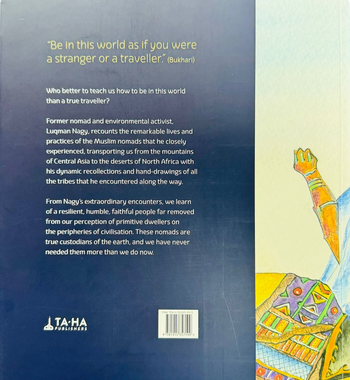
"Be in this world as if you were a stranger or a traveller." (Bukhari) Who better to teach us how to be in this world than a true traveller? Former nomad and environmental activist, Luqman Nagy, recounts the remarkable lives and practices of the Muslim nomads that he closely experienced, transporting us from the mountains of Central Asia to the deserts of North Africa with his dynamic recollections and hand-drawings of all the tribes that he encountered along the way. From Nagy's extraordinary encounters, we learn of a resilient, humble, faithful people far removed from our perception of primitive dwellers on the peripheries of civilisation. These nomads are true custodians of the earth, and we have never needed them more than we do now.
Content:
What the Book Covers
- The history and lifestyle of Muslim nomadic tribes
- The Berbers (Amazigh) of North Africa and the Atlas Mountains
- The Yörük nomads of Türkiye and their Central Asian roots
- Migration routes, tribal customs, and pastoral traditions
- The cultural and linguistic heritage of nomadic Muslim communities
- The impact of colonialism and modernization on traditional nomadic life
Key Features - Rich historical and cultural insights
- Beautifully written and illustrated by the author
- Explains the origins and identities of different nomadic groups
- Highlights Islamic heritage across Africa, the Middle East, and Central Asia
- Educational and engaging for readers interested in history, geography, and culture
Why Read This Book?
This book offers a unique journey into the lives of Muslim nomads whose traditions, resilience, and movements influenced the Islamic world for centuries. It helps readers appreciate the diversity of Muslim cultures and understand how nomadic societies preserved faith, language, and heritage despite changing times.
Page:01
ENCOUNTERS WITH
MUSLIM NOMADS
The Wandering
People who have Shaped the Islamic World
Written and Illustrated by
Luqman Nagy
Page:02
The French colonised North Africa (the 'Arab West') in the nineteenth century - Algeria in 1830, Tunisia in 1881, and Morocco in 1912. They theorised that, in the past, Morocco consisted of two distinct regions: the lands of state treasury, bled al-makhzan, and the lands of dissidence, bled al-siba.
Page:03
30 ENCOUNTERS WITH MUSLIM NOMADS
Berber nomads call themselves Amazight, or 'free or noble men'. Unfortunately, they are known inthe West as Berbers, an offensive term originating in ancient times. The Ancient Greeks referred to all people not able to understand their language as barbaroi, or 'barbarians. The Ancient Romans, not unlike the Greeks, used the term 'Berber' (from the Latin barbarus) to denote the incomprehensible foreign tribes they found inhabiting North Africa.
Throughout their long history, the Berbers were never a unified people. Today, approximately 25 million Berbers inhabit a broad swath of territory comprising many North African and Sahelian nations. They can be found living along the Atlantic coast of Morocco, and as far east as the Siwa Oasis in western Egypt and from the banks of the Mediterranean Sea to the Niger River.
The Berbers, who account for sixty percent of Morocco's population, speak Tamazight (+oCoX4+) a very ancient language, which employs the equally ancient and unique Tifinagh script, derived from a Berber writing system in use for two millennia. A modified version of this ancient script is now employed in Moroccan elementary schools in teaching the Berber language, which became a mandatory subject in 2001.
A century ago the majority of Moroccan Berbers lived a rural semi-nomadic existence, making their semi-annual trek from the desert plains and mountain slopes to the grazing areas of the Middle and High Atlas Mountains. Today, the actual number of families making these migrations has fallen drastically. In 1988, for example, while several hundred families migrated, today only a dozen or so continue this tradition. The migration route is not a haphazard one. To reach the grazing pastures, the nomads ply the same welltrodden sheep paths their ancestors have used for generations.
1 These countries are Morocco, Algeria, Tunisia, Libya, Egypt, Niger, Mali, Mauritania, and Burkina Faso
2 Southam, Morocco's Last Berbers on their 4,000-year-old Annual Migration- a Tradition that is now
under Threat
Berbers of the Atlas Mountains 31
When temperatures start to rise in spring, the Berber nomads proceed to migrate from the Saharan lowlands to the cooler, higher elevations of the Atlas Mountains where they erect their camel-hair tents.
Page:04
YÖRÜKLER OF THE TAURUS MOUNTAINS
The pastoral nomads of Türkiye, the Yörükler, are thought to have originally migrated westward from Central Asia in the eleventh century. They first entered Anatolia (the highlands of central Türkiye) with the waves of Seljuq migrants immediately after the Battle of Malazgirt
1 The term derives from the Turkish verb yürümek (to walk'), Yörükler, therefore, means those: who walk, ie, the walkers' or 'wanderers'
2 The decisive battle took place on August 26, 1071 on the plains of Malazgirt in eastern Türkiye The Turkish Seljuq army led by Alp Arslan defeated the Greek Byzantine Emperor Romanus Diogenes IV. This proved to be one of the most important battles in the history of Western Asia. The Sejugs were thus able to extend the frontiers of Islam into the very heart of Byzantine Christian territory in an extremely short period of time, vast tracts of former Greek-speaking land became forever Turkish. (Nagy. The Book of Islamic Dynasties, 47, 49)
Publisher
Ta Ha Publisher
Author
- Luqman Nagy
Shipping and Delivery
We dispatch orders directly from our UK and USA warehouses, offering multiple shipping options to suit your needs. We proudly ship worldwide.
UK Deliveries (from UK warehouse):
Standard shipping typically arrives within 3–4 working days. Expedited delivery takes 2–3 working days. We aim to dispatch orders the same day or next working day, with next-day delivery options available where applicable.
USA Deliveries (from USA warehouse):
Orders usually arrive within 4–7 working days.
Europe (shipped from UK):
Standard delivery takes approximately 6–10 working days, with expedited services available in 3–5 working days.
Canada:
Estimated delivery time is 5–10 working days.
Worldwide Shipping:
International orders generally arrive within 5–20 working days, depending on destination and shipping method selected.
For precise delivery timelines based on your location, please contact us by email and our team will provide detailed information tailored to your address.
Sample Pages - Content
Page:01
ENCOUNTERS WITH
MUSLIM NOMADS
The Wandering
People who have Shaped the Islamic World
Written and Illustrated by
Luqman Nagy
Page:02
The French colonised North Africa (the 'Arab West') in the nineteenth century - Algeria in 1830, Tunisia in 1881, and Morocco in 1912. They theorised that, in the past, Morocco consisted of two distinct regions: the lands of state treasury, bled al-makhzan, and the lands of dissidence, bled al-siba.
Page:03
30 ENCOUNTERS WITH MUSLIM NOMADS
Berber nomads call themselves Amazight, or 'free or noble men'. Unfortunately, they are known inthe West as Berbers, an offensive term originating in ancient times. The Ancient Greeks referred to all people not able to understand their language as barbaroi, or 'barbarians. The Ancient Romans, not unlike the Greeks, used the term 'Berber' (from the Latin barbarus) to denote the incomprehensible foreign tribes they found inhabiting North Africa.
Throughout their long history, the Berbers were never a unified people. Today, approximately 25 million Berbers inhabit a broad swath of territory comprising many North African and Sahelian nations. They can be found living along the Atlantic coast of Morocco, and as far east as the Siwa Oasis in western Egypt and from the banks of the Mediterranean Sea to the Niger River.
The Berbers, who account for sixty percent of Morocco's population, speak Tamazight (+oCoX4+) a very ancient language, which employs the equally ancient and unique Tifinagh script, derived from a Berber writing system in use for two millennia. A modified version of this ancient script is now employed in Moroccan elementary schools in teaching the Berber language, which became a mandatory subject in 2001.
A century ago the majority of Moroccan Berbers lived a rural semi-nomadic existence, making their semi-annual trek from the desert plains and mountain slopes to the grazing areas of the Middle and High Atlas Mountains. Today, the actual number of families making these migrations has fallen drastically. In 1988, for example, while several hundred families migrated, today only a dozen or so continue this tradition. The migration route is not a haphazard one. To reach the grazing pastures, the nomads ply the same welltrodden sheep paths their ancestors have used for generations.
1 These countries are Morocco, Algeria, Tunisia, Libya, Egypt, Niger, Mali, Mauritania, and Burkina Faso
2 Southam, Morocco's Last Berbers on their 4,000-year-old Annual Migration- a Tradition that is now
under Threat
Berbers of the Atlas Mountains 31
When temperatures start to rise in spring, the Berber nomads proceed to migrate from the Saharan lowlands to the cooler, higher elevations of the Atlas Mountains where they erect their camel-hair tents.
Page:04
YÖRÜKLER OF THE TAURUS MOUNTAINS
The pastoral nomads of Türkiye, the Yörükler, are thought to have originally migrated westward from Central Asia in the eleventh century. They first entered Anatolia (the highlands of central Türkiye) with the waves of Seljuq migrants immediately after the Battle of Malazgirt
1 The term derives from the Turkish verb yürümek (to walk'), Yörükler, therefore, means those: who walk, ie, the walkers' or 'wanderers'
2 The decisive battle took place on August 26, 1071 on the plains of Malazgirt in eastern Türkiye The Turkish Seljuq army led by Alp Arslan defeated the Greek Byzantine Emperor Romanus Diogenes IV. This proved to be one of the most important battles in the history of Western Asia. The Sejugs were thus able to extend the frontiers of Islam into the very heart of Byzantine Christian territory in an extremely short period of time, vast tracts of former Greek-speaking land became forever Turkish. (Nagy. The Book of Islamic Dynasties, 47, 49)
Who is Luqman Nagy?
Luqman Nagy is a seasoned scholar with a unique blend of Western education and deep Middle Eastern linguistic and cultural immersion. His rich travels and academic background lend depth and authenticity to his works on Islamic heritage.