


The Qur’an Parallel Arabic-English by M.A.S. Abdel Haleem
The Qur’an Parallel Arabic-English by M.A.S. Abdel Haleem
Product Details
Product Details
- M.A.S. Abdel Haleem
- 24.1 × 16.5 × 5 cm
- 9.5 × 6.5 × 2 inches
- Hard Cover
- English Translation
Couldn't load pickup availability
The Qur’an Parallel Arabic-English by M.A.S. Abdel Haleem
The Quran: English Translation with Parallel Arabic Text by M.A.S. Abdel Haleem is a beautifully presented bilingual edition designed for readers seeking clarity and deeper understanding of the Quran. This hardcover edition places the original Arabic text alongside a contemporary English translation, making it ideal for study, recitation, and reflection. Renowned for its readability and linguistic accuracy, Abdel Haleem’s translation preserves the meaning and eloquence of the Quran while using modern English accessible to today’s readers. Published by Oxford University Press, this edition also includes explanatory notes, historical context, and thematic references to help readers better appreciate the message of the Quran. Suitable for students, families, reverts, and Islamic libraries, it serves as an excellent resource for both academic and personal study.
From Author:
The Qur'an, believed by Muslims to be the word of God, was revealed to the Prophet Muhammad 1400 years ago. Recognized as the greatest literary masterpiece in Arabic, the sacred text has nevertheless remained difficult to understand in its English translations. First published in 2004, M.A.S. Abdel Haleem's translation has been acclaimed for its success in avoiding archaism and cryptic language to produce a version that is both faithful to the original and easy to read. Now for the first time it is published with the original Arabic text to give a greater appreciation and understanding of the holy book. The traditional Arabic calligraphic pages are displayed alongside the English translation, which has been revised for this new edition. A useful general introduction on the revelation, stylistic features, issues of interpretation and translation of the Qur'an is included, together with summaries of each sura, essential footnotes and an index. The verses are individually numbered to facilitate comparison with the Arabic. It is an edition both for those familiar with the Qur'an and for those coming to it for the first time; the message of the Qur'an was directly addressed to all people regardless of class, gender, or age, and this dual-language edition is equally accessible to everyone.
Content:
-
Key Features
- Parallel Arabic and English text for easy reading and comparison
- Contemporary English translation by M. A. S. Abdel Haleem
- Clear language free from difficult archaic expressions
- Helpful notes, commentary, and references throughout
- Includes thematic index and explanatory introductions
- Suitable for students, researchers, and general readers
Translation Style
This translation is recognized for presenting the Qur’an in fluent and natural English while preserving the beauty and meaning of the original Arabic. M. A. S. Abdel Haleem carefully explains historical context, Qur’anic themes, and linguistic nuances, making the text easier to understand for modern readers.
Content Highlights
The edition includes:
- Stories of the Prophets including Adam, Abraham, Moses, and Jesus
- Discussions on faith, worship, morality, and the afterlife
- Detailed explanatory notes and cross references
- Meccan and Medinan surahs with contextual introductions
- Spiritual lessons, guidance, and reflections for daily life
Critical Acclaim
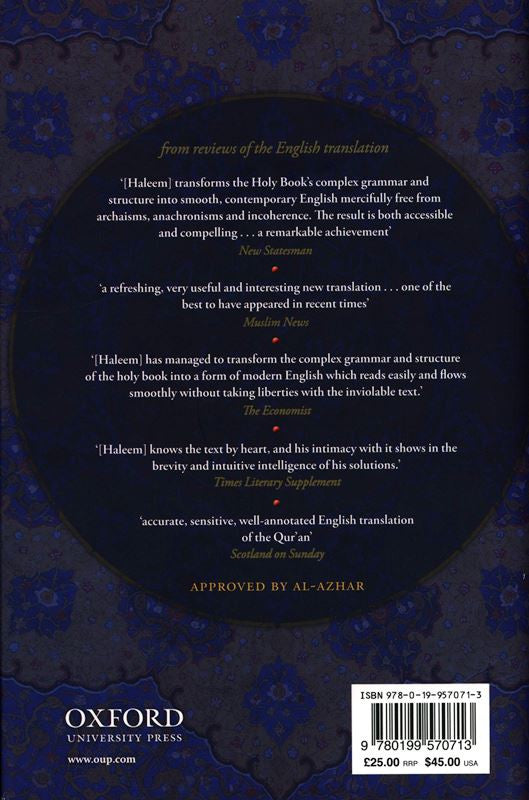
This translation has received praise from respected publications for its readability, accuracy, and scholarly approach. Reviewers have described it as one of the most accessible and compelling English translations of the Qur’an available today.
Ideal For
- English-speaking Muslims seeking deeper understanding of the Qur’an
- Students of Islamic studies and comparative religion
- Readers looking for a side-by-side Arabic and English Qur’an
- Personal study, teaching, gifting, and daily recitation
Spiritual Value
The Qur’an remains the ultimate source of guidance, mercy, and wisdom for humanity. This parallel-text edition helps readers connect the beauty of the Arabic revelation with a reliable English interpretation, making it an excellent companion for reflection, learning, and spiritual growth.


Sample Pages
Page:01
THE QUR'AN
ENGLISH TRANSLATION BY
M. A. S. Abdel Haleem
Parallel Arabic Text
Page:02
Aaron (Moses' brother) 170; blessed 451; God's guidance 139; grace 310; as messenger 218, 364; mission to the Egyptians 368; Moses requests his support from God 390; as Moses' spokesman 314: receives the Scriptures 327; rejection by disbelievers 346; and the worship of the golden calf 319
Abdul Muttalib (Muhammad's grandfather) xil, xxxv
Abdullah (Muhammad's father) xii, xxxv Abel (Adam's son) 113
Abraha (Christian ruler of Yemen), threatens Mecca 602, 603
Abraham xviii, 199, 528; as an example 550-1; builds the Ka'ba xii, 23 n. d, 25 n. ceases to pray on behalf of his disbelieving father 206; condemns idolatry 327-8, 371, 400, 492, and is blessed with the birth of Isaac 451; devotion to God 20-1, 22, 457; dialogue with God xx; as encouragement to believers to be mindful of God $38, 542; example 268, 333: faith 63; forbidden to plead for Lot's people 231: grace 309: guests, and the destruction of Lot's people 521-4: monotheism 138-9: prayers for the prosperity of Mecca 256, 261; questioning of the prophecy of Isaac's birth 266; receives the same message as that given to Muhammad 485; rite of pilgrimage 333, 336; standing before God 59
Abraham, people 338; chosen by God 55 Abraham, wife, and the prophecy of Isaac's birth 230-1, 521-4
Abu Bakr: father of 'A'isha 194. 353
n. a, flees from Mecca and hides in a cave xxviii; Rightly Guided Caliph xiv; preservation of the Qur'an xvii, xxxv Abu Hanifa, women permitted to be judges
Abu Lahab (uncle and opponent of
Muhammad), condemnation 604 Abu Talib (Muhammad's uncle) xii, xiii, xxxv 'Ad (Hud's people) 257, 338; arrogance 454; condemnation 401-2; wronged themselves 199; destruction 364, 503, 506, 529; disbelief 159-60, 228-9, as example to those who disbelieved $19, 523; disbelief 257; punishment 471.479. 530; punishment denied $67; rejection of Hud 373-4; corruption condemned 594 Adam: angels submit to 152-3; chosend
by God 55: creation and favoured over
the angels 7; disobedience 153-4, 321; without a father as was Jesus 51, 58 'adhab 4. a
adna al-jilbab 427 n.4 adoption 419
adultery 351, 353: forbidden 286; marriage rather than adultery 83; punishments for 115 n.4
advocacy, forbidden in the event of the betrayal of trust 96
afterlife 107, 132, 143, 447-51; contrast with temporal life 405
Ahmad (name of Muhammad) 553 'A'isha (Muhammad's wife), accused of adultery falsely
Alexander the Great, identification with Dhu 1-Qarnayn 303 n. 4.
Ali, Abdullah Ysuf, translation of the Qur'an
'Ali (Rightly Guided Caliph) xiv al-alamin 2 n. e
allies, disbelieving relatives not to be allies [against Muslims) 191 almsgiving xix, 45-9, 195, 285-6, 409, 595. 596-7, charitable spending (runfiquna) 3 n.fi commanded before it is too late 555-6; commendation 98; before conversations between believers and Muhammad 545; continuation 353: during pilgrimages 34: as marks of belief 28; rewards for 558; standing of blood- relatives in calls upon believers
Amina (Muhammad's mother)
angels 561; ascent to God 569; blessing 378 n. b; as bringers of justice 263; creation 435; dealing out of punishment to disbelievers $10; deny being worshipped 434: disbelievers' claims about refuted 527-9; encourage believers 481; as gatekeepers of Hell 576-8; gender xxxi, as the daughters of God 274 n. b, 287, 294 n. 4, 312, 325 n. a, denial of the pagan belief 526 n. 4, refutation 306, 447, 452-3, 527 n. g. 528, seen as God's servants 490-1, 494 n. 4, 495: guardian angels 251; lack of arrogance 274; as messengers of God 268; prayers for the salvation of believers 468-9; as receptors of men at the Day of Judgement 520; record people's deeds in writing 565 n. b; role on the Day of Judgement 363, 568; subordination to Adam
Page:03
THE NIGHT-COMER THE MOST HIGH
والماء والطَّارِقِ وَمَا أَدْرَكَ مَا الطَّارِقُ النَّجْمُ الثَّاقِبُ إِنكل نفس لا عَلَيْهَا حَافِظ نظرِ الْإِنسَنُ مِمَّ خُلِقَ خُلِقَ مِن مَّاو دافي يخرج من بين الصُّلْبِ وَالتَّرَابِ إِنَّهُ عَلَى رَجَمِهِ لَقَادِرُ
يوم تبلى السراير فالمُر مِن قُووَوَلَا نَاصِينَ وَالسَّمَاءِ ذَاتِ الرجع وَالْأَرْضِ ذَاتِ الصَّدْعِ إِنَّهُ لَقَولُ فَصَلَ وَمَا هُوَ الْمَزَلِ إِنَّهُمْ
يكيدُونَ كيدان واكِدُ كَيْنَا فَهْلِ الْكَفِرِينَ أَنْهَاتُهُمْ رُودان
سورة الأعلى
سيح أسْوَرَتِكَ الْأَعْلَى الَّذِي خَلَقَ فَسَوَّى وَالَّذِي قَدَّرَ فَهَدَى وَالَّذِي أَخْرَجَ المُرْعَى فَجَعَلَهُ عُنَا أَحْوَى سَنُقْرِئُكَ فَلَا تَنسَى إِلَّا مَا شَاءَ اللَّهُ إِنَّهُ يَعْلَمُ الْجَهَرَ وَمَا يَخْفَى وَنُنَتِرُكَ
اليسرى مذكر ان نَفَعَتِ الذِكْرَى سَيَذْكُرُ مَن يَخْشَى وَيَتَجَنَّهَا الْأَشْقَى الَّذِي يَصْلَى النَّارَ الكُبرى ثُمَّ لَا يَمُوتُ
فِيهَا وَلَا يَى قَدْ أَفْلَحَ مَن تَزَكَّى وَذَكَرَ اسْمَ رَبِّهِ فَصَلَّىThe Night-Comer A Meccan sura that uses a series of examples to illustrate resurrection from the grave.
THE NAME OF GOD, THE LORD
OF MERCY, THE GIVER OF MERCY By the sky and the night-comer- What will explain to you what the night-comer is? The piercing star- *there is a watcher over every soul.
Man should reflect on what he was created from. "He is created from spurting fluid, 'then he emerges from
The pronoun here is taken to refer to the person rather than the fluid.
Of the mother, where she carries the baby. He emerges from the womb as he will emerge from the grave.
For plants to come out, and humans on the Day of Resurrection.
Or We shall make things easy for you". Literally:
between the backbone and breastbone: God is certainly able to bring him back to life. "On the Day when secrets are laid bare 10 he will have no power and no one to help him.
"By the sky and its recurring rain, 12 by the earth that cracks open!< is This is truly a decisive statement; it is not somethingto be taken lightly. Theyplot and scheme, 16 but so do I: 17 [Prophet], let the disbelievers be, let them be for a while.
The Most High
A Meccan sura reassuring the Prophet of God's help and urging him to continue.
IN THE NAME OF GOD, THE LORD OF MERCY, THE GIVER OF MERCY
[Prophet], glorify the name of your Lord the Most High, who created [all things] in due proportion; 'who deter mined their destinies and guided them; who brought out the green pasture then made it dark debris. "[Prophet], will not forget-unless God wishes; We shall teach you [the Qur'an] and you He knows both what is open and what is hidden-We shall show you the easy So remind, if reminding is useful. 10 Those who stand in awe of God will heed the reminder, "but it will be ig nored by the most wicked, "who will enter the Great Fire, "where they will neither die nor live 14 Prosperous are those who purify themselves, 15 remem- ber the name of their Lord, and pray.
'We shall ease you towards ease!
• Razi cites many instances in the Qur'an where this structure conveys the meaning 'warn [everyone), whether [or not] warning will help.
They will neither be granted the respite of death, nor be able to enjoy their continued state of life (Razi).
Page:04
from reviews of the English translation
[Haleem] transforms the Holy Book's complex grammar and structure into smooth, contemporary English mercifully free from archaisms, anachronisms and incoherence. The result is both accessible and compelling... a remarkable achievement'
New Statesman
'a refreshing, very useful and interesting new translation... one of the best to have appeared in recent times' Muslim News
[Haleem] has managed to transform the complex grammar and structure of the holy book into a form of modern English which reads easily and flows smoothly without taking liberties with the inviolable text.' The Economist
[Haleem] knows the text by heart, and his intimacy with it shows in the brevity and intuitive intelligence of his solutions." Times Literary Supplement
accurate, sensitive, well-annotated English translation of the Qur'an' Scotland on Sunday