


An Explanation of Muhammad ibn Abd al-Wahhab’s Kashf al-Shubuhat | Study of Shirk in Islam
An Explanation of Muhammad ibn Abd al-Wahhab’s Kashf al-Shubuhat | Study of Shirk in Islam
Publisher:
Al Hidaayah Publishing
Author:
Abu Ammaar Yasir Qadhi
Language:
English
Binding:
Hard Cover
Pages: 210
Size: 18x25 cm
Couldn't load pickup availability
Collapsible content
Description of islamic Book
An Explanation of Muhammad ibn Abd al-Wahhab’s Kashf al-Shubuhat is a critical study of shirk in Islam and the foundations of Tawheed. This important work in Islamic creed clarifies misconceptions about worship and monotheism, making it an essential resource for students of Aqeedah and seekers of authentic Islamic knowledge.
From Author:
Shaykh Muhammad ibn Abd al-Wahhab was a renowned 18th-century Islamic scholar and reformer, best known for reviving the call to Tawheed and warning against shirk. His writings on Aqeedah and Islamic creed continue to influence students of knowledge worldwide.
Content:
A Critical Study of Shirk
An Explanation of Muhammad ibn 'Abd al-Wahhab’s Kashf al-Shubuhat by Abu Ammaar Yasir Qadhi provides a detailed study of Shirk, its definitions, forms, causes, dangers, and the arguments used to justify it. The work explains and expands upon Ibn 'Abd al-Wahhab’s Kashf al-Shubuhat (“The Clearing of Doubts”).
Understanding Shirk
The book begins by defining Shirk from linguistic and Islamic perspectives and explains the concept of associating partners with Allah. It explores how acts of worship can be directed toward other than Allah and why understanding Shirk is essential.
Tawhid & Shirk
The work examines the relationship between Tawhid and Shirk, including the discussion of how Tawhid preceded the emergence of Shirk and evidence related to human nature, the people of Nuh, and Adam.
Dangers of Shirk
The author explores the serious consequences and dangers of Shirk, emphasizing its significance within Islamic belief and the importance of recognizing and avoiding it.
Importance of Knowing Shirk
The book explains why Muslims should study Shirk and learn to recognize its various forms rather than limiting their understanding to a general definition.
Categories of Shirk
It discusses different classifications, including Shirk in relation to the categories of Tawhid, major and minor Shirk, and apparent and hidden Shirk.
Evidences & Arguments
The work examines evidences from the Qur’an, Sunnah, intellect, and Fitrah, while addressing arguments used to justify acts of Shirk and presenting responses to them.
A Comprehensive Study
With an introductory discussion of Shirk and a detailed explanation of Kashf al-Shubuhat, this book provides a structured resource for readers and students seeking to understand Tawhid, Shirk, and Islamic creed.
Page:01
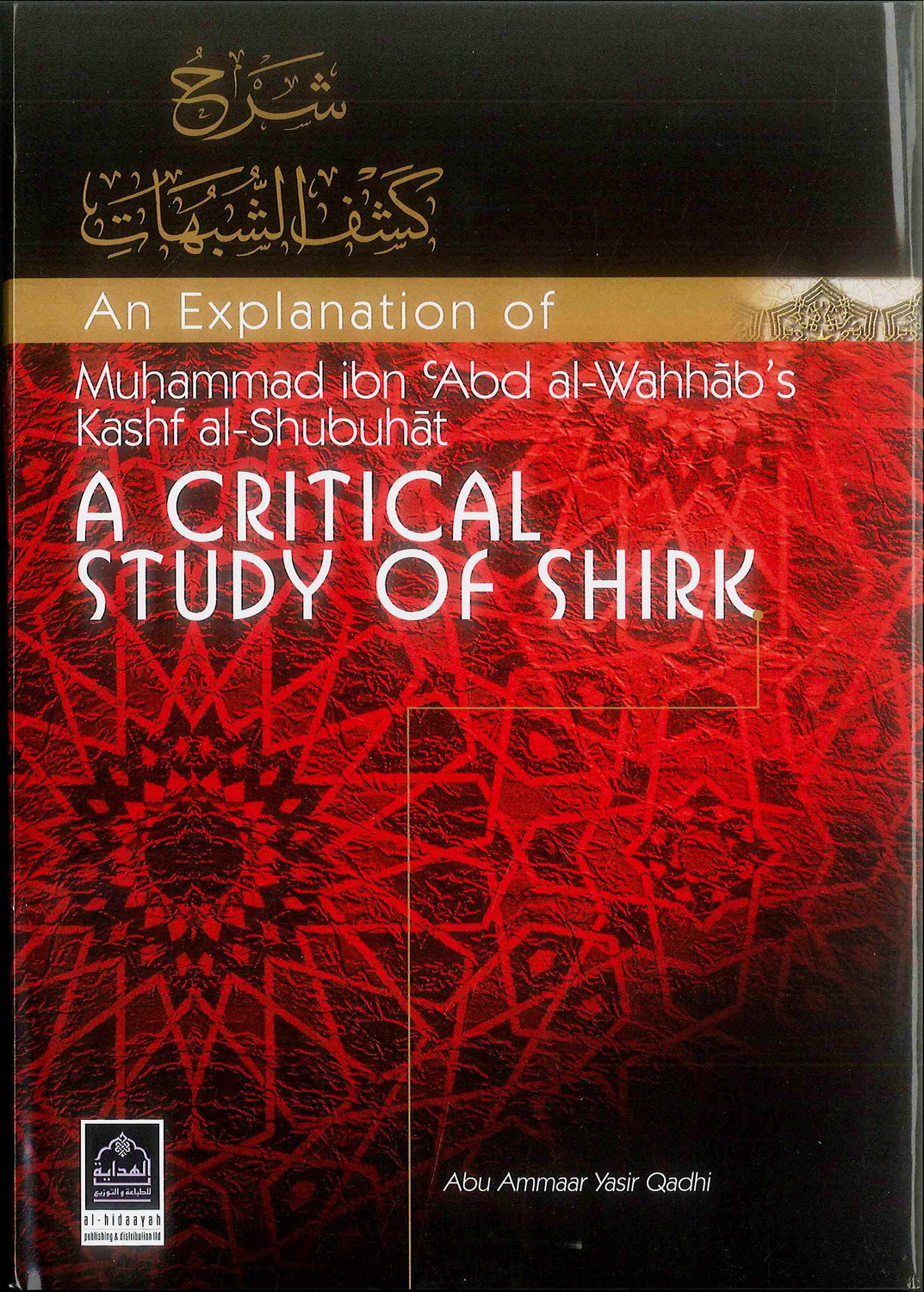
شراح كشف الشبهات
An Explanation of
Muhammad ibn 'Abd al-Wahhab's Kashf al-Shubuhat
A CRITICAL STUDY OF SHIRK
الهداية للطباعة والتوزيع
al-hidaayah publishing & distribution d
Abu Ammaar Yasir Qadhi
Page:02
شرح كشف الشات
An Explanation of
Muhammad ibn Abd al-Wahhab's Kashf al-Shubuhat
A CRITICAL STUDY OF SHIRK
Abu Ammaar Yasir Qadhi
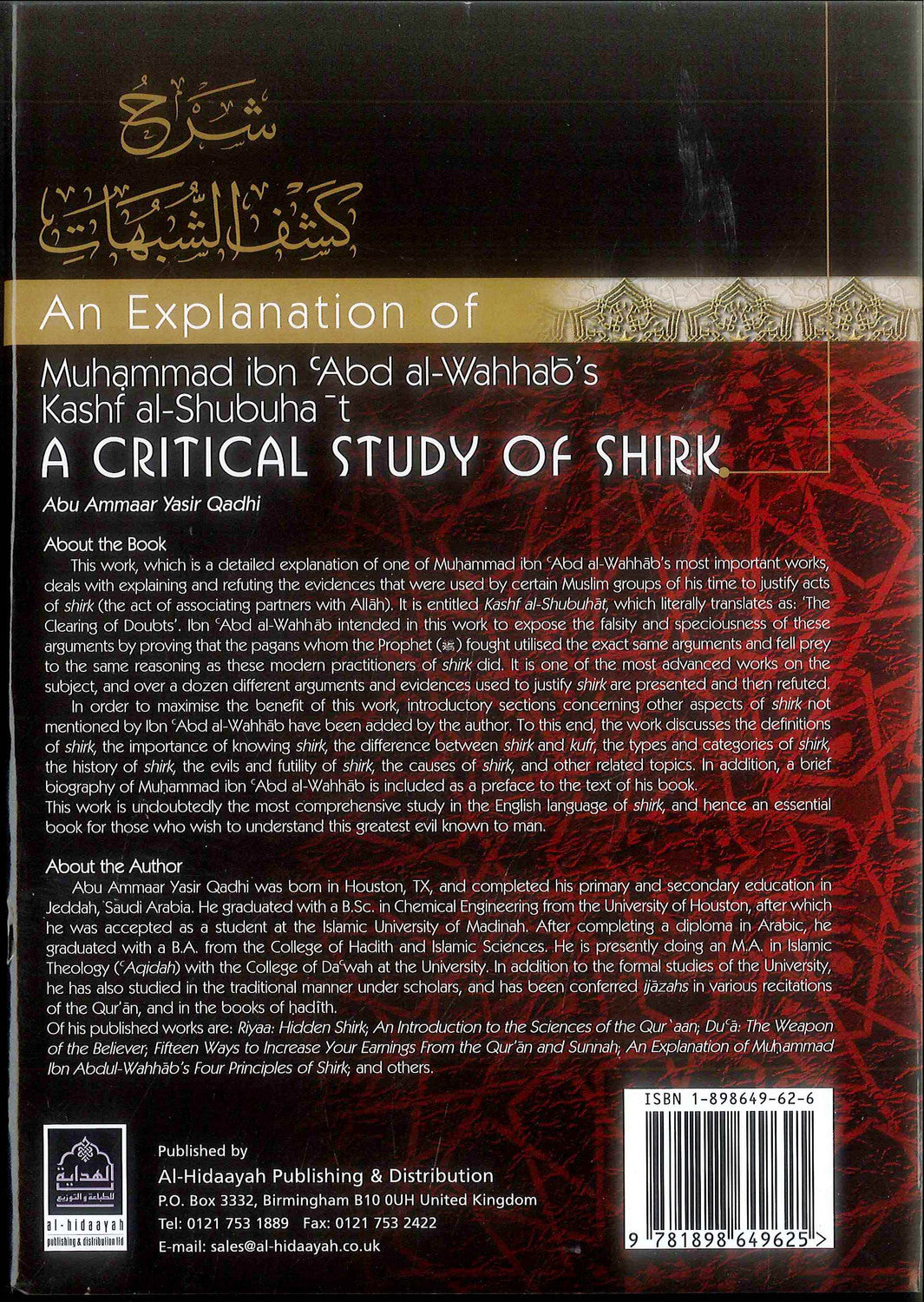
About the Book
This work, which is a detailed explanation of one of Muhammad ibn 'Abd al-Wahhab's most important works, deals with explaining and refuting the evidences that were used by certain Muslim groups of his time to justify acts of shirk (the act of associating partners with Allah). It is entitled Kashf al-Shubuhat, which literally translates as: 'The Clearing of Doubts'. Ibn 'Abd al-Wahhab intended in this work to expose the falsity and speciousness of these arguments by proving that the pagans whom the Prophet () fought utilised the exact same arguments and fell prey. to the same reasoning as these modern practitioners of shirk did. It is one of the most advanced works on the subject, and over a dozen different arguments and evidences used to justify shirk are presented and then refuted. In order to maximise the benefit of this work, introductory sections concerning other aspects of shirk not mentioned by Ibn 'Abd al-Wahhab have been added by the author. To this end, the work discusses the definitions of shirk, the importance of knowing shirk, the difference between shirk and kufr, the types and categories of shirk, the history of shirk, the evils and futility of shirk, the causes of shirk, and other related topics. In addition, a brief biography of Muhammad ibn 'Abd al-Wahhab is included as a preface to the text of his book.
This work is undoubtedly the most comprehensive study in the English language of shirk, and hence an essential book for those who wish to understand this greatest evil known to man.
About the Author
Abu Ammaar Yasir Qadhi was born in Houston, TX, and completed his primary and secondary education in Jeddah, Saudi Arabia. He graduated with a B.Sc. in Chemical Engineering from the University of Houston, after which he was accepted as a student at the Islamic University of Madinah. After completing a diploma in Arabic, he graduated with a B.A. from the College of Hadith and Islamic Sciences. He is presently doing an M.A. in Islamic Theology (Aqidah) with the College of Da'wah at the University. In addition to the formal studies of the University, he has also studied in the traditional manner under scholars, and has been conferred ijazahs in various recitations of the Qur'an, and in the books of hadith.
Of his published works are: Riyaa: Hidden Shirk; An Introduction to the Sciences of the Qur`aan; Du'a: The Weapon of the Believer; Fifteen Ways to Increase Your Earnings From the Qur'an and Sunnah; An Explanation of Muhammad Ibn Abdul-Wahhab's Four Principles of Shirk; and others.
Page:03
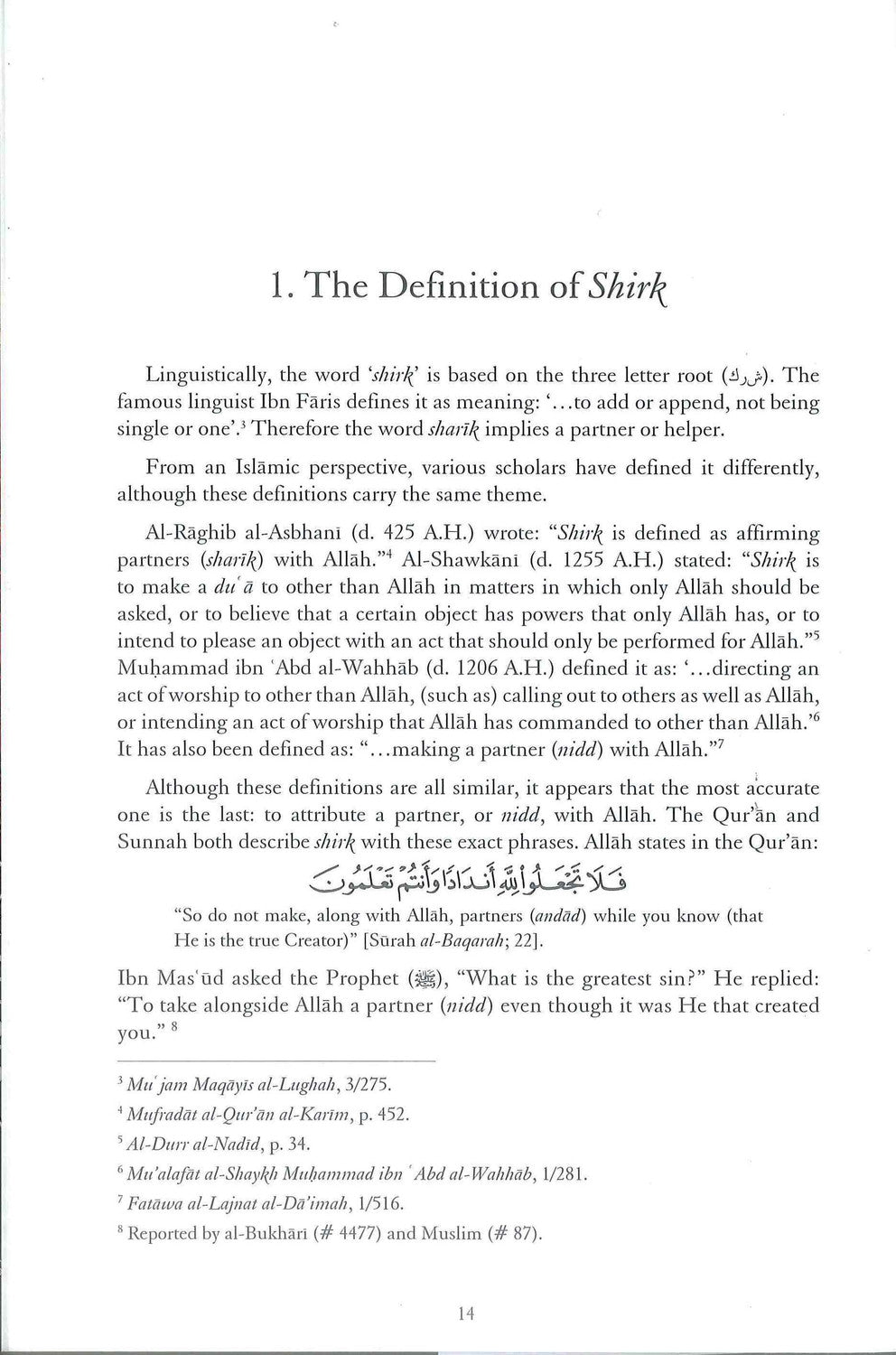
The Definition of Shirk
Linguistically, the word 'shirk' is based on the three letter root (,). The famous linguist Ibn Faris defines it as meaning: ...to add or append, not being single or one'. Therefore the word sharik implies a partner or helper.
From an Islamic perspective, various scholars have defined it differently, although these definitions carry the same theme.
Al-Raghib al-Asbhani (d. 425 A.H.) wrote: "Shirk is defined as affirming partners (sharik) with Allah."+ Al-Shawkāni (d. 1255 A.H.) stated: "Shirk is to make a du a to other than Allah in matters in which only Allah should be asked, or to believe that a certain object has powers that only Allah has, or to intend to please an object with an act that should only be performed for Allah."5 Muhammad ibn 'Abd al-Wahhab (d. 1206 A.H.) defined it as: '...directing an act of worship to other than Allah, (such as) calling out to others as well as Allah, or intending an act of worship that Allah has commanded to other than Allah." It has also been defined as: "...making a partner (nidd) with Allah."
Although these definitions are all similar, it appears that the most accurate one is the last: to attribute a partner, or nidd, with Allah. The Qur'an and Sunnah both describe shirk with these exact phrases. Allah states in the Qur'an:
فَلا تَجْعَلُوا لِلَّهِ أَندَادًا وَأَنتُمْ تَعْلَمُونَ
"So do not make, along with Allah, partners (andad) while you know (that He is the true Creator)" [Surah al-Baqarah; 22].
Ibn Mas'ud asked the Prophet (), "What is the greatest sin?" He replied: "To take alongside Allāh a partner (nidd) even though it was He that created you.
Page:03
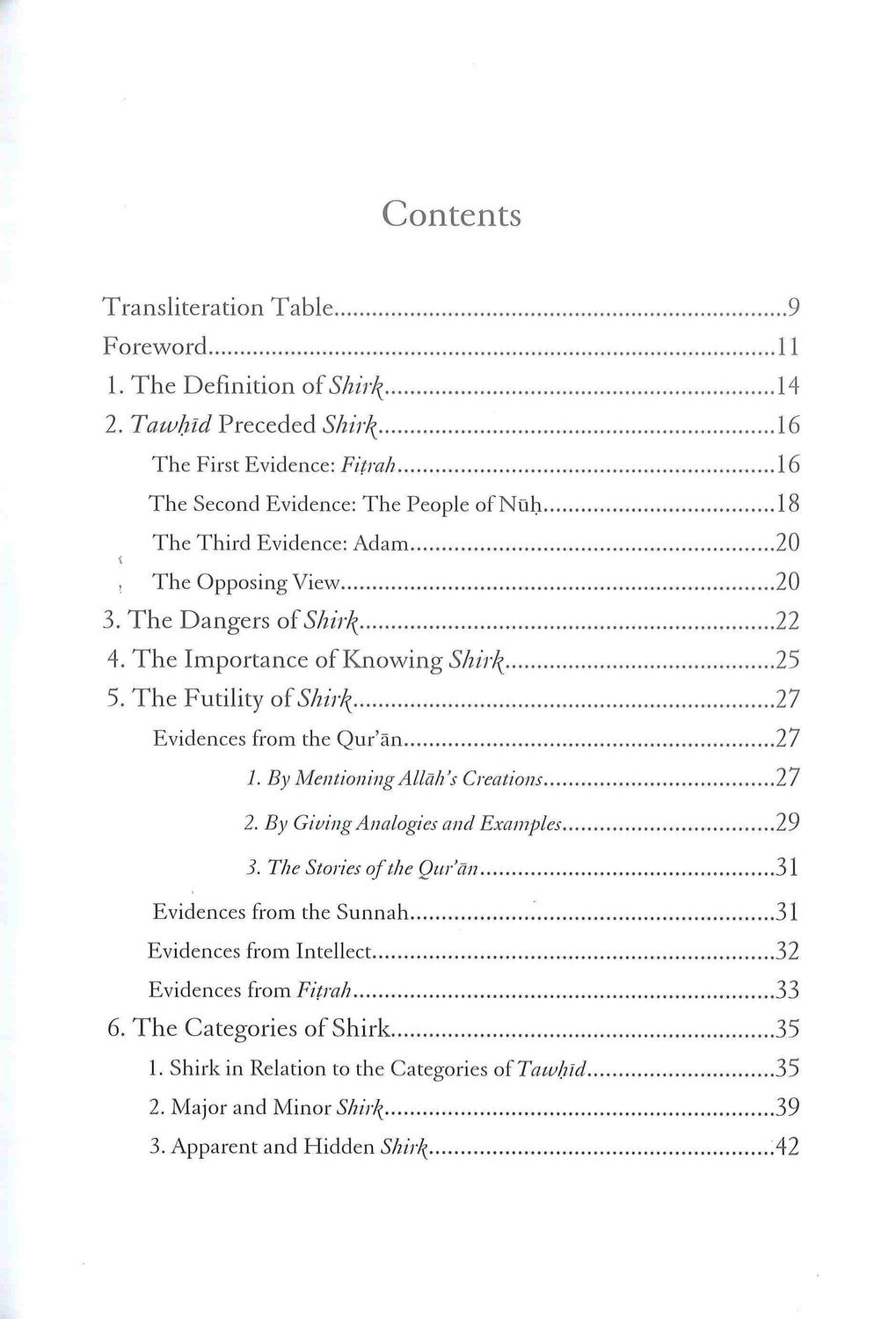
Contents
Transliteration Table..
Foreword.
1. The Definition of Shirk.
2. Tawhid Preceded Shirk.
The First Evidence: Fitrah..
The Second Evidence: The People of Nüḥ..
The Third Evidence: Adam
The Opposing View.
3. The Dangers of Shirk..
4. The Importance of Knowing Shirk.
5. The Futility of Shirk
Evidences from the Qur'an.....
1. By Mentioning Allah's Creations
2. By Giving Analogies and Examples
3. The Stories of the Qur'an.
Evidences from the Sunnah
Evidences from Intellect
Evidences from Fitrah..
6. The Categories of Shirk
1. Shirk in Relation to the Categories of Tawhid.
2. Major and Minor Shirk.
3. Apparent and Hidden Shir
Publisher
Al Hidaayah Publishing
Author
- Abu Ammaar Yasir Qadhi
Shipping and Delivery
We dispatch orders directly from our UK and USA warehouses, offering multiple shipping options to suit your needs. We proudly ship worldwide.
UK Deliveries (from UK warehouse):
Standard shipping typically arrives within 3–4 working days. Expedited delivery takes 2–3 working days. We aim to dispatch orders the same day or next working day, with next-day delivery options available where applicable.
USA Deliveries (from USA warehouse):
Orders usually arrive within 4–7 working days.
Europe (shipped from UK):
Standard delivery takes approximately 6–10 working days, with expedited services available in 3–5 working days.
Canada:
Estimated delivery time is 5–10 working days.
Worldwide Shipping:
International orders generally arrive within 5–20 working days, depending on destination and shipping method selected.
For precise delivery timelines based on your location, please contact us by email and our team will provide detailed information tailored to your address.
Sample Pages - Content
Page:01
شراح كشف الشبهات
An Explanation of
Muhammad ibn 'Abd al-Wahhab's Kashf al-Shubuhat
A CRITICAL STUDY OF SHIRK
الهداية للطباعة والتوزيع
al-hidaayah publishing & distribution d
Abu Ammaar Yasir Qadhi
Page:02
شرح كشف الشات
An Explanation of
Muhammad ibn Abd al-Wahhab's Kashf al-Shubuhat
A CRITICAL STUDY OF SHIRK
Abu Ammaar Yasir Qadhi
About the Book
This work, which is a detailed explanation of one of Muhammad ibn 'Abd al-Wahhab's most important works, deals with explaining and refuting the evidences that were used by certain Muslim groups of his time to justify acts of shirk (the act of associating partners with Allah). It is entitled Kashf al-Shubuhat, which literally translates as: 'The Clearing of Doubts'. Ibn 'Abd al-Wahhab intended in this work to expose the falsity and speciousness of these arguments by proving that the pagans whom the Prophet () fought utilised the exact same arguments and fell prey. to the same reasoning as these modern practitioners of shirk did. It is one of the most advanced works on the subject, and over a dozen different arguments and evidences used to justify shirk are presented and then refuted. In order to maximise the benefit of this work, introductory sections concerning other aspects of shirk not mentioned by Ibn 'Abd al-Wahhab have been added by the author. To this end, the work discusses the definitions of shirk, the importance of knowing shirk, the difference between shirk and kufr, the types and categories of shirk, the history of shirk, the evils and futility of shirk, the causes of shirk, and other related topics. In addition, a brief biography of Muhammad ibn 'Abd al-Wahhab is included as a preface to the text of his book.
This work is undoubtedly the most comprehensive study in the English language of shirk, and hence an essential book for those who wish to understand this greatest evil known to man.
About the Author
Abu Ammaar Yasir Qadhi was born in Houston, TX, and completed his primary and secondary education in Jeddah, Saudi Arabia. He graduated with a B.Sc. in Chemical Engineering from the University of Houston, after which he was accepted as a student at the Islamic University of Madinah. After completing a diploma in Arabic, he graduated with a B.A. from the College of Hadith and Islamic Sciences. He is presently doing an M.A. in Islamic Theology (Aqidah) with the College of Da'wah at the University. In addition to the formal studies of the University, he has also studied in the traditional manner under scholars, and has been conferred ijazahs in various recitations of the Qur'an, and in the books of hadith.
Of his published works are: Riyaa: Hidden Shirk; An Introduction to the Sciences of the Qur`aan; Du'a: The Weapon of the Believer; Fifteen Ways to Increase Your Earnings From the Qur'an and Sunnah; An Explanation of Muhammad Ibn Abdul-Wahhab's Four Principles of Shirk; and others.
Page:03
The Definition of Shirk
Linguistically, the word 'shirk' is based on the three letter root (,). The famous linguist Ibn Faris defines it as meaning: ...to add or append, not being single or one'. Therefore the word sharik implies a partner or helper.
From an Islamic perspective, various scholars have defined it differently, although these definitions carry the same theme.
Al-Raghib al-Asbhani (d. 425 A.H.) wrote: "Shirk is defined as affirming partners (sharik) with Allah."+ Al-Shawkāni (d. 1255 A.H.) stated: "Shirk is to make a du a to other than Allah in matters in which only Allah should be asked, or to believe that a certain object has powers that only Allah has, or to intend to please an object with an act that should only be performed for Allah."5 Muhammad ibn 'Abd al-Wahhab (d. 1206 A.H.) defined it as: '...directing an act of worship to other than Allah, (such as) calling out to others as well as Allah, or intending an act of worship that Allah has commanded to other than Allah." It has also been defined as: "...making a partner (nidd) with Allah."
Although these definitions are all similar, it appears that the most accurate one is the last: to attribute a partner, or nidd, with Allah. The Qur'an and Sunnah both describe shirk with these exact phrases. Allah states in the Qur'an:
فَلا تَجْعَلُوا لِلَّهِ أَندَادًا وَأَنتُمْ تَعْلَمُونَ
"So do not make, along with Allah, partners (andad) while you know (that He is the true Creator)" [Surah al-Baqarah; 22].
Ibn Mas'ud asked the Prophet (), "What is the greatest sin?" He replied: "To take alongside Allāh a partner (nidd) even though it was He that created you.
Page:03
Contents
Transliteration Table..
Foreword.
1. The Definition of Shirk.
2. Tawhid Preceded Shirk.
The First Evidence: Fitrah..
The Second Evidence: The People of Nüḥ..
The Third Evidence: Adam
The Opposing View.
3. The Dangers of Shirk..
4. The Importance of Knowing Shirk.
5. The Futility of Shirk
Evidences from the Qur'an.....
1. By Mentioning Allah's Creations
2. By Giving Analogies and Examples
3. The Stories of the Qur'an.
Evidences from the Sunnah
Evidences from Intellect
Evidences from Fitrah..
6. The Categories of Shirk
1. Shirk in Relation to the Categories of Tawhid.
2. Major and Minor Shirk.
3. Apparent and Hidden Shir
Who is Abu Ammaar Yasir Qadhi?
Abu Ammaar Yasir Qadhi is an American Muslim scholar, academic, and author known for his works on Islamic theology, history, and contemporary issues. He studied at the Islamic University of Madinah and Yale University, and serves as a prominent lecturer and teacher for Muslims worldwide