


Al-Ubudiyyah: Being a True Slave of Allah | Classical Islamic Spirituality Book by Ibn Taymiyyah | Worship, Sincerity & Purification of the Heart
Al-Ubudiyyah: Being a True Slave of Allah | Classical Islamic Spirituality Book by Ibn Taymiyyah | Worship, Sincerity & Purification of the Heart
Publisher:
Ta Ha Publisher
Author:
Ibn Taymiyyah
Language:
English
Binding:
Soft Cover
Pages: 120
Size: 15x21cm
Couldn't load pickup availability


Collapsible content
Description of islamic Book
Al-Ubudiyyah: Being a True Slave of Allah by Shaykh al-Islam Ibn Taymiyyah is a profound Islamic classical work explaining the true meaning of worship, servitude, sincerity, and submission to Allah. Rooted in the Qur’an and Sunnah, this book teaches believers how complete obedience, love, reliance, and humility toward Allah form the foundation of true faith and spiritual purification.
From Author:
In Al-Ubudiyyah: Being a True Slave of Allah, Shaykh al-Islam Ibn Taymiyyah explains that the essence of human existence is complete servitude and submission to Allah alone. He clarifies that true worship is not restricted to rituals such as prayer and fasting, but includes every inward and outward action that Allah loves and is pleased with, including sincerity, patience, gratitude, reliance upon Allah, humility, and righteous character. The author emphasizes that every person is naturally dependent upon Allah, and real freedom can only be achieved through sincere obedience to Him rather than becoming enslaved by worldly desires, wealth, status, or people. Drawing upon the Qur’an and authentic Sunnah, Ibn Taymiyyah demonstrates that true happiness, peace of heart, and spiritual success are attained through strengthening Tawheed, purifying the soul, and dedicating all acts of worship solely to Allah. The book serves as a timeless reminder for believers to renew their sincerity, deepen their relationship with Allah, and understand the comprehensive meaning of worship in Islam.
Content:
1. Meaning of ‘Ubudiyyah (Servitude to Allah)
True worship as complete submission to Allah
Human need to have a single ultimate purpose
Inner peace found only in devotion to Allah
2. Purpose of Human Life
Every heart seeks something to worship
Without Allah, people become attached to false “gods” (wealth, ego, power)
Real fulfillment comes from turning to Allah
3. Dimensions of Worship (‘Ibadah)
Worship includes belief, actions, and obedience
Love of Allah as the highest form of devotion
Worship as a comprehensive way of life
4. Prophets as Perfect Slaves of Allah
Prophets exemplify true servitude
They combine obedience, trust, and humility
5. Divine Decree (Qadar)
Understanding Allah’s will and wisdom
Human actions within divine decree
Patience and acceptance of Allah’s plan
6. Obedience and Accountability
Importance of following Allah’s commands
Enjoining good and forbidding evil
Avoiding innovation (bid‘ah) in religion
7. Spiritual Struggle and Sincerity
Striving for righteousness (jihād al-nafs)
Avoiding hypocrisy and false spirituality
Purifying intentions for Allah alone
Key Message
The book teaches that true freedom and peace come only through complete submission to Allah, and that every human being is, in reality, a servant of something—so the highest honor is to be the servant of Allah alone.
Page no :1
Shaykh al-Islam Ibn Taymiyah
Al-'Ubudiyyah
Being a True Slave of Allah
Translated by: Nasiruddin al-Khattab
Page no:2
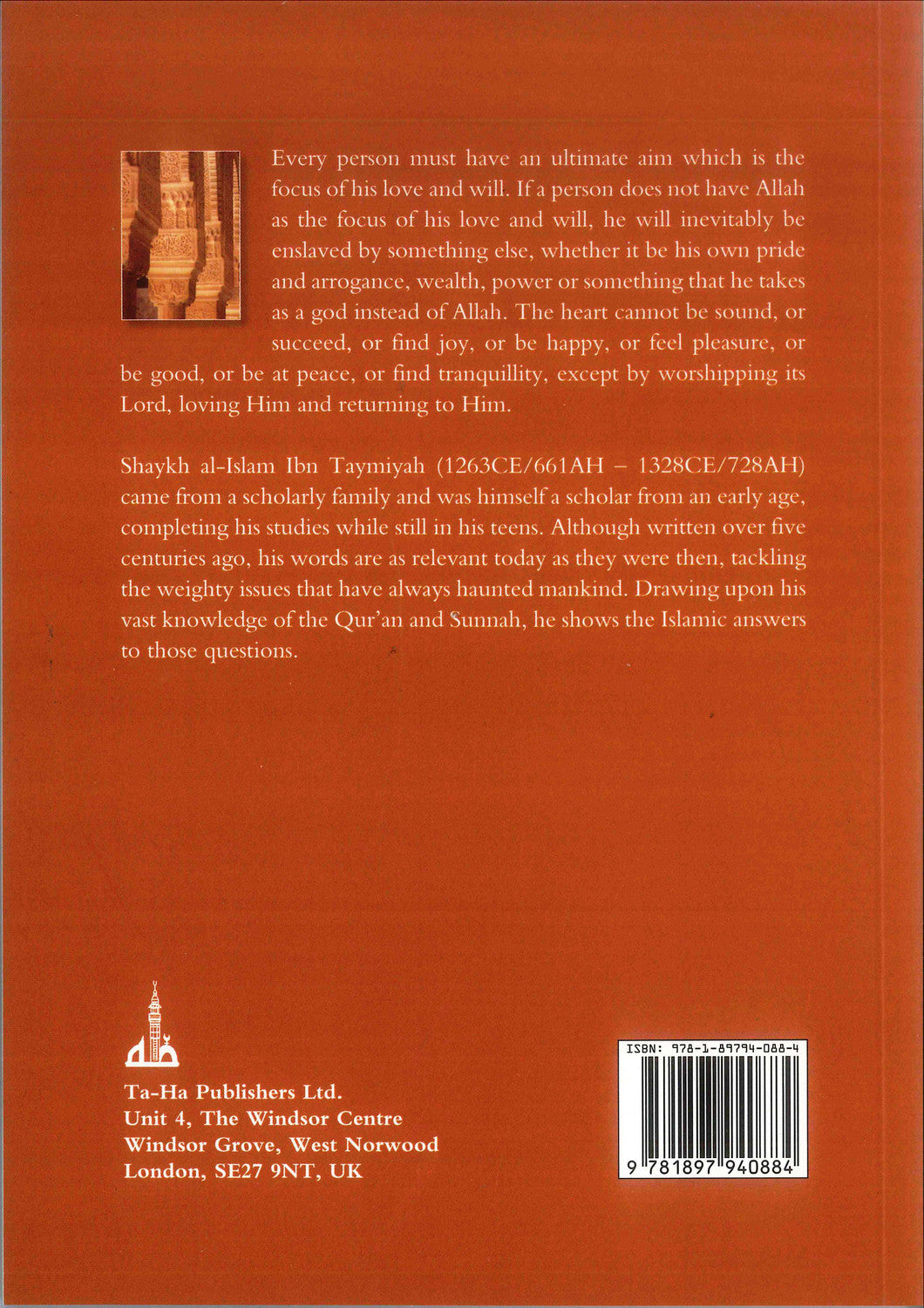
Every person must have an ultimate aim which is the focus of his love and will. If a person does not have Allah as the focus of his love and will, he will inevitably be enslaved by something else, whether it be his own pride and arrogance, wealth, power or something that he takes as a god instead of Allah. The heart cannot be sound, or succeed, or find joy, or be happy, or feel pleasure, or be good, or be at peace, or find tranquillity, except by worshipping its Lord, loving Him and returning to Him.
Shaykh al-Islam Ibn Taymiyah came from a scholarly family and was himself a scholar from an early age, completing his studies while still in his teens. Although written over five centuries ago, his words are as relevant today as they were then, tackling the weighty issues that have always haunted mankind. Drawing upon his vast knowledge of the Qur'an and Sunnah, he shows the Islamic answers to those questions.
Page:03
Translator's Foreword
Translator's Notes
Who is Ibn Taymiyah?
Introduction
Contents
Al-'Ubudiyyah - Part One
Dimensions of 'Ibadah
Prophets are also slaves
'Ibadah - An all-embracing concept
Degrees of love
Only for Allah
Allah is Sufficient for us
We are all slaves
Lesser kinds of 'ubudiyyah
Heeding the commands of Allah is essential
True worship
Worship and enslavement
Al-qada' wa'l-qadar (Divine decree and preordainment)
The Prophets and the Divine Decree
The case of sin
Al-'Ubudiyyah - Part Two
The obligation of enjoining the good
No equality
The people of the Qur'an
Striving
Iniquitous inconsistencies
False claims of gnosis Confused views of qadar
Page:04
Introduction
Praise be to Allah, we praise Him and seek His help and forgiveness. We seek refuge with Allah from the evil of our own selves and from our evil deeds. Whomsoever Allah guides can never be lead astray, and whomsoever Allah leaves astray cannot be guided.
I bear witness that there is no god but Allah alone, with no partner or associate, and I bear witness that Muhammad is His slave and Messenger.
The prominent scholar, defender of the Sunnah and opponent of bid'ah (innovation), Shaykh al-Islam Ahmad ibn 'Abd al-Halim ibn Taymiyah, may Allah have mercy on him, was asked about the ayah:
"O mankind! Worship your Lord..." (al-Baqarah 2:21)
What is worship (ibadah), and what are its implications? Does it include all the issues of deen (religion) or not? What is the real essence of 'ubudiyyah (enslavement to Allah)? Is it the highest level of achievement that can be attained in this world or in the Hereafter, or is there something higher? This is the issue that will be explained here.
Publisher
Ta Ha Publisher
Author
- Ibn Taymiyyah
Shipping and Delivery
We dispatch orders directly from our UK and USA warehouses, offering multiple shipping options to suit your needs. We proudly ship worldwide.
UK Deliveries (from UK warehouse):
Standard shipping typically arrives within 3–4 working days. Expedited delivery takes 2–3 working days. We aim to dispatch orders the same day or next working day, with next-day delivery options available where applicable.
USA Deliveries (from USA warehouse):
Orders usually arrive within 4–7 working days.
Europe (shipped from UK):
Standard delivery takes approximately 6–10 working days, with expedited services available in 3–5 working days.
Canada:
Estimated delivery time is 5–10 working days.
Worldwide Shipping:
International orders generally arrive within 5–20 working days, depending on destination and shipping method selected.
For precise delivery timelines based on your location, please contact us by email and our team will provide detailed information tailored to your address.
Sample Pages - Content
Page no :1
Shaykh al-Islam Ibn Taymiyah
Al-'Ubudiyyah
Being a True Slave of Allah
Translated by: Nasiruddin al-Khattab
Page no:2
Every person must have an ultimate aim which is the focus of his love and will. If a person does not have Allah as the focus of his love and will, he will inevitably be enslaved by something else, whether it be his own pride and arrogance, wealth, power or something that he takes as a god instead of Allah. The heart cannot be sound, or succeed, or find joy, or be happy, or feel pleasure, or be good, or be at peace, or find tranquillity, except by worshipping its Lord, loving Him and returning to Him.
Shaykh al-Islam Ibn Taymiyah came from a scholarly family and was himself a scholar from an early age, completing his studies while still in his teens. Although written over five centuries ago, his words are as relevant today as they were then, tackling the weighty issues that have always haunted mankind. Drawing upon his vast knowledge of the Qur'an and Sunnah, he shows the Islamic answers to those questions.
Page:03
Translator's Foreword
Translator's Notes
Who is Ibn Taymiyah?
Introduction
Contents
Al-'Ubudiyyah - Part One
Dimensions of 'Ibadah
Prophets are also slaves
'Ibadah - An all-embracing concept
Degrees of love
Only for Allah
Allah is Sufficient for us
We are all slaves
Lesser kinds of 'ubudiyyah
Heeding the commands of Allah is essential
True worship
Worship and enslavement
Al-qada' wa'l-qadar (Divine decree and preordainment)
The Prophets and the Divine Decree
The case of sin
Al-'Ubudiyyah - Part Two
The obligation of enjoining the good
No equality
The people of the Qur'an
Striving
Iniquitous inconsistencies
False claims of gnosis Confused views of qadar
Page:04
Introduction
Praise be to Allah, we praise Him and seek His help and forgiveness. We seek refuge with Allah from the evil of our own selves and from our evil deeds. Whomsoever Allah guides can never be lead astray, and whomsoever Allah leaves astray cannot be guided.
I bear witness that there is no god but Allah alone, with no partner or associate, and I bear witness that Muhammad is His slave and Messenger.
The prominent scholar, defender of the Sunnah and opponent of bid'ah (innovation), Shaykh al-Islam Ahmad ibn 'Abd al-Halim ibn Taymiyah, may Allah have mercy on him, was asked about the ayah:
"O mankind! Worship your Lord..." (al-Baqarah 2:21)
What is worship (ibadah), and what are its implications? Does it include all the issues of deen (religion) or not? What is the real essence of 'ubudiyyah (enslavement to Allah)? Is it the highest level of achievement that can be attained in this world or in the Hereafter, or is there something higher? This is the issue that will be explained here.
Who is Ibn Taymiyyah?
Ibn Taymiyyah (1263–1328) was a highly influential Islamic scholar and theologian known for his dedication to the Quran and Sunnah. Originating from Harran, he became a leading figure in the Hanbali school of thought. Ibn Taymiyyah advocated for a pure and direct approach to Islamic teachings, urging Muslims to avoid practices he considered innovations, like saint worship and shrine reverence. His writings span theology, law, and philosophy, leaving a lasting impact on Islamic thought and inspiring later reformers. While his interpretations are sometimes debated, his scholarship remains deeply respected across the Muslim world.