


A Reference Guide for Character Development (Therapy from Quran and Sunnah-1)
A Reference Guide for Character Development (Therapy from Quran and Sunnah-1)
Publisher:
IIPH (International Islamic Publishing House)
Author:
Dr Feryad A Hussain
Language:
English
Binding:
Hard Cover
Pages: 224
Size: 21.5x14.5x1inch
Couldn't load pickup availability
Collapsible content
Description of islamic Book
“A Reference Guide for Character Development – Therapy from Quran and Sunnah” is a beneficial Islamic self-development book that focuses on improving character and behavior through authentic Islamic teachings. Drawing guidance from the Quran and Sunnah, the book helps readers understand the importance of good manners, self-discipline, emotional control, and spiritual growth in daily life.
The book discusses essential qualities such as patience, honesty, humility, gratitude, kindness, forgiveness, and responsibility. It also highlights negative habits and behaviors that can harm personal growth and relationships, while providing practical Islamic solutions for overcoming them.
From Author:
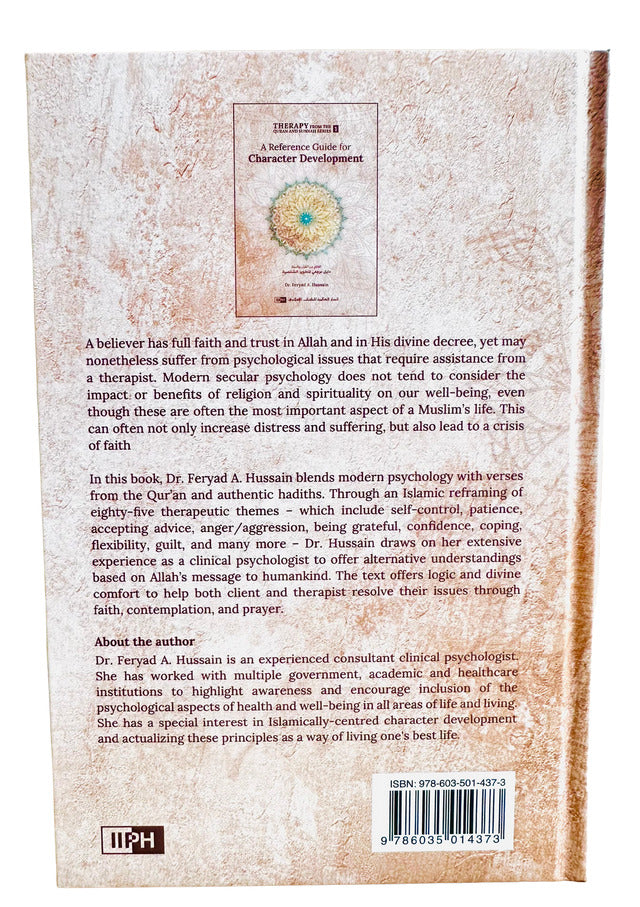
A believer has full faith and trust in Allah and in His divine decree, yet may nonetheless suffer from psychological issues that require assistance from a therapist. Modern secular psychology does not tend to consider the impact or benefits of religion and spirituality on our well-being, even though these are often the most important aspect of a Muslim’s life. This can often not only increase distress and suffering, but also lead to a crisis of faith
In this book, Dr. Feryad A. Hussain blends modern psychology with verses from the Qur’an and authentic hadiths. Through an Islamic reframing of eighty-five therapeutic themes – which include self-control, patience, accepting advice, anger/aggression, being grateful, confidence, coping, flexibility, guilt, and many more – Dr. Hussain draws on her extensive experience as a clinical psychologist to offer alternative understandings based on Allah’s message to humankind. The text offers logic and divine comfort to help both client and therapist resolve their issues through faith, contemplation, and prayer.
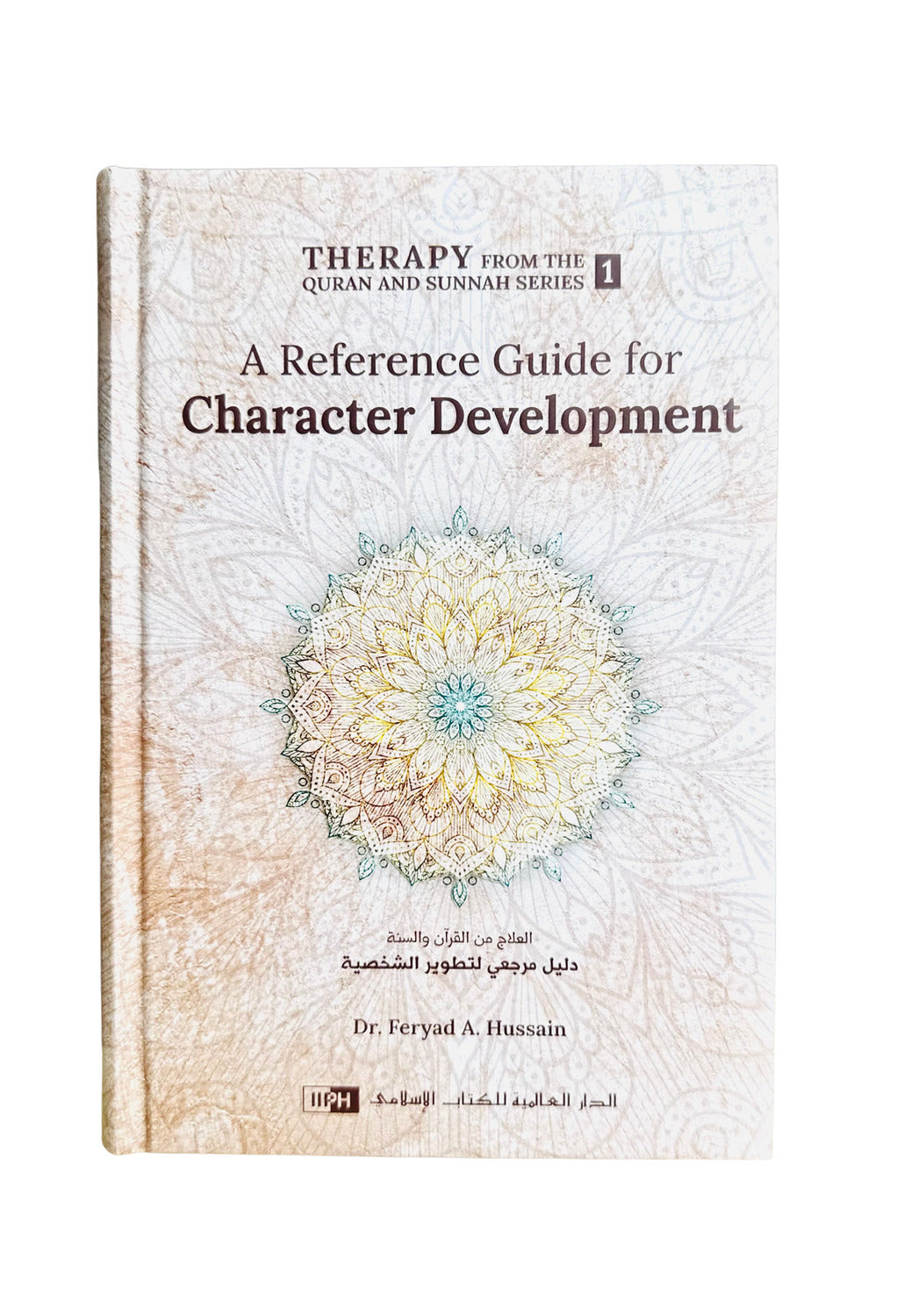
Page:01
THERAPY FROM THE
QURAN AND SUNNAH SERIES
A Reference Guide for Character Development
العلاج من القرآن والسنة
لتطوير الشخصية دليل مرجعي
Dr. Feryad A. Hussain
الدار العالمية للكتاب الإسلامي PM
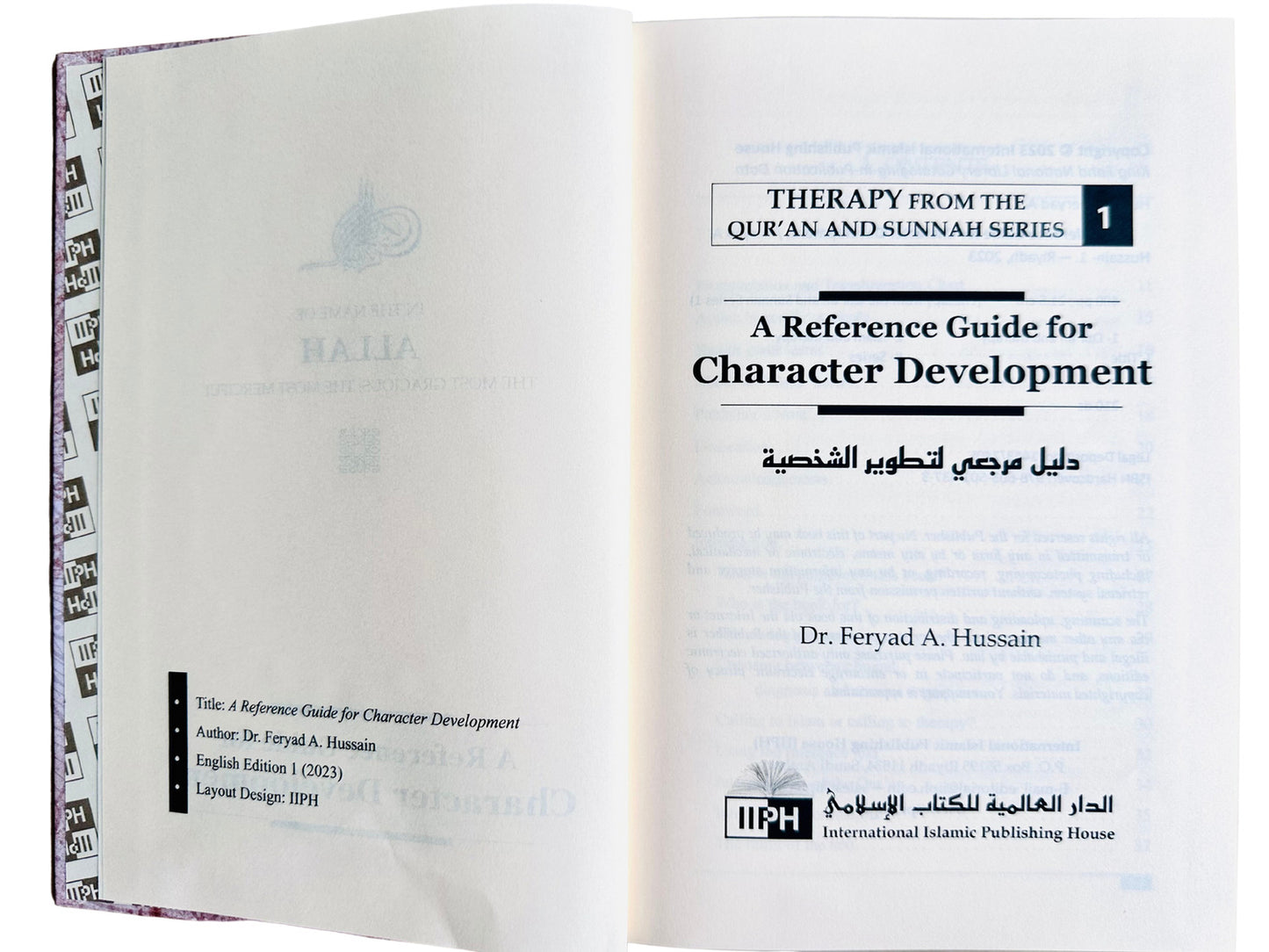
Page:02
THERAPY FROM THE QUR'AN AND SUNNAH SERIES
A Reference Guide for
Character Development
Title: A Reference Guide for Character Development
Author: Dr. Feryad A. Hussain
English Edition 1 (2023)
Layout Design: IIPH
دليل مرجعي لتطوير الشخصية
IIPH
Dr. Feryad A. Hussain
الدار العالمية للكتاب الإسلامي
International Islamic Publishing House
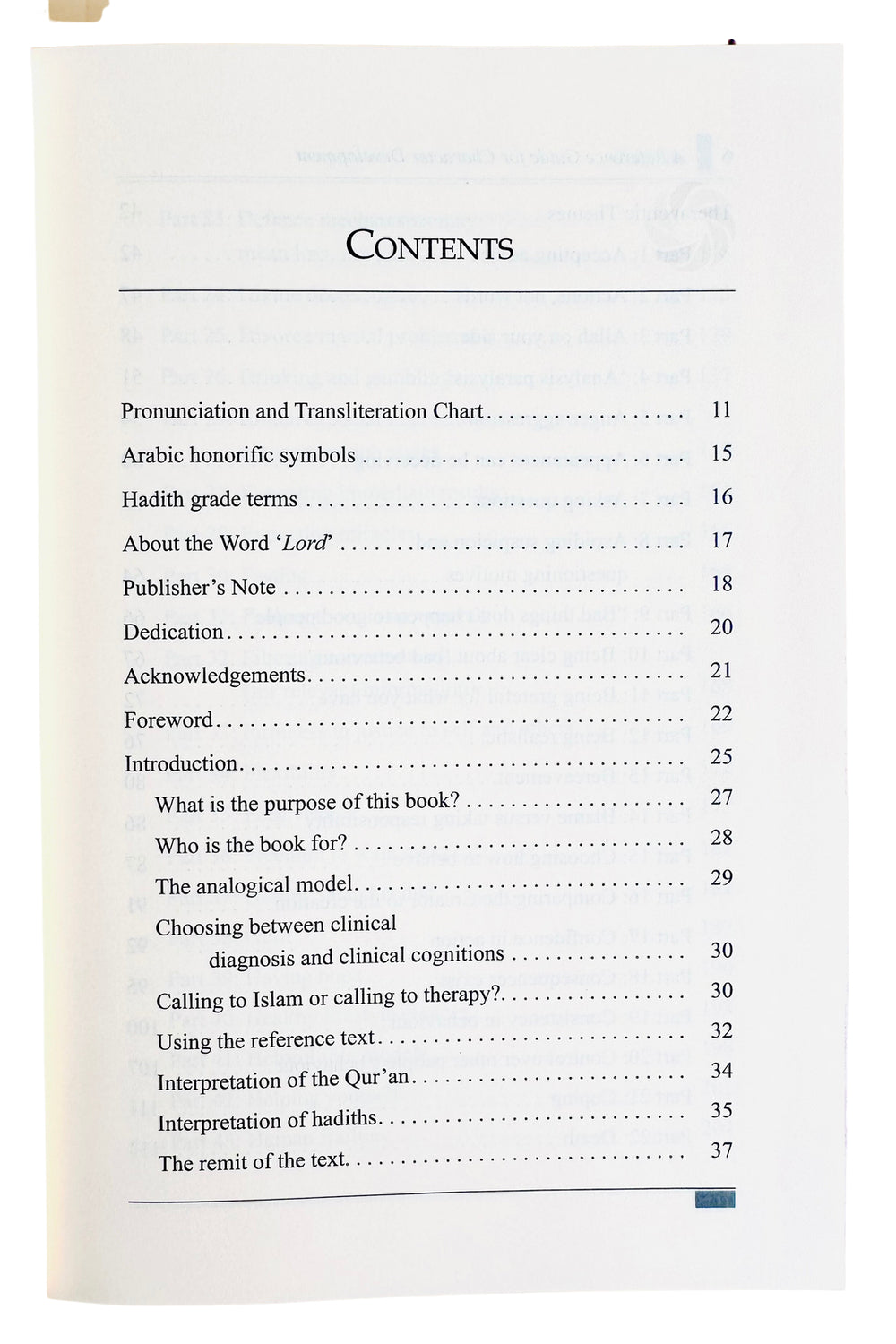
Page:03
CONTENTS
Pronunciation and Transliteration Chart...
Arabic honorific symbols.
Hadith grade terms
About the Word 'Lord'
Publisher's Note
Dedication.
Acknowledgements.
Foreword..
Introduction..
What is the purpose of this book?
Who is the book for?
The analogical model..
Choosing between clinical
diagnosis and clinical cognitions
Calling to Islam or calling to therapy?. Using the reference text. Interpretation of the Qur'an. Interpretation of hadiths.
The remit of the text..
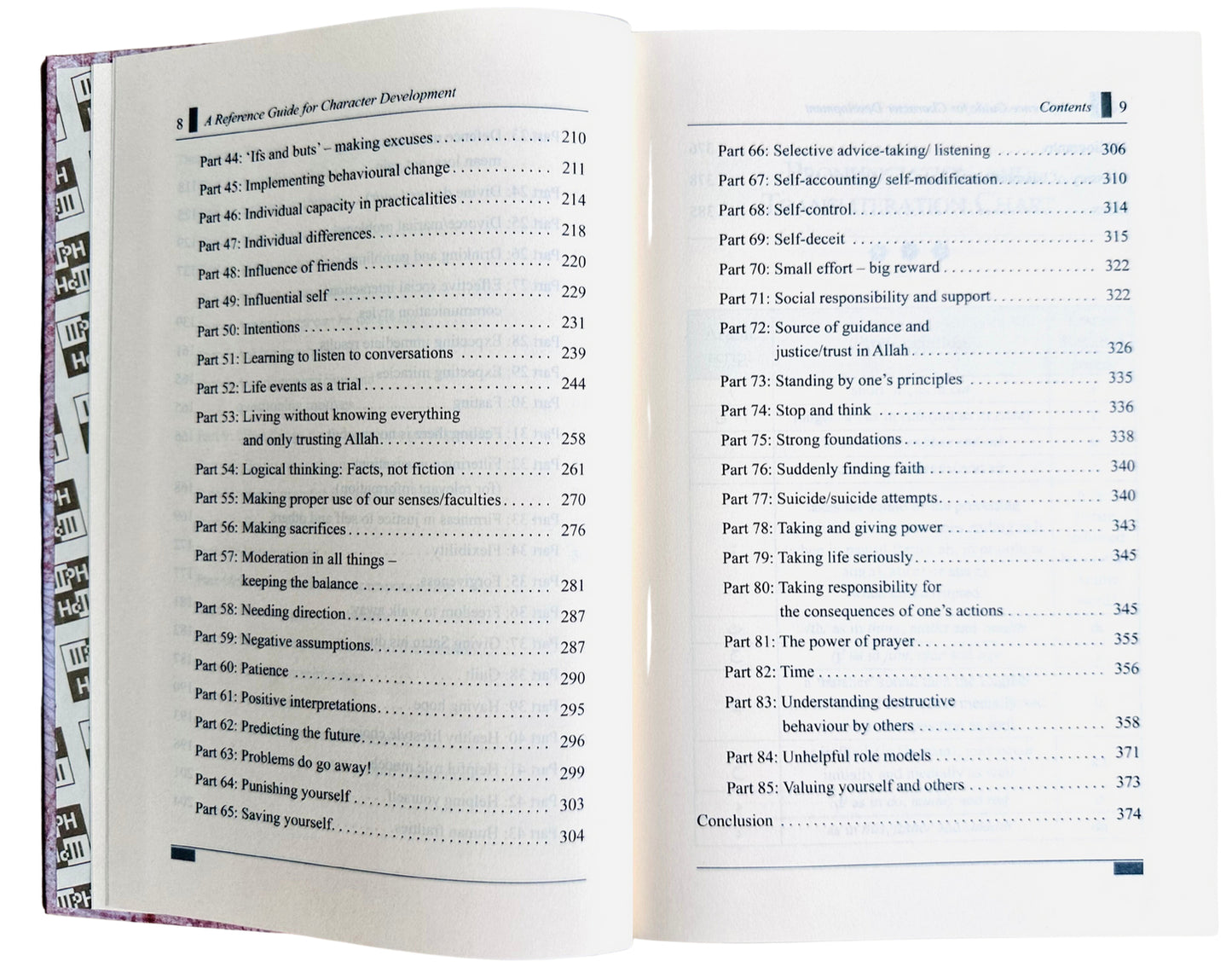
Page:04
A Reference Guide for Character Development
single not Contents 9
Part 44: 'Ifs and buts' - making excuses..
Part 45: Implementing behavioural change..
Part 66: Selective advice-taking/ listening
Part 46: Individual capacity in practicalities.
Part 67: Self-accounting/ self-modification.
Part 68: Self-control..
Part 47: Individual differences..
Part 69: Self-deceit
Part 48: Influence of friends
Part 70: Small effort - big reward.
Part 49: Influential self
Part 71: Social responsibility and support.
Part 50: Intentions.
Part 72: Source of guidance and
Part 51: Learning to listen to conversations
justice/trust in Allah..
Part 52: Life events as a trial.
Part 73: Standing by one's principles
Part 53: Living without knowing everything and only trusting Allah..
Part 74: Stop and think
Part 75: Strong foundation
Part 54: Logical thinking: Facts, not fiction .
Part 76: Suddenly finding faith
Part 55: Making proper use of our senses/faculties..
Part 56: Making sacrifices..
Part 57: Moderation in all things - keeping the balance
Part 58: Needing direction..
Part 77: Suicide/suicide attempts.
Part 78: Taking and giving power
Part 79: Taking life seriously.
Part 80: Taking responsibility for the consequences of one's actions
Part 59: Negative assumptions.
Part 81: The power of prayer..
Part 60: Patience
Part 82: Time..
Part 61: Positive interpretations.
Part 83: Understanding destructive
Part 62: Predicting the future.
behaviour by others
Part 65: Saving yourself..
Part 64: Punishing yourself..
Part 63: Problems do go away!
Part 84: Unhelpful role models
Part 85: Valuing yourself and others.
Conclusion
Page:05
A Reference Guide for Character Development
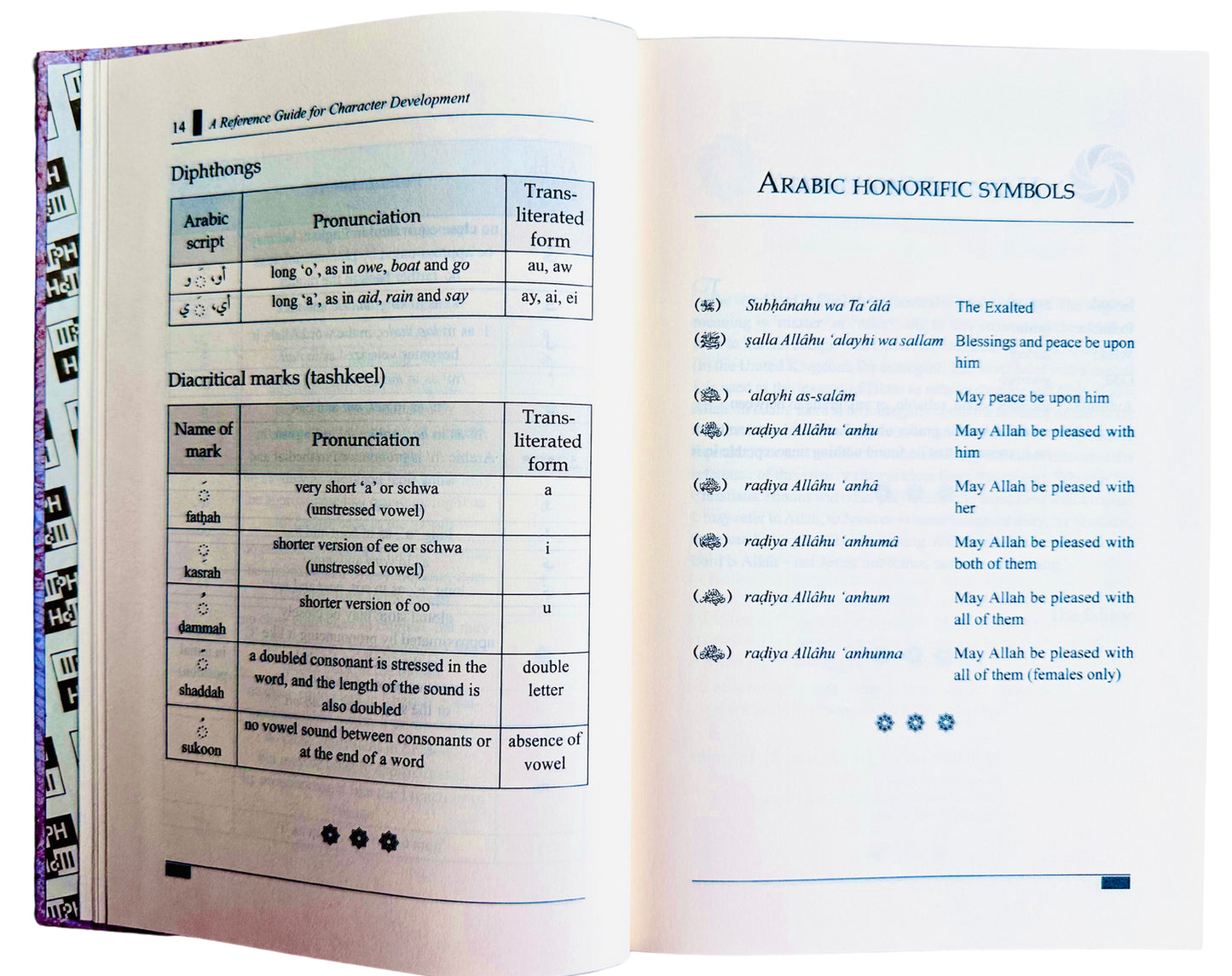
Diphthongs
Arabic
Pronunciation
script
Trans-
literated form
ARABIC HONORIFIC SYMBOLS
أو و
أي، ي
long 'o', as in owe, boat and go long 'a', as in aid, rain and say
au, aw
ay, ai, ei
Subhanahu wa Ta'âlâ
The Exalted
(*) şalla Allahu 'alayhi wa sallam Blessings and peace be upon him
Diacritical marks (tashkeel)
Name of
Pronunciation
mark
Trans- literated form
() 'alayhi as-salâm () radiya Allahu 'anhu
May peace be upon him
May Allah be pleased with him
fathah
very short 'a' or schwa (unstressed vowel)
() radiya Allahu 'anhâ
May Allah be pleased with
shorter version of ee or schwa
kasrah
(unstressed vowel)
shorter version of oo
dammah
shaddah
a doubled consonant is stressed in the word, and the length of the sound is also doubled
double
() radiya Allahu 'anhuma
) radiya Allahu 'anhum
() radiya Allahu 'anhunna
her
May Allah be pleased with both of them
May Allah be pleased with all of them
May Allah be pleased with all of them (females only)
letter
sukoon
no vowel sound between consonants or absence of
at the end of a word
vowel
Page:06
A Reference Guide for Character Development
it had not been there the day before. Thus We explain the revelations
in detail for people who reflect. (Yoonus 10: 23-24)1
These verses offer a powerful analogy of the ingratitude of individuals for the blessings they have and again of the selective use
of guidance, this time after they have received benefit.
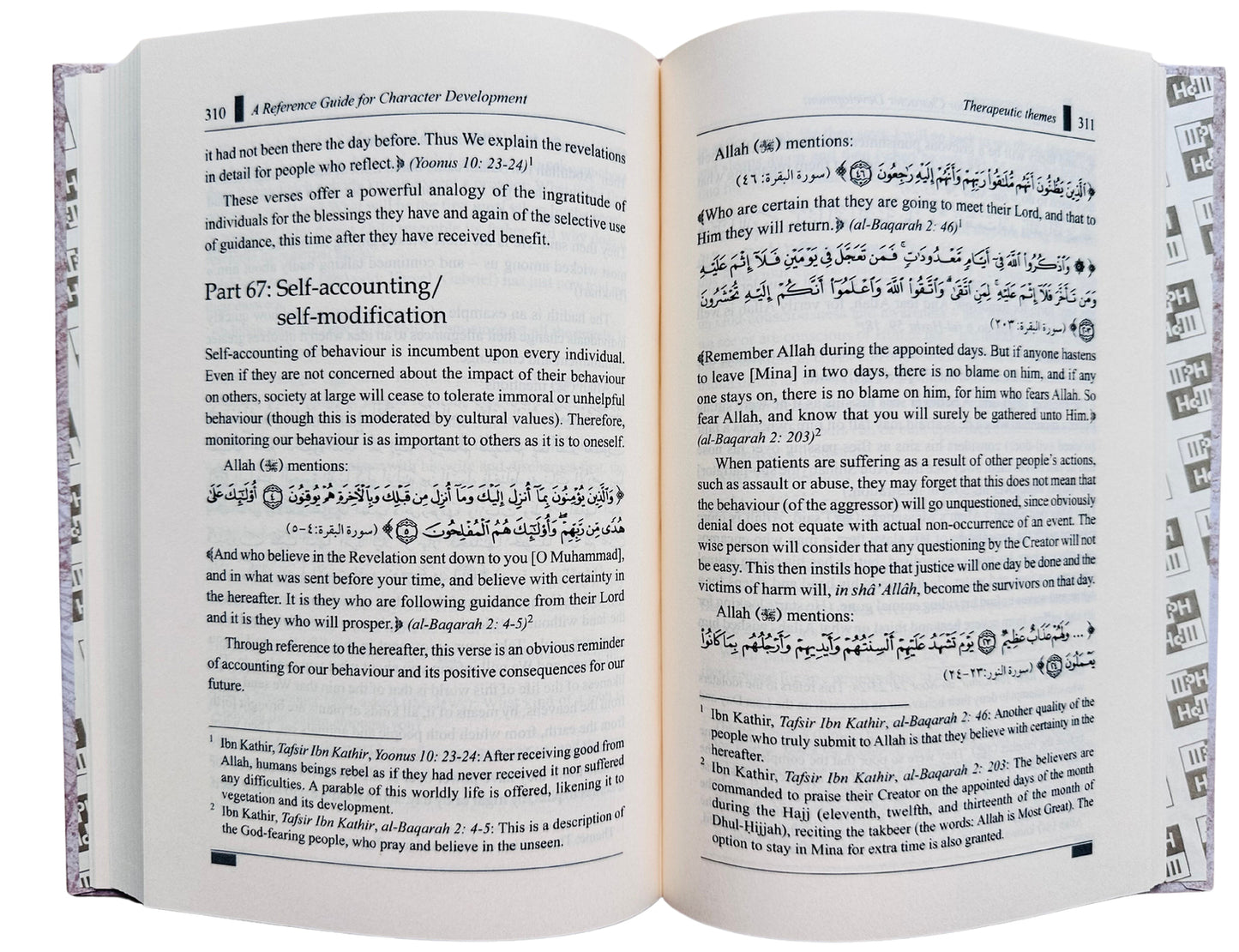
Part 67: Self-accounting/
self-modification
Self-accounting of behaviour is incumbent upon every individual. Even if they are not concerned about the impact of their behaviour on others, society at large will cease to tolerate immoral or unhelpful behaviour (though this is moderated by cultural values). Therefore, monitoring our behaviour is as important to others as it is to oneself. Allah () mentions:
وَالَّذِينَ يُؤْمِنُونَ بِمَا أُنزِلَ إِلَيْكَ وَمَا أُنزِلَ مِن قَبْلِكَ وَبِالْآخِرَةِ هُمْ يُوقِنُونَ أُولَبِكَ عَلَى هُدًى مِن رَّبِّهِمْ وَأُوْلَبِكَ هُمُ الْمُفْلِحُونَ ﴾ (سورة البقرة : ٤ - ٥)
And who believe in the Revelation sent down to you [O Muhammad], and in what was sent before your time, and believe with certainty in the hereafter. It is they who are following guidance from their Lord and it is they who will prosper. (al-Baqarah 2: 4-5)2
Through reference to the hereafter, this verse is an obvious reminder of accounting for our behaviour and its positive consequences for our
future.
1Ibn Kathir, Tafsir Ibn Kathir, Yoonus 10: 23-24: After receiving good from Allah, humans beings rebel as if they had never received it nor suffered any difficulties. A parable of this worldly life is offered, likening it to
vegetation and its development.
Ibn Kathir, Tafsir Ibn Kathir, al-Baqarah 2: 4-5: This is a description of the God-fearing people, who pray and believe in the unseen.
Allah (3) mentions:
Therapeutic themes
الَّذِينَ يَظُنُّونَ أَنَّهُم مُلَقُوا رَتِهِمْ وَأَنَّهُمْ إِلَيْهِ رَاجِعُونَ )
(سورة البقرة: ٤٦)
Who are certain that they are going to meet their Lord, and that to Him they will return.» (al-Baqarah 2: 46)
وَاذْكُرُوا اللَّهَ فِي أَيَّامٍ مَعْدُودَاتٍ فَمَن تَعَجَّلَ فِي يَوْمَيْنِ فَلَا إِثْمَ عَلَيْهِ وَمَن تَأَخَرَ فَلَا إِثْمَ عَلَيْهِ لِمَنِ اتَّقَى وَاتَّقُوا اللَّهَ وَاعْلَمُوا أَنَّكُمْ إِلَيْهِ تُحْشَرُونَ
(سورة البقرة: ٢٠٣)
Remember Allah during the appointed days. But if anyone hastens to leave [Mina] in two days, there is no blame on him, and if any one stays on, there is no blame on him, for him who fears Allah. So fear Allah, and know that you will surely be gathered unto Him. (al-Baqarah 2: 203)2
When patients are suffering as a result of other people's actions, such as assault or abuse, they may forget that this does not mean that the behaviour (of the aggressor) will go unquestioned, since obviously denial does not equate with actual non-occurrence of an event. The wise person will consider that any questioning by the Creator will not be easy. This then instils hope that justice will one day be done and the victims of harm will, in sha' Allah, become the survivors on that day. Allah (3) mentions:
... وَقَهُمْ عَذَابٌ عَظِيمٌ يَوْمَ تَشْهَدُ عَلَيْهِمْ أَلْسِنَتُهُمْ وَأَيْدِيهِمْ وَأَرْجُلُهُم بِمَا كَانُوا
يعْمَلُونَ ) (سورة النور : ٢٣-٢٤)
hereafter.
Ibn Kathir, Tafsir Ibn Kathir, al-Baqarah 2: 46: Another quality of the people who truly submit to Allah is that they believe with certainty in the 2 Ibn Kathir, Tafsir Ibn Kathir, al-Baqarah 2: 203: The believers are commanded to praise their Creator on the appointed days of the month during the Hajj (eleventh, twelfth, and thirteenth of the month of Dhul-Hijjah), reciting the takbeer (the words: Allah is Most Great). The option to stay in Mina for extra time is also granted.
Page:07
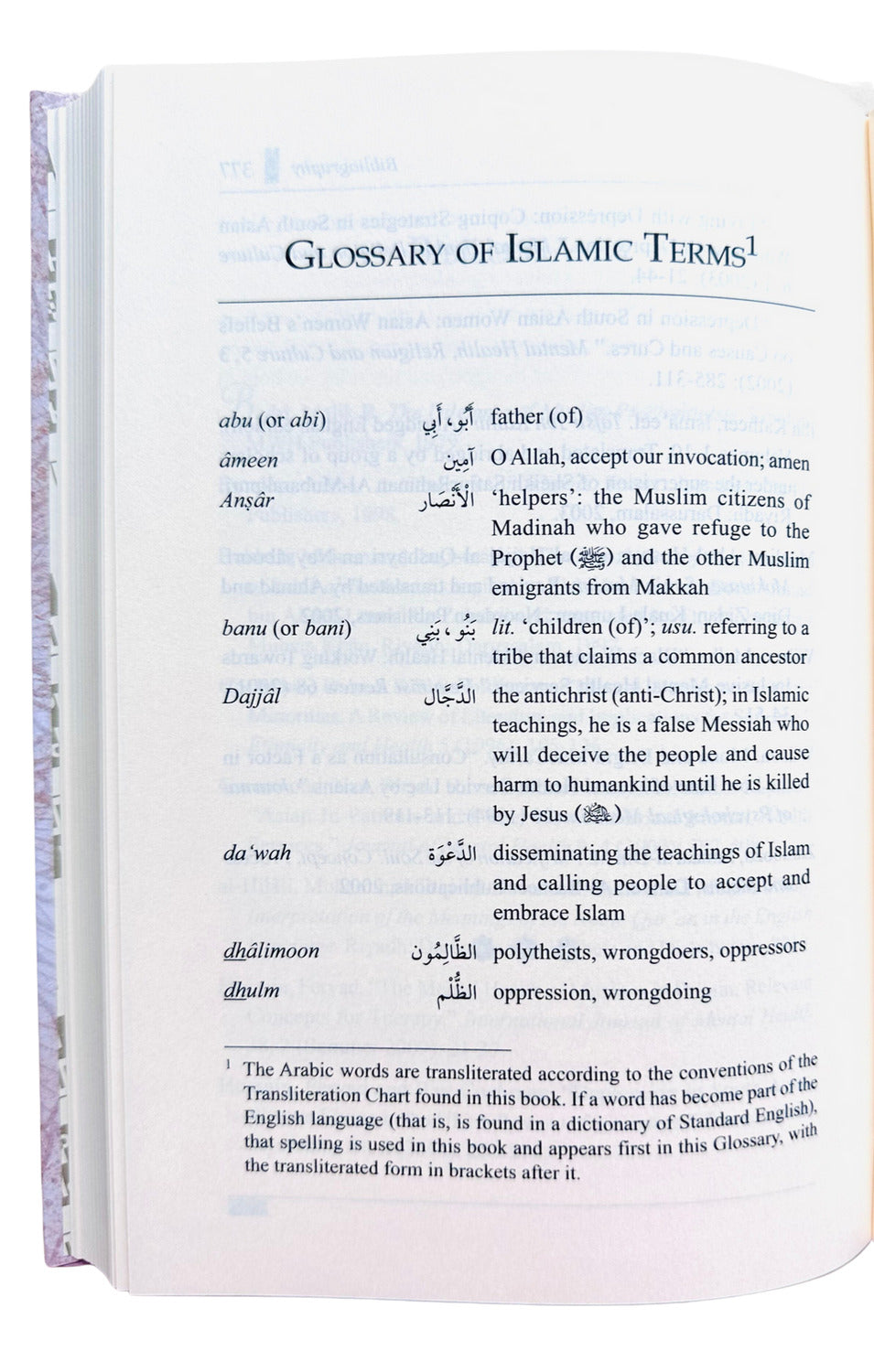
GLOSSARY OF ISLAMIC TERMS1
Dajjal
da'wah
dhâlimoon dhulm
(father (of أبو ، أبي
O Allah, accept our invocation; amen helpers': the Muslim citizens of Madinah who gave refuge to the Prophet () and the other Muslim emigrants from Makkah
lit. children (of)'; usu. referring to a atribe that claims a common ancestor JJ the antichrist (anti-Christ); in Islamic
teachings, he is a false Messiah who will deceive the people and cause harm to humankind until he is killed by Jesus ()
disseminating the teachings of Islam الدعوة
and calling people to accept and
embrace Islam
JÚ polytheists, wrongdoers, oppressors
oppression, wrongdoing
The Arabic words are transliterated according to the conventions of the Transliteration Chart found in this book. If a word has become part of the English language (that is, is found in a dictionary of Standard English), that spelling is used in this book and appears first in this Glossary, with
the transliterated form in brackets after it.
Page:08
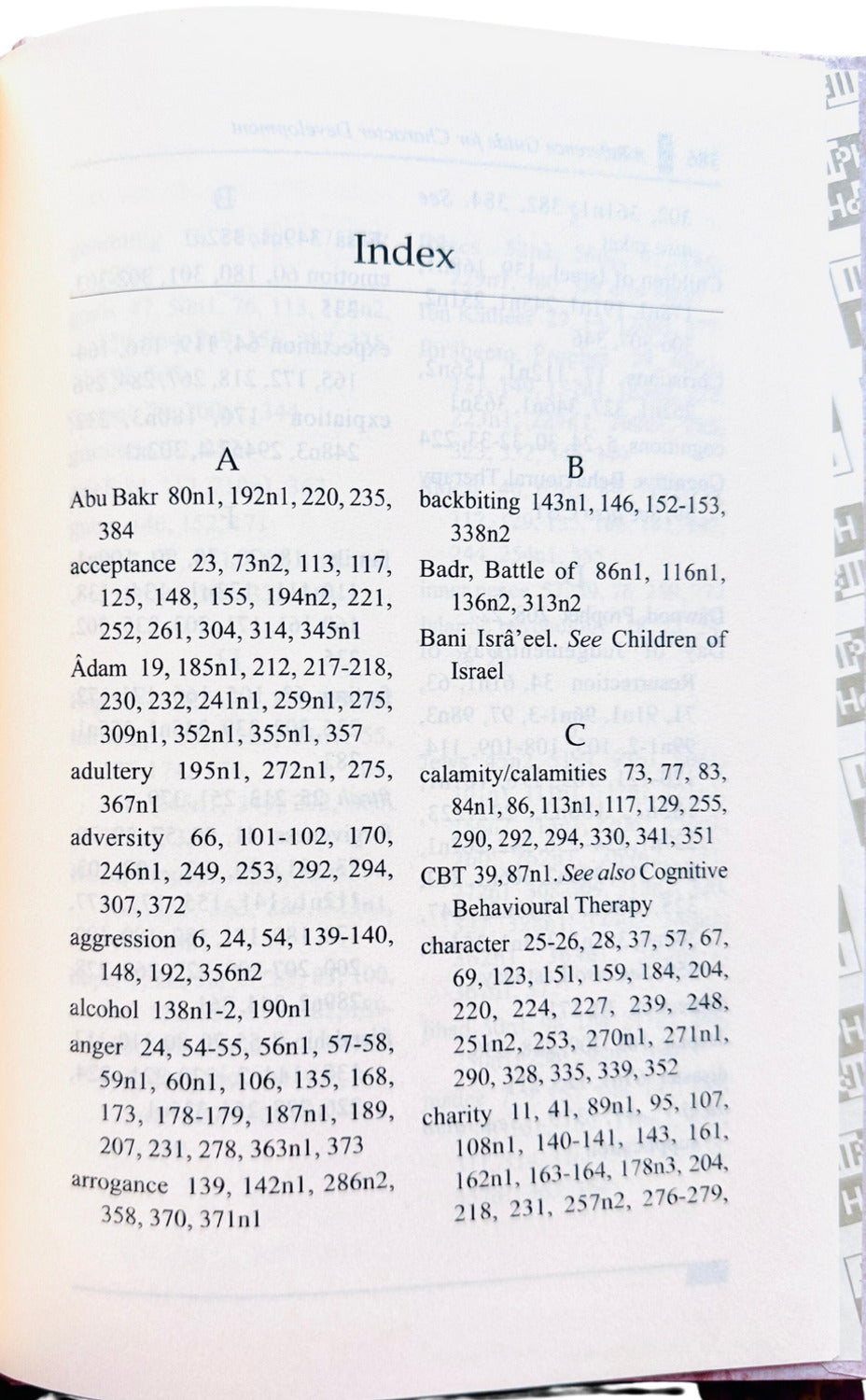
Index
Page:09
THERAPY
QUAN AND SERIES
A Reference Guide for Character Development
A believer has full faith and trust in Allah and in His divine decree, yet may nonetheless suffer from psychological issues that require assistance from a therapist. Modern secular psychology does not tend to consider the impact or benefits of religion and spirituality on our well-being, even though these are often the most important aspect of a Muslim's life. This can often not only increase distress and suffering, but also lead to a crisis of faith
In this book, Dr. Feryad A. Hussain blends modern psychology with verses from the Qur'an and authentic hadiths. Through an Islamic reframing of eighty-five therapeutic themes which include self-control, patience, accepting advice, anger/aggression, being grateful, confidence, coping, flexibility, guilt, and many more Dr. Hussain draws on her extensive experience as a clinical psychologist to offer alternative understandings based on Allah's message to humankind. The text offers logic and divine comfort to help both client and therapist resolve their issues through faith, contemplation, and prayer.
About the author
Dr. Feryad A. Hussain is an experienced consultant clinical psychologist. She has worked with multiple government, academic and healthcare institutions to highlight awareness and encourage inclusion of the psychological aspects of health and well-being in all areas of life and living. She has a special interest in Islamically-centred character development and actualizing these principles as a way of living one's best life.
Publisher
IIPH (International Islamic Publishing House)
Author
- Dr Feryad A Hussain
Shipping and Delivery
We dispatch orders directly from our UK and USA warehouses, offering multiple shipping options to suit your needs. We proudly ship worldwide.
UK Deliveries (from UK warehouse):
Standard shipping typically arrives within 3–4 working days. Expedited delivery takes 2–3 working days. We aim to dispatch orders the same day or next working day, with next-day delivery options available where applicable.
USA Deliveries (from USA warehouse):
Orders usually arrive within 4–7 working days.
Europe (shipped from UK):
Standard delivery takes approximately 6–10 working days, with expedited services available in 3–5 working days.
Canada:
Estimated delivery time is 5–10 working days.
Worldwide Shipping:
International orders generally arrive within 5–20 working days, depending on destination and shipping method selected.
For precise delivery timelines based on your location, please contact us by email and our team will provide detailed information tailored to your address.
Sample Pages - Content
Page:01
THERAPY FROM THE
QURAN AND SUNNAH SERIES
A Reference Guide for Character Development
العلاج من القرآن والسنة
لتطوير الشخصية دليل مرجعي
Dr. Feryad A. Hussain
الدار العالمية للكتاب الإسلامي PM
Page:02
THERAPY FROM THE QUR'AN AND SUNNAH SERIES
A Reference Guide for
Character Development
Title: A Reference Guide for Character Development
Author: Dr. Feryad A. Hussain
English Edition 1 (2023)
Layout Design: IIPH
دليل مرجعي لتطوير الشخصية
IIPH
Dr. Feryad A. Hussain
الدار العالمية للكتاب الإسلامي
International Islamic Publishing House
Page:03
CONTENTS
Pronunciation and Transliteration Chart...
Arabic honorific symbols.
Hadith grade terms
About the Word 'Lord'
Publisher's Note
Dedication.
Acknowledgements.
Foreword..
Introduction..
What is the purpose of this book?
Who is the book for?
The analogical model..
Choosing between clinical
diagnosis and clinical cognitions
Calling to Islam or calling to therapy?. Using the reference text. Interpretation of the Qur'an. Interpretation of hadiths.
The remit of the text..
Page:04
A Reference Guide for Character Development
single not Contents 9
Part 44: 'Ifs and buts' - making excuses..
Part 45: Implementing behavioural change..
Part 66: Selective advice-taking/ listening
Part 46: Individual capacity in practicalities.
Part 67: Self-accounting/ self-modification.
Part 68: Self-control..
Part 47: Individual differences..
Part 69: Self-deceit
Part 48: Influence of friends
Part 70: Small effort - big reward.
Part 49: Influential self
Part 71: Social responsibility and support.
Part 50: Intentions.
Part 72: Source of guidance and
Part 51: Learning to listen to conversations
justice/trust in Allah..
Part 52: Life events as a trial.
Part 73: Standing by one's principles
Part 53: Living without knowing everything and only trusting Allah..
Part 74: Stop and think
Part 75: Strong foundation
Part 54: Logical thinking: Facts, not fiction .
Part 76: Suddenly finding faith
Part 55: Making proper use of our senses/faculties..
Part 56: Making sacrifices..
Part 57: Moderation in all things - keeping the balance
Part 58: Needing direction..
Part 77: Suicide/suicide attempts.
Part 78: Taking and giving power
Part 79: Taking life seriously.
Part 80: Taking responsibility for the consequences of one's actions
Part 59: Negative assumptions.
Part 81: The power of prayer..
Part 60: Patience
Part 82: Time..
Part 61: Positive interpretations.
Part 83: Understanding destructive
Part 62: Predicting the future.
behaviour by others
Part 65: Saving yourself..
Part 64: Punishing yourself..
Part 63: Problems do go away!
Part 84: Unhelpful role models
Part 85: Valuing yourself and others.
Conclusion
Page:05
A Reference Guide for Character Development
Diphthongs
Arabic
Pronunciation
script
Trans-
literated form
ARABIC HONORIFIC SYMBOLS
أو و
أي، ي
long 'o', as in owe, boat and go long 'a', as in aid, rain and say
au, aw
ay, ai, ei
Subhanahu wa Ta'âlâ
The Exalted
(*) şalla Allahu 'alayhi wa sallam Blessings and peace be upon him
Diacritical marks (tashkeel)
Name of
Pronunciation
mark
Trans- literated form
() 'alayhi as-salâm () radiya Allahu 'anhu
May peace be upon him
May Allah be pleased with him
fathah
very short 'a' or schwa (unstressed vowel)
() radiya Allahu 'anhâ
May Allah be pleased with
shorter version of ee or schwa
kasrah
(unstressed vowel)
shorter version of oo
dammah
shaddah
a doubled consonant is stressed in the word, and the length of the sound is also doubled
double
() radiya Allahu 'anhuma
) radiya Allahu 'anhum
() radiya Allahu 'anhunna
her
May Allah be pleased with both of them
May Allah be pleased with all of them
May Allah be pleased with all of them (females only)
letter
sukoon
no vowel sound between consonants or absence of
at the end of a word
vowel
Page:06
A Reference Guide for Character Development
it had not been there the day before. Thus We explain the revelations
in detail for people who reflect. (Yoonus 10: 23-24)1
These verses offer a powerful analogy of the ingratitude of individuals for the blessings they have and again of the selective use
of guidance, this time after they have received benefit.
Part 67: Self-accounting/
self-modification
Self-accounting of behaviour is incumbent upon every individual. Even if they are not concerned about the impact of their behaviour on others, society at large will cease to tolerate immoral or unhelpful behaviour (though this is moderated by cultural values). Therefore, monitoring our behaviour is as important to others as it is to oneself. Allah () mentions:
وَالَّذِينَ يُؤْمِنُونَ بِمَا أُنزِلَ إِلَيْكَ وَمَا أُنزِلَ مِن قَبْلِكَ وَبِالْآخِرَةِ هُمْ يُوقِنُونَ أُولَبِكَ عَلَى هُدًى مِن رَّبِّهِمْ وَأُوْلَبِكَ هُمُ الْمُفْلِحُونَ ﴾ (سورة البقرة : ٤ - ٥)
And who believe in the Revelation sent down to you [O Muhammad], and in what was sent before your time, and believe with certainty in the hereafter. It is they who are following guidance from their Lord and it is they who will prosper. (al-Baqarah 2: 4-5)2
Through reference to the hereafter, this verse is an obvious reminder of accounting for our behaviour and its positive consequences for our
future.
1Ibn Kathir, Tafsir Ibn Kathir, Yoonus 10: 23-24: After receiving good from Allah, humans beings rebel as if they had never received it nor suffered any difficulties. A parable of this worldly life is offered, likening it to
vegetation and its development.
Ibn Kathir, Tafsir Ibn Kathir, al-Baqarah 2: 4-5: This is a description of the God-fearing people, who pray and believe in the unseen.
Allah (3) mentions:
Therapeutic themes
الَّذِينَ يَظُنُّونَ أَنَّهُم مُلَقُوا رَتِهِمْ وَأَنَّهُمْ إِلَيْهِ رَاجِعُونَ )
(سورة البقرة: ٤٦)
Who are certain that they are going to meet their Lord, and that to Him they will return.» (al-Baqarah 2: 46)
وَاذْكُرُوا اللَّهَ فِي أَيَّامٍ مَعْدُودَاتٍ فَمَن تَعَجَّلَ فِي يَوْمَيْنِ فَلَا إِثْمَ عَلَيْهِ وَمَن تَأَخَرَ فَلَا إِثْمَ عَلَيْهِ لِمَنِ اتَّقَى وَاتَّقُوا اللَّهَ وَاعْلَمُوا أَنَّكُمْ إِلَيْهِ تُحْشَرُونَ
(سورة البقرة: ٢٠٣)
Remember Allah during the appointed days. But if anyone hastens to leave [Mina] in two days, there is no blame on him, and if any one stays on, there is no blame on him, for him who fears Allah. So fear Allah, and know that you will surely be gathered unto Him. (al-Baqarah 2: 203)2
When patients are suffering as a result of other people's actions, such as assault or abuse, they may forget that this does not mean that the behaviour (of the aggressor) will go unquestioned, since obviously denial does not equate with actual non-occurrence of an event. The wise person will consider that any questioning by the Creator will not be easy. This then instils hope that justice will one day be done and the victims of harm will, in sha' Allah, become the survivors on that day. Allah (3) mentions:
... وَقَهُمْ عَذَابٌ عَظِيمٌ يَوْمَ تَشْهَدُ عَلَيْهِمْ أَلْسِنَتُهُمْ وَأَيْدِيهِمْ وَأَرْجُلُهُم بِمَا كَانُوا
يعْمَلُونَ ) (سورة النور : ٢٣-٢٤)
hereafter.
Ibn Kathir, Tafsir Ibn Kathir, al-Baqarah 2: 46: Another quality of the people who truly submit to Allah is that they believe with certainty in the 2 Ibn Kathir, Tafsir Ibn Kathir, al-Baqarah 2: 203: The believers are commanded to praise their Creator on the appointed days of the month during the Hajj (eleventh, twelfth, and thirteenth of the month of Dhul-Hijjah), reciting the takbeer (the words: Allah is Most Great). The option to stay in Mina for extra time is also granted.
Page:07
GLOSSARY OF ISLAMIC TERMS1
Dajjal
da'wah
dhâlimoon dhulm
(father (of أبو ، أبي
O Allah, accept our invocation; amen helpers': the Muslim citizens of Madinah who gave refuge to the Prophet () and the other Muslim emigrants from Makkah
lit. children (of)'; usu. referring to a atribe that claims a common ancestor JJ the antichrist (anti-Christ); in Islamic
teachings, he is a false Messiah who will deceive the people and cause harm to humankind until he is killed by Jesus ()
disseminating the teachings of Islam الدعوة
and calling people to accept and
embrace Islam
JÚ polytheists, wrongdoers, oppressors
oppression, wrongdoing
The Arabic words are transliterated according to the conventions of the Transliteration Chart found in this book. If a word has become part of the English language (that is, is found in a dictionary of Standard English), that spelling is used in this book and appears first in this Glossary, with
the transliterated form in brackets after it.
Page:08
Index
Page:09
THERAPY
QUAN AND SERIES
A Reference Guide for Character Development
A believer has full faith and trust in Allah and in His divine decree, yet may nonetheless suffer from psychological issues that require assistance from a therapist. Modern secular psychology does not tend to consider the impact or benefits of religion and spirituality on our well-being, even though these are often the most important aspect of a Muslim's life. This can often not only increase distress and suffering, but also lead to a crisis of faith
In this book, Dr. Feryad A. Hussain blends modern psychology with verses from the Qur'an and authentic hadiths. Through an Islamic reframing of eighty-five therapeutic themes which include self-control, patience, accepting advice, anger/aggression, being grateful, confidence, coping, flexibility, guilt, and many more Dr. Hussain draws on her extensive experience as a clinical psychologist to offer alternative understandings based on Allah's message to humankind. The text offers logic and divine comfort to help both client and therapist resolve their issues through faith, contemplation, and prayer.
About the author
Dr. Feryad A. Hussain is an experienced consultant clinical psychologist. She has worked with multiple government, academic and healthcare institutions to highlight awareness and encourage inclusion of the psychological aspects of health and well-being in all areas of life and living. She has a special interest in Islamically-centred character development and actualizing these principles as a way of living one's best life.
Who is Dr Feryad A Hussain?
Dr. Feryad A. Hussain is a clinical psychologist known for her work integrating Islamic teachings with modern psychological practices. She has authored books like Therapy from the Quran and Ahadith and A Reference Guide for Character Development, which offer Islamic perspectives on addressing psychological challenges. These works combine Quranic verses and Hadith with therapeutic approaches to tackle issues such as anger, patience, self-control, and emotional well-being.