


A Lost Etiquette by Muhammad Ismail Al-Muqaddim | Reviving Islamic Manners & Conduct
A Lost Etiquette by Muhammad Ismail Al-Muqaddim | Reviving Islamic Manners & Conduct
Publisher:
IIPH (International Islamic Publishing House)
Author:
Muhammad Ismail al-Muqaddim
Language:
English
Binding:
Hard Cover
Pages: 185
Size: 22cmx15cm
Couldn't load pickup availability


Collapsible content
Description of islamic Book
A Lost Etiquette addresses the decline of Islamic manners in personal and social life, highlighting the importance of reviving noble character and proper conduct as taught in the Qur’an and Sunnah.
From Author:
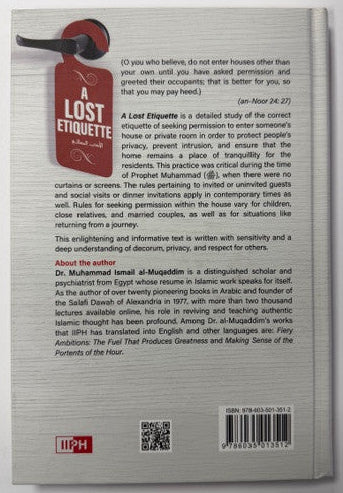
O you who believe, do not enter houses other than your own until you have asked permission and greeted their occupants; that is better for you, so that you may pay heed.} (an-Noor 24: 27)
A Lost Etiquette is a detailed study of the correct etiquette of seeking permission to enter someone’s house or private room in order to protect people’s privacy, prevent intrusion, and ensure that the home remains a place of tranquillity for the residents. This practice was critical during the time of Prophet Muhammad (bpuh), when there were no curtains or screens. The rules pertaining to invited or uninvited guests and social visits or dinner invitations apply in contemporary times as well. Rules for seeking permission within the house vary for children, close relatives, and married couples, as well as for situations like returning from a journey.
This enlightening and informative text is written with sensitivity and a deep understanding of decorum, privacy, and respect for others.
Page:01
LOST ETIQUETTEA COMPREHENSIVE RESEARCH INTO THE RULESAND ETIQUETTE OF SEEKING PERMISSIONالأدب الضائعM. ISMAIL AL-MUQADDIMالدار العالمية للكتاب الإسلامي
Page:02
Contentshieddien HusseinPronunciation and Transliteration Chart.Arabic honorific symbolsHadith grade terms.داشتAbout the Word "Lord"Publisher's Notek may be produced or mechanical, including and retrieval system,via the Internet or via Publisher is illegal and onic editions, and do not materials. Your support(UPH) Arabia h.comTranslator's Foreword.Preface to the Revised Arabic EditionPreface to the 1st Arabic EditionDefinition of isti 'dhanNote.The ruling of isti 'dhân.The wisdom behind seeking permission. Seeking permission has been legislated to conceal the private affairs of people and their wealth. The way to seek permissionWhat comes first: the salám or the isti 'dhân? A point of benefit.Permission is to be sought three times
Page:03
Amusing incidentshighlighting the reprimand ofthose who answer: MeAl-Khateeb al-Baghdadi reports:"Ali ibn 'Aşim al-Wäsiți mentions: I arrived in Bases and wathe house of Shu'bah.I knocked on the door, and he asked: Who is it? I replied: And [it is me].He exclaimed: What is this? I do not have a friend called He came out to me and explained: Muhammad ibn al-Ma narrated from Jabir ibn 'Abdullah:He (Jabir) related: I came to the Messenger of Allah regarding a debt which my father owed.I knocked on the door.He asked: Who is there?I replied: Me.He came out repeating: Me, me...-as if he disliked the stat (Bukhari and Muslim)'He also reported that Ahmad ibn Yahya relates:A man knocked on the door of another man. He asked WheaThe man replied: Ha and dhd [It is me). He ordered: O Ha aná dhá! Enter!al-Baghdadi, al-Jami' li Akhlaq, 1:163-164.After this, the man's nickname beca He also reported from Muhammad His father said: I knocked on the d asked: Who is there? I replied: Me beHe answered: Nobody knows the s Then al-Khateeb al-Baghdidi sepe I heard fudge "Ali ibn al-Masin s The scholar would say that when he would ask: Who is it? If the pe would respond [sarcastically) Th Abu Nu'aym al-Fadl ibn Dakan enjoyed playing jokes on people "Ali ibn al-Abbis al-Magini'i sa al-Angazi narrate that a man kn He asked: Who is it? The man replied: Me He asked: Who is "me? He replied: One of the children Abu Na'aym went out to him an I did not think any of his child Another of these amusing inciden in his al-Jimi from Mugheerah A man came to briboem an bere?al-Baghdadi, alJim & 1 al-Baghdadi, af Almig, 1 al-Baghdi, af-Jamil 12 adb-Dhahabi, Sar &'m an-Naba
Page:04
A Lost EtiquetteThe wisdom behind repeating the isti dhan three timesWhoever ascertains that the people of the household have heardmust leave after the third isti 'dhânAnother situation: Those who knowtheir greeting was not heard should leave after seeking permission three times.Does knocking on the door hold the same place as uttering words of isti 'dhân?.NoteIf it is said to a person: Enter inIf someone is told: Wait until I where should the person wait? The impermissibility of lookin without the permission of the mA point of benefitAn individual looks inside a he being permitted, and one of the the person's eye. Is the inhabit If a messenger is sent to fetch count as permission for the ins The recommendation for Musi Do not take up the time of tho Do not show up before your aThe sublimity of Islamic dec A point of benefit Seeking permission within the Proofs and evidenceA man need not seek his wife! permission before entering It is preferred for a man to not his wife before enteringShould a man seek permission entering to see his wife, on wi has pronounced divorce once?NoteGranting permission through a signal.If permitted, a person should ascertain if it woloTis better to abstain due to circumstances.If an individual is asked who it is,the person should not answer: MeThe reason for the dislike of saying: MeNote..Amusing incidents highlighting thereprimand of those who answer: Me.There is no harm in saying 'me' at an appropriate time when alluding to oneselfWhere does the one seeking permission stand? Note.What does one do if not permitted to enter? Alternatives to lying.
Publisher
IIPH (International Islamic Publishing House)
Author
- Muhammad Ismail al-Muqaddim
Shipping and Delivery
We dispatch orders directly from our UK and USA warehouses, offering multiple shipping options to suit your needs. We proudly ship worldwide.
UK Deliveries (from UK warehouse):
Standard shipping typically arrives within 3–4 working days. Expedited delivery takes 2–3 working days. We aim to dispatch orders the same day or next working day, with next-day delivery options available where applicable.
USA Deliveries (from USA warehouse):
Orders usually arrive within 4–7 working days.
Europe (shipped from UK):
Standard delivery takes approximately 6–10 working days, with expedited services available in 3–5 working days.
Canada:
Estimated delivery time is 5–10 working days.
Worldwide Shipping:
International orders generally arrive within 5–20 working days, depending on destination and shipping method selected.
For precise delivery timelines based on your location, please contact us by email and our team will provide detailed information tailored to your address.
Sample Pages - Content
Page:01
LOST ETIQUETTEA COMPREHENSIVE RESEARCH INTO THE RULESAND ETIQUETTE OF SEEKING PERMISSIONالأدب الضائعM. ISMAIL AL-MUQADDIMالدار العالمية للكتاب الإسلامي
Page:02
Contentshieddien HusseinPronunciation and Transliteration Chart.Arabic honorific symbolsHadith grade terms.داشتAbout the Word "Lord"Publisher's Notek may be produced or mechanical, including and retrieval system,via the Internet or via Publisher is illegal and onic editions, and do not materials. Your support(UPH) Arabia h.comTranslator's Foreword.Preface to the Revised Arabic EditionPreface to the 1st Arabic EditionDefinition of isti 'dhanNote.The ruling of isti 'dhân.The wisdom behind seeking permission. Seeking permission has been legislated to conceal the private affairs of people and their wealth. The way to seek permissionWhat comes first: the salám or the isti 'dhân? A point of benefit.Permission is to be sought three times
Page:03
Amusing incidentshighlighting the reprimand ofthose who answer: MeAl-Khateeb al-Baghdadi reports:"Ali ibn 'Aşim al-Wäsiți mentions: I arrived in Bases and wathe house of Shu'bah.I knocked on the door, and he asked: Who is it? I replied: And [it is me].He exclaimed: What is this? I do not have a friend called He came out to me and explained: Muhammad ibn al-Ma narrated from Jabir ibn 'Abdullah:He (Jabir) related: I came to the Messenger of Allah regarding a debt which my father owed.I knocked on the door.He asked: Who is there?I replied: Me.He came out repeating: Me, me...-as if he disliked the stat (Bukhari and Muslim)'He also reported that Ahmad ibn Yahya relates:A man knocked on the door of another man. He asked WheaThe man replied: Ha and dhd [It is me). He ordered: O Ha aná dhá! Enter!al-Baghdadi, al-Jami' li Akhlaq, 1:163-164.After this, the man's nickname beca He also reported from Muhammad His father said: I knocked on the d asked: Who is there? I replied: Me beHe answered: Nobody knows the s Then al-Khateeb al-Baghdidi sepe I heard fudge "Ali ibn al-Masin s The scholar would say that when he would ask: Who is it? If the pe would respond [sarcastically) Th Abu Nu'aym al-Fadl ibn Dakan enjoyed playing jokes on people "Ali ibn al-Abbis al-Magini'i sa al-Angazi narrate that a man kn He asked: Who is it? The man replied: Me He asked: Who is "me? He replied: One of the children Abu Na'aym went out to him an I did not think any of his child Another of these amusing inciden in his al-Jimi from Mugheerah A man came to briboem an bere?al-Baghdadi, alJim & 1 al-Baghdadi, af Almig, 1 al-Baghdi, af-Jamil 12 adb-Dhahabi, Sar &'m an-Naba
Page:04
A Lost EtiquetteThe wisdom behind repeating the isti dhan three timesWhoever ascertains that the people of the household have heardmust leave after the third isti 'dhânAnother situation: Those who knowtheir greeting was not heard should leave after seeking permission three times.Does knocking on the door hold the same place as uttering words of isti 'dhân?.NoteIf it is said to a person: Enter inIf someone is told: Wait until I where should the person wait? The impermissibility of lookin without the permission of the mA point of benefitAn individual looks inside a he being permitted, and one of the the person's eye. Is the inhabit If a messenger is sent to fetch count as permission for the ins The recommendation for Musi Do not take up the time of tho Do not show up before your aThe sublimity of Islamic dec A point of benefit Seeking permission within the Proofs and evidenceA man need not seek his wife! permission before entering It is preferred for a man to not his wife before enteringShould a man seek permission entering to see his wife, on wi has pronounced divorce once?NoteGranting permission through a signal.If permitted, a person should ascertain if it woloTis better to abstain due to circumstances.If an individual is asked who it is,the person should not answer: MeThe reason for the dislike of saying: MeNote..Amusing incidents highlighting thereprimand of those who answer: Me.There is no harm in saying 'me' at an appropriate time when alluding to oneselfWhere does the one seeking permission stand? Note.What does one do if not permitted to enter? Alternatives to lying.
Who is Muhammad ibn Ismail Al-Muqaddim?
Muhammad ibn Ismail Al-Muqaddim is a contemporary Islamic scholar, preacher, and author from Egypt, known for his profound knowledge and impactful contributions to Islamic education and da'wah. Born in 1952 in Alexandria, Egypt, Al-Muqaddim has dedicated his life to studying and teaching Islam.