


33 Ways to Develop Khushoo in Salah – Improve Focus, Humility & Devotion in Prayer | Islamic Book
33 Ways to Develop Khushoo in Salah – Improve Focus, Humility & Devotion in Prayer | Islamic Book
Publisher:
IIPH (International Islamic Publishing House)
Author:
Muhammad Salih al-Munajjid
Language:
English
Binding:
Paper back
Pages: 80
Size: 21.5 × 14.5 cm
Couldn't load pickup availability


Collapsible content
Description of islamic Book
A practical and inspiring Islamic guide that teaches 33 proven methods to develop khushoo’ (humility, focus, and devotion) in Salah, helping Muslims strengthen their spiritual connection with Allah and improve the quality of their prayer.
From Author:
Shaykh Muhammad Salih al-Munajjid’s little book is perhaps one of the most widely-circulated among Muslims today. This is because the topic touches worshippers where it hurts—we know that we often lapse into an automatic sort of prayer when we lose concentration. The Shaykh points out that this loss of concentration really stems from a lack of humility and devotion—in Arabic, khushoo‘.
His aim in writing this book is to help us to get back that khushoo‘. His step-by-step approach makes it simple. He gives practical advice and uses the excellent example of the prayer of the Messenger of Allah (blessings and peace be upon him) to guide us, so that as worshippers, we can truly return to a state of humility and devotion before the Lord.
Page:01
33 Ways of Developing
AL-KHUSHOO'
Humility and Devotion in Prayer
۳۳ سبباً للخشوع في الصلاة
Muhammad Ṣāliḥ Al-Munajjid
الدار العالمية للكتاب الإسلامي
Page:02
Humility and devotion in prayer
some prayer that will be his last prayer, so let him have khushoo in the prayer that he is doing, for he does not know whether this will be his last prayer.
4. Thinking about and interacting with
the verses and phrases in remembrance of Allah being recited during the prayer
The Qur'an was revealed to be pondered over. Allah says:
كتَب أَنزَلَتَهُ إِلَيْكَ مُبَرَكَ لِيَدَّبَّرُوا ابنته ويتذكر أولوا الألب )
(سورة من (٢٩)
[This is] a Book [the Qur'an] which We have sent down to you, full of blessings that they may ponder over its verses, and that people of understanding may remember.) (Qur'an 38: 29) You cannot ponder over its verses unless you have some knowledge of the meaning of what you are reciting, so that you can think about it and be moved to tears by it. Allah (3) says:
وَالَّذِينَ إِذَا نُكَّرُوا بِقَايَتِ رَبِّهِمْ لَمْ يَمِرُّوا عَلَيْهَا مِمَّا وَعُمْيَانَا )
(سورة الفرقان: ۷۳)
And those who, when they are reminded of the âyâr [proofs, evidence, verses, lessons, signs, and revelations] of their Lord, do not fall deaf and blind at that.)
(Qur'an 25: 73)
is quite clear. Ibn
Thus the importance of studying tafseer Jareer (may Allah have mercy on him) said: "I am astonished at people who read the Qur'an and do not know what it means. How tafseer: exigesis, commentary, or explanation of the meanings (usu. of Qur'anic verses)
Page:03
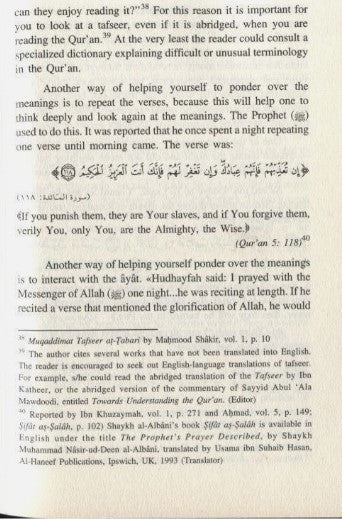
can they enjoy reading it?" For this reason it is important for you to look at a tafseer, even if it is abridged, when you are reading the Qur'an." At the very least the reader could consult a specialized dictionary explaining difficult or unusual terminology in the Qur'an.
Another way of helping yourself to ponder over the meanings is to repeat the verses, because this will help one to think deeply and look again at the meanings. The Prophet (g) used to do this. It was reported that he once spent a night repeating one verse until morning came. The verse was:
وإن تعذبهم فَإِنَّهُمْ عِبَادَةٌ وَإِن تَغْفِرْ لَهُمْ فَإِنَّكَ أَنتَ العزيز الحكيمُ ٥
(سورة المائدة: ۱۱۸)
If you punish them, they are Your slaves, and if You forgive them, verily You, only You, are the Almighty, the Wise.)
(Qur'an 5: 11840 Another way of helping yourself ponder over the meanings is to interact with the âyât. «Hudhayfah said: I prayed with the Messenger of Allah (g) one night...he was reciting at length. If he recited a verse that mentioned the glorification of Allah, he would
Muqaddimat Tafseer at-Tabari by Mahmood Shakir,
The author cites several works that have not been translated into English. The reader is encouraged to seek out English-language translations of tafseer. For example, s/he could read the abridged translation of the Tafseer by Ibn Katheer, or the abridged version of the commentary of Sayyid Abul 'Ala Mawdoodi, entitled Towards Understanding the Qur'an. (Editor)
Reported by Ibn Khuzaymah, and Ahmad, Sifat as-Salah, p. 102) Shaykh al-Albáni's book Sifat as-Saláh is available in English under the title The Prophet's Prayer Described, by Shaykh Muhammad Nasir-ud-Deen al-Albini, translated by Usama ibn Suhaib Hasan, Al-Haneef Publications, Ipswich, UK, 1993 (Translator)
Publisher
IIPH (International Islamic Publishing House)
Author
- Muhammad Salih al-Munajjid
Shipping and Delivery
We dispatch orders directly from our UK and USA warehouses, offering multiple shipping options to suit your needs. We proudly ship worldwide.
UK Deliveries (from UK warehouse):
Standard shipping typically arrives within 3–4 working days. Expedited delivery takes 2–3 working days. We aim to dispatch orders the same day or next working day, with next-day delivery options available where applicable.
USA Deliveries (from USA warehouse):
Orders usually arrive within 4–7 working days.
Europe (shipped from UK):
Standard delivery takes approximately 6–10 working days, with expedited services available in 3–5 working days.
Canada:
Estimated delivery time is 5–10 working days.
Worldwide Shipping:
International orders generally arrive within 5–20 working days, depending on destination and shipping method selected.
For precise delivery timelines based on your location, please contact us by email and our team will provide detailed information tailored to your address.
Sample Pages - Content
Page:01
33 Ways of Developing
AL-KHUSHOO'
Humility and Devotion in Prayer
۳۳ سبباً للخشوع في الصلاة
Muhammad Ṣāliḥ Al-Munajjid
الدار العالمية للكتاب الإسلامي
Page:02
Humility and devotion in prayer
some prayer that will be his last prayer, so let him have khushoo in the prayer that he is doing, for he does not know whether this will be his last prayer.
4. Thinking about and interacting with
the verses and phrases in remembrance of Allah being recited during the prayer
The Qur'an was revealed to be pondered over. Allah says:
كتَب أَنزَلَتَهُ إِلَيْكَ مُبَرَكَ لِيَدَّبَّرُوا ابنته ويتذكر أولوا الألب )
(سورة من (٢٩)
[This is] a Book [the Qur'an] which We have sent down to you, full of blessings that they may ponder over its verses, and that people of understanding may remember.) (Qur'an 38: 29) You cannot ponder over its verses unless you have some knowledge of the meaning of what you are reciting, so that you can think about it and be moved to tears by it. Allah (3) says:
وَالَّذِينَ إِذَا نُكَّرُوا بِقَايَتِ رَبِّهِمْ لَمْ يَمِرُّوا عَلَيْهَا مِمَّا وَعُمْيَانَا )
(سورة الفرقان: ۷۳)
And those who, when they are reminded of the âyâr [proofs, evidence, verses, lessons, signs, and revelations] of their Lord, do not fall deaf and blind at that.)
(Qur'an 25: 73)
is quite clear. Ibn
Thus the importance of studying tafseer Jareer (may Allah have mercy on him) said: "I am astonished at people who read the Qur'an and do not know what it means. How tafseer: exigesis, commentary, or explanation of the meanings (usu. of Qur'anic verses)
Page:03
can they enjoy reading it?" For this reason it is important for you to look at a tafseer, even if it is abridged, when you are reading the Qur'an." At the very least the reader could consult a specialized dictionary explaining difficult or unusual terminology in the Qur'an.
Another way of helping yourself to ponder over the meanings is to repeat the verses, because this will help one to think deeply and look again at the meanings. The Prophet (g) used to do this. It was reported that he once spent a night repeating one verse until morning came. The verse was:
وإن تعذبهم فَإِنَّهُمْ عِبَادَةٌ وَإِن تَغْفِرْ لَهُمْ فَإِنَّكَ أَنتَ العزيز الحكيمُ ٥
(سورة المائدة: ۱۱۸)
If you punish them, they are Your slaves, and if You forgive them, verily You, only You, are the Almighty, the Wise.)
(Qur'an 5: 11840 Another way of helping yourself ponder over the meanings is to interact with the âyât. «Hudhayfah said: I prayed with the Messenger of Allah (g) one night...he was reciting at length. If he recited a verse that mentioned the glorification of Allah, he would
Muqaddimat Tafseer at-Tabari by Mahmood Shakir,
The author cites several works that have not been translated into English. The reader is encouraged to seek out English-language translations of tafseer. For example, s/he could read the abridged translation of the Tafseer by Ibn Katheer, or the abridged version of the commentary of Sayyid Abul 'Ala Mawdoodi, entitled Towards Understanding the Qur'an. (Editor)
Reported by Ibn Khuzaymah, and Ahmad, Sifat as-Salah, p. 102) Shaykh al-Albáni's book Sifat as-Saláh is available in English under the title The Prophet's Prayer Described, by Shaykh Muhammad Nasir-ud-Deen al-Albini, translated by Usama ibn Suhaib Hasan, Al-Haneef Publications, Ipswich, UK, 1993 (Translator)
Who is Muhammad Salih al-Munajjid?
Muhammad Salih al-Munajjid is a prominent Islamic scholar, author, and preacher from Saudi Arabia, widely recognized for his contributions to contemporary Islamic education and online da'wah efforts.