


Usury Unbound: The Struggle for Shari'ah Compliance – Islamic Finance
Usury Unbound: The Struggle for Shari'ah Compliance – Islamic Finance
Publisher:
IRON HEART PUBLISHING
Author:
Wasim A. Ismail
Language:
English
Binding:
Soft Cover
Pages: 292
Size: 15.24 x 1.85 x 22.86 cm6 × 0.73 × 9 in
Impossible de charger la disponibilité du service de retrait


Contenu réductible
Description du livre
Usury Unbound: The Struggle for Shari'ah Compliance – Islamic Finance
Usury Unbound: The Struggle for Shari'ah Compliance by Wasim A. Ismail provides a detailed examination of Riba (usury), one of the most significant issues facing Muslims in contemporary financial systems. The book explores the foundations of Islamic finance, the prohibition of Riba in Islam, and the challenges Muslims encounter when navigating conventional banking and economic structures. Through historical analysis, practical examples, and discussions of modern financial instruments, the author explains how usury impacts justice, equity, and social responsibility within society. The work also examines Islamic alternatives such as Murabahah, Musharakah, Mudarabah, and Ijarah, helping readers understand pathways toward genuine Shari'ah compliance. This book is an essential resource for students of Islamic economics, finance professionals, and Muslims seeking ethical financial guidance.
From Author:
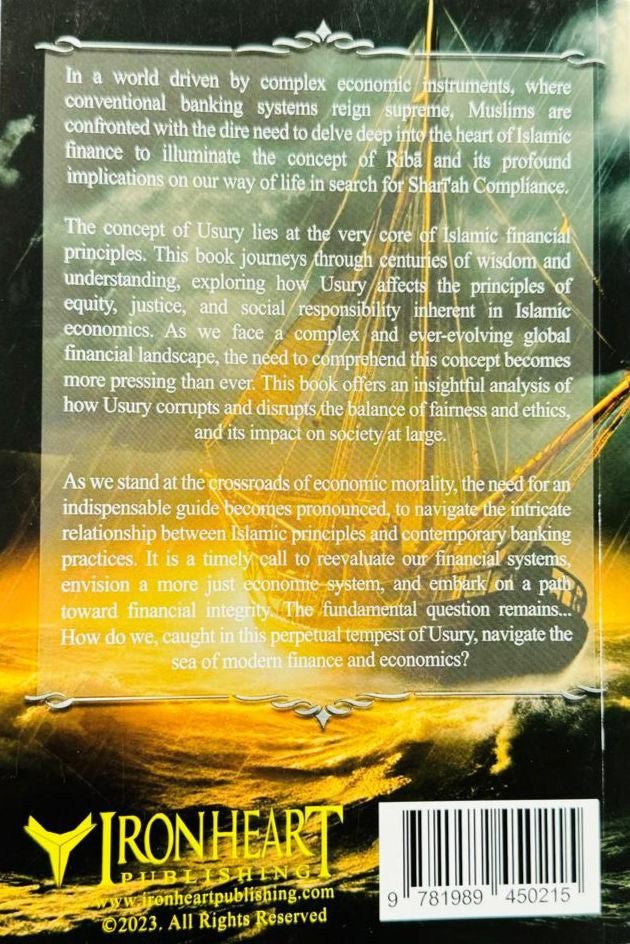
In a world driven by complex economic instruments, where conventional banking systems reign supreme, Muslims are confronted with the dire need to delve deep into the heart of Islamic finance to illuminate the concept of Ribā and its profound implications on our way of life in search for Sharī'ah Compliance.
The concept of Usury lies at the very core of Islamic financial principles. This book journeys through centuries of wisdom and understanding, exploring how Usury affects the principles of equity, justice, and social responsibility inherent in Islamic economics. As we face a complex and ever-evolving global financial landscape, the need to comprehend this concept becomes more pressing than ever. This book offers an insightful analysis of how Usury corrupts and disrupts the balance of fairness and ethics, and its impact on society at large.
As we stand at the crossroads of economic morality, the need for an indispensable guide becomes pronounced, to navigate the intricate relationship between Islamic principles and contemporary banking practices. It is a timely call to reevaluate our financial systems, envision a more just economic system, and embark on a path toward financial integrity. The fundamental question remains... How do we, caught in this perpetual tempest of Usury, navigate the sea of modern finance and economics?
Content:
1. Understanding Riba in Islam
Explains the Islamic concept of Riba and its prohibition.
Examines Qur'anic and Prophetic teachings regarding usury.
Highlights the spiritual, moral, and economic implications of interest-based transactions.
2. History of Banking and Finance
Traces the development of financial practices from early trade systems to modern banking.
Discusses bills of exchange, money lending, and the role of goldsmiths in the emergence of banking.
Explains how historical financial mechanisms evolved into contemporary institutions.
3. How Modern Banking Functions
Analyzes the structure of conventional banking systems.
Explains money creation through lending and debt expansion.
Challenges common assumptions about banks as simple financial intermediaries.
4. Bank Interest and Riba
Investigates whether modern bank interest differs from the Riba prohibited in Islam.
Reviews arguments commonly used to distinguish contemporary interest from classical usury.
Evaluates these claims through Islamic legal principles.
5. Inflation and Interest
Discusses the argument that interest compensates lenders for inflation.
Examines the economic effects of inflation on both lenders and borrowers.
Presents a critique of using inflation as a justification for interest.
6. Critique of Common Justifications
Addresses arguments related to low versus high interest rates.
Examines analogies between interest and rent.
Discusses government regulation, investment bonds, and other contemporary financial products.
Evaluates these positions through Islamic jurisprudential reasoning.
7. Shari'ah-Compliant Financial Principles
Introduces key concepts of Islamic finance.
Emphasizes fairness, shared risk, and ethical economic conduct.
Encourages alternatives to interest-based financial systems.
8. Economic Ethics and Social Justice
Explores the relationship between finance, morality, and social responsibility.
Highlights the Islamic emphasis on justice and equity in economic transactions.
Encourages reflection on the broader societal effects of debt-based economies.
Éditeur
IRON HEART PUBLISHING
Auteur
- Wasim A. Ismail
Shipping and Delivery
We dispatch orders directly from our UK and USA warehouses, offering multiple shipping options to suit your needs. We proudly ship worldwide.
UK Deliveries (from UK warehouse):
Standard shipping typically arrives within 3–4 working days. Expedited delivery takes 2–3 working days. We aim to dispatch orders the same day or next working day, with next-day delivery options available where applicable.
USA Deliveries (from USA warehouse):
Orders usually arrive within 4–7 working days.
Europe (shipped from UK):
Standard delivery takes approximately 6–10 working days, with expedited services available in 3–5 working days.
Canada:
Estimated delivery time is 5–10 working days.
Worldwide Shipping:
International orders generally arrive within 5–20 working days, depending on destination and shipping method selected.
For precise delivery timelines based on your location, please contact us by email and our team will provide detailed information tailored to your address.
Exemples de pages - Contenu
Page:01
WASIM A ISMAIL
USURY UNBOUND
GGLE FOR SHART AH COMPLIANCE
Page:02
THE EMPTY VAULT OF BANKING
his and that you are to forward the payment to him, not the furniture store. You look over the letter and decide to just send him the $10,000
the same day because your client finally paid you.
The storekeeper received $9,500 for the dining room set from the goldsmith, and the goldsmith took your $10,000, and therefore, pocketed $500. While the storekeeper sold a commodity to you and accepted $9,500 for it, the goldsmith actually settled your loan early and took $500 of interest for doing so. Clearly, this is a backdoor to usury. As far as you're concerned, you paid $10,000 for the dining room set, but behind the scenes, a usurious transaction took place in which you were
not involved.
The above scenario is a simplified example of something that takes place on a much larger scale - Bills of Exchange. These financial instruments originated before the fourteenth century and were used in the realm of international trade.
"Merchants had been conducting international trade for many centuries and gradually a way of paying for goods abroad, without the necessity of having to carry great quantities of gold and silver around the world, was devised. In its simplest form this was a letter given by the buyer of the goods to the seller authorizing an agent of the buyer in the home country of the seller to pay for the goods he had bought, so that the seller could collect the money he was owed in his own country and his own currency. These bills were always post-dated to allow time for the goods to be sold and the money transferred, and what began to happen was that merchants, who wanted to get hold of their money quickly, could sell the bill to another merchant who had ready cash, at less than its face value. The second merchant would then cash the bill in when it reached its due date and make a nice profit without having to do anything at all. This was called discounting. Dealing in these bills became a more and more sophisticated business and before long there were merchants who found it more profitable to trade in bills than actual commodities. Their trade was pure usury. This was one of
the transactions taken over by the banker."
The bedrock of banking was devised when professional scribes or scriveners, whose original roles were limited to writing loan contracts between borrowers and lenders, became the middlemen managing loan funds. Instead of borrowers and lenders meeting directly, the scriveners
USURY UNBOUND
developed a system in which they would borrow the money from the lender, give him a rate of return, and then loan it out to the borrower and charge him a higher interest rate and pocket the difference. In addition to this, there were the goldsmiths who were the trustees of gold and silver which people left with them for safekeeping. A goldsmith would issue a receipt as proof of the precious metals. People would use these receipts as currency and no longer felt the need to redeem the gold. Goldsmiths realized this and began to create more receipts in order to make purchases and even loaned the receipts out for interest,181
It is vital to understand today's conventional monetary system, which is inherently based on debt. Contrary to widespread belief, banks are not financial intermediaries in the true sense. One might get the impression that banks pool depositors' monies together, and then loan out the pooled money to those who are looking to borrow. In reality, money creation takes place when people approach banks for loans. The key function of banks is money creation, not intermediation.
The loan is simply a computerized journal entry. If someone comes to the bank to borrow $10,000, the bank simply makes an internal transaction without having to wait for anyone's deposits, as illustrated here
Page:03
BANK INTEREST IS THE PROHIBITED RIBA
offset by charging 15% interest in order to make up for the decline in the
value of the currency.
In the context of debt, the lender issues a loan of $100 to the borrower, and both agree on a 10% interest rate to be paid in one year. Therefore, the borrower would settle $110 in one year. If the government accepts this, then it should apply it to all sectors across the board, not just banking. Why not raise rent on property, wages for labour, and maybe adjust bank interest for inflation notwithstanding the original loan agreements? To restrict the problem of inflation as solvable by adjusting
and charging interest rates is beyond naïve.
I will add here that the argument of inflation is futile. That is because inflation doesn't only affect the lender, it also affects the borrower. Everyone in a given society pays the price for inflation. Justifying the charging of interest on loans might compensate the lender, but it would add another burden on the borrower. The borrower is facing rising prices in general, and on top of that, has to pay more to settle the loan. The irony here is that this refutes the essence of the argument of those who say that the wisdom behind the prohibition of Riba is to protect the poor from being exploited. Well, in this case, they are paying it twice, with inflation and interest!
Aside from trying to justify low interest rates as being acceptable, and not high rates, proponents of bank interest try to differentiate between bank interest and the Riba of the time of Jahiliyyah to be one in which the lender charges the borrower Riba only if he is not able to settle the loan on the agreed upon due date.
The issue of high or low interest rates has been dealt with previously. Allah instructed the believers to leave any and every remaining Ribă without exception, and that the lenders are entitled to their capital sum, the original principal and no more.
As for restricting the Riba of the time of Jahiliyyah to only be the one charged if the borrower doesn't settle the loan on time, then this is actually evidence against the proponents of bank interest. They claim that bank interest is agreed upon at the beginning of the contract, whereas the Riba at the time of Jahiliyyah was contingent upon settling the loan on time. In that case, one can argue that the lender did not charge any Riba in the beginning, so it was an interest-free loan unless the borrower
was not able to pay the loan on time.
On the other hand, it is known that the scenario of predetermined Riba did exist at the time of Jahiliyyah. This is evident when looking at how lenders would forward their money to the caravans of Quraysh. They would determine the Riba from the outset. This is exactly how modern-day banking works. Besides, proponents of bank interest should
USURY UNBOUND
know that even the scenario they speak of regarding the Ribă of the time of Jahiliyyah also exists in conventional banking, What happens if someone does not pay a loan back to the bank on time? In addition to the agreed upon interest from the beginning of the contract, the bank
will charge more interest!
There are those who tried to legitimize Ribá by stating that the charging of interest on debt is the same as charging rent on land, as if to make an analogy between the two. Just as one lends his money to the bank so that the bank invests it and benefits from it, and returns a fixed amount of interest to the lender, in the same way, one would rent out his land to a farmer who would harvest it and pay the owner of the land a fixed amount of rent. Such an analogy is rejected from the outset.
In order for an analogical deduction (Qiyas) to be valid, the defining factor ('Illah ale) for the two scenarios has to be identical. The defining factor of renting out land is that the land in and of itself provides benefit; it is planted and harvested. As for currency, there is no intrinsic benefit from it. In fact, some scholars disallowed renting out farm land for currency, and instead, allowed sharecropping (al-Muzara'ah) which involves a person giving a piece of land to another for him to farm it on the condition that they will share the produce.
Some will bring another claim that government intervention makes Ribă permissible, due to the fact that the government regulates the interest rates so as to guarantee fixed amounts of profit for investors. However, government regulation is irrelevant to the ruling of Riba. In fact, I would say that institutionalizing Riba, as is done today with modern banking, in no way changes the ruling of Riba and the reality that the arrangement resembles the Riba of the time of the Jahiliyyah (which was not institutionalized). Perhaps I can add here that the prohibition of fornication and adultery applies whether it is done on an individual basis or in institutionalized places regulated by the government.
Some have also attempted to justify the issuance of government investment bonds. They claimed that there is no Riba between the government and its citizens, just as there is no Riba between a father and his son. This is another attempt to utilize Qiyas; however, Qiyas can only be based on a foundation that is supported by the Divine Texts and the consensus of scholars. This phrase about there being no Riba between a father and his son is not found in the Qur'an or the Sunnah, nor is there a consensus on this issue. It was mentioned in some schools of thought but without any supporting evidence. It is not found in any Ahadith.
if it was to be considered in the first place. What does the negation of There is also the question as to the meaning of such a phrase, that is, Riba between a father and son actually mean? Does it mean that it never
Page:04
In a world driven by complex economic instruments, where conventional banking systems reign supreme, Muslims are confronted with the dire need to delve deep into the heart of Islamic finance to illuminate the concept of Riba and its profound implications on our way of life in search for Shari'ah Compliance.
The concept of Usury lies at the very core of Islamic financial principles. This book journeys through centuries of wisdom and understanding, exploring how Usury/affects the principles of equity, justice, and social responsibility inherent in Islamic economics. As we face a complex and ever-evolving global financial landscape, the need to comprehend this concept becomes more pressing than ever. This book offers an insightful analysis of how Usury corrupts and disrupts the balance of fairness and ethics, and its impact on society at large.
As we stand at the crossroads of economic morality, the need for an indispensable guide becomes pronounced, to navigate the intricate relationship between Islamic principles and contemporary banking practices. It is a timely call to reevaluate our financial systems, envision a more just economie system, and embark on a path toward financial integrity. The fundamental question remains... How do we, caught in this perpetual tempest of Usury, navigate the sea of modern finance and economics?
Who is Wasim A. Ismail?
Wasim A. Ismail is an Islamic author, educator, and lecturer who specializes in Islamic creed ('Aqīdah), contemporary ideological movements, and Islamic studies. He holds a Master of Arts in Islamic Studies from the International Open University (IOU), along with a B.Sc. in Islamic Economics, Banking and Finance and a Higher Diploma from the same institution. Professionally, he is also an MBA and Certified Public Accountant (CPA) and has taught accounting, business, and economics at the college level since 2005. His work emphasizes adherence to the Qur'an, authentic Sunnah, and the understanding of the early Muslim generations (Salaf).