


The Virtues of the Qur’an – By Shaykh al-Islam Muhammad ibn ‘Abdul-Wahab | English Softcover (75 Pages)
The Virtues of the Qur’an – By Shaykh al-Islam Muhammad ibn ‘Abdul-Wahab | English Softcover (75 Pages)
Publisher:
MuSunnah Publications
Author:
Shaykh al-Islam Muhammad ibn 'Abdul-Wahab
Language:
English
Binding:
Soft Cover
Pages: 75
Size: 17x15 cm
Impossible de charger la disponibilité du service de retrait


Contenu réductible
Description du livre
The Virtues of the Qur’an explores the spiritual greatness, blessings, and excellence of Allah’s final revelation. Written by the celebrated scholar Shaykh al-Islam Muhammad ibn ‘Abdul-Wahab, this concise book highlights the importance of reading, reflecting upon, and implementing the Qur’an, encouraging believers to appreciate its role as a source of guidance, mercy, and light in life.
From Author:
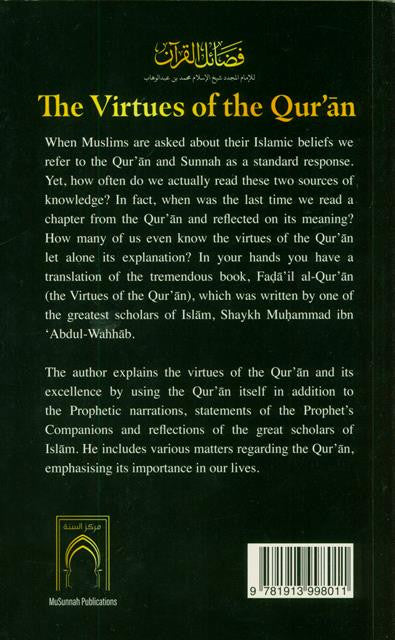
When Muslims are asked about their Islamic beliefs we refer to the Qu'ran and Sunnah as a standard response. Yet, how often do we actually read these two sources of knowledge? In fact, when was the last time we read a chapter from the Qu'ran and reflected on its meaning? How many of us even know the virtues of the Qu'ran let alone its explanation? In your hands you have a translation of the tremendous book, Fada'il al-Qu'ran (the Virtues of the Qur'an), which was written by one of the greatest scholars of Islam, Shaykh Muhammad ibn 'Abdul-Wahab.
Éditeur
MuSunnah Publications
Auteur
- Shaykh al-Islam Muhammad ibn 'Abdul-Wahab
Shipping and Delivery
We dispatch orders directly from our UK and USA warehouses, offering multiple shipping options to suit your needs. We proudly ship worldwide.
UK Deliveries (from UK warehouse):
Standard shipping typically arrives within 3–4 working days. Expedited delivery takes 2–3 working days. We aim to dispatch orders the same day or next working day, with next-day delivery options available where applicable.
USA Deliveries (from USA warehouse):
Orders usually arrive within 4–7 working days.
Europe (shipped from UK):
Standard delivery takes approximately 6–10 working days, with expedited services available in 3–5 working days.
Canada:
Estimated delivery time is 5–10 working days.
Worldwide Shipping:
International orders generally arrive within 5–20 working days, depending on destination and shipping method selected.
For precise delivery timelines based on your location, please contact us by email and our team will provide detailed information tailored to your address.
Exemples de pages - Contenu
Who is Shaykh al-Islam Muhammad ibn 'Abdul-Wahab?
Shaykh al-Islam Muhammad ibn ‘Abdul-Wahab was a prominent 18th-century Islamic scholar best known for his work in advancing Tawhid (the Oneness of Allah) and advocating purification of Islamic belief and practice according to the Qur’an and Sunnah. His writings emphasize returning to authentic scripture and promoting understanding of core Islamic teachings grounded strictly in primary sources. The Virtues of the Qur’an reflects this approach by drawing attention to the Qur’an’s central role in guiding belief and action.