


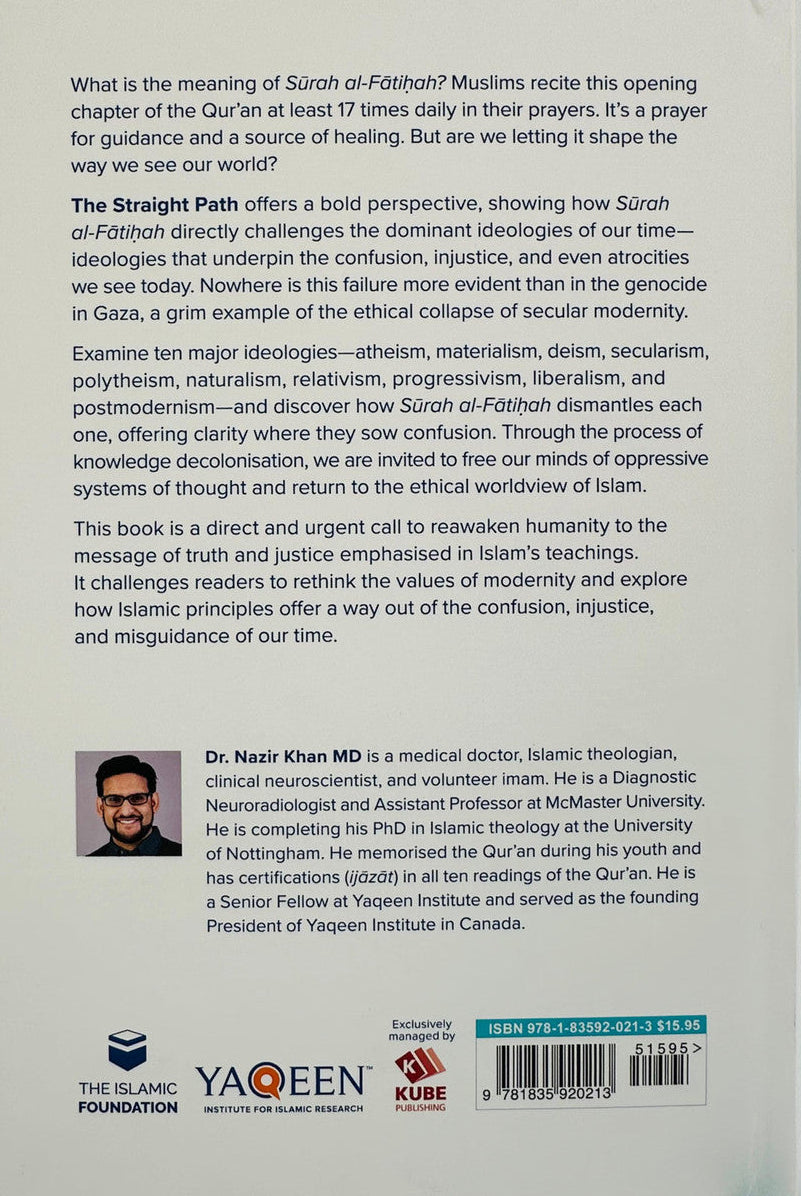
The Straight Path offers a bold perspective, showing how Surah al-Fatiha directly challenges the dominant ideologies of our time, ideologies that underpin the confusion, injustice, and even atrocities we see today. Nowhere is this failure more evident than in the genocide in Gaza, a grim example of the ethical collapse of secular modernity.
1
/
de
5
The Straight Path: How Surah Al-Fatiha Addresses Modern Ideologies – Islamic Guidance for Today’s Challenges
The Straight Path: How Surah Al-Fatiha Addresses Modern Ideologies – Islamic Guidance for Today’s Challenges
No reviews
Publisher:
Kube Publishing
Author:
Nazir Khan
Language:
English
Binding:
Hard Cover
Pages: 245
Size: 24cmx16cm
Prix habituel
$23.99 USD
Prix habituel
Prix promotionnel
$23.99 USD
Prix unitaire
/
par
Frais d'expédition calculés à l'étape de paiement.
Impossible de charger la disponibilité du service de retrait


Contenu réductible
Description du livre
A powerful and thought-provoking book that explores how Surah Al-Fatiha provides timeless guidance and responds to modern ideological challenges through the lens of Islamic belief.
From Author:
Éditeur
Kube Publishing
Auteur
- Nazir Khan
Shipping and Delivery
We dispatch orders directly from our UK and USA warehouses, offering multiple shipping options to suit your needs. We proudly ship worldwide.
UK Deliveries (from UK warehouse):
Standard shipping typically arrives within 3–4 working days. Expedited delivery takes 2–3 working days. We aim to dispatch orders the same day or next working day, with next-day delivery options available where applicable.
USA Deliveries (from USA warehouse):
Orders usually arrive within 4–7 working days.
Europe (shipped from UK):
Standard delivery takes approximately 6–10 working days, with expedited services available in 3–5 working days.
Canada:
Estimated delivery time is 5–10 working days.
Worldwide Shipping:
International orders generally arrive within 5–20 working days, depending on destination and shipping method selected.
For precise delivery timelines based on your location, please contact us by email and our team will provide detailed information tailored to your address.
Exemples de pages - Contenu
Pg:01
CULARY BERALI
HEISI
ATER
OG
SM RELATIVIS MATERIALISM SECULARIS SM ATHEIS!
IBERALIS
POLYTHE
ATHEISM
المستقيم
SECULA ATHEIS SECU DEIS
ATH MA
Straight Path
How Surah al-Fatihah addresses modern ideologies
Dr. Nazir Khan
Pg:02
nor of
with uing-
brary.
Haque
Contents
Author's acknowledgements
Forewords
7
al-Isti'ädhah-Foreword by Imam Tom Facchine al-Basmalah-Foreword by Shaykh Yousef Wahb
9
13
The Straight Path
Author's introduction
16
Overview: Surah al-Fatihah and modern ideologies Alhamdulillah-Atheism dismantled
26
28
Rabb al-'Alamin-Materialism dismantled al-Rahman al-Rahim-Deism dismantled Maliki Yawm al-Din-Secularism dismantled
Iyyaka na'budu-Polytheism dismantled
46
64
81
94
Wa iyyaka nastain-Naturalism dismantled
112
Ihdina al-şirāṭ al-mustaqim-Relativism dismantled
134
Şirat alladhina anamta 'alayhim-Progressivism dismantled
153
Ghayri al-maghḍübi 'alayhim-Liberalism dismantled
170
Wa-la al-ḍallin-Postmodernism dismantled
188
Conclusion
Glossary
204
214
Bibliography
Classical Islamic works (in chronological order)
218
Other references (in alphabetical order)
Pg:03
94
Iyyaka na budu You alone
do we worship
Polytheism dismantled
Trom the Islamic perspective, acquiring sound knowledge of God and His divine attributes is the basis for knowing how to live in this world and pursue ethical conduct. We see this mirrored in al-Fatihah. After establishing the foundations of knowledge about God, the chapter turns to the required duty of the servants of God.162 This begins with the statement "You alone do we worship" (iyyaka na'budu). This also demonstrates grammatical shift (iltifat) from third-person tense to second- person, signaling a concomitant shift in the human psyche prepared to address God directly after acquiring a sound under- standing of His attributes of perfection. 163 The one who has properly internalised the meanings of Islam's theocentric vision has prepared himself for the intimacy and immediacy of a direct relationship with the Divine. 164
162 Al-Razi divides Sürat al-Fatihah into knowledge of the Lord and knowledge of servitude, and further divides the latter into acts of the servant and the effects of those acts. Al-Razi, Great Exegesis, 1:418-19.
163 Al-Razi, Great Exegesis, 1:449.
164 Al-Qunawi and Ibn al-Tamjid, Hashiyat al-Qunawi 'ala tafsir al-Baydawi wa-ma'ahu ḥāshiyat Ibn al-Tamjid, (Beirut: DKI, 2001), 1:223-29.
إياك
The chapter also teaches the etiquettes of supplicating to Allah, in that one begins first with due praise and worshiping Allah alone before proceeding with one's request. 165 Shaykh Mohammed Elshinawy writes:
In the opening chapter of the Qur'an (al-Fatiha), it is meaningful that God placed the phrase 'Only You do we worship' after the verses praising and extolling Him. This sequence captures how servitude is an offshoot of recognition, and hence a Muslim is moved to worship God both internally and externally. The external motivation is the revealed command of God which obligates people to perform ritual worship, while the internal motivation results from an appreciation of God's Perfection and one's own imperfection and appreciation of His benevolence.166
165 Al-Tha'labi, Kashf al-bayan 'an tafsir al-Qur'an, 2:508; al-Nasafi, al-Taysir fi al-tafsir, 1:149; Sa'id Hawwa, Asas fi al-tafsir, 1:48-49.
166 Mohammad Elshinawy, "Why Does God Ask People to Worship Him?," Yaqeen Institute for Islamic Research
Pg:04
132
The Straight Path
Worse than AI colonialism is AI genocide, which has been taking place in Gaza. A recent investigation found that the Israeli army used an AI program called Lavender to mark thousands of Palestinians as targets without adequate verification, then enabled the military to bomb them when they entered their family homes. 238 They have also made use of so-called robot dogs, or Vision 60 units produced by the American company Ghost Robotics, in their campaign of destruction. As experts have noted, Israel's use of AI-enhanced weaponry raises ethical questions about how the technology can help facilitate violence and further Palestinian dispossession by reducing Israel's human cost of
conducting warfare."239
The future of scientific innovation can be either one that serves humanity or one that threatens to exterminate it. Electing the former course requires restoring the theocentric value structure that enabled scientific innovation in the first place. Turning back to seek help and guidance from God in all our affairs allows for the prioritisation of ethical virtues necessary to ensure that the physical means are to our benefit and not to our detriment.
It is Allah who is always in control of our affairs. Therefore, the most appropriate course of action is
to seek His aid and place our absolute trust in Him, while utilising the worldly means that He has established for us.
Pg:05
What is the meaning of Surah al-Fatihah? Muslims recite this opening chapter of the Qur'an at least 17 times daily in their prayers. It's a prayer for guidance and a source of healing. But are we letting it shape the way we see our world?
The Straight Path offers a bold perspective, showing how Surah al-Fatihah directly challenges the dominant ideologies of our time- ideologies that underpin the confusion, injustice, and even atrocities we see today. Nowhere is this failure more evident than in the genocide in Gaza, a grim example of the ethical collapse of secular modernity. Examine ten major ideologies-atheism, materialism, deism, secularism, polytheism, naturalism, relativism, progressivism, liberalism, and postmodernism-and discover how Surah al-Fatihah dismantles each one, offering clarity where they sow confusion. Through the process of knowledge decolonisation, we are invited to free our minds of oppressive systems of thought and return to the ethical worldview of Islam.
This book is a direct and urgent call to reawaken humanity to the message of truth and justice emphasised in Islam's teachings. It challenges readers to rethink the values of modernity and explore how Islamic principles offer a way out of the confusion, injustice, and misguidance of our time.
Dr. Nazir Khan MD is a medical doctor, Islamic theologian, clinical neuroscientist, and volunteer imam. He is a Diagnostic Neuroradiologist and Assistant Professor at McMaster University. He is completing his PhD in Islamic theology at the University of Nottingham. He memorised the Qur'an during his youth and has certifications (ijāzāt) in all ten readings of the Qur'an. He is a Senior Fellow at Yaqeen Institute and served as the founding President of Yaqeen Institute in Canada.
THE ISLAMIC FOUNDATION
YAQEEN
INSTITUTE FOR ISLAMIC RESEARCH
Who is Nazir Khan?
Dr. Nazir Khan is a contemporary Islamic scholar, researcher, and educator known for his work in Qur’anic studies, Islamic theology, and intellectual engagement with modern ideologies. With a strong academic background in both traditional Islamic scholarship and Western education, he brings a balanced and analytical approach to contemporary Islamic thought.
Customers helping others by Reviews - جزاك اللهُ خيراً
4.94 ★ (49)
Verified