


The Ruling on the One Who Leaves Off the Prayer | Shaykh Muhammad Taqi-ud-Deen al-Hilali
The Ruling on the One Who Leaves Off the Prayer | Shaykh Muhammad Taqi-ud-Deen al-Hilali
Publisher:
Authentic Statements Publications
Author:
Shaykh Muhammad Taqiud-Deen al-Hilali
Language:
English
Binding:
Paper back
Pages: 112
Size: 9.0 x 0.5 x 6.0 in
Impossible de charger la disponibilité du service de retrait


Contenu réductible
Description du livre
The Ruling on the One Who Leaves Off the Prayer | Shaykh Muhammad Taqi-ud-Deen al-Hilali
The Ruling on the One Who Leaves Off the Prayer by Shaykh Muhammad Taqi-ud-Deen al-Hilali examines one of the most significant issues in Islamic jurisprudence: the ruling concerning a Muslim who abandons the obligatory prayer. Drawing upon the Qur'an, authentic Sunnah, and the statements of the early scholars and jurists, the author presents the various scholarly opinions regarding those who neglect Salah out of denial or laziness. He discusses the spiritual, legal, and practical consequences of abandoning prayer while highlighting the central importance of Salah as the second pillar of Islam. Written in a clear and evidence-based style, this book is an excellent resource for students of knowledge and Muslims seeking a deeper understanding of this critical aspect of Islamic belief and practice.
From Author:
Al-Hilali’s work: In The Ruling on the One Who Leaves Off the Prayer emphasizes the information on one of the main tenets of the Muslim faith which is Salah. This book discusses the terrible end and the Shariah verdict for missing the obligatory prayers and highlights the place of this act of worship in the life of a Muslim.
The Importance of Salah in Islam
After that, Shaykh al-Hilali sets the stage by defining Salah as one of the five main pillars of the Islam religion. It also calls prayer not only as a worship but an interaction betweeen a believer and Allah. The author emphasizes many a Quranic verse and a hadith revealing the pivotal role the prayer occupies in the life of a believer in terms of faith, spirituality, and association with Allah.
The Rulings on Abandoning Prayer
This book discusses in details the different opinions from the Islamic jurists as to how the absentee from the prayers should be treated. Shaykh al-Hilali compares the lazy people in Salah with those who deny Salah at all, looking at the Islamic legal right of both sides. This work uses Quranic ayats, Hadiths, and the rulings of scholars and jurists summarise the spiritual and legal consequences of leaving out this act of worship.
Éditeur
Authentic Statements Publications
Auteur
- Shaykh Muhammad Taqiud-Deen al-Hilali
Shipping and Delivery
We dispatch orders directly from our UK and USA warehouses, offering multiple shipping options to suit your needs. We proudly ship worldwide.
UK Deliveries (from UK warehouse):
Standard shipping typically arrives within 3–4 working days. Expedited delivery takes 2–3 working days. We aim to dispatch orders the same day or next working day, with next-day delivery options available where applicable.
USA Deliveries (from USA warehouse):
Orders usually arrive within 4–7 working days.
Europe (shipped from UK):
Standard delivery takes approximately 6–10 working days, with expedited services available in 3–5 working days.
Canada:
Estimated delivery time is 5–10 working days.
Worldwide Shipping:
International orders generally arrive within 5–20 working days, depending on destination and shipping method selected.
For precise delivery timelines based on your location, please contact us by email and our team will provide detailed information tailored to your address.
Exemples de pages - Contenu
Page:01
THE RULING ON THE ANP
WHO LEAVES OFF THE PRAYER
Shaykh Muhammad Taqiud-Deen al-Hilali
Page:02
The Reling en the One Who Lenres Off the Prayer
الخرينَ باسكال سر قالوا لين الصدق وترك تعليم الينكينَ وَكُنَّا تَقُومُ مَعَ القيمين وكالكون يرى الذين حق أنت البين
"Every sold will be retained for what it has earned, escept the compacions of the rigist (Le. the true beliewes). In gardens, they will ask one another about the crimimais. (they will say to them): "What has carved you te snter Hell!" they will say: "We were not of these whe ozed to sifer the prayers, nor would we feed the poor, end we used to epeak faleelood with vain talk, and we saaine belie the Day of judgement, until there canne to ite thar which is certain (Lo, death)" [Sirah Al-boltieththir 74:38, 471
So they om pot free from eftler being thet esch of thess attributes were that wbicit entered Inaninio the fire snd mads tham love from the criminals, or all of them together, and ireleed, the cass is that every one of 1lten does that by themselves, and the angle of it being a poesl is cirar. If it were all four of these afixirs tegether, then this is only due to the sewnrity of their disbalief aml thrir pinitiment. Othervios, end one of these nerassitates the (cfo:ementius2d) poniinment, as it is nat permissible to jein that which has no cffect in ihelf in the popisiment to what steeds alone by itself
The Ruling on the One Who Leaues Off the Prayer
necessitating B). It is koorn that leaving off the prayer and what is martioned altug with it is oat s comfition in the pumzishnesst our diabelioring in the Day of Reconprise, ftatlır, it by itself is sufficient esncerning the peritsinnent, Se, that inclicales that each attribute ammiionad aleeg with it is Ilhe thot. as it is not possicle for someone to say: "no one will be perished exceyr who gathened thess feur aftributes," at each one of them nesessflatss that ene is s criminal. Allah the Clorifted neade the criminals the opposile of the Mirruims, and the ore who leases off the preyer from the criminals who are thrown inte the fire. And lie said:
إن الخرينَ فِي مَكَلي وسعيهم عبرة في آثار عَلى وُجُوهِهِمْ ذُو قوانش
"Indeed the criminale are in misguidance and vill burn.
The Day they will be dragged in the Fire on their faess,
it will be said to them: "taste the touch of Hell" (Sirah Al-Qamar 54:47-(6)
And He the Most Higit sail:
إِذَا الَّذِينَ تَجْرَمُوا كَانُوا مِنَ الَّينَ مَامَنُوا يَضْحَكُونَ
"Verilyl Those who conunitted cricues liur the worldly life) used to laugh at theee who belleved." [Silrah Al-Mutafiifin $329)
So he made the criminals the opposite of the believers (end) Maslices.
ما هُمْ حَك التربية )
"So the intercessien of thz iotereessures will not bmafit them." [steah al Ninidalrihir verse 48]
Page:03
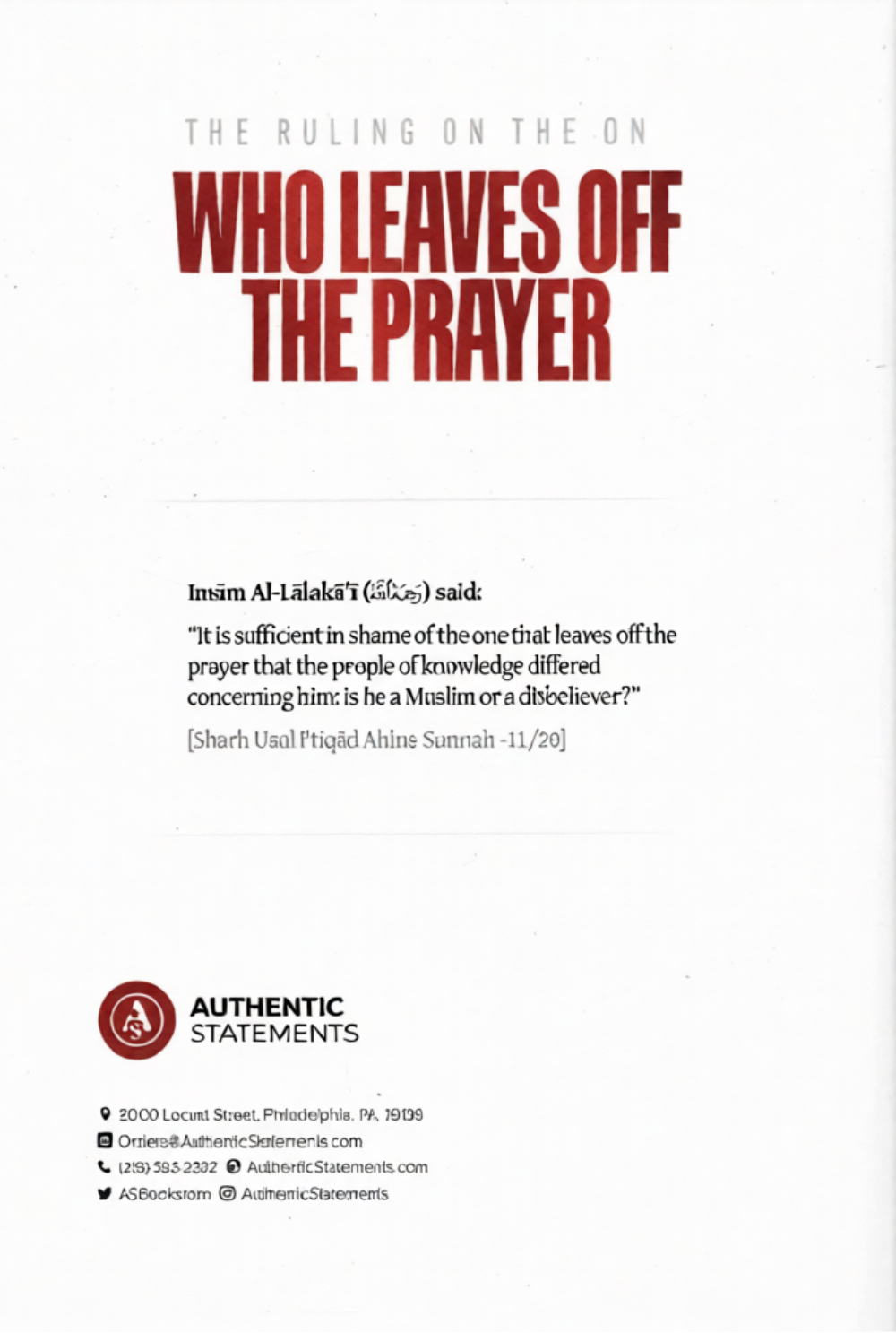
THE RULING ON THE ON
WHO LEAVES OFF THE PRAYER
Insim Al-Lalaka'i (ka) said:
"It is sufficient in shame of the one that leaves off the prayer that the people of knowledge differed concerning him: is he a Muslim or a disbeliever?"
[Sharh Usal P'tiqad Ahine Sunnah -11/20]
Who is Muhammad Taqî-ud-Din al-Hilâli?
Muhammad Taqî-ud-Din al-Hilâli (1893–1987) was a renowned Islamic scholar, translator, and linguist from Morocco. He was known for his contributions to Islamic teachings and his collaboration with Muhammad Muhsin Khan in translating The Noble Quran into English. Al-Hilâli was well-versed in Arabic, English, and other languages, allowing him to bridge the gap between Islamic scholarship and Western audiences. He studied and taught in various countries, including Morocco, Saudi Arabia, and India, making a lasting impact on Islamic literature and dawah (propagation of Islam).