


The Remedy for Those Victimized by Sins (Ad-Da’ wad-Dawa) by Ibn al-Qayyim
The Remedy for Those Victimized by Sins (Ad-Da’ wad-Dawa) by Ibn al-Qayyim
Publisher:
IIPH (International Islamic Publishing House)
Author:
Ibn al-Qayyim al-Jawziyyah
Language:
English
Binding:
Hard Cover
Pages: 560
Size: 14.5 x 21.5
Impossible de charger la disponibilité du service de retrait


Contenu réductible
Description du livre
The Remedy for Those Victimized by Sins (Ad-Da’ wad-Dawa) by Ibn al-Qayyim
The Remedy for Those Victimized by Sins (Ad-Da’ wad-Dawa) by Ibn al-Qayyim al-Jawziyyah is a profound classical work that explores the causes and cures of spiritual diseases. This book provides deep insight into the harmful effects of sins on the heart, soul, and daily life, while offering practical guidance for repentance and self-purification. Drawing from the Qur’an and authentic Hadith, Ibn al-Qayyim explains how believers can overcome temptations, resist Shaytan, and strengthen their connection with Allah. The book also highlights the importance of sincere repentance, remembrance, and obedience in achieving inner peace and spiritual growth. It serves as both a diagnosis and a remedy for anyone seeking to reform their life and stay firm on the straight path.
From Author:
Do you find yourself committing sins despite your best intentions? Do concepts of Allah’s love and mercy delude you into believing that you will be forgiven regardless of your actions? Are you afflicted with trials and want a way out? Would you like to transform your life so that you stay on the straight path and are rewarded by Allah?
The Remedy, written by the distinguished classical scholar Ibn al-Qayyim, provides an in-depth analysis of all the above questions and more. The author quotes numerous Qur’anic verses, hadiths, and incidents to explain how you can avoid sins, counter Satan’s endless whispers, and emancipate yourself from the fetters of illicit worldly desires.
This well-researched, comprehensive work also aims to enrich your relationship with Allah and enable you to gain proximity with Him by praying, supplicating, obeying His commands, and living according to the Qur’an and Sunnah. Ibn al-Qayyim’s timeless words move the hearts, jolt the conscience, and inspire practical action.
Content:
Pronunciation and Transliteration Chart
Arabic honorific symbols..
Hadith grade terms.
About the Word 'Lord'Publisher's
Note
Foreword
Supplication Is a Medicine.
Persistent Supplication
Being Hasty about the Supplication's Response.
Times of Istijabah.
Perfecting the Supplication
Some Secrets of Supplication
Supplication Is Like a Weapon
Between Supplication and Qadar
Between Allah's Pardon and CommandDeluded.
The Difference between Delusion and Assuming Good.
Harms of Sin and Disobedience.
Sins Cause Legislative Punishments.
Punishments Are Legislative and Universal
Universal Punishments Are Spiritual and Physical
Physical Punishments Are in This World and the Hereafter
Éditeur
IIPH (International Islamic Publishing House)
Auteur
- Ibn al-Qayyim al-Jawziyyah
Shipping and Delivery
We dispatch orders directly from our UK and USA warehouses, offering multiple shipping options to suit your needs. We proudly ship worldwide.
UK Deliveries (from UK warehouse):
Standard shipping typically arrives within 3–4 working days. Expedited delivery takes 2–3 working days. We aim to dispatch orders the same day or next working day, with next-day delivery options available where applicable.
USA Deliveries (from USA warehouse):
Orders usually arrive within 4–7 working days.
Europe (shipped from UK):
Standard delivery takes approximately 6–10 working days, with expedited services available in 3–5 working days.
Canada:
Estimated delivery time is 5–10 working days.
Worldwide Shipping:
International orders generally arrive within 5–20 working days, depending on destination and shipping method selected.
For precise delivery timelines based on your location, please contact us by email and our team will provide detailed information tailored to your address.
Exemples de pages - Contenu
Page:01
Contents
Pronunciation and Transliteration Chart
Arabic honorific symbols..
Hadith grade terms.
About the Word 'Lord'
Publisher's Note
Foreword
Supplication Is a Medicine.
Persistent Supplication
Being Hasty about the Supplication's Response.
Times of Istijabah.
Perfecting the Supplication
Some Secrets of Supplication
Supplication Is Like a Weapon
Between Supplication and Qadar
Between Allah's Pardon and Command
Deluded.
The Difference between Delusion and Assuming Good.
Harms of Sin and Disobedience.
Sins Cause Legislative Punishments.
Punishments Are Legislative and Universal
Universal Punishments Are Spiritual and Physical
Physical Punishments Are in This World and the Hereafter
Page:02
THE REMEDY FOR THOSE VICTIMIZED BY SINS
الداء والدواء
Do you find yourself committing sins despite your best intentions? Do concepts of Allah's love and mercy delude you into believing that you will be forgiven regardless of your actions? Are you afflicted with trials and want a way out? Would you like to transform your life so that you stay on the straight path and are rewarded by Allah? The Remedy, written by the distinguished classical scholar Ibn al-Qayyim, provides an in-depth analysis of all the above questions and more. The author quotes numerous Qur'anic verses, hadiths, and incidents to explain how you can avoid sins, counter Satan's endless whispers, and emancipate yourself from the fetters of illicit worldly desires.
IBN AL-QAYYIM
This well-researched, comprehensive work also aims to enrich your relationship with Allah and enable you to gain proximity with Him by praying, supplicating, obeying His commands, and living according to the Qur'an and Sunnah. Ibn al-Qayyim's timeless words move the hearts, jolt the conscience, and inspire practical action.
About the author
Ibn al-Qayyim was an Islamic jurist, commentator on the Qur'an, astronomer, chemist, philosopher, psychologist, scientist, and theologian. He was a close student and successor of Shaykh al-Islâm Ibn Taymiyah. His contributions to the Islamic library are extensive and mainly include Qur'anic commentaries and understanding and analysis of the hadiths of the Prophet (blessings and peace be upon him).
Page:03
House Data
Contents
Sins / Ibn al-Qayyim
Pronunciation and Transliteration Chart
Arabic honorific symbols
Hadith grade terms
About the Word 'Lord'
Publisher's Note
Foreword
Supplication Is a Medicine
Persistent Supplication.
Being Hasty about the Supplication's Response.
book may be produced or or mechanical, including -age and retrieval system,
ok via the Internet or via The Publisher is illegal and ctronic editions, and do not ted materials. Your support Sina
Some Secrets of Supplication.
Supplication Is Like a Weapon
Between Supplication and Qadar.
Between Allah's Pardon and Command.
Deluded People.
Times of Istijabah.
Perfecting the Supplication.
The Difference between Delusion and Assuming Good.
Harms of Sin and Disobedience
Sins Cause Legislative Punishments.
Punishments Are Legislative and Universal
Universal Punishments Are Spiritual and Physical
Physical Punishments Are in This World and the Hereafter
Page:04
Punishments Are Legislative and Universal
There are two types of punishments for sins: legislative and universal When the legislative punishment is established, it rescinds or lightens the universal punishment. The Master (Allah) hardly combines both punishments for someone unless the first is insufficient to remove
the sin or disease.
If legislative punishments are not executed, they (all) become universal and perhaps more severe than the former. It is plausible that they may be less severe, but they will affect everyone. Legislative punishments are specific. Our Lord, the Blessed and High, only punishes by His law those who participate in the crime directly.
Universal punishment occurs at large and specifically. When the sin is hidden, it harms its doer specifically. On the other hand, when sin is publicized, it harms everyone. When people see evil and (indirectly) participate by not denouncing it, Allah soon afflicts them collectively with His punishment.
It was previously mentioned that Allah (3) set legislative punishments in proportion to the harm caused by the sin and the inborn desire for it. Allah (3) has made them of three types: killing, cutting, and whipping. He has legislated death for disbelief and what is close to it, like fornication and homosexuality, for these corrupt the religion, lineage, and human nature.
Imam Ahmad mentions, "Apart from murder, I do not know of any sin greater than fornication." His proof was the following hadith:
Punishments are legislative and universal «'Abdullah ibn Mas'ood asked: O Messenger of Allah! Which sin is the greatest?
He replied: To ascribe a rival to Allah since He created you.
He asked: Then what?
He replied: To kill your child, fearing there will not be enough food
for the family.
He asked: Then what?
He replied: To fornicate with your neighbour's wife.>> (Bukhari and Muslim)
Allah () reveals in confirmation of this:
وَالَّذِينَ لَا يَدْعُونَ مَعَ اللَّهِ إِلَهَا ءَاخَرَ وَلَا يَقْتُلُونَ النَّفْسَ الَّتِي حَرَّمَ اللَّهُ إِلَّا بِالْحَقِّ وَلَا يَزْنُونَ ... (سورة الفرقان: ٦٨)
Those who do not call upon any other god besides Allah; and who do not kill, for that is forbidden by Allah, except in the course of justice; and who do not commit fornication or adultery... (al-Furqan 25: 68)
The Prophet() mentioned the worst of each type in answer to the question. Since 'Abdullâh asked about the greatest sin, he answered with the greatest types (of sin) and the greatest of each type: 1- The greatest type of polytheism is a person ascribing an equal to Allah.
2- The greatest type of murder is killing one's child, fearing there will not be enough to eat and drink.'
3- The greatest type of fornication is committing adultery with the neighbour's wife, for the evil of fornication increases in proportion to the number of sanctities it violates.
Allah mentions:
(Do not kill your children for fear of poverty, for We will provide for them and for you. Verily, killing them is a grave sin.) (al-Isra' 17:31)
Page:05
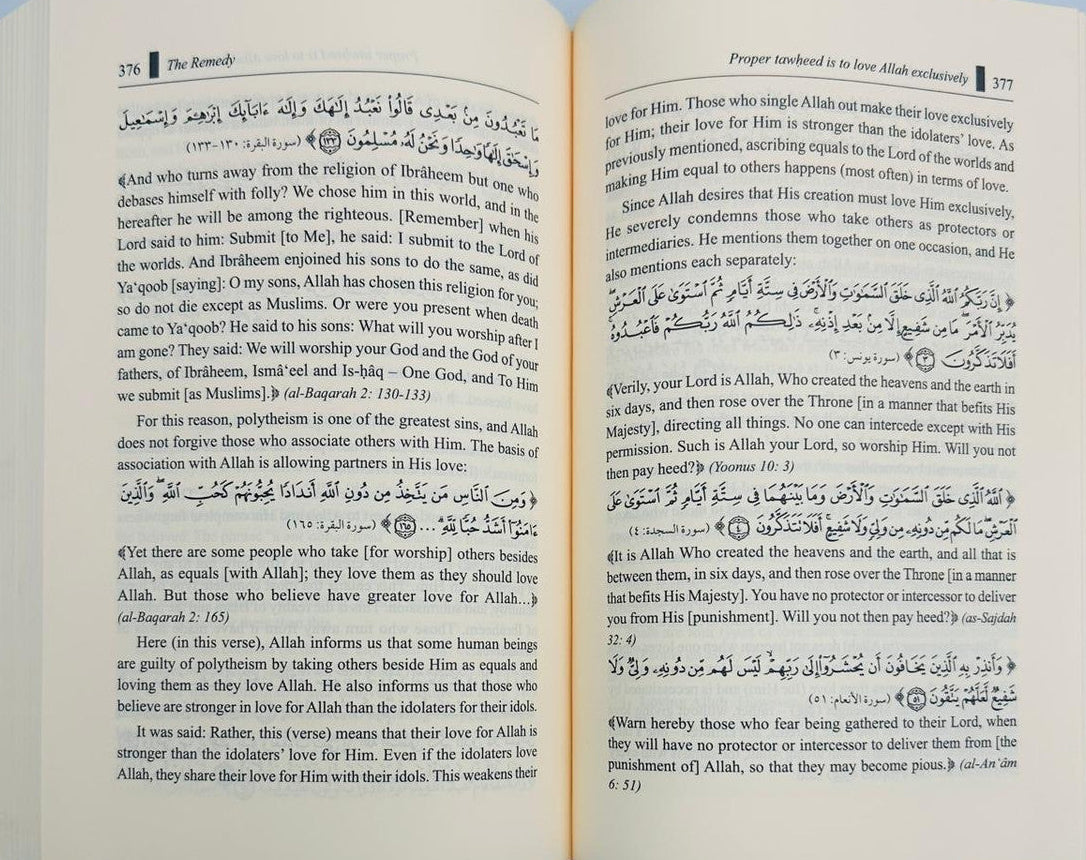
The Remedy of
مَا تَعْبُدُونَ مِنْ بَعْدِى قَالُوا نَعْبُدُ إلَهَ إِلهَ بَابِكَ إِبْرَاهِيمَ وَإِسْمَعِيلَ
وَاسْحَقَ الهَا وَاحِدًا وَنَحْنُ لَهُ مُسْلِمُونَ ) (سورة البقرة: ۱۳۰-۱۳۳)
And who turns away from the religion of Ibrâheem but one who debases himself with folly? We chose him in this world, and in the hereafter he will be among the righteous. [Remember] when his Lord said to him: Submit [to Me], he said: I submit to the Lord of the worlds. And Ibrâheem enjoined his sons to do the same, as did Ya'qoob [saying]: O my sons, Allah has chosen this religion for you; so do not die except as Muslims. Or were you present when death came to Ya'qoob? He said to his sons: What will you worship after I am gone? They said: We will worship your God and the God of your fathers, of Ibrâheem, Ismâ'eel and Is-hâq - One God, and To Him we submit [as Muslims]. (al-Baqarah 2: 130-133)
For this reason, polytheism is one of the greatest sins, and Allah does not forgive those who associate others with Him. The basis of association with Allah is allowing partners in His love:
Proper tawheed is to love Allah exclusively
love for Him. Those who single Allah out make their love exclusively previously mentioned, ascribing equals to the Lord of the worlds and for Him; their love for Him is stronger than the idolaters' love. As making Him equal to others happens (most often) in terms of love. Since Allah desires that His creation must love Him exclusively, He severely condemns those who take others as protectors or intermediaries. He mentions them together on one occasion, and He
also mentions each separately:
إنَّ رَبَّكُمُ اللَّهُ الَّذِى خَلَقَ السَّمَوَاتِ وَالْأَرْضَ فِي سِتَّةِ أَيَّامٍ ثُمَّ اسْتَوَى عَلَى الْعَرْشِ يُدَبِّرُ الْأَمْرَ مَا مِن شَفِيعٍ إِلَّا مِنْ بَعْدِ إِذْنِهِ، ذَلِكُمُ اللَّهُ رَبُّكُمْ فَاعْبُدُوهُ أَفَلا تَذَكَّرُونَ ﴾ (سورة يونس: ٣)
Verily, your Lord is Allah, Who created the heavens and the earth in six days, and then rose over the Throne [in a manner that befits His Majesty], directing all things. No one can intercede except with His permission. Such is Allah your Lord, so worship Him. Will you not then pay heed? (Yoonus 10: 3)
وَمِنَ النَّاسِ مَن يَتَّخِذُ مِن دُونِ اللَّهِ أَندَادًا يُحِبُّونَهُمْ كَحُتِ اللَّهِ وَالَّذِينَ اللَّهُ الَّذِي خَلَقَ السَّمَوَاتِ وَالْأَرْضَ وَمَا بَيْنَهُمَا فِي سِتَّةِ أَيَّامٍ ثُمَّ اسْتَوَى عَلَى
الْعَرْشِ مَا لَكُم مِّن دُونِهِ، مِن وَلِي وَلَا شَفِيعِ أَفَلَا تَتَذَكَّرُونَ ) (سورة السجدة: ٤)
ءَامَنُوا أَشَدُّ حُبًّا لِلَّهِ ... (سورة البقرة : ١٦٥)
Yet there are some people who take [for worship] others besides Allah, as equals [with Allah]; they love them as they should love Allah. But those who believe have greater love for Allah...) (al-Baqarah 2: 165)
Here (in this verse), Allah informs us that some human beings are guilty of polytheism by taking others beside Him as equals and loving them as they love Allah. He also informs us that those who believe are stronger in love for Allah than the idolaters for their idols.
It was said: Rather, this (verse) means that their love for Allah is stronger than the idolaters' love for Him. Even if the idolaters love Allah, they share their love for Him with their idols. This weakens their
It is Allah Who created the heavens and the earth, and all that is between them, in six days, and then rose over the Throne [in a manner that befits His Majesty]. You have no protector or intercessor to deliver you from His [punishment]. Will you not then pay heed?) (as-Sajdah 32:4)
وَأَنذِرْ بِهِ الَّذِينَ يَخَافُونَ أَن يُحْشَرُوا إِلَى رَبِّهِمْ لَيْسَ لَهُم مِّن دُونِهِ، وَلِيٌّ وَلَا شَفِيعُ لَعَلَّهُمْ يَتَّقُونَ ﴾ (سورة الأنعام: ٥١)
(Warn hereby those who fear being gathered to their Lord, when they will have no protector or intercessor to deliver them from [the punishment of] Allah, so that they may become pious. (al-An'am 6: 51)