


The Principle of Love & Desire by Ibn Taymiyyah | Islamic Aqeedah & Spirituality Book
The Principle of Love & Desire by Ibn Taymiyyah | Islamic Aqeedah & Spirituality Book
Publisher:
Authentic Statements Publications
Author:
Shaykhul-Islam Ibn Taymiyyah
Language:
English
Binding:
Soft Cover
Pages: 291
Size: 15x21cm
Impossible de charger la disponibilité du service de retrait


Contenu réductible
Description du livre
The Principle of Love & Desire by Ibn Taymiyyah | Islamic Aqeedah & Spirituality Book
The Principle of Love & Desire by Shaykhul-Islam Ibn Taymiyyah is a powerful Islamic work exploring the role of love, desire, and devotion in shaping human faith and behavior. Rooted in authentic Islamic creed (‘aqeedah), the book explains how true love for Allah forms the foundation of tawheed, iman, worship, and obedience. Ibn Taymiyyah examines the relationship between love and hatred for the sake of Allah while clarifying misconceptions that led various sects astray from the straight path.
Through Qur’anic verses, prophetic narrations, and deep spiritual insights, readers gain a clearer understanding of sincerity, attachment to Allah, and purification of the heart. This thought-provoking book is ideal for students of knowledge, seekers of spiritual growth, and readers interested in Islamic theology and self-purification.
From Author:
The Principle of Love and Desire is one of Ibn Taymiyyah’s many important works on ‘aqīdah. In it, he explains how love is the basis of every movement that occurs in the universe and every action of Bani Ādam. He explains that love necessitates hate for the things that oppose what one loves, and that this love and hate is the foundation of Islām, tawḥīd, and īmān. He also discusses the many sects that strayed from Allāh’s straight path due to their misunderstanding of this fundamental principle. The following are excerpts from the text: “The basis of īmān (faith) is loving for Allāh’s sake and hating for Allāh’s sake, so the one who loves for Allāh, hates for Allāh, gives for Allāh, and withholds for Allāh, has completed his īmān.” “… and Allāh, the Most High, said: ﴿وَمِنَ النَّاسِ مَن يَتَّخِذُ مِن دُونِ اللَّهِ أَندَادًا يُحِبُّونَهُمْ كَحُبِّ اللَّهِ ۖ وَالَّذِينَ آمَنُوا أَشَدُّ حُبًّا لِّلَّهِ﴾ ‘And of mankind are some who take (for worship) others besides Allāh as rivals (to Allāh). They love them as they love Allāh. But those who believe love Allāh more (than anything else).’ [Sūrah al-Baqarah 2:165]” “…and the Prophet Muḥammad ﷺ said: ثلاث من كن فيه وجد بهن حلاوة الإيمان: أن يكون الله ورسوله أحب إليه مما سواهما، وأن يحب المرء لا يحبه إلا لله، وأنيكره أن يعود في الكفر بعد أن أنقذه الله منه، كما يكره أن يقذف في النار. ‘There are three qualities, whoever has them will taste the sweetness of īmān: to love Allāh and His Messenger ﷺ more than anyone else; to love a person only for the sake of Allāh; and to hate to return to disbelief after Allāh has saved him from it, as much as he would hate to be thrown into the Fire.’” “…So every movement and every action in the world is based on love and desire, and every love or desire that is not based on the love for Allāh and the desire to see His Face is futile and corrupt.
Content:
Main Theme
The book explains that:
- Love and desire are the foundation of every human action
- Hate and dislike arise because they oppose what a person loves
- True faith is built upon loving and hating for the sake of Allah
- Every movement and action in creation occurs according to Allah’s command and wisdom
Core Concepts Discussed
Love as the Basis of Action
Ibn Taymiyyah explains that:
- Every action originates from a form of love or desire
- Even difficult actions are performed because of a greater desired outcome
- Human behavior is driven by seeking benefit or avoiding harm
Love and Hate in Faith
The book highlights the principle that:
- Loving for Allah’s sake
- Hating for Allah’s sake
- Giving and withholding for Allah
are among the foundations of complete iman (faith).
Topics Covered
- The relationship between:
- love (al-hubb)
- desire (al-iraadah)
- hate (al-bughd)
- dislike (al-karaahah)
- The role of intention in worship and action
- The spiritual foundations of tawhid and iman
- Human motivation and voluntary action
- The obedience of the angels to Allah
- Refutations of misguided sects and theological deviations
Spiritual and Intellectual Value
This work combines:
- Islamic creed (‘aqidah)
- spirituality
- psychology of human behavior
- Qur’anic reflection
Éditeur
Authentic Statements Publications
Auteur
- Shaykhul-Islam Ibn Taymiyyah
Shipping and Delivery
We dispatch orders directly from our UK and USA warehouses, offering multiple shipping options to suit your needs. We proudly ship worldwide.
UK Deliveries (from UK warehouse):
Standard shipping typically arrives within 3–4 working days. Expedited delivery takes 2–3 working days. We aim to dispatch orders the same day or next working day, with next-day delivery options available where applicable.
USA Deliveries (from USA warehouse):
Orders usually arrive within 4–7 working days.
Europe (shipped from UK):
Standard delivery takes approximately 6–10 working days, with expedited services available in 3–5 working days.
Canada:
Estimated delivery time is 5–10 working days.
Worldwide Shipping:
International orders generally arrive within 5–20 working days, depending on destination and shipping method selected.
For precise delivery timelines based on your location, please contact us by email and our team will provide detailed information tailored to your address.
Exemples de pages - Contenu
Page:01
قاعدة في المحببة
THE PRINCIPLE OF
LOVE & DESIRE
SHAYKHUL-ISLAM IBN TAYMIYYAH
Page:02
Ch.1
The Principle of Love and Desire
Al-Hubb (Love) & al-Bughd (Hate)
All praise be to Allah; we praise Him and seek His help, His guidance, and His forgiveness. We seek refuge with Allah from the evil of our own selves and the wickedness of our actions. Whomever Allah guides, there is none to misguide him, and whomever Allah misguides, there is none to guide him. We bear witness that there is none worthy of worship except Allah, alone with no partners, and we bear witness that Muhammad is his beloved slave and Messenger, may Allah's peace and blessings be upon him, his family, and his Companions.
As for what follows:
This is an important principle concerning love and its connected issues written by the Scholar of Islam, Shaykh Ibn Taymiyyah (may Allah be pleased with him).
The Shaykh said:
This book is about love and hate, and the things from them that are praiseworthy and blameworthy. The foundation of every action and movement in the world is al-bubb (love) and al-iraadab (desire). Al-bughd (hate) and al-kiraahah (dislike), on the other hand, obstruct and oppose everything that is achieved by love, so they are the foundation of every abandonment and neglect. This is if you define abandonment of an action as something existential, as it is defined by many of the People of Kalaam (rhetoric); but if what is meant by abandonment and neglect is the absence of action, then the absence of action can sometimes be due to an absence of the requirements of love and desire, or it can be due to their opposite-hate and dislike.
Action, on the other hand, can only come about from love and desire; even actions that are disliked or hated are compelled by love and desire, because they are done in order to achieve something that is desired. To clarify: Love and desire are either attained directly or indirectly, such as when a person does something he dislikes to reach his objective (i.e., the thing he loves or desires), such as drinking unpleasant medicine or doing things that oppose his desire or patience.
Therefore, these actions may be disliked from some aspects, but they are still performed out of love and desire, although the love is not for the action itself but rather for what it will lead to. For example, a person desires the cure that comes from drinking medicine, even if he dislikes the medicine; and he loves Allah's mercy and protection from His punishment, which comes from abandoning one's desires, as Allah, the Most High, said:
وأما مَن خَافَ مَقَامَ رَبِّهِ ونهى النفس عن الهوى
Page:03
But as for he who feared standing before his Lord, and restrained himself from impure evil desires, and lusts...
[Soorah an-Naazi'aat 79:40]
No living person would leave something they desire unless it was for something they desire more. Likewise, no one would do something they dislike unless their desire for the outcome was greater than their dislike. Furthermore, no one would leave something they desire unless their dislike of the outcome was greater than their desire.
Therefore, love and desire are the foundations, the causes, and the prerequisites of hate and dislike. There is no hate without love. A hated action in the world only exists due to its opposition to something that is loved. If love did not exist for that thing, there would be no hatred for its opposite. However, love is different one may love something for what it is, not out of opposition to something hated. A person's hatred and anger is elicited by the things that prevent him from the things he loves, and an obstacle and a prerequisite that he cannot be made to do. It is found that the hatred is more severe if it is for something that prohibits someone from what they love.
Due to this principle, the basis of cemaan (faith) is loving for Allah's sake and hating for Allah's sake, so the one who loves for Allah, hates for Allah, gives for Allah, and withholds for Allah, has completed his cemaan.
Love and desire are the foundations of hate and dislike, and the foundations for the removal of the things that are hated and disliked. Therefore, hatred does not exist except for love, and it cannot be removed except with love.
Hence, love is the basis of everything that exists, and the motivation of everything that one seeks to make present. The motivation to make something present is a real affair, but it prevents the existence of its opposite, so it is the basis of every hated thing that exists, and both an obstacle and a prerequisite of hate and dislike.
This is the status of love, as we have mentioned: love and desire are the basis of every movement in the world. Indeed, the natural state of a body is rest, so when a body leaves this state of rest it will be inclined to return to that state. Any movement must come from a force applied to that body; therefore, every voluntary movement comes from desire.
Movement is of three types: it is either voluntary, involuntary, or forced. If the movement is intentional, then it is voluntary movement; if the movement is done naturally without thinking, then it is involuntary movement; and if it is neither of those, then it is forced movement.
Page:04
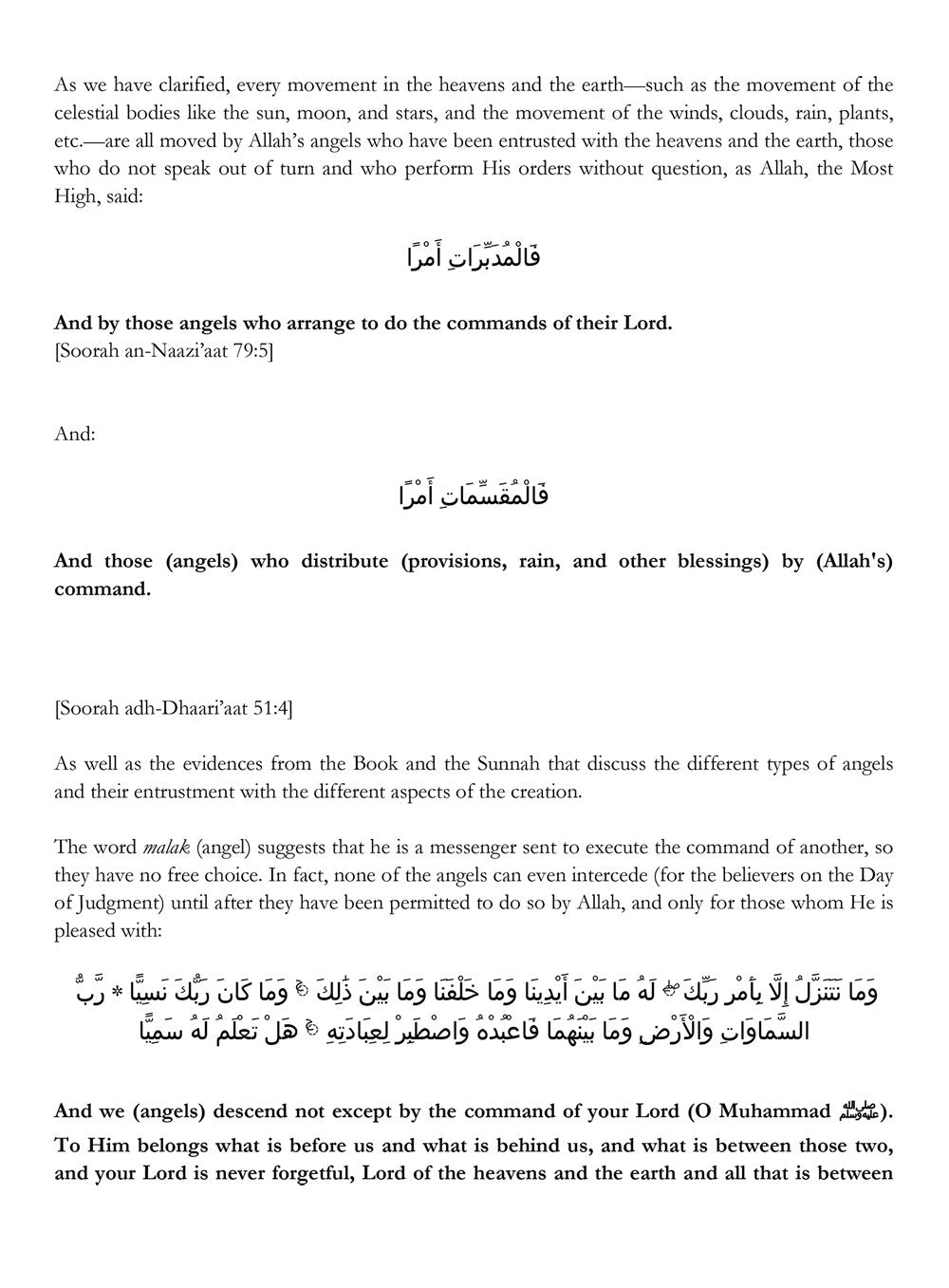
As we have clarified, every movement in the heavens and the earth-such as the movement of the celestial bodies like the sun, moon, and stars, and the movement of the winds, clouds, rain, plants, etc. are all moved by Allah's angels who have been entrusted with the heavens and the earth, those who do not speak out of turn and who perform His orders without question, as Allah, the Most High, said:
قالمديرات أمر
And by those angels who arrange to do the commands of their Lord.
[Soorah an-Naazi'aat 79:5]
And:
وَالْمُقَسمَاتِ أَمْرًا
And those (angels) who distribute (provisions, rain, and other blessings) by (Allah's) command.
[Soorah adh-Dhaari'aat 51:4]
As well as the evidences from the Book and the Sunnah that discuss the different types of angels and their entrustment with the different aspects of the creation.
The word malak (angel) suggests that he is a messenger sent to execute the command of another, so they have no free choice. In fact, none of the angels can even intercede (for the believers on the Day of Judgment) until after they have been permitted to do so by Allah, and only for those whom He is pleased with:
وَمَا تَنَزَّلُ إلَّا يأمر ربِّكَ لَهُ مَا بَيْنَ أَيْدِينَا وَمَا خَلْفَنَا وَمَا بَين ذَلِكَ * وَمَا كَانَ رَبُّكَ نَسِيًّا . ۖ السماوات والأرض وما بينهما قاعيده واصطير لِعِبَادَتِهِ * هَلْ تَعْلَمُ لَهُ سَمِيًّا
And we (angels) descend not except by the command of your Lord (O Muhammad). To Him belongs what is before us and what is behind us, and what is between those two, and your Lord is never forgetful, Lord of the heavens and the earth and all that is between.
Page:05
THE PRINCIPLE OF
LOVE & DESIRE
The Principle of Love and Desire is one of Ibn Taymiyyah's many important works on 'aqidah. In it, he explains how love is the basis of every movement that occurs in the universe and every action of Bani Adam. He explains that love necessitates hate for the things that oppose what one loves, and that this love and hate is the foundation of Islām, tawḥīd, and īmān. He also discusses the many sects that strayed from Allah's straight path due to their misunderstanding of this fundamental principle.
The following are excerpts from the text:
"The basis of īmān (faith) is loving for Allah's sake and hating for Allah's sake, so the one who loves for Allāh, hates for Allah, gives for Allah, and withholds for Allah, has completed his īmān."