


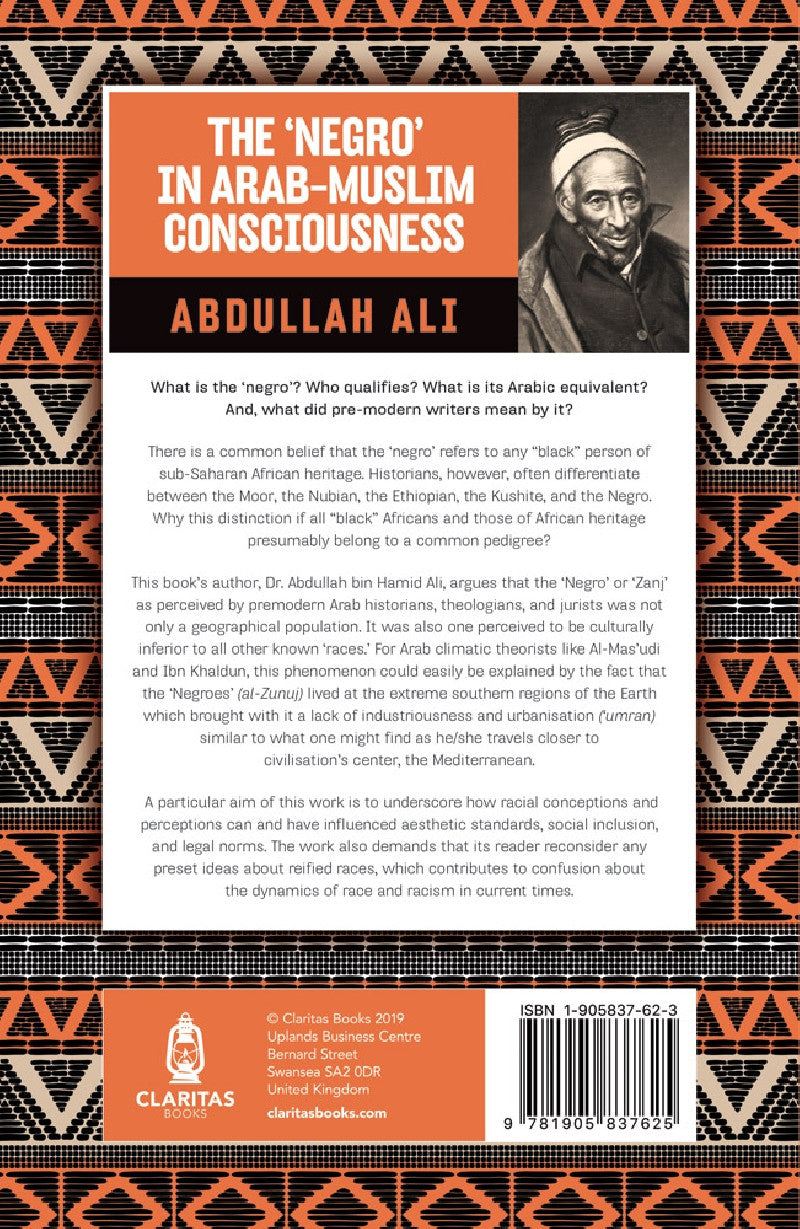
What is the ‘negro’? Who qualifies? What is its Arabic equivalent? And, what did pre-modern writers mean by it? There is a common belief that the ‘negro’ refers to any “black” person of sub-Saharan African heritage. Historians, however, often differentiate between the Moor, the Nubian, the Ethiopian, the Kushite, and the Negro. Why this distinction if all “black” Africans and those of African heritage presumably belong to a common pedigree? This book’s author, Dr. Abdullah bin Hamid Ali, argues that the ‘Negro’ or ‘Zanj’ as perceived by premodern Arab historians, theologians, and jurists was not only a geographical population. It was also one perceived to be culturally inferior to all other known ‘races.’ For Arab climatic theorists like Al-Mas’udi and Ibn Khaldun, this phenomenon could easily be explained by the fact that the ‘Negroes’ (al-Zunuj) lived at the extreme southern regions of the Earth which brought with it a lack of industriousness and urbanisation (‘umran) similar to what one might find as he/she travels closer to civilisation’s center, the Mediterranean. A particular aim of this work is to underscore how racial conceptions and perceptions can and have influenced aesthetic standards, social inclusion, and legal norms. The work also demands that its reader reconsider any preset ideas about reified races, which contributes to confusion about the dynamics of race and racism in current times.
1
/
de
4
The Negro in Arab Muslim Consciousness –Islamic Historical Perspectives by Abdullah Ali
The Negro in Arab Muslim Consciousness –Islamic Historical Perspectives by Abdullah Ali
No reviews
Publisher:
Claritas Books
Author:
Abdullah Ali
Language:
English
Binding:
Soft Cover
Pages: 294
Size: 15x22cm
Prix habituel
$30.99 USD
Prix habituel
Prix promotionnel
$30.99 USD
Prix unitaire
/
par
Frais d'expédition calculés à l'étape de paiement.
Impossible de charger la disponibilité du service de retrait


Contenu réductible
Description du livre
The Negro in Arab Muslim Consciousness –Islamic Historical Perspectives by Abdullah Ali
The Negro in Arab Muslim Consciousness by Abdullah bin Hamid Ali is a scholarly study exploring how early Arab Muslim historians and scholars understood the concept of “Negro” (Zanj). The book examines historical ideas about race, identity, and culture in Islamic civilization.
From Author:
Éditeur
Claritas Books
Auteur
- Abdullah Ali
Shipping and Delivery
We dispatch orders directly from our UK and USA warehouses, offering multiple shipping options to suit your needs. We proudly ship worldwide.
UK Deliveries (from UK warehouse):
Standard shipping typically arrives within 3–4 working days. Expedited delivery takes 2–3 working days. We aim to dispatch orders the same day or next working day, with next-day delivery options available where applicable.
USA Deliveries (from USA warehouse):
Orders usually arrive within 4–7 working days.
Europe (shipped from UK):
Standard delivery takes approximately 6–10 working days, with expedited services available in 3–5 working days.
Canada:
Estimated delivery time is 5–10 working days.
Worldwide Shipping:
International orders generally arrive within 5–20 working days, depending on destination and shipping method selected.
For precise delivery timelines based on your location, please contact us by email and our team will provide detailed information tailored to your address.
Exemples de pages - Contenu
Page 01
AVAVA
AVAVA
W
W
AAA
THE 'NEGRO'
>IN ARAB-MUSLIM
CONSCIOUSNESS
AVAVA
ABDULLAH ALI
AAA
AAA
VANAN SOOOOOO?
Page 02
CONTENTS
INTRODUCTION
Guiding Questions What is special?
CHAPTER 1
Arabian "Blacks" or "White" Arabs?
What is an Arab?
Whom Did Arabs Considered "White"?
How Arabs Became White
The Prophet's Complexion
Conclusion
CHAPTER 2
Perceiving "Black" Through Arab Eyes
Did Prophet Muhammad Have Anything to Say
About Blacks?
Were the Prophet's Companions Racists?
Is Racism Part of the Islamic Legacy?
Conclusion
CHAPTER 3
The Connection between Blackness and Slavehood
CHAPTER 4
Slavery: From Africa to Arabia
91
ནང
Why Was There No Islamic Emancipation Proclamation?
Page 03
CHAPTER 1
Arabian "Blacks" or "White" Arabs?
The original inhabitants of Arabia...were not the familiar Ar- abs of our own time, but a very much darker people. A pro- to-negroid belt of mankind stretched across the ancient world from Africa to Malaya. This belt, by environmental and other evolutionary processes, became in parts transformed, giving rise to the Hamitic peoples of Africa to the Dravidian peoples of India, and to an intermediate dark people inhabiting the Ara- bian peninsula. In the course of time two big migrations of fair- skinned peoples came from the north, one of them the mon- goloids, to break through and transform the dark belt of man beyond India, and the other, the caucasoids, to drive a wedge between India and Africa.
Dr. Bertram Thomas
Former Prime Minister to the Sultan of Muscat and Oman
Page 04
AVA
THE 'NEGRO' IN ARAB-MUSLIM CONSCIOUSNESS
ABDULLAH ALI
What is the 'negro"? Who qualifies? What is its Arabic equivalent? And, what did pre-modern writers mean by it?
There is a common belief that the 'negro' refers to any "black" person of sub-Saharan African heritage. Historians, however, often differentiate between the Moor, the Nubian, the Ethiopian, the Kushite, and the Negro. Why this distinction if all "black" Africans and those of African heritage presumably belong to a common pedigree?
This book's author, Dr. Abdullah bin Hamid Ali, argues that the 'Negro' or 'Zanj' as perceived by premodern Arab historians, theologians, and jurists was not only a geographical population. It was also one perceived to be culturally inferior to all other known 'races.' For Arab climatic theorists like Al-Mas'udi and Ibn Khaldun, this phenomenon could easily be explained by the fact that the 'Negroes' (al-Zunuj) lived at the extreme southern regions of the Earth which brought with it a lack of industriousness and urbanisation (umran) similar to what one might find as he/she travels closer to civilisation's center, the Mediterranean.
A particular aim of this work is to underscore how racial conceptions and perceptions can and have influenced aesthetic standards, social inclusion, and legal norms. The work also demands that its reader reconsider any preset ideas about reified races, which contributes to confusion about the dynamics of race and racism in current times.
VA
VA
CLARITAS
Claritas Books 2019 Uplands Business Centre Bernard Street Swansea SA2 ODR
Who is Abdullah Ali?
Abdullah Yusuf Ali (1872–1953) was an Indian-born British Islamic scholar, writer, and translator. He is best known for his widely used English translation and commentary of the Holy Quran, The Holy Qur’an: Text, Translation and Commentary. His work helped English-speaking readers understand the meanings and teachings of the Quran. He was also an author and public speaker who contributed extensively to Islamic literature in English
Customers helping others by Reviews - جزاك اللهُ خيراً
4.94 ★ (49)
Verified