


Tajweed Rules of the Qur’an Part Three | Advanced Qur’an Recitation with Tajweed Rules
Tajweed Rules of the Qur’an Part Three | Advanced Qur’an Recitation with Tajweed Rules
Publisher:
Kareema Czerepinski
Author:
Kareema Carol Czerepinski
Language:
English
Binding:
Paper back
Pages: 110
Size: 21x30cm
Impossible de charger la disponibilité du service de retrait


Contenu réductible
Description du livre
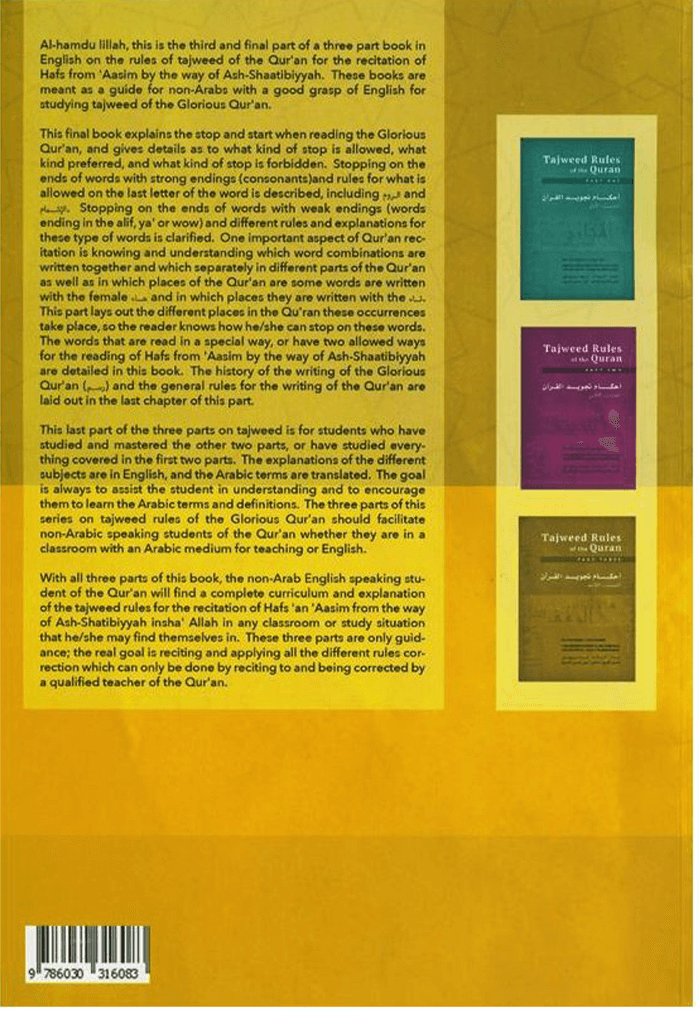
This advanced-level Tajweed book continues the internationally renowned learning series by Kareema Carol Czerepinski. It focuses on refining pronunciation skills and mastering advanced Tajweed rules through clear explanations, colourful diagrams, and practical exercises, helping students recite the Qur’an beautifully and correctly.
From Author:
Éditeur
Kareema Czerepinski
Auteur
- Kareema Carol Czerepinski
Shipping and Delivery
We dispatch orders directly from our UK and USA warehouses, offering multiple shipping options to suit your needs. We proudly ship worldwide.
UK Deliveries (from UK warehouse):
Standard shipping typically arrives within 3–4 working days. Expedited delivery takes 2–3 working days. We aim to dispatch orders the same day or next working day, with next-day delivery options available where applicable.
USA Deliveries (from USA warehouse):
Orders usually arrive within 4–7 working days.
Europe (shipped from UK):
Standard delivery takes approximately 6–10 working days, with expedited services available in 3–5 working days.
Canada:
Estimated delivery time is 5–10 working days.
Worldwide Shipping:
International orders generally arrive within 5–20 working days, depending on destination and shipping method selected.
For precise delivery timelines based on your location, please contact us by email and our team will provide detailed information tailored to your address.
Exemples de pages - Contenu
Who is Kareema Carol Czerepinski?
Kareema Carol Czerepinski is a distinguished Islamic educator and author widely recognized for her contributions to teaching Tajweed—the science of proper Qur’an recitation. Originally from the United States, she embraced Islam and dedicated her life to studying the Qur’an and Arabic language. With years of experience teaching in Islamic institutions, she has developed a clear, structured, and accessible method for explaining the rules of Tajweed to non-Arabic speakers. Her acclaimed series, Tajweed Rules of the Qur’an (Parts 1, 2, and 3), is used by students and teachers worldwide to perfect Qur’anic recitation according to classical principles.