


Shirk According to Scholars from the Four Madhhabs – Evidence of Tawheed
Shirk According to Scholars from the Four Madhhabs – Evidence of Tawheed
Publisher:
Jamiah Media
Author:
Shaykh Dr. Muhammad al-Khumayyis
Language:
English
Binding:
Soft Cover
Pages: 210
Size: 5.9 × 8.3 in15x21 Cm
Impossible de charger la disponibilité du service de retrait


Contenu réductible
Description du livre
Shirk According to Scholars from the Four Madhhabs – Evidence of Tawheed
Shirk According to Scholars from the Four Madhhabs by Shaykh Dr. Muhammad al-Khumayyis is a valuable work that gathers the statements and positions of scholars from the four major Sunni schools of jurisprudence regarding Tawheed and the prohibition of Shirk. The author demonstrates that concern for preserving pure monotheism was not limited to any single school, but was a shared principle among Hanafi, Maliki, Shafi'i, and Hanbali scholars. By presenting quotations from authoritative scholars across the madhhabs, the book refutes the misconception that discussions concerning Tawheed and warnings against Shirk are exclusive to particular later movements. It serves as an important reference for students of Aqeedah and anyone seeking a deeper understanding of the unanimous emphasis placed on pure worship of Allah throughout Islamic scholarship.
From Author:
Shirk According To Scholars From The Four Madhhabs The Followers of the Imams Abu Haneefah, ash-Shafi malik Ahmad and others have exerted great effort in promoting tawheed and averting shirk. So the matter is not as some think that only the Hanbli scholars combated innovation and the shirk of the Quburiyyah and others. I have maintained that I shall not quote anything from Shaykh ul-Islam Ibn Taymiyyah, his student al-Allamah Ibn ul-Qayyim or from Imam Muhammad ibn Abdul Wahhab (rahimahumullah) and his offspring.This is because i desired to show the comcern of this serious issue with the Hanbali scholars and to avoid it seemong as if those scholars mentioned have a monopoly on the subject and went into the issue the most, to the extent that some of the ignoramuses attach issues related to aqeedah to "Wahhabism" and the likes.
Content:
1. Tawheed and Rejection of Shirk Across All Madhhabs
The author highlights that scholars from all four madhhabs—Hanafi, Maliki, Shafi‘i, and Hanbali—strongly emphasized Tawheed and warned against shirk. The book argues that concern for correct belief is not limited to any one school of thought.
2. Definition of Shirk in Classical Scholarship
The book presents definitions of shirk as understood by early jurists and theologians, explaining it as:
Associating partners with Allah in worship
Directing acts of devotion to other than Allah
Believing in powers or attributes equal to Allah
3. Categories of Shirk
It explains how scholars categorized shirk into forms such as:
Major shirk (shirk akbar): acts that remove a person from Islam
Minor shirk (shirk asghar): subtle forms such as showing off in worship
Hidden forms of shirk involving intention and reliance on others besides Allah
4. Prevention of Shirk (Sadd al-Dhara’i)
A key focus is how scholars from all madhhabs emphasized blocking the means that lead to shirk, such as:
Avoiding excessive reverence of graves
Preventing practices that could lead to saint worship
Protecting pure monotheism in belief and action
5. Examples of Practices Cautioned Against
The book lists examples mentioned by classical scholars where actions could lead to shirk or innovation, including:
Excessive veneration of righteous people
Seeking help from the dead
Rituals that compromise direct worship of Allah
Structure of the Book
Maliki Madhhab Section
Introduction to Maliki views on shirk
Definitions of shirk among Maliki scholars
Categories and legal discussions
Preventive measures against shirk
Examples of prohibited practices
Conclusion
Hanafi Madhhab Section
Hanafi understanding of shirk
Classification of shirk
Warnings against practices leading to shirk
Scholarly examples and rulings
Conclusion
Shafi‘i Madhhab Section
Discussion of shirk in Shafi‘i scholarship
Legal and theological definitions
Preventive principles
Examples from classical texts
Éditeur
Jamiah Media
Auteur
- Shaykh Dr. Muhammad al-Khumayyis
Shipping and Delivery
We dispatch orders directly from our UK and USA warehouses, offering multiple shipping options to suit your needs. We proudly ship worldwide.
UK Deliveries (from UK warehouse):
Standard shipping typically arrives within 3–4 working days. Expedited delivery takes 2–3 working days. We aim to dispatch orders the same day or next working day, with next-day delivery options available where applicable.
USA Deliveries (from USA warehouse):
Orders usually arrive within 4–7 working days.
Europe (shipped from UK):
Standard delivery takes approximately 6–10 working days, with expedited services available in 3–5 working days.
Canada:
Estimated delivery time is 5–10 working days.
Worldwide Shipping:
International orders generally arrive within 5–20 working days, depending on destination and shipping method selected.
For precise delivery timelines based on your location, please contact us by email and our team will provide detailed information tailored to your address.
Exemples de pages - Contenu
Page:01
SHIRK
According To Scholars From The Four
Madhhabs
By Shaykh, Dr Muhammad al-Khumayyis (Professor, Faculty of Usul ud-Din, Imam University, Riyadh)
Translated by Abdul Haq Al-Ashanti
JAMIAH MEDIA
Page:02
SHIRK
According To Scholars From The Four
Madhhabs
The followers of the Imams Abu Haneefah, ash-Shafi'i, Malik, Ahmad and others have exerted great effort in promoting tawheed and averting shirk. So the matter is not as some think that only the Hanbali scholars combated innovation and the shirk of the Quburiyyah and others. I have maintained that I shall not quote anything from Shaykh ul-Islam Ibn Taymiyyah, his student al-'Allamah Ibn ul-Qayyim or from Imam Muhammad ibn 'AbdulWahhab (rahimahumullah) and his offspring. This is because I desired to show the concern of this serious issue with the Hanbali scholars and to avoid it seeming as if those scholars mentioned have a monopoly on the subject and went into the issue the most, to the extent that some of the ignoramuses attach issues related to 'aqeedah to "Wahhabism" and the likes.
Shaykh, Dr Muhammad al-Khumayyis
Page:03
Contents
1. Shirk According To Scholars From The Maliki Madhhab
Introduction
Definition of Shirk According to Some Maliki Scholars
The Categories of Shirk According to the Maliki Scholars Preventing the Means That Lead to Shirk According to the Maliki Scholars
Samples of Shirk Which the Maliki Scholars Have Cautioned Against
Conclusion
2. Shirk According To Scholars From The Hanafi Madhhab
Introduction
Definition of Shirk According to the Hanafi Scholars
Categories of Shirk According to The Hanafi Scholars
The Means to Shirk Which the Hanafi Scholars Have Cautioned Against
Samples of Shirk Which the Hanafi Scholars Have Cautioned Against
Conclusion
3. Shirk According To Scholars From The Shafi'i Madhhab Introduction
Page:04
Shirk According To Scholars From The Maliki Madhhab
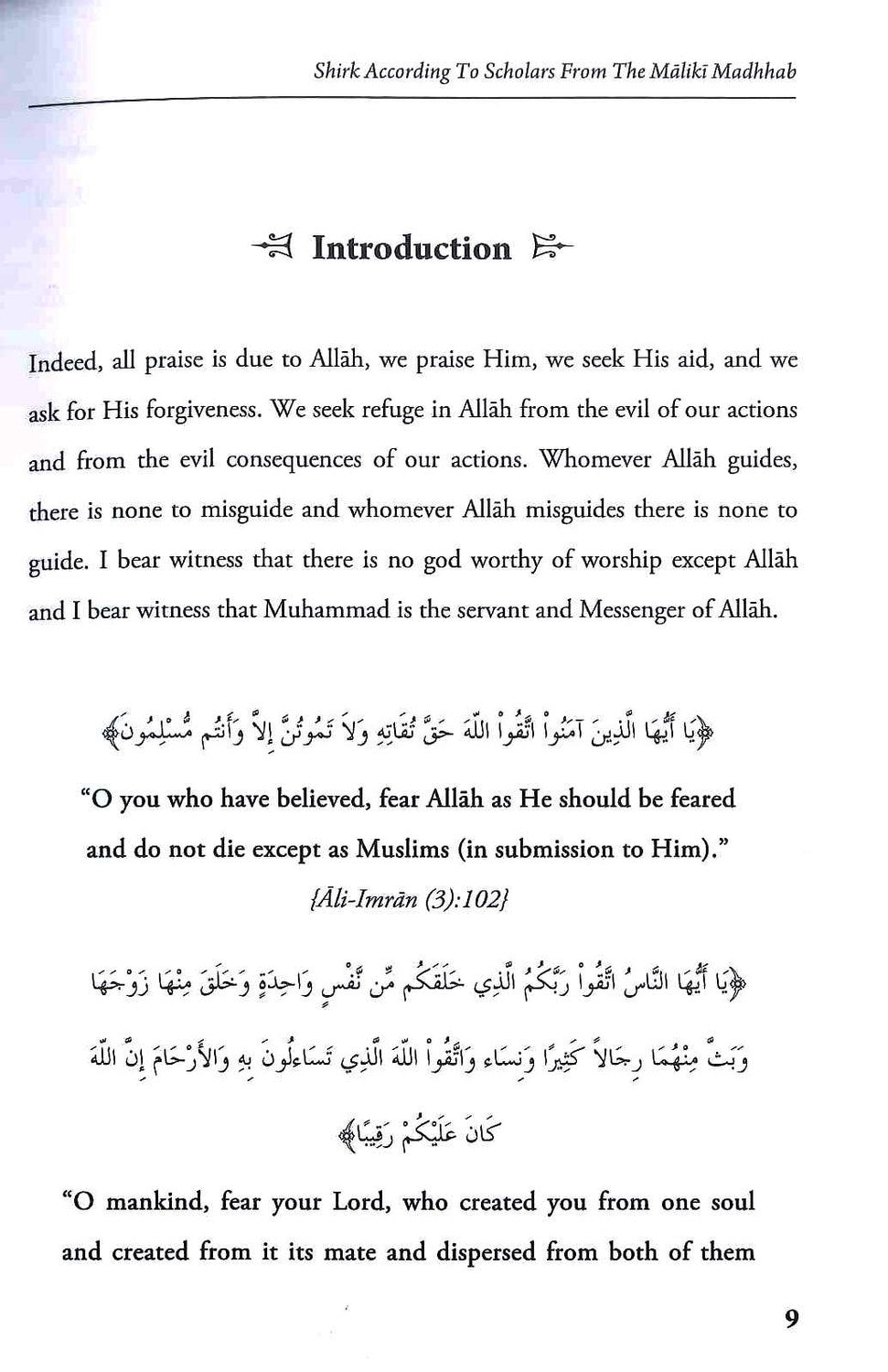
Introduction
Indeed, all praise is due to Allah, we praise Him, we seek His aid, and we ask for His forgiveness. We seek refuge in Allah from the evil of our actions and from the evil consequences of our actions. Whomever Allah guides, there is none to misguide and whomever Allah misguides there is none to guide. I bear witness that there is no god worthy of worship except Allāh and I bear witness that Muhammad is the servant and Messenger of Allāh.
ويَا أَيُّهَا الَّذِينَ آمَنُواْ اتَّقُواْ اللّهَ حَقَّ تُقَاتِهِ وَلَا تَمُوتُنَّ إِلَّا وَأَنتُم مُّسْلِمُونَ ﴾
you who have believed, fear Allah as He should be feared and do not die except as Muslims (in submission to Him)."
{Ali-Imran (3):102}
يا أَيُّهَا النَّاسُ اتَّقُواْ رَبَّكُمُ الَّذِي خَلَقَكُم مِّن نَّفْسٍ وَاحِدَةٍ وَخَلَقَ مِنْهَا زَوْجَهَا
وَبَثَّ مِنْهُمَا رِجَالاً كَثِيرًا وَنِسَاء وَاتَّقُوا اللَّهَ الَّذِي تَسَاءَلُونَ بِهِ وَالْأَرْحَامَ إِنَّ اللَّهَ كَانَ عَلَيْكُمْ رَقِيبًا
“O mankind, fear your Lord, who created you from one soul
and created from it its mate and dispersed from both of them
Who is Shaykh Dr Muhammad al-Khumayyis?
Shaykh Dr. Muhammad ibn 'Abd al-Rahman al-Khumayyis is a Saudi Islamic scholar, researcher, and author known for his works on Islamic creed ('Aqeedah), Tawheed, and comparative studies of Islamic theological schools. He earned advanced academic qualifications in Islamic studies and has authored numerous books examining the beliefs of the early Muslim scholars and the four Sunni madhhabs. His writings are widely used by students of knowledge for their focus on authentic sources from the Qur'an, Sunnah, and the understanding of the Salaf.