


Continuing with the Reflections series, this book focusses on the third chapter in the Holy Qur'an. Written in simple and easy to read format, allowing the reader to absorb the key points of Surah Al-Imran is trying to convey.
1
/
de
4
Reflections on Surah Al-Imran – Tafsir & Spiritual Insights from the Qur’an
Reflections on Surah Al-Imran – Tafsir & Spiritual Insights from the Qur’an
Publisher:
Kube Publishing
Author:
Anis Ahmad
Language:
English
Binding:
Paper back
Pages: 104
Size: 21cmx15cm
Prix habituel
$11.95 USD
Prix habituel
Prix promotionnel
$11.95 USD
Prix unitaire
/
par
Frais d'expédition calculés à l'étape de paiement.
Impossible de charger la disponibilité du service de retrait


Contenu réductible
Description du livre
A thoughtful and inspiring reflection on Surah Al-Imran, offering practical lessons, spiritual insights, and deeper understanding of one of the most powerful chapters of the Qur’an.
From Author:
Éditeur
Kube Publishing
Auteur
- Anis Ahmad
Shipping and Delivery
We dispatch orders directly from our UK and USA warehouses, offering multiple shipping options to suit your needs. We proudly ship worldwide.
UK Deliveries (from UK warehouse):
Standard shipping typically arrives within 3–4 working days. Expedited delivery takes 2–3 working days. We aim to dispatch orders the same day or next working day, with next-day delivery options available where applicable.
USA Deliveries (from USA warehouse):
Orders usually arrive within 4–7 working days.
Europe (shipped from UK):
Standard delivery takes approximately 6–10 working days, with expedited services available in 3–5 working days.
Canada:
Estimated delivery time is 5–10 working days.
Worldwide Shipping:
International orders generally arrive within 5–20 working days, depending on destination and shipping method selected.
For precise delivery timelines based on your location, please contact us by email and our team will provide detailed information tailored to your address.
Exemples de pages - Contenu
Page:01
REFLECTIONS ON SURAH AL 'IMRAN
A Thematic Understanding
THE ISLAMIC FOUNDATION
Page:02
Ack Contents
» Acknowledgements
» Preface
» The Context
» An Overview
» Tawhid: The Common Theme in All Divine Scriptures
» The Qur'an as a Touchstone for Truth
>> The Wisdom Behind Naskh, Qualification of Ayat
>> Avoiding an Immoderate, Lavish and Prodigal Living » Success of Truth Over Falsehood
>> Invitation to Use Reason (Ta'aqul), Critical Thinking, Contemplation (Tafakkur) and Introspection (Tadabbur)
>> Realization of Tawhid as a Matter of Faith, and a Way of Life >> Unity and Variety
>> The Culture of Freedom of Faith and Unity in Variety » Bani Isra'il's Delusions
» The Ethics of Intercommunal Relations
>> Interfaith Relationship
» No Intercession of them
» Kind and Hospitable Attitude Towards Unbelievers Holding of Key Positions
>> Obedience to the Prophet
Page:03
inviting them
ent. They are the people whose works have gone in the world to come. They have none to come to =ychology of the People of the Book, their their consistent evading and avoiding clear Sture, the Prophet keeps on i Pan which endorses the original teachings of -, Musa and 'Isa, and also corrects confusions mism of the Prophet, his consistency and 'wah workers. He even prays for those who r progeny to one day enter into the fold of People of the Book, the Prophet also invites ere called ummi (literally, a person who did onal schooling), to embrace Islam. Though literary tradition of excellence in poetry, and ng and the art of warfare. The word ummi or that they were not carriers of a Divine Book, Isra'il.
of the Book, the Qur'an also discusses the at in its present form, it contains only a small The Qur'anic revelation, on the other hand, ersion and provides a complete code of life. nse, it is to their own advantage to welcome
aith and teachings of Ibrahim, Ishaq, Ismail iced those who were given a portion of the Book henever their learned men are summoned to fference among them, a party of them turns they say: The Fire of Hell shall not touch us ys. Their false beliefs which they have forged How then, will they fare when We shall gather y about which there is no doubt-when every
human being shall be paid in full for what he has done, and none shall be wronged!" (Al 'Imran 3: 23-25)
Bani Isra'il's Delusions
The above ayat refer to one of the self-deceptions of the People of the Book, which posit that, due to being a "chosen" people, they will receive special treatment in the Hereafter, and that even if they must go through punishment for their unethical behaviour, the Hellfire will not touch them except for a short and temporary duration. The Qur'an questions their self-claimed preferential treatment in the life Hereafter, because Allah is extremely Just (al-Adil) and people shall be judged by Him only on the basis of their beliefs and deeds, not their genealogy.
The Qur'an tells us that the Bani Isra'il lost its leadership role due to its daring and continuous violations of its own Scriptures; whereas the Muslim community, due to its conscious acceptance of serving Allah alone, was given this noble role and responsibility. The prayer that follows has a tacit message on why a change in leadership becomes necessary: "Say (O Prophet): "O Allah, Lord of the dominion! You bestow dominion on whomever You please and take away dominion from whomever You please; and You exalt whom You please and abase whom You please. In Your hand is all good. Surely You are All- Powerful. You cause night to pass into the day and the day to pass into the night. You bring forth the living out of the dead and You bring the dead out of the living, and You grant livelihood to whomever You will, beyond all reckoning."" (Al 'Imran 3: 26-27)
This beautiful du'a' carries an indication that the leadership role of Bani Isra'il was going to be transferred to the Muslim ummah; and that Bani Isra'il, due to their ungratefulness and rebellious attitude, was going to be relieved of the leadership role. Here, this leadership role is called a fadl or blessing of Allah, which He bestows upon whomsoever He wills. But those
REFLECTIONS ON SURAH AL 'IMRAN: A THEMATIC UNDERSTANDING
Page:04
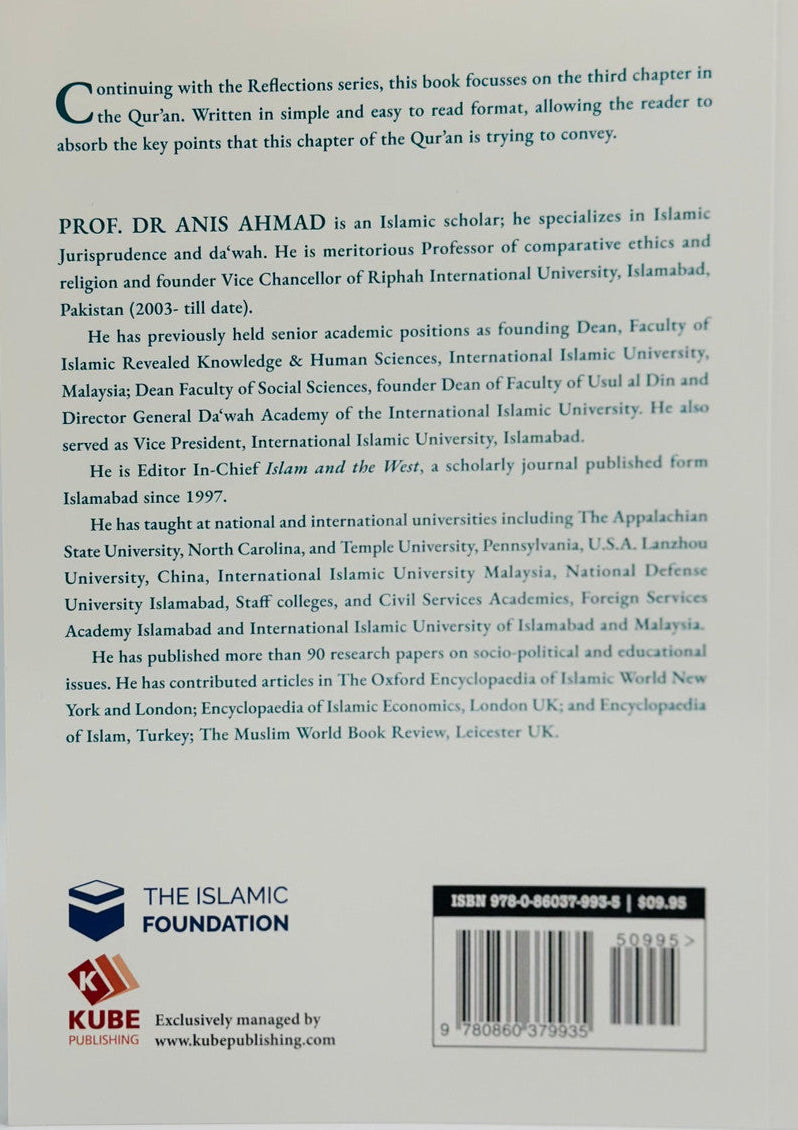
Continuing with the Reflections series, this book focusses on the third chapter in
Quran. Written in simple and easy to read formats, allowing the reader to
absorb the key points that this chapter of the Qur'an is trying to convey.
PROF. DR ANIS AHMAD is an Islamic scholar; he specializes in Islamic Jurisprudence and da'wah. He is meritorious Professor of comparative ethics and religion and founder Vice Chancellor of Riphah International University, Islamabad, Pakistan (2003- till date).
He has previously held senior academic positions as founding Dean, Faculty of Islamic Revealed Knowledge & Human Sciences, International Islamic University, Malaysia; Dean Faculty of Social Sciences, founder Dean of Faculty of Usul al Din and Director General Da'wah Academy of the International Islamic University. He also served as Vice President, International Islamic University, Islamabad.
He is Editor In-Chief Islam and the West, a scholarly journal published form Islamabad since 1997.
He has taught at national and international universities including The Appalachian State University, North Carolina, and Temple University, Pennsylvania, U.S.A. Lanzhou University, China, International Islamic University Malaysia, National Defense University Islamabad, Staff colleges, and Civil Services Academies, Foreign Services Academy Islamabad and International Islamic University of Islamabad and Malaysia.
He has published more than 90 research papers on socio-political and educational issues. He has contributed articles in The Oxford Encyclopaedia of Islamic World New York and London; Encyclopaedia of Islamic Economics, London UK; and Encyclopaedia of Islam, Turkey; The Muslim World Book Review, Leicester UK.
Who is Anis Ahmad?
Dr. Anis Ahmad is a distinguished Islamic scholar, academic, and author known for his contributions to contemporary Islamic thought, education, and research. With a strong background in Islamic studies and social sciences, he has played a significant role in promoting authentic Islamic scholarship and intellectual development within the Muslim world.
Customers helping others by Reviews - جزاك اللهُ خيراً
4.93 ★ (44)
Verified