


Raising Children in Islam by Shaykh Abdur Razzaaq Al-Badr
Raising Children in Islam by Shaykh Abdur Razzaaq Al-Badr
Publisher:
Maktabatul-Irshad
Author:
Shaykh Abdur Razzaaq bin Abdul Muhsin Al-Badr
Language:
English
Binding:
Soft Cover
Pages: 68
Size: 8.3 × 5.8 × 0.2 inches
Impossible de charger la disponibilité du service de retrait


Contenu réductible
Description du livre
Raising Children in Islam by Shaykh Abdur Razzaaq Al-Badr | Islamic Parenting Book
Raising Children in Islam by Shaykh Abdur Razzaaq bin Abdul Muhsin Al-Badr is a beneficial Islamic parenting guide that highlights the responsibility of Muslim parents in nurturing children upon the teachings of the Qur’an and authentic Sunnah. The book discusses the importance of discipline, moral upbringing, Islamic manners, education, and protecting children from harmful influences while developing strong faith and character. Written in a concise and easy-to-understand style, this work serves as a practical reminder for parents, teachers, and guardians seeking authentic Islamic guidance on raising righteous children. Published by Maktabatul-Irshad, this valuable book encourages parents to fulfill the trust Allah has placed upon them and to prepare children for success in this life and the Hereafter.
From Author:
Éditeur
Maktabatul-Irshad
Auteur
- Shaykh Abdur Razzaaq bin Abdul Muhsin Al-Badr
Shipping and Delivery
We dispatch orders directly from our UK and USA warehouses, offering multiple shipping options to suit your needs. We proudly ship worldwide.
UK Deliveries (from UK warehouse):
Standard shipping typically arrives within 3–4 working days. Expedited delivery takes 2–3 working days. We aim to dispatch orders the same day or next working day, with next-day delivery options available where applicable.
USA Deliveries (from USA warehouse):
Orders usually arrive within 4–7 working days.
Europe (shipped from UK):
Standard delivery takes approximately 6–10 working days, with expedited services available in 3–5 working days.
Canada:
Estimated delivery time is 5–10 working days.
Worldwide Shipping:
International orders generally arrive within 5–20 working days, depending on destination and shipping method selected.
For precise delivery timelines based on your location, please contact us by email and our team will provide detailed information tailored to your address.
Exemples de pages - Contenu
Page:01
RAISING CHILDREN IN ISLAM
SHAYKH ABDUR RAZZAAQ BIN ABDUL MUHSIN AL-BADR
Page:02
THE OBLIGATION TO PROTECT ONE'S CHILD FROM THE HELL-FIRE
Thus what is mandatory-O brothers-is that we carry out this responsibility, give care to this flock and fulfill their obligations as required. Allah (J) says:
RAISING CHILDREN IN ISLAM severe, who resist not Allah in that which He commanded them, but do that which they are commanded." [Surah at-Tahrim 66:6]
With what will we protect ourselves from the Fire? With obedience to Allah (30) by fulfilling His commands while being submissive to His legislation. 'Alee Ibn Abee Talib, the magnificent Companion (26), said concerning the meaning of, "Ward off from yourselves and your families a Fire:"
يَا أَيُّهَا الَّذِينَ آمَنُوا قُوا أَنْفُسَكُمْ وَأَهْلِيكُمْ نَارًا وَقُودُهَا النَّاسُ وَالْحِجَارَةُ عَلَيْهَا مَلَائِكَةٌ غِلَاظٌ شِدَادٌ لَا يَعْصُونَ
اللهَ مَا أَمَرَهُمْ وَيَفْعَلُونَ مَا يُؤْمَرُونَ )
"O ye who believe! Ward off from yourselves and your families a Fire whereof the fuel is men and stones, over which are set angels strong, severe, who resist not Allah in that which He commanded them, but do that which they are commanded." [Surah at-Tahrim 66:6]
"Ward off from yourselves and your families a Fire," this is an instruction that is mandatory upon every Muslim-Le., to protect himself and his family (which includes his wife, child and whoever is in his care and guardianship) from the Fire. From the descriptions of the Fire is that its "fuel is men and stones," (and refuge is sought with Allah) and over it "are set angels strong,
«أَدْبُوهُم وعلموهم
"Discipline and educate them."
This is the meaning of warding off the Fire from them. And al-Hasan al-Basree () also said regarding the
same verse:
امروهم بالفرائض وعلموهم الخيره
"Command them with the obligatory acts and teach them the good."
Therefore, protecting one's child from the Hell-fire is fulfilled with two important, magnificently tremendous matters that must be observed: Discipline and education, disciplining and teaching the child:
1. "Discipline them:" You cultivate them to have traits, and character, good beautiful
Page:03
THE OBLIGATION TO PROTECT ONE'S CHILD FROM THE HELL-FIRE
and hit them to do so (pray the Salah) at ten;" and if he is lazy and prefers to play while having reached ten years old and does not pray or leaves the Salah, then we must hit him so that he can be heedful and know that the affair is a dangerous one and should not be taken lightly. However, when we strike the child, we do it to discipline him not to destroy him: we correct him with a hit so that he becomes disciplined, stronger and thus directed towards the Masjid while we accompany him. This is the second manner:
RAISING CHILDREN IN ISLAM
keep away from wickedness and immoral behavior from a young age.
a) "Separate them in their beds," meaning, do not allow them to sleep under one mattress and
no ni cover, rather separate them; because their dos sleeping together under one mattress and cover will lead to serious disasters and dangers whose 10 outcome is dispraised (and refuge is sought with Allah): matters like fornication, homosexuality and other than that from the lewd acts that are prevalent in some places. And from the greatest reasons for this is negligence in the upbringing.
((وَاضْرِبُوهُمْ عَلَيْهَا لِعَشْرِ))
"...and hit them to do so (pray the Salah) at ten."
"Separate them in their beds:" If the child reaches the age of ten and nears the time when he would have a wet dream-you must pay attention to this matter-separate them in their beds. Do not allow them to sleep in the same mattress or ones that are close to each other, because this will lead to what is after it (and) refuge is sought with Allah). Thus the children will be accustomed to good manners and values like this, and they are also to be disciplined to
:says (سبحانه وتعال) Allah
و يَا أَيُّهَا الَّذِينَ آمَنُوا لِيَسْتَأْذِنَكُمُ الَّذِينَ مَلَكَتْ أَيْمَانُكُمْ
وَالَّذِينَ لَمْ يَبْلُغُوا الحلم مِنْكُمْ ثَلَاثَ مَرَّاتٍ مِنْ قَبْلِ صَلَاةِ الفجر وجين لطعون ببابكم من الظهيرة ومِنْ بَعْدِ صَلاة الْعِشَاءِ ثَلَاثُ عَوْرَاتٍ لَكُمْ لَيْسَ عَلَيْكُمْ وَلَا عَلَيْهِمْ جُنَاحٌ بعْدَهُنَّ طَوَّافُونَ عَلَيْكُمْ بَعْضُكُمْ عَلَى بَعْضٍ كذلك يُبين الله
لَكُمُ الْآيَاتِ وَاللَّهُ عَلِيمٌ حَكِيمٌ)
"O you who believe! Let your slaves and slave- girls, and those among you who have not come to the age of puberty ask your permission (before they come to your presence) on three
Page:04
RAISING CHILDREN
IN ISLAM
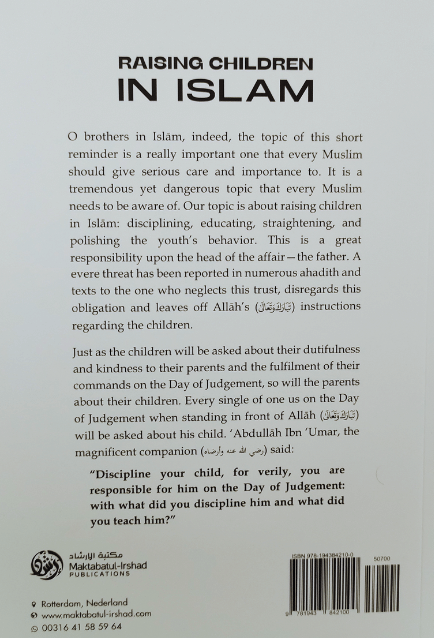
O brothers in Islam, indeed, the topic of this short reminder is a really important one that every Muslim should give serious care and importance to. It is a tremendous yet dangerous topic that every Muslim needs to be aware of. Our topic is about raising children in Islam: disciplining, educating, straightening, and polishing the youth's behavior. This is a great responsibility upon the head of the affair-the father. A evere threat has been reported in numerous ahadith and texts to the one who neglects this trust, disregards this obligation and leaves off Allah's (43) instructions regarding the children.
Just as the children will be asked about their dutifulness and kindness to their parents and the fulfilment of their commands on the Day of Judgement, so will the parents about their children. Every single of one us on the Day of Judgement when standing in front of Allah (30) will be asked about his child. 'Abdullah Ibn 'Umar, the
:said (رضي الله عنه وأرضاء) magnificent companion
"Discipline your child, for verily, you are responsible for him on the Day of Judgement: with what did you discipline him and what did you teach him?"
Who is Shaykh Abdur Razzaaq Bin Abdul Muhsin Al Badr?
The author’s intention is to make the profound meanings of the Al-Haa’iyah creed poem accessible and relevant. Through clear explanation, Shaykh Al-Badr guides readers into the poem’s theological insights, emphasizing reliance on the Qur’an and Sunnah and refuting deviant doctrinal positions — such as those who reject the Sunnah as a source of belief.