


The third part of the Islamic Curriculum series. Key topics of this part include; lessons on salah, ahadith on appreciation, the migration and the journey to Ta’if, the stories of Ibrahim (as) and Isma’il (as). Minor signs of Qiyamah, importance on being kind to parents and the etiquettes of studying and reciting the Qur’an. Complete with its very own workbook with differentiated activities using Bloom’s Taxonomy.
1
/
de
4
Islamic Curriculum Coursebook 3 (المنهج الإسلامي) – Interactive Islamic Studies Learning Book for Kids
Islamic Curriculum Coursebook 3 (المنهج الإسلامي) – Interactive Islamic Studies Learning Book for Kids
Publisher:
An Nasihah Publications
Author:
An Nasihah Publications
Language:
English
Binding:
Soft Cover
Pages: 164
Size: 23x16cm
Prix habituel
$14.99 USD
Prix habituel
Prix promotionnel
$14.99 USD
Prix unitaire
/
par
Frais d'expédition calculés à l'étape de paiement.
Impossible de charger la disponibilité du service de retrait


Contenu réductible
Description of Book
Islamic Curriculum Coursebook 3 (المنهج الإسلامي) – Interactive Islamic Studies Learning Book for Kids
Islamic Curriculum Coursebook 3 is an engaging Islamic studies book designed to help Muslim children strengthen their Islamic knowledge through colorful lessons and interactive learning. It covers Salah, appreciation and gratitude, the migration and journey to Ta’if, stories of Prophets Ibrahim and Isma‘il عليهما السلام, kindness to parents, and etiquettes of studying and reciting the Quran.
From Author:
Publisher
An Nasihah Publications
Author
- An Nasihah Publications
Sample Pages - Content
Page no:01
An Nasihah
Islamic Curriculum
Fiqh • Ahadith
• Sirah
• Tarikh Aqa'id
• Akhlaq
المنهج الاسلامي للأطفال
Мононен
• Ādāb
ноном
I♥ Islam
Немененен
An Nasihah Publications
HOHGHGHGI
Coursebook
Page no:02
Learning Objectives
Figh
At the end of this unit pupils should be able to:
Define the key terms of fiqh.
Describe the different types of najāsah (impurity).
Distinguish between the fara'id & sunan of ghusl.
Summarise şalah, the conditions before and during salah, nawaqiḍ and method.
Demonstrate when and how Salātul Witr, Şalatul Qasr and Salātul Mariḍ are performed.
27
27
Fiqh
Page no:03
Fiqh
Şalah
Method of ṣalāh for girls
1) Ensure the hair is fully covered.
2) Lift both hands up to the shoulders and
اللهُ أَكْبَرُ :say
3) Place the right hand on top of the left on the chest with both palms facing towards the chest and the fingers being kept close together.
4) Read Du'a' al-Istiftäḥ (Thana'), Ta'awwudh, Tasmiyah, Surah Fatihah and at least one long ayah or three short äyät of the Qur'an.
5) Saying
bigo into ruku'. In ruku' the back should be slightly bent in order to be able to touch the knees with the fingers being kept close together. (In ruku', sajdah and qa'dah the fingers will be kept close to each other.) The ankles should also be together. Recite
.at least three times سُبْحَانَ رَبِي الْعَظِيم
Page no:04
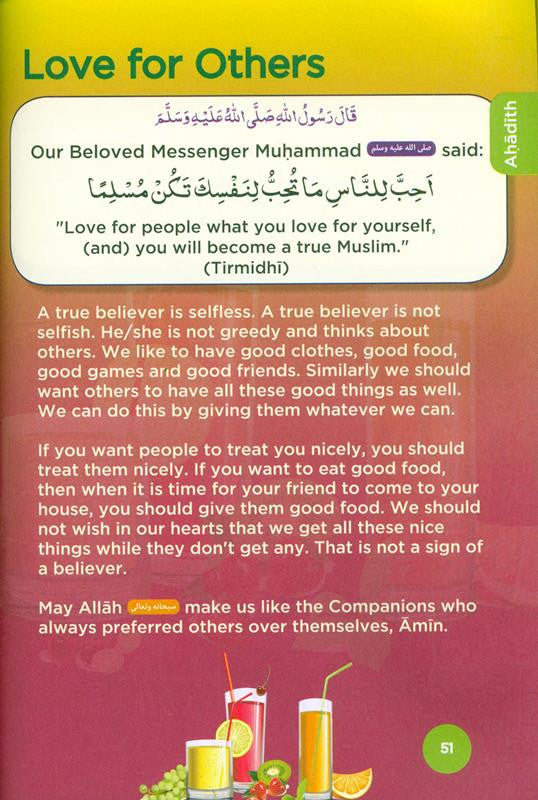
Love for Others
قَالَ رَسُولُ اللَّهِ صَلَّى اللَّهُ عَلَيْهِ وَسَلَّمَ
Our Beloved Messenger Muḥammad said:
أحِبَّ لِلنَّاسِ مَا تُحِبُّ لِنَفْسِكَ تَكُن مُسْلِمًا
"Love for people what you love for yourself, (and) you will become a true Muslim." (Tirmidhi)
A true believer is selfless. A true believer is not selfish. He/she is not greedy and thinks about others. We like to have good clothes, good food, good games arid good friends. Similarly we should want others to have all these good things as well. We can do this by giving them whatever we can.
If you want people to treat you nicely, you should treat them nicely. If you want to eat good food, then when it is time for your friend to come to your house, you should give them good food. We should not wish in our hearts that we get all these nice things while they don't get any. That is not a sign of a believer.
May Allah, make us like the Companions who always preferred others over themselves, Āmin.
51
Aḥādith
An Nasihah Publications
An Nasihah Publications — recognized for producing structured Islamic curriculum materials designed for young Muslim learners using interactive and age-appropriate educational methods.
Customers helping others by Reviews - جزاك اللهُ خيراً
4.94 ★ (49)
Verified