Page:01
GOD
ARISES
الإسلام يتحدى
Maulana Wahiduddin Khan
Page:02
CONTENTS
PUBLISHER'S NOTE
FOREWORD
CHALLENGE OF MODERN KNOWLEDGE
Logical Positivism
REVIEW
THE METHOD OF ARGUMENT
The Line of Argument
NATURE AND SCIENCE SPEAK ABOUT GOD
ARGUMENT FOR THE LIFE HEREAFTER
Probability
The Concept of the Afterlife as an Imperative
Empirical Evidence
AFFIRMATION OF PROPHETHOOD
THE CHALLENGE OF THE QUR'AN
Predictions
The Mummy of Merneptah
Survival of Arabic Language
Contradictions in Human Reasoning
Darwinism
Political Philosophy
The Qur'an
Biblical Inconsistency
Secular Contradictions
Historical Inaccuracy
Page:03
CHALLENGE OF MODERN KNOWLEDGE
With the splitting of the atom, all of man's conceptions of matter have been drastically altered. In fact, the advance of science in the past century has culminated in a knowledge explosion, the like of which has never before been experienced in human history, and in the wake of which all ancient ideas about God and religion have had to be re-examined. This, as Julian Huxley puts it, is the challenge of modern knowledge. In the following pages, I propose to answer this challenge, for I am convinced that, far from having a damaging effect on religion, modern knowledge has served to clarify and consolidate its truths. Many modern discoveries support Islamic claims made 1400 years ago that what is laid down in the Qur'an is the ultimate truth, and that this will be borne out by all future knowledge.
"We still show them Our signs in all the regions of the earth and in their own souls, until they clearly see that this is the truth." (Qur'an 41: 53)
Modern atheistic thinkers dismiss religion as being unfounded in fact. They maintain that it springs from man's desire to find meaning in the universe. While the urge to find an explanation is not in itself wrong, they hold that the inadequacy of our predecessors' knowledge led them to wrong conclusions, namely, the existence of a God or gods, the notions that creation and destruction were a function of the godhead, that man's fate was of concern to God, that there was a life after death in heaven or hell, as warranted by the morality of man's life on earth, and that all thinking on these matters must necessarily be regulated by religion. They feel that, in the light
Page:04
God Arises
Anti-religionists feel, therefore, that man's recent mental evolution is the very antithesis of religious thinking. Modern, advanced knowledge has it that reality is only that which can stand up to the tests of observation and experience, whereas religion is based on a concept of reality which cannot in this way be subjected to analysis and scientifically proved: it follows then that it has no basis in actuality. In other words, religion gives an unrealistic account of real events. Since man's knowledge was limited in ancient times, the correct explanations of natural phenomena were bound to elude him. This being so, the suppositions he made which hinged on religion were distinctly far-fetched and, at best, tangential. But, thanks to the universal law of evolution, man has at last emerged from the darkness in which he was engulfed, and now, in the light of modern knowledge, it is possible for him to discard odd, conjectural beliefs and arrive at the true nature of things by purely empirical methods. T. R. Miles writes:
"It might be said that metaphysicians of the past have done something comparable to writing a cheque without adequate funds in the bank. They have used words without proper 'cash' to back them; they have been unable to give their words 'cash-value' in terms of states of affairs.
'The Absolute is incapable of evolution and progress' is a grammatically correct sentence; but the words are like a dud cheque, and cannot be 'cashed'."
All those things, which were formerly attributed to supernatural forces, are now wholly explainable in terms of natural causes, modern thinking having it that the "discovery" of God was a mere assumption arising from ignorance. With the spread of knowledge, this belief has automatically disappeared. Julian Huxley writes:
Religion and the Scientific Outlook, George Allen and Unwin
Page:05
GOD ARISES
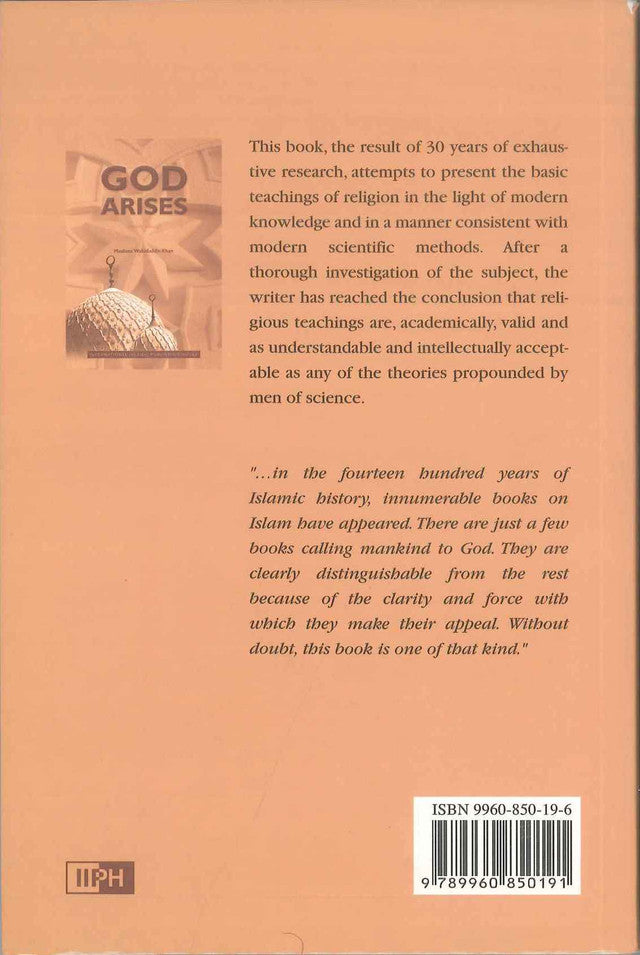
This book, the result of 30 years of exhaus- tive research, attempts to present the basic teachings of religion in the light of modern knowledge and in a manner consistent with modern scientific methods. After a thorough investigation of the subject, the writer has reached the conclusion that reli- gious teachings are, academically, valid and as understandable and intellectually accept- able as any of the theories propounded by men of science.
"...in the fourteen hundred years of Islamic history, innumerable books on Islam have appeared. There are just a few books calling mankind to God. They are clearly distinguishable from the rest because of the clarity and force with which they make their appeal. Without doubt, this book is one of that kind."