Page:01
أحكام الجنائز
FUNERAL RITES
IN ISLAM
Dr. Abu Ameenah Bilal Philips
الدار العالمية للكتاب الإسلامي
Page:02
Funeral Rites in Islam
me a good substitute after him.)"
3) Surah Yasin
The practice of specifically reading the 36th chapter of the Qur'an, Surah Yasin, in the presence of the dying has no basis in the authentic Sunnah. 14 Neither the Prophet () nor his Companions did it, or recommended that it be done. However, it does fall under the general heading of 'good things' which could be said in the presence of one who is dying, but it carries with it no special value. Reciting this chapter is like reciting any other chapter in the Qur'an. Consequently, one may read it for the dying, if one wishes to do so, or if the dying person requests it due to his or her personal preference for it. However, to specify that Surah Yasin should be read for the dying and to believe that doing so has special value is considered bid'ah, a sinful innovation in the religion.
4) Facing Qiblah
Turning the body of one who is dying so that he or she faces the qiblah (Makkah) has no foundation in the practice of the Prophet () and his Companions. The body should be turned to face Makkah when it is placed in the grave, according to the Prophet's instructions. However, at the time of dying, there were no such instructions. Turning the body became a custom after the time of the Prophet's Companions, but was objected to by the scholars of
13 Muslim (English trans), vol. 2, p. 436, hadith no. 2002.
14 There is an inauthentic hadith to that effect narrated by Ma'qil and collected in Sunan Abi Dawud, vol. 2, p. 889, hadith no. 3115. Sunan Ibn Majah, vol. 2, p. 367 hadith no. 1448. See also Mishkat al-Maşabiḥ, vol. 1, p. 338. It is declared inauthentic in Daif Sunan Abi Dawud, p. 316, hadith no. 683.
Page:03
Funeral Rites in Islam
certainty, and it must take place before the actual throes of death begin. This point is evident in the Prophet's attempt to get his uncle Abu Talib to bear witness to Allah's oneness when the latter was on his deathbed. Abu Talib knew about Allah, Islam, and the Prophet () very well. Similarly, the following incident involving the Prophet's servant is one of a person who knew about Allah and the Prophet.
عَنْ أَنَسٍ هِ قَالَ : كَانَ غُلَامٌ يَهُودِيٌّ يَخْدُمُ النَّبِيَّ صلى الله عليه وسلم فَمَرِضَ فَأَتَاهُ النَّبِيُّ صلى الله عليه وسلم يَعُودُهُ فَقَعَدَ عِنْدَ رَأْسِهِ فَقَالَ لَهُ: ((أَسْلِمْ)). فَنَظَرَ إِلَى أَبِيهِ وَهُوَ عِنْدَهُ فَقَالَ لَهُ أَطِعْ أَبَا الْقَاسِمِ ، فَأَسْلَمَ فَخَرَجَ النَّبِيُّ صلى الله عليه وسلم وَهُوَ يَقُولُ: ((الْحَمْدُ لِلَّهِ الَّذِي أَنْقَذَهُ مِنَ النَّارِ)). [فلما مات ، قال : (صلوا على صاحبكم)).
Anas also narrated, "When a Jewish youth who used to serve the Prophet got sick, the Prophet () visited him. The Prophet (*) sat by his head and said to him, "Accept Islam." The boy looked at his father who was near him, and the man said, "Obey Abul- Qāsim." So the boy accepted Islam and the Prophet () left saying, "All praise is due to Allah, who saved him from the Fire. [When the boy died, the Prophet (Blessings and Peace be
Abu Hurayrah reported Allah's Messenger
O as saying, "I testify that there is no god worthy of worship but Allah and that I am the Messenger of Allah. Any servant who meets Allah with those two (testimonies), having no doubt in them, will enter Paradise." [Muslim (English trans), vol. 1, p. 20, hadith no. 41].
8 The Prophet () is reported by 'Abdullah ibn 'Umar to have said, "Allah, Most Great and Glorious, will accept His servant's repentance until the throes of death begin." (Collected by Tirmidhi and Ibn Majah and authenticated by Shaykh al- Albani in Sahih Sunan Ibn Majah, vol. 2, p. 418, hadith no. 3430. See Riyadh-us- Şaleḥin, vol. 1, p. 12, hadith no. 18, for an English translation of this hadith).
Muslim (English trans), vol. 1, p. 18, hadith no. 36.
10 Bukhari (Arabic-English), vol. 2, p. 246, hadith no. 438, Sunan Abi Dawud, vol. 2, Pp. 881-82, hadith no. 3089 and Mishkat al-Maşabiḥ, vol. 1, p. 328.
Page:04
Funeral Rites in Islam
me a good substitute after him.)"
3) Surah Yasin
The practice of specifically reading the 36th chapter of the Qur'an, Surah Yasin, in the presence of the dying has no basis in the authentic Sunnah.14 Neither the Prophet () nor his Companions did it, or recommended that it be done. However, it does fall under the general heading of 'good things' which could be said in the presence of one who is dying, but it carries with it no special value. Reciting this chapter is like reciting any other chapter in the Qur'an. Consequently, one may read it for the dying, if one wishes to do so, or if the dying person requests it due to his or her personal preference for it. However, to specify that Surah Yasin should be read for the dying and to believe that doing so has special value is considered bid'ah, a sinful innovation in the religion.
4) Facing Qiblah
Turning the body of one who is dying so that he or she faces the qiblah (Makkah) has no foundation in the practice of the Prophet () and his Companions. The body should be turned to face Makkah when it is placed in the grave, according to the Prophet's instructions. However, at the time of dying, there were no such instructions. Turning the body became a custom after the time of the Prophet's Companions, but was objected to by the scholars of
13 Muslim (English trans), vol. 2, p. 436, hadith no. 2002.
14 There is an inauthentic hadith to that effect narrated by Ma'qil and collected in Sunan Abi Dawud, vol. 2, p. 889, hadith no. 3115. Sunan Ibn Majah, vol. 2, p. 367 hadith no. 1448. See also Mishkat al-Maşabiḥ, vol. 1, p. 338. It is declared inauthentic in Daif Sunan Abi Dawud, p. 316, hadith no. 683.
Page:05
FUNERAL RITES IN ISLAM
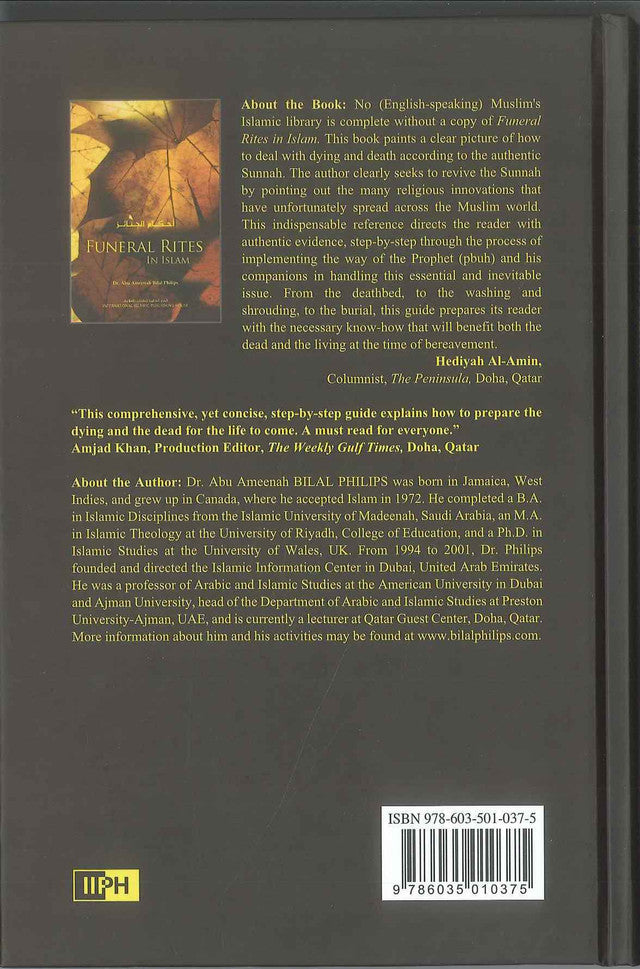
About the Book: No (English-speaking) Muslim's Islamic library is complete without a copy of Funeral Rites in Islam. This book paints a clear picture of how to deal with dying and death according to the authentic Sunnah. The author clearly seeks to revive the Sunnah by pointing out the many religious innovations that have unfortunately spread across the Muslim world. This indispensable reference directs the reader with authentic evidence, step-by-step through the process of implementing the way of the Prophet (pbuh) and his companions in handling this essential and inevitable issue. From the deathbed, to the washing and shrouding, to the burial, this guide prepares its reader with the necessary know-how that will benefit both the dead and the living at the time of bereavement.
Hediyah Al-Amin, Columnist, The Peninsula, Doha, Qatar
"This comprehensive, yet concise, step-by-step guide explains how to prepare the dying and the dead for the life to come. A must read for everyone." Amjad Khan, Production Editor, The Weekly Gulf Times, Doha, Qatar
About the Author: Dr. Abu Ameenah BILAL PHILIPS was born in Jamaica, West Indies, and grew up in Canada, where he accepted Islam in 1972. He completed a B.A. in Islamic Disciplines from the Islamic University of Madeenah, Saudi Arabia, an M.A. in Islamic Theology at the University of Riyadh, College of Education, and a Ph.D. in Islamic Studies at the University of Wales, UK. From 1994 to 2001, Dr. Philips founded and directed the Islamic Information Center in Dubai, United Arab Emirates. He was a professor of Arabic and Islamic Studies at the American University in Dubai and Ajman University, head of the Department of Arabic and Islamic Studies at Preston University-Ajman, UAE, and is currently a lecturer at Qatar Guest Center, Doha, Qatar