


« Quatre principes du Shirk par Muhammad ibn Abd al-Wahhab – Tawhid et Aqida »
« Quatre principes du Shirk par Muhammad ibn Abd al-Wahhab – Tawhid et Aqida »
Publisher:
Al Hidaayah Publishing
Author:
Yasir Qadhi
Language:
Anglais
Binding:
Couverture rigide
Pages: 60
Size: 18 x 25 cm
Impossible de charger la disponibilité du service de retrait
Contenu réductible
Description du livre
L'explication des quatre principes du shirk selon Muhammad ibn Abd al-Wahhab constitue un guide clair pour comprendre le tawhid et éviter le shirk en islam. Cet ouvrage essentiel de la foi islamique expose les principes fondamentaux du culte, ce qui en fait une ressource précieuse pour les étudiants en aqida et les chercheurs d'une connaissance islamique authentique.
De l'auteur :
Cheikh Muhammad ibn Abd al-Wahhab était un éminent érudit et réformateur islamique du XVIIIe siècle. Il est connu pour son insistance sur le Tawhid (monothéisme) et sa mise en garde contre le shirk (associationnisme), et ses ouvrages sur la Aqida (cathéda) demeurent une source d'influence pour les étudiants en sciences islamiques du monde entier.
Éditeur
Al Hidaayah Publishing
Auteur
- Yasir Qadhi
Shipping and Delivery
We dispatch orders directly from our UK and USA warehouses, offering multiple shipping options to suit your needs. We proudly ship worldwide.
UK Deliveries (from UK warehouse):
Standard shipping typically arrives within 3–4 working days. Expedited delivery takes 2–3 working days. We aim to dispatch orders the same day or next working day, with next-day delivery options available where applicable.
USA Deliveries (from USA warehouse):
Orders usually arrive within 4–7 working days.
Europe (shipped from UK):
Standard delivery takes approximately 6–10 working days, with expedited services available in 3–5 working days.
Canada:
Estimated delivery time is 5–10 working days.
Worldwide Shipping:
International orders generally arrive within 5–20 working days, depending on destination and shipping method selected.
For precise delivery timelines based on your location, please contact us by email and our team will provide detailed information tailored to your address.
Exemples de pages - Contenu
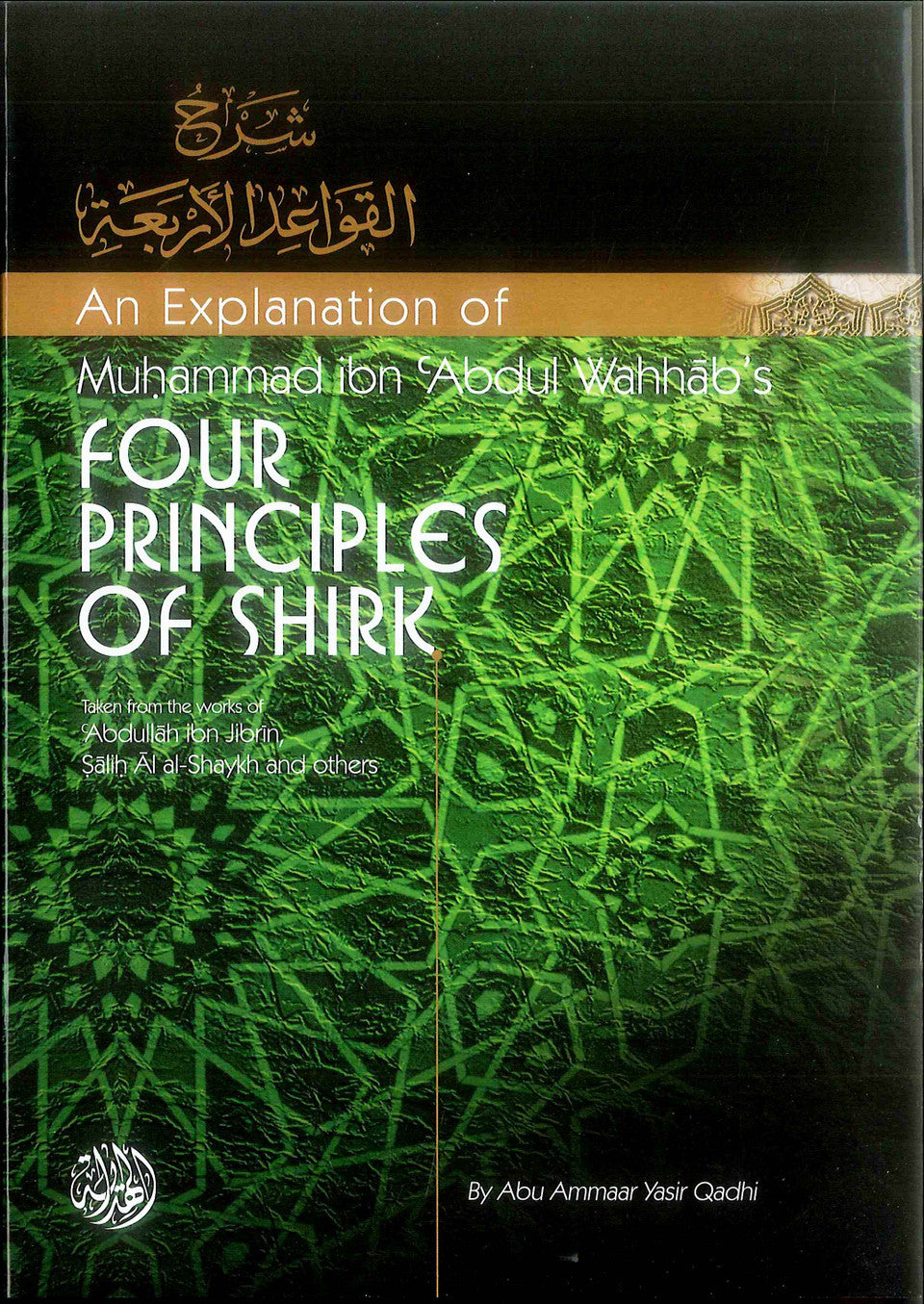
Page:01
شراح القواعد الأربعة
An Explanation of
Muhammad ibn Abdul Wahhab's
FOUR PRINCIPLES OF SHIRK
Taken from the works of Abdullah ibn Jibrin
Salih Al al-Shaykh and others
By Abu Ammaar Yasir Qadhi
Page:02
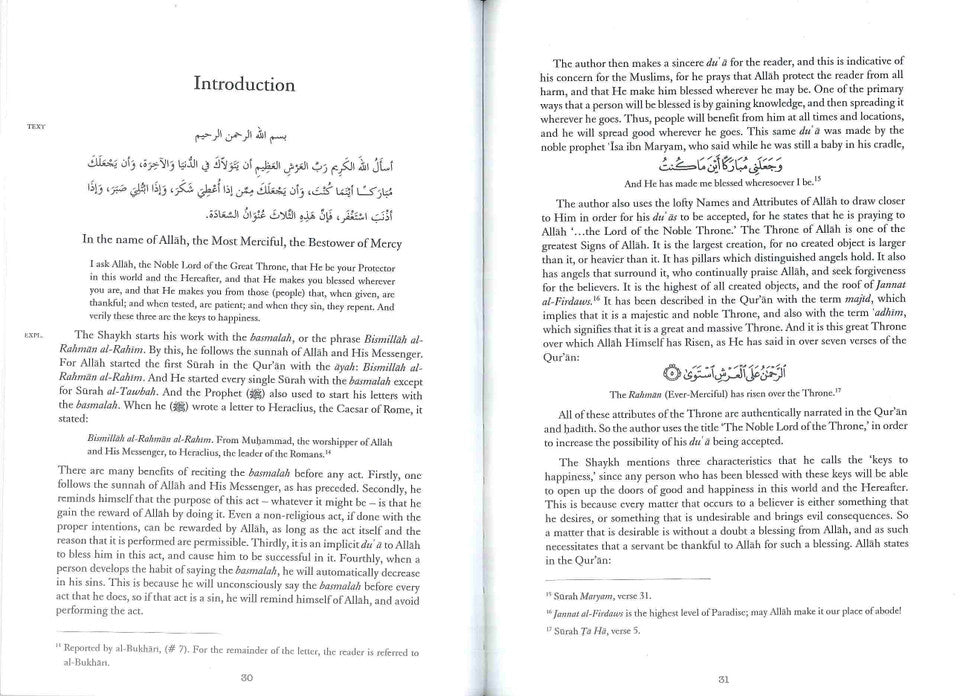
Introduction
بسم الله الرحمن الرحيم
أسأَلُ اللهَ الكَرِيم رَبَّ العَرْشِ العَظِيمِ أَن يَتَوَلاكَ فِي الدُّنْيَا وَالْآخِرَةِ، وَأَن يَجْعَلَكَ مُبَارَكًا أَيْنَمَا كُنْتَ، وَأَن يَجْعَلَكَ مِمَّن إذا أُعْطِيَ شَكَرَ، وَإِذَا ابْتُلِيَ صَبَرَ، وَإِذَا
أَذْنَبَ اسْتَغْفَر فَإِنَّ هَذِهِ الثَّلاثَ عُنْوَانُ السَّعَادَة.
In the name of Allah, the Most Merciful, the Bestower of Mercy
I ask Allah, the Noble Lord of the Great Throne, that He be your Protector in this world and the Hereafter, and that He makes you blessed wherever you are, and that He makes you from those (people) that, when given, are thankful; and when tested, are patient; and when they sin, they repent. And verily these three are the keys to happiness.
The Shaykh starts his work with the basmalah, or the phrase Bismillah al- Rahman al-Rahim. By this, he follows the sunnah of Allah and His Messenger. For Allah started the first Surah in the Qur'an with the ayah: Bismillah al- Rahman al-Rahim. And He started every single Surah with the basmalah except for Surah al-Tawbah. And the Prophet () also used to start his letters with the basmalah. When he () wrote a letter to Heraclius, the Caesar of Rome, it stated:
Bismillah al-Rahman al-Rahim. From Muhammad, the worshipper of Allah and His Messenger, to Heraclius, the leader of the Romans.14
There are many benefits of reciting the basmalah before any act. Firstly, one follows the sunnah of Allah and His Messenger, as has preceded. Secondly, he reminds himself that the purpose of this act - whatever it might be - is that he gain the reward of Allah by doing it. Even a non-religious act, if done with the proper intentions, can be rewarded by Allah, as long as the act itself and the reason that it is performed are permissible. Thirdly, it is an implicit du a to Allah to bless him in this act, and cause him to be successful in it. Fourthly, when a person develops the habit of saying the basmalah, he will automatically decrease in his sins. This is because he will unconsciously say the basmalah before every act that he does, so if that act is a sin, he will remind himself of Allah, and avoid performing the act.
14 Reported by al-Bukhari, (#7). For the remainder of the letter, the reader is referred to al-Bukhari.
The author then makes a sincere du'a for the reader, and this is indicative of his concern for the Muslims, for he prays that Allah protect the reader from all harm, and that He make him blessed wherever he may be. One of the primary ways that a person will be blessed is by gaining knowledge, and then spreading it wherever he goes. Thus, people will benefit from him at all times and locations, and he will spread good wherever he goes. This same du'a was made by the noble prophet 'Isa ibn Maryam, who said while he was still a baby in his cradle,
وَجَعَلَنِي مُبَارَكًا أَيْنَ مَا كُنتُ
And He has made me blessed wheresoever I be. 15
The author also uses the lofty Names and Attributes of Allah to draw closer to Him in order for his du as to be accepted, for he states that he is praying to Allah ...the Lord of the Noble Throne.' The Throne of Allah is one of the greatest Signs of Allah. It is the largest creation, for no created object is larger than it, or heavier than it. It has pillars which distinguished angels hold. It also has angels that surround it, who continually praise Allah, and seek forgiveness for the believers. It is the highest of all created objects, and the roof of Jannat al-Firdaws. 16 It has been described in the Qur'an with the term majid, which implies that it is a majestic and noble Throne, and also with the term 'adhim, which signifies that it is a great and massive Throne. And it is this great Throne over which Allah Himself has Risen, as He has said in over seven verses of the Qur'an:
الرَّحْمَنُ عَلَى الْعَرْشِ اسْتَوَى )
The Rahman (Ever-Merciful) has risen over the Throne."7
All of these attributes of the Throne are authentically narrated in the Qur'an and hadith. So the author uses the title "The Noble Lord of the Throne,' in order to increase the possibility of his du'a being accepted.
The Shaykh mentions three characteristics that he calls the 'keys to happiness,' since any person who has been blessed with these keys will be able to open up the doors of good and happiness in this world and the Hereafter. This is because every matter that occurs to a believer is either something that he desires, or something that is undesirable and brings evil consequences. So a matter that is desirable is without a doubt a blessing from Allah, and as such necessitates that a servant be thankful to Allah for such a blessing. Allah states in the Qur'an:
15 Surah Maryam, verse 31.
16 Jannat al-Firdaws is the highest level of Paradise; may Allah make it our place of abode! 17 Surah Ta Ha, verse 5.
Page:03
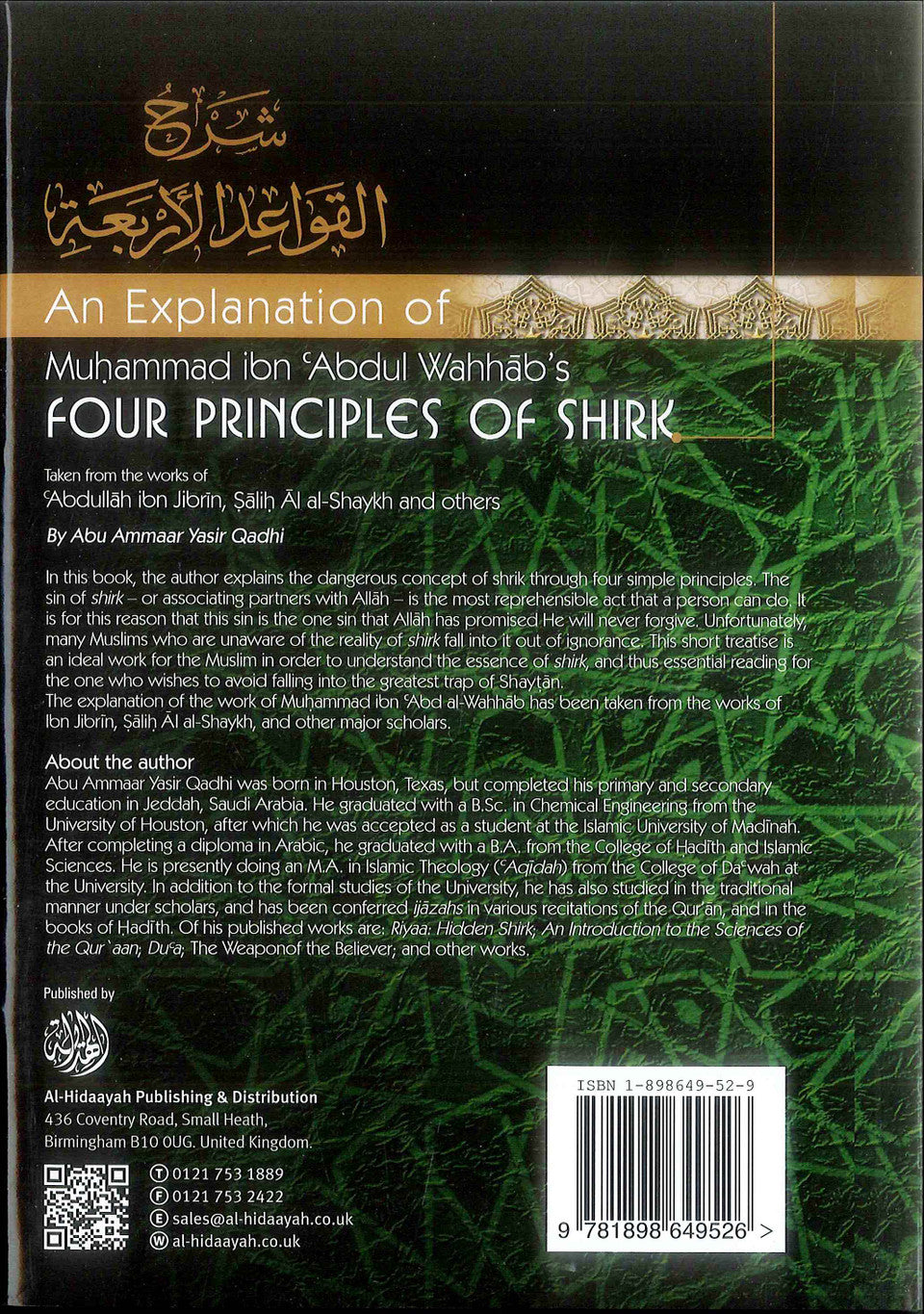
شراح القواعد الأربعة
An Explanation of THAT
Muḥammad ibn Abdul Wahhab's
FOUR PRINCIPLES OF SHIRK
Taken from the works of
Abdullah ibn Jibrin, Ṣāliḥ Al al-Shaykh and others
By Abu Ammaar Yasir Qadhi
In this book, the author explains the dangerous concept of shrik through four simple principles. The sin of shirk - or associating partners with Allah - is the most reprehensible act that a person can do. It is for this reason that this sin is the one sin that Allah has promised He will never forgive. Unfortunately, many Muslims who are unaware of the reality of shirk fall into it out of ignorance. This short treatise is an ideal work for the Muslim in order to understand the essence of shirk, and thus essential reading for- the one who wishes to avoid falling into the greatest trap of Shaytan.
The explanation of the work of Muhammad ibn Abd al-Wahhab has been taken from the works of Ibn Jibrin, Ṣāliḥ Al al-Shaykh, and other major scholars.
About the author
Abu Ammaar Yasir Qadhi was born in Houston, Texas, but completed his primary and secondary education in Jeddah, Saudi Arabia. He graduated with a B.Sc. in Chemical Engineering from the University of Houston, after which he was accepted as a student at the Islamic University of Madinah. After completing a diploma in Arabic, he graduated with a B.A. from the College of Hadith and Islamic Sciences. He is presently doing an M.A. in Islamic Theology (Aqidah) from the College of Dawah at the University. In addition to the formal studies of the University, he has also studied in the traditional manner under scholars, and has been conferred ijāzahs in various recitations of the Qur'an, and in the books of Hadith. Of his published works are: Riyaa: Hidden Shirk; An Introduction to the Sciences of the Qur`aan; Dufa; The Weaponof the Believer; and other works.
Who is Yasir Qadhi?
Shaykh Muhammad ibn Abd al-Wahhab was an 18th-century Islamic scholar known for reviving Tawheed and clarifying the dangers of shirk in Islam.