


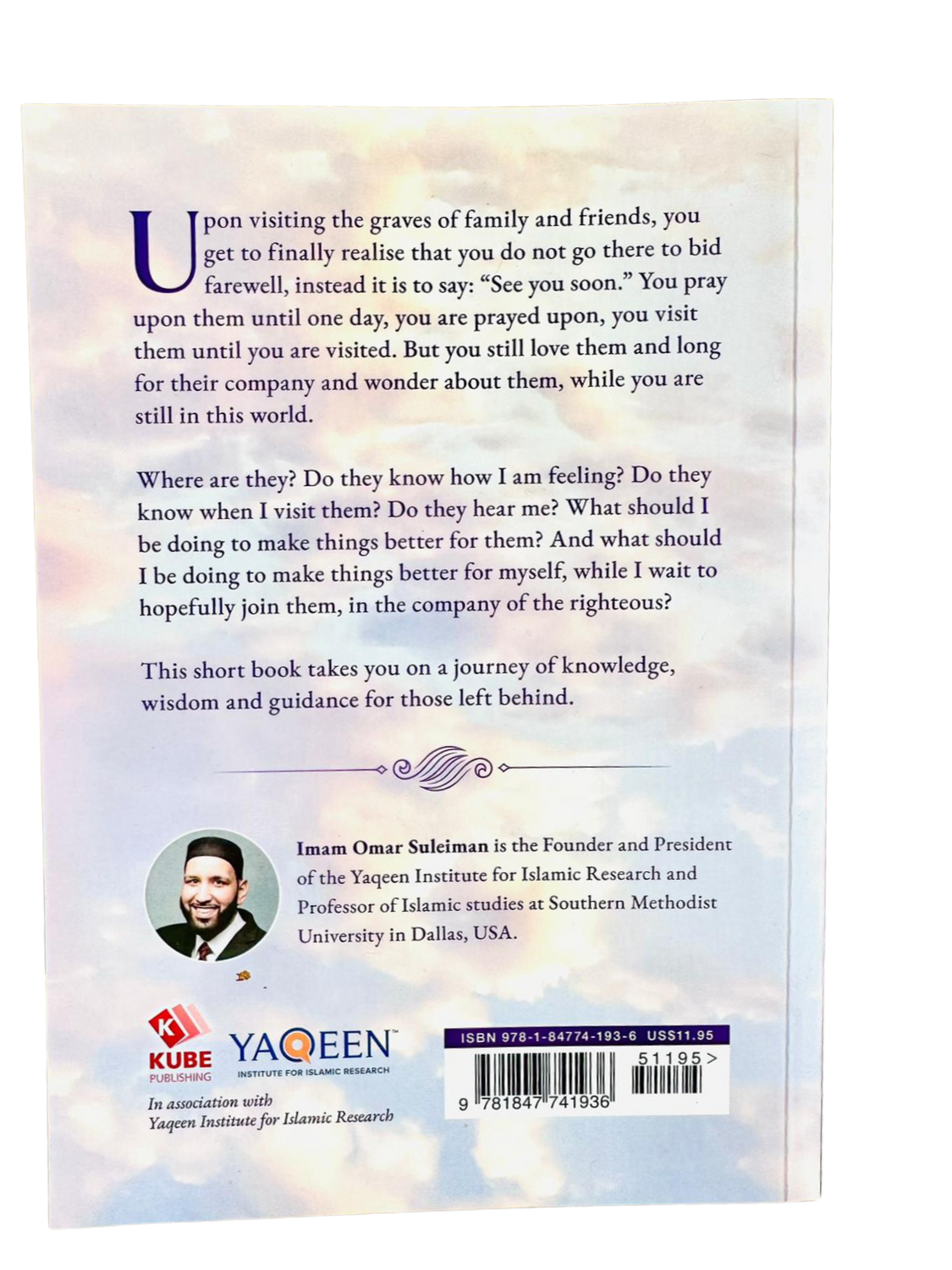
As our community encounters death at an increasing rate, how do we honor those who have left us beyond the Janazah? How can the families of our deceased brothers and sisters cope and grow, while staying connected to their loved ones? This book is meant to provide guidance spiritually to those who are grieving, while also covering the rulings associated with death and mourning for practical purposes. We pray that this will offer clarity and comfort to those who need it most in these difficult times.
1
/
de
10
For Those Left Behind | Islamic Guidance on Death, Grief & Coping with Loss in Islam
For Those Left Behind | Islamic Guidance on Death, Grief & Coping with Loss in Islam
No reviews
Publisher:
Kube Publishing
Author:
Omar Suleiman
Language:
English
Binding:
Paper back
Pages: 114
Size: 14x21cm
Prix habituel
$11.95 USD
Prix habituel
Prix promotionnel
$11.95 USD
Prix unitaire
/
par
Frais d'expédition calculés à l'étape de paiement.
Impossible de charger la disponibilité du service de retrait


Contenu réductible
Description du livre
For Those Left Behind: Guidance on Death and Grieving by Omar Suleiman is a thoughtful and compassionate book that offers comfort and understanding to those experiencing the pain of losing a loved one. Death is one of the most difficult realities of life, and this book provides spiritual guidance rooted in Islamic teachings to help believers navigate the emotions and challenges that follow loss.
Drawing upon the Qur’an, Hadith, and the wisdom of Islamic scholars, the author reflects on the meaning of death, the temporary nature of this world, and the eternal life that awaits in the Hereafter. The book encourages readers to approach grief with patience, hope, and trust in Allah’s mercy and wisdom.
From Author:
Éditeur
Kube Publishing
Auteur
- Omar Suleiman
Shipping and Delivery
We dispatch orders directly from our UK and USA warehouses, offering multiple shipping options to suit your needs. We proudly ship worldwide.
UK Deliveries (from UK warehouse):
Standard shipping typically arrives within 3–4 working days. Expedited delivery takes 2–3 working days. We aim to dispatch orders the same day or next working day, with next-day delivery options available where applicable.
USA Deliveries (from USA warehouse):
Orders usually arrive within 4–7 working days.
Europe (shipped from UK):
Standard delivery takes approximately 6–10 working days, with expedited services available in 3–5 working days.
Canada:
Estimated delivery time is 5–10 working days.
Worldwide Shipping:
International orders generally arrive within 5–20 working days, depending on destination and shipping method selected.
For precise delivery timelines based on your location, please contact us by email and our team will provide detailed information tailored to your address.
Exemples de pages - Contenu
Page:01
Contents
To Allah belongs that which He has taken, and that which He has given.
And everything is with Allah in accordance with its prescribed time.
So be patient and seek reward [from Allah].
Introduction
The Janazah...
2. The Burial.
3. The Best Du'a's Prophet Muhammad
4. The Best Deeds on Their Behalf.
5. Where Are They?
6.Are They With Each Other?.
7.Do They Hear Me When I Visit?.
8.Do They Know What Is Happening to Me?
9. What If I Dream About Them?
10. Are They Considered Shuhada"?.
11. Losing a Child
12. Condolences
13. The Widow
14. Women Praying Janazah.
15. How Do I Move On?
Page:02
The Janazah
You entered this world with the call to prayer (adhan) being recited over you, but without any prayer (salah) being performed. When you depart from this world, there will be a prayer read over you, but there will be no call to prayer for it. The contrast between these two epic events has much significance. It is as if to say that the fleeting life which you experience in this world is as short as the duration between the call to prayer and the prayer itself.
While you were still inside the womb of your mother, an angel was appointed to register the duration of your life and the exact date of your death. This paradoxically implies that the moment you enter this world, you are actually already in one sense on your way to exit from it. All of these stark realities constitute a powerful reminder that we should consistently perform our prayers before we are prayed upon. This is because this life is far shorter than we may initially think.
Upon their death, every Muslim is entitled to have the funeral prayer (salah al-janazah) performed upon them by their fellow believers. Not only is it a religious act of worship, but it is also a way to bid farewell to our loved ones. Furthermore, it constitutes a sobering reminder that we too will one day follow them on the same path. The wise person is the one who always visualises the fateful day when the funeral prayer is offered over their dead body, and allows that thought to shape their life trajectory. The Prophet taught us how to perform the funeral prayer in elaborate detail. The prayer is unique in
both its form and order, as it consists of four successive takbirs. After the first takbir we are required to recite Surah al-Fatihah. After the second, one should send prayers (salawat) upon the Prophet, preferably through a full reading of the al-Salāh al-Ibrahimiyyah, which we are already accustomed to reciting during our regular prayers. After finishing it, one then reads the third takbir, which should be followed with a du'a' for the deceased. There are a number of confirmed supplications which have all been transmitted from the Prophet. Among them is the following:
اللَّهُمَّ اغْفِرْ حَيْنَا وَمَيِّتِنَا، وَشَاهِدِنَا وَغَائِبِنَا، وَصَغِيرِنَا وَكَبِيرِنَا، وَذَكَرِنَا وَأُنْثَانَا، اللَّهُمَّ مَنْ أَحْيَيْتَهُ مِنَّا فَأَحْيِهِ عَلَى الإِسْلَامِ ، وَمَنْ تَوَفَّيْتَهُ مِنَّا فَتَوَفَهُ عَلَى الْإِيمَانِ
"O Allah, forgive our living ones, deceased ones, present ones, absent ones, our little youngsters, elderly folk, our males, and our females. O Allah, whoever You have decreed to live amongst us, then let them live upon Islam. And whoever You decree to die, then have them die with full faith."
Page:03
When the Prophet passed away, 'A'ishah
cried loudly. When Fatimah
she realised that the Prophet
screamed and heard the weeping of 'Ã'ishah, had left this world. At that
moment she recited the following beautiful poetic words:
يَا أَبَتَاهُ مِنْ رَبِّهِ مَا أَدْنَاهُ، يَا أَبَتَاهُ إِلَى جِبْرِيلَ أَنْعَاهُ، يَا أَبْتَاهُ جَنَّةَ الفِرْدَوْسِ مَأْوَاهُ
"O my dear father! How close he is now to his Lord. O my dear father! To Jibril we announce his passing. O my dear father! The Highest Eternal Garden (Jannah al-Firdaws) is now his abode."
Knowing that a person will die is one thing, but to actually see their soul leave the body is a completely different experience. To wash their dead body is an even more intense, emotional experience. Anyone who has washed the dead will attest to the fact that performing this purification process for someone that they had known has a completely different feeling compared to doing it for an unknown person. Upon washing the body of a friend or loved one, you truly realise the deception and worthlessness of this life, as a dead body lays before you. Before this person's death, you had many priceless memories with them and shared deep emotional moments. You recall all the interactions and conversations you had with that person throughout the years; but now you see this lifeless corpse before you. Because of the impact found in this contrast, you may really begin to cherish the last moments you have with them, as you stand and watch their deceased body. You might gently stroke them or even kiss them on the forehead. In fact, it is narrated that after the Prophet passed away, Abu Bakr kissed his forehead for the last time. In addition, when 'Uthman ibn Maz'ün passed away, the Prophet did the same thing to him; he kissed his forehead and looked at him with deep contemplation.
One of the hardest acts to perform in this world is putting dirt on the face and the other parts of the body of a deceased person. In fact, the whole funeral process involves many difficult steps and stages. First, you see the soul exit the body. Thereafter, you wash the body, comb the hair, and then enshroud and perfume it in preparation for the burial. You give your loved one your last kiss on their head and cherish the final moments with them.. Then, as a means of honouring them and allowing their body to rest, you must put dirt on their face. This is undoubtedly a difficult thing to do, but it is a necessary rite in our religion. In fact, we have a moving account where Fatimah asked Anas ibn Malik a difficult question after the Prophet was buried: how did they feel putting the Prophet beneath the Earth
Page:04
Losing a Child
During the divine night journey (al-Isra' wa al-Mi'raj), the Prophet related that one of the most prominent scenes he encountered was a beautiful garden which contained every conceivable colour. He then said that he noticed an extremely tall man inside the garden. He was so tall that his head actually reached above the clouds. The Prophet observed that there were children playing around this man. Interestingly, the Prophet also remarked that he had never seen so many children in one place. To appreciate this scenery, imagine being situated in a most beautiful garden, where you observe a man who is so tall that his head is in the sky. In addition, you find children rejoicing and playing in every segment of this garden. The Prophet turned to the angels accompanying him in his journey, and said: "Who is this man?" In response, the angels said: "This is Ibrahim." Then the Prophet asked about the identities of the children playing around him. The angels said in response: "These are Losing a Child the children who died in a state of original purity (fitrah)." One of the Companions who was listening to these accounts of the divine night journey then said: "O Messenger of Allah, what about the children of the disbelievers?" The Prophet said in response: "And the children of the disbelievers."
Ultimately, this account demonstrates that when a prepubescent child dies, there is no uncertainty and ambiguity about their destination in the Hereafter. Nevertheless, the greater issue of concern is the pain that parents feel once they lose their child. In fact, that is likely to be one of the most difficult trials that they can face in their life. A parent is always willing to sacrifice his or her own wealth and health instead of seeing their child suffer or perish. Taking these factors into mind, there is no doubt that it is a nightmare for a parent to lose a child. There are many ḥadīths from the Prophet which reflect these themes and the severity of this trial. For instance, in one key ḥadīth, the Prophet mentioned that after the death of a child, Allah asks the angels: "Did you take the coolness of the eyes of My servant?" They will say in response: "Yes, O Allah." Then, with reference to the grief of the parent, Allah asks: "And what did my servant say as a result of that?" The angels respond by saying:
حَمِدَكَ وَاسْتَرْجَعَ
"He praised You (hamidaka) and said, 'To Allah we belong,
band to Him we return.""
Page:05
Where Are They?
Without any doubt, observing a body which has been badly mutilated has a serious psychological toll on a person. This topic is far more difficult to discuss than the previous ones, especially since the initial issues pertained to the blessings and treatment a righteous believer will receive after their death. But once discussing death, one can never ignore the point about how fragile the human body is. This is especially the case if the body has undergone horrific damage through a car accident, or been badly mistreated through mutilation, for instance.
One cannot imagine the difficulties and pains that the Muslims experienced in the aftermath of the Battle of Uhud. Without any doubt, Uhud was a very unique experience for the Muslims, as they never experienced a conflict like that in their history. For instance, the way the chief of the martyrs (sayyid al-shuhada") Hamzah was killed and mutilated was absolutely gruesome.
Where are They?
In the aftermath of this battle, the Prophet comforted the devastated believers by sharing with them the following good news: "When your brothers were killed, Allah put their souls in the bodies of green birds." He further mentioned that their souls-which are now situated in the bodies of these birds- freely fly over the rivers of Paradise (Jannah), and eat from its blessed fruits. They also nestle themselves inside lamps of gold under the shade of Allah's Throne. One cannot imagine how pleasant and satisfying their experience in the other world must be. Not only do they enjoy the eminent rank of being from among the martyrs of Uhud (shuhada' Uhud), but they are also now blessed with this incredible state of existence, where they have the freedom to go wherever they wish in Paradise.
What even further beautifies this spectacle is that they are honoured with the presence of Hamzah, the chief of the martyrs. While enjoying the sweetness of Allah's reward, as well as resting and marvelling at the incredible existence they found themselves in, they actually asked: "Who is going to tell our brothers that we are alive in Paradise?" They wanted their fellow Muslims to know the pleasant and blessed state they found themselves in. Furthermore, it was important for their brothers to know about their salvation so that they would maintain a steadfast posture in battles and not be discouraged from continuing to strive in the path of Allah. Lastly, the people of Madinah were in a sorrowful state in the battle's aftermath, and there were large gatherings where the mourners were wailing over the dead bodies of their loved ones. These martyrs were aware of the sorrow of their community, and wanted to alleviate their pain by conveying to them the blissful state they were in
Who is Omar Suleiman?
Omar Suleiman is a renowned Islamic scholar, speaker, and educator known for his deep knowledge of Qur’an, Sunnah, and contemporary Islamic thought. He is the founder and president of the Yaqeen Institute for Islamic Research, which focuses on producing authentic, research-based Islamic knowledge and resources for Muslims worldwide.
Customers helping others by Reviews - جزاك اللهُ خيراً
4.94 ★ (49)
Verified