


Al-Istighaathah – An Answer Regarding Swearing by Other Than Allah & Prayer Towards the Graves by Shaykhul-Islam Ibn Taymiyyah
Al-Istighaathah – An Answer Regarding Swearing by Other Than Allah & Prayer Towards the Graves by Shaykhul-Islam Ibn Taymiyyah
Publisher:
Noor Al-Furqaan Publications
Author:
Shaykhul-Islaam Ibn Taymiyyah
Language:
English
,
Arabic
Binding:
Soft Cover
Pages: 61
Size: 14x21cm
Impossible de charger la disponibilité du service de retrait


Contenu réductible
Description du livre
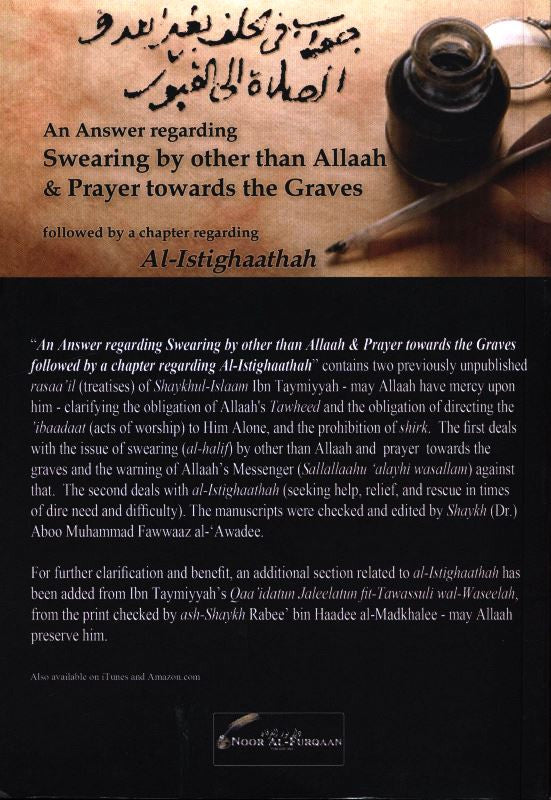
Al-Istighaathah (followed by An Answer Regarding Swearing by Other Than Allah & Prayer Towards the Graves) is a concise Islamic treatise addressing two critical issues: the obligation of directing all worship and oaths exclusively to Allah, and the prohibition of praying towards graves or relying on other than Allah for help. The book reinforces the principles of tawḥīd (monotheism) and warns against forms of association (shirk).
From Author:
In this work, Shaykhul-Islam Ibn Taymiyyah presents firm evidence from the Qur’an and authentic Sunnah to clarify that acts of worship (including oaths and supplication) must be directed solely to Allah, and that invoking any created being or praying towards graves deviates from the pure monotheistic teachings of Islam. The additional al-Istighaathah section reinforces proper Islamic etiquette of seeking help only from Allah in times of need.
Éditeur
Noor Al-Furqaan Publications
Auteur
- Shaykhul-Islaam Ibn Taymiyyah
Shipping and Delivery
We dispatch orders directly from our UK and USA warehouses, offering multiple shipping options to suit your needs. We proudly ship worldwide.
UK Deliveries (from UK warehouse):
Standard shipping typically arrives within 3–4 working days. Expedited delivery takes 2–3 working days. We aim to dispatch orders the same day or next working day, with next-day delivery options available where applicable.
USA Deliveries (from USA warehouse):
Orders usually arrive within 4–7 working days.
Europe (shipped from UK):
Standard delivery takes approximately 6–10 working days, with expedited services available in 3–5 working days.
Canada:
Estimated delivery time is 5–10 working days.
Worldwide Shipping:
International orders generally arrive within 5–20 working days, depending on destination and shipping method selected.
For precise delivery timelines based on your location, please contact us by email and our team will provide detailed information tailored to your address.
Exemples de pages - Contenu
Who is Ibn Taymiyyah?
Ibn Taymiyyah (1263–1328) was a highly influential Islamic scholar and theologian known for his dedication to the Quran and Sunnah. Originating from Harran, he became a leading figure in the Hanbali school of thought. Ibn Taymiyyah advocated for a pure and direct approach to Islamic teachings, urging Muslims to avoid practices he considered innovations, like saint worship and shrine reverence. His writings span theology, law, and philosophy, leaving a lasting impact on Islamic thought and inspiring later reformers. While his interpretations are sometimes debated, his scholarship remains deeply respected across the Muslim world.