


A Treasury of Sacred Maxims | Commentary on Islamic Legal Principles & Islamic Jurisprudence
A Treasury of Sacred Maxims | Commentary on Islamic Legal Principles & Islamic Jurisprudence
Publisher:
Kube Publishing
Author:
Shahrul Hussain
Language:
English
Binding:
Hard Cover
Pages: 168
Size: 13x20cm
Impossible de charger la disponibilité du service de retrait


Contenu réductible
Description du livre
A Treasury of Sacred Maxims | Commentary on Islamic Legal Principles is an insightful exploration of the fundamental legal maxims that guide Islamic jurisprudence. These maxims serve as essential principles used by scholars to interpret and apply Islamic law across different circumstances.
The book explains how Islamic legal principles provide a framework for understanding complex legal rulings in a consistent and balanced manner. Through these maxims, scholars can derive rulings that reflect justice, fairness, and wisdom while remaining faithful to the teachings of the Qur’an and Sunnah.
From Author:
Éditeur
Kube Publishing
Auteur
- Shahrul Hussain
Shipping and Delivery
We dispatch orders directly from our UK and USA warehouses, offering multiple shipping options to suit your needs. We proudly ship worldwide.
UK Deliveries (from UK warehouse):
Standard shipping typically arrives within 3–4 working days. Expedited delivery takes 2–3 working days. We aim to dispatch orders the same day or next working day, with next-day delivery options available where applicable.
USA Deliveries (from USA warehouse):
Orders usually arrive within 4–7 working days.
Europe (shipped from UK):
Standard delivery takes approximately 6–10 working days, with expedited services available in 3–5 working days.
Canada:
Estimated delivery time is 5–10 working days.
Worldwide Shipping:
International orders generally arrive within 5–20 working days, depending on destination and shipping method selected.
For precise delivery timelines based on your location, please contact us by email and our team will provide detailed information tailored to your address.
Exemples de pages - Contenu
Page:01
Considerations in the Removal of Harm
الضَّرَرُ لا يُزالُ بالضَّرَرِ
Harm is not replaced by harm
The condition for the application of this maxim is that
harm cannot be replaced with harm that is greater than the present harm. It seems self-defeating to remove harm if it is only replaced by a similar harm, or worse. Rather, the aim in Islam is to eliminate harm completely, if not, then as much as possible. The legal import of this maxim is found more in personal and commercial law, with little significance in spiritual law. The maxim has various applications in Shariah. For example, a house is owned jointly by more than one person and one of the co-owners wants to divide the house and partition his area off in order to get his own privacy.
Page:02
The Presumption is Freedom from Jiability
الأَصْلُ بَرَاءَةُ الذَّمَّةِ
The original state is freedom from liability
This maxim is one of the fundamental principles of the Islamic judicial process. Although it is a subsidiary maxim of the core maxim 'certainty is not overruled by doubt, some jurists argue that it is an independent maxim due to its far reaching application in judicial processes. There are two key words in this maxim: The word bara'ah means to be free of something and the word dhimmah means liability, commitment and responsibility. What this maxim means is that liability is a transitory and contingent attribute, and freedom from it is the original status of humans. Hence, when a person is born he is free from any liability unless proof can be provided to the contrary.
Page:03
The Proximate Cause Takes Precedence
إذا اجْتَمَعَ المُباشِرُ والمُتَسَبْبُ يُضافُ الحُكْمُ إِلَى المُبَاشِرِ
If the doer and the causer are blamed, the action is attributed
This maxim has a great role to play in criminal procedures to determine who the blame rests with and who is ultimately responsible. The meaning of this maxim is that when the direct causer of an act and the proximate causer, i.e. the person that indirectly leads to the execution of the act, come together, the ruling shall be on the direct causer as he is the foremost cause for the performance of that act. In matters of criminal procedure, in which this maxim is mostly applied, it is an indispensable value that judgment shall be based on the effective and dominant reasons not to the conducive sources. This is because the former is stronger and closer
Page:04
THE TREASURY SERIES IN ISLAMIC THOUGHT AND CIVILISATION
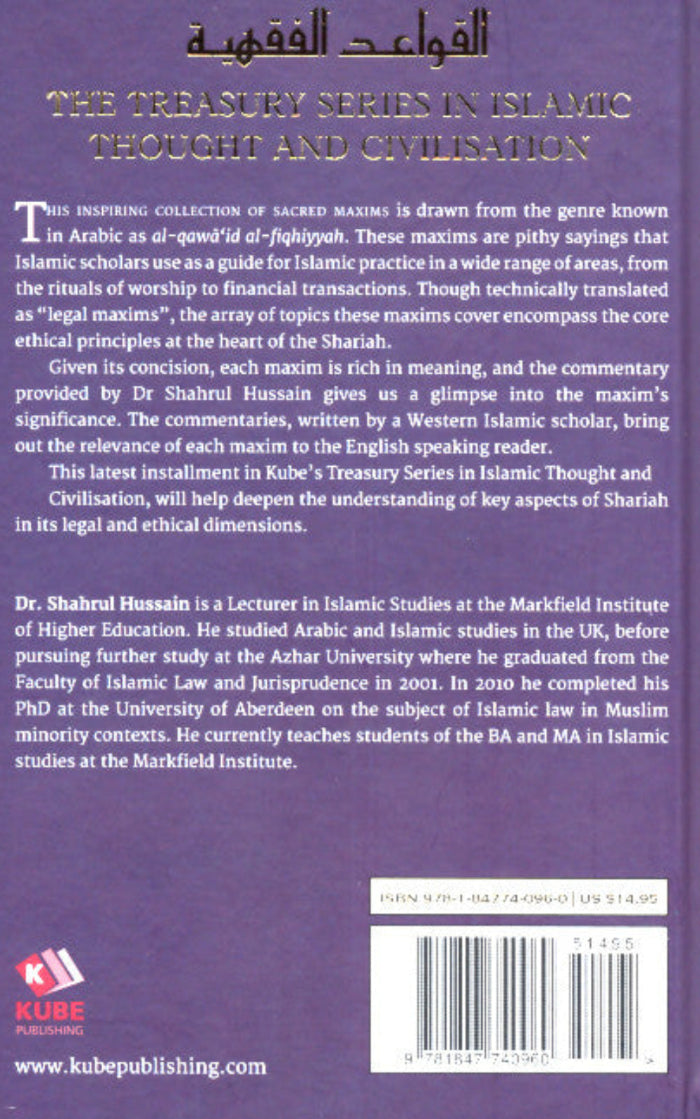
HIS INSPIRING COLLECTION OF SACRED MAXIMS is drawn from the genre known in Arabic as al-qawa'id al-fiqhiyyah. These maxims are pithy sayings that Islamic scholars use as a guide for Islamic practice in a wide range of areas, from the rituals of worship to financial transactions. Though technically translated as "legal maxims", the array of topics these maxims cover encompass the core ethical principles at the heart of the Shariah.
Given its concision, each maxim is rich in meaning, and the commentary provided by Dr Shahrul Hussain gives us a glimpse into the maxim's significance. The commentaries, written by a Western Islamic scholar, bring out the relevance of each maxim to the English speaking reader.
This latest installment in Kube's Treasury Series in Islamic Thought and Civilisation, will help deepen the understanding of key aspects of Shariah in its legal and ethical dimensions.
Dr. Shahrul Hussain is a Lecturer in Islamic Studies at the Markfield Institute of Higher Education. He studied Arabic and Islamic studies in the UK, before pursuing further study at the Azhar University where he graduated from the Faculty of Islamic Law and Jurisprudence in 2001. In 2010 he completed his PhD at the University of Aberdeen on the subject of Islamic law in Muslim minority contexts. He currently teaches students of the BA and MA in Islamic studies at the Markfield Institute.
Who is Shahrul Hussain?
Shahrul Hussain is a contemporary Islamic author and educator known for presenting Islamic teachings and historical narratives in a clear, engaging, and accessible style. His work focuses on helping readers—especially younger audiences and general readers—understand important events, figures, and values in Islamic history.