


A Description of the Supererogatory Sunnah Prayers | Guide to Voluntary Prayers in Islam
A Description of the Supererogatory Sunnah Prayers | Guide to Voluntary Prayers in Islam
Détails du produit
Détails du produit
- Shaykh Muhammad Ibn 'Umar Baazmool
- Soft Cover
- 15x21cm
- Islamic Books
Impossible de charger la disponibilité du service de retrait
A Description of the Supererogatory Sunnah Prayers is an informative Islamic guide explaining voluntary acts of prayer prescribed in Islam. The book covers the virtues, importance, and proper method of performing Sunnah and optional prayers according to authentic Islamic teachings.
From Author:
This work was compiled to clarify the importance, virtues, and proper description of the supererogatory (Nafl) and Sunnah prayers legislated in Islam according to authentic evidence from the Qur’an and Sunnah. The objective is to help Muslims strengthen their worship by understanding voluntary prayers that complement obligatory acts of devotion and increase closeness to Allah.
The book explains the Prophetic guidance regarding optional prayers, their timings, rulings, and benefits, encouraging believers to establish consistency in acts of worship beyond the obligatory prayers. Through authentic knowledge and practical instruction, readers are guided toward strengthening sincerity, devotion, and adherence to the Sunnah while seeking Allah’s pleasure and reward.
Content:
A Description of the Supererogatory (Sunnah) Prayers by Shaykh Muhammad ibn ‘Umar Bāzmūl is a beneficial Islamic guide that explains the importance, virtues, and detailed rulings of voluntary (Nafl) and Sunnah prayers in Islam. The opening pages emphasize the significance of following the example of the Prophet Muhammad ﷺ in maintaining regular supererogatory prayers as a means of strengthening one’s worship and drawing closer to Allah.
The introduction highlights that voluntary prayers serve as a completion and compensation for any shortcomings in the obligatory prayers. Since human beings naturally fall short in perfecting their acts of worship, these Sunnah prayers act as a means of rectifying deficiencies and increasing reward with Allah.
The work stresses that every obligatory act in Islam is complemented by legislated voluntary acts, including prayer, fasting, charity, and pilgrimage. These additional acts reflect Allah’s mercy and His desire to elevate the ranks of His servants while purifying them from errors and shortcomings.
A major theme of the opening section is the strong emphasis placed on regularly performing Sunnah prayers. The author explains that consistently abandoning these voluntary prayers is discouraged and may indicate negligence in one’s religious commitment, as highlighted by classical scholars.
The book also introduces the structure of its content, covering the various Sunnah prayers associated with the five daily prayers, including Fajr, Dhuhr, ‘Asr, and Maghrib. It outlines their rulings, descriptions, virtues, and practical guidance such as what to recite, how to perform them, and how to make up missed Sunnah prayers.
Overall, this work serves as a clear and practical reference for Muslims who wish to revive the Sunnah, improve the quality of their obligatory prayers, and establish consistency in voluntary worship as taught by the Prophet ﷺ.


Exemples de pages
Pg:01
A Description of the Supererogatory (Sunnah) Prayers
Shaykh Muhammad Ibn 'Umar Bāzmūl
Revised 2nd Edition
Includes Rulings of the Duha Prayer
Pg:02
مقدمة
Introduction'
O Muslim, be consistent with the regular supererogatory Prayers, imitating the excellent example of the Prophet (). As Allah
,said (سُبْحَانَهُ وَتَعَالَى)
لَقَدْ كَانَ لَكُمْ فِي رَسُولِ اللَّهِ أَسْوَةٌ حَسَنَةٌ لِمَن كَانَ يَرْجُوا اللَّهَ
وَالْيَوْمَ الْآخِرَ وَذَكَرَ اللَّهَ كَثِيرًا
)
"Indeed, in the Messenger of Allāh you have a good example to follow for him who hopes for (the meeting with) Allah and the Last Day, and remembers Allah much." [Surah al-Ahzab 33:21]
Being consistent with the supererogatory Prayers is also a way to compensate for any fault or deficiency that transpired in the obligatory Prayers.
Man is prone to fall short and fail to achieve perfection, and therefore he is in need of something to compensate for his negligence.
For this reason - O Muslim - you cannot afford to neglect the regular supererogatory Prayers, as this will earn you extra rewards, which you will find with your Lord.
'Translator's Note: Introduction taken from al-Mulakhkhaş al-Fiqhi (1/120- 123), Shaykh Ṣāliḥ al-Fawzan.
10
Along with every obligatory act, whether it is the compulsory prayer, compulsory fasting, compulsory Zakah or compulsory Hajj, a corresponding supererogatory act has been legislated. All of these obligations are accompanied by similar supererogatory acts that have been legislated to compensate for any flaw and to rectify any discrepancy.'
The fact that Allah has prescribed different acts of worship, so as to elevate His servants in degrees and cleanse them of their sins, is a blessing which He bestows upon them.
Furthermore, my dear brothers, you should know that performance of the regular supererogatory Prayers is heavily emphasised and it is disliked to abandon them. Whoever continuously leaves off these Prayers is considered to be sinful2, and according to some Imāms such a person is untrustworthy because constantly leaving off these Prayers suggests a weakness in his Religion and negligence on his part.
1 Translator's Note: The Prophet () said, "The first of the actions for which a servant will be held accountable on the Day of Judgement will be his Prayers. If they are correct, then he will be successful and prosper. However, if they are flawed, then he will have failed and lost. If there is a deficiency in his obligatory Prayers, Allah () will say, 'See if my servant has any supererogatory Prayers to compensate for the deficiency in his obligatory Prayers.' Then the rest of his actions will be judged in a similar fashion." Related by Imam al-Tirmidhi and others. Refer to Sahih al-Targhib wa al-Tarhib (no. 538) of al-Albānī.
2 Translator's Note: Ibn Taymiyyah (d.728H) was asked, Majmu' al-Fatawa (23/127), "What is said concerning a person who is inconsistent with the supererogatory Sunnah Prayers?"
He responded, "Whoever continuously abandons the Sunnah Prayers, then this shows a weakness in his Religion. In the madhhab of Ahmad (d.241H), al-Shafi'i (d.204H) and others, his witness is rejected."
11
Pg:02
مقدمة
Introduction'
O Muslim, be consistent with the regular supererogatory Prayers, imitating the excellent example of the Prophet (). As Allah
,said (سُبْحَانَهُ وَتَعَالَى)
لَقَدْ كَانَ لَكُمْ فِي رَسُولِ اللَّهِ أَسْوَةٌ حَسَنَةٌ لِمَن كَانَ يَرْجُوا اللَّهَ
وَالْيَوْمَ الْآخِرَ وَذَكَرَ اللَّهَ كَثِيرًا
)
"Indeed, in the Messenger of Allāh you have a good example to follow for him who hopes for (the meeting with) Allah and the Last Day, and remembers Allah much." [Surah al-Ahzab 33:21]
Being consistent with the supererogatory Prayers is also a way to compensate for any fault or deficiency that transpired in the obligatory Prayers.
Man is prone to fall short and fail to achieve perfection, and therefore he is in need of something to compensate for his negligence.
For this reason - O Muslim - you cannot afford to neglect the regular supererogatory Prayers, as this will earn you extra rewards, which you will find with your Lord.
'Translator's Note: Introduction taken from al-Mulakhkhaş al-Fiqhi (1/120- 123), Shaykh Ṣāliḥ al-Fawzan.
10
Along with every obligatory act, whether it is the compulsory prayer, compulsory fasting, compulsory Zakah or compulsory Hajj, a corresponding supererogatory act has been legislated. All of these obligations are accompanied by similar supererogatory acts that have been legislated to compensate for any flaw and to rectify any discrepancy.'
The fact that Allah has prescribed different acts of worship, so as to elevate His servants in degrees and cleanse them of their sins, is a blessing which He bestows upon them.
Furthermore, my dear brothers, you should know that performance of the regular supererogatory Prayers is heavily emphasised and it is disliked to abandon them. Whoever continuously leaves off these Prayers is considered to be sinful2, and according to some Imāms such a person is untrustworthy because constantly leaving off these Prayers suggests a weakness in his Religion and negligence on his part.
1 Translator's Note: The Prophet () said, "The first of the actions for which a servant will be held accountable on the Day of Judgement will be his Prayers. If they are correct, then he will be successful and prosper. However, if they are flawed, then he will have failed and lost. If there is a deficiency in his obligatory Prayers, Allah () will say, 'See if my servant has any supererogatory Prayers to compensate for the deficiency in his obligatory Prayers.' Then the rest of his actions will be judged in a similar fashion." Related by Imam al-Tirmidhi and others. Refer to Sahih al-Targhib wa al-Tarhib (no. 538) of al-Albānī.
2 Translator's Note: Ibn Taymiyyah (d.728H) was asked, Majmu' al-Fatawa (23/127), "What is said concerning a person who is inconsistent with the supererogatory Sunnah Prayers?"
He responded, "Whoever continuously abandons the Sunnah Prayers, then this shows a weakness in his Religion. In the madhhab of Ahmad (d.241H), al-Shafi'i (d.204H) and others, his witness is rejected."
11
Pg:03
Foreword
Introduction
Table of Contents
Definition
The Excellence of the Regular Voluntary Prayers
A Description of the Supererogatory Prayers
The Supererogatory Prayer of Fajr
S
IO
12
13
16
The Ruling of this Prayer
Its Description and Virtue
The Shortness of this Prayer
What to Recite During this Prayer
Lying Down After Performing this Prayer What a Person should do if they Miss this Prayer
The Supererogatory Sunnah Prayer of Zuhr The Ruling of this Prayer
Its Description and Virtue
What if One Misses the Four Rak'ah before Zuhr What if One Misses the Two Rak'ah after Zuhr
The Supererogatory Sunnah Prayer of 'Asr The Ruling of this Prayer
Its Virtue
Its Description
The Supererogatory Sunnah Prayer of Maghrib The Ruling of this Prayer
Its Virtue and Description
22
17
18
20
2 2 2 2
2.4.
27
29
31
32
32 36
37
41
42
42
43
46
47
47
944
3
Pg:04
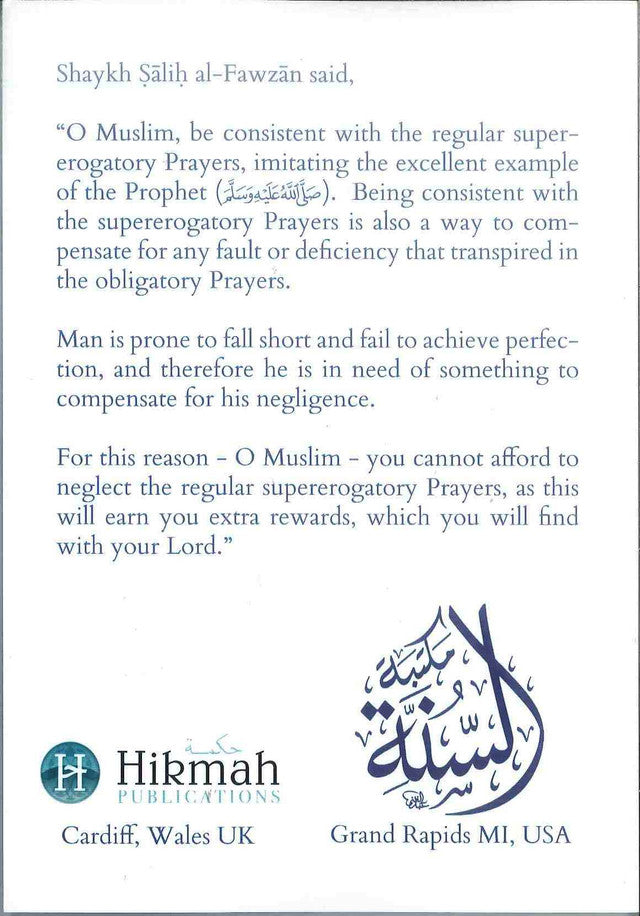
Shaykh Ṣāliḥ al-Fawzan said,
"O Muslim, be consistent with the regular super- erogatory Prayers, imitating the excellent example of the Prophet). Being consistent with the supererogatory Prayers is also a way to com- pensate for any fault or deficiency that transpired in the obligatory Prayers.
Man is prone to fall short and fail to achieve perfec- tion, and therefore he is in need of something to compensate for his negligence.
For this reason
O Muslim
-
you cannot afford to neglect the regular supererogatory Prayers, as this will earn you extra rewards, which you will find your Lord."
with
H Hikmah
PUBLICATIONS
Cardiff, Wales UK
اسَبَة :
Grand Rapids MI, USA