


A Commentary on Al-Waraqat – Usul al-Fiqh Explained by Imam al-Juwayni
A Commentary on Al-Waraqat – Usul al-Fiqh Explained by Imam al-Juwayni
Publisher:
Suhaib Sirajudin
Author:
Imamul Haramain Abdul Malik Ibn Abdillah
Language:
English
Binding:
Hard Cover
Pages: 220
Size: 17x23 cm
Impossible de charger la disponibilité du service de retrait


Contenu réductible
Description du livre
A Commentary on Al-Waraqat – Usul al-Fiqh Explained by Imam al-Juwayni
A Commentary on Al-Waraqat is a detailed and accessible explanation of the classical text Al-Waraqat by Imam al-Haramayn al-Juwayni, a foundational work in the science of Usul al-Fiqh (principles of Islamic jurisprudence). This edition, authored by Suhaib Sirajudin, presents the original Arabic text alongside its English translation and in-depth commentary, making complex legal concepts easier to understand. The book explores key topics such as sources of Islamic law, legal reasoning, and the methodology used by scholars—particularly within the Shafi‘i school. Designed for both beginners and advanced students, it serves as an essential guide for anyone seeking a structured understanding of Islamic legal theory and its practical applications
From Author:
This is a commentary on the book of Imamul Haramin Abul Malik Al Juwaini's Al-Waraqat. It is a text on the subject of Usul al-fiqh. It is a text on Islamic Jurisprudence (Usul al-fiqh) according to the majority of scholars but more specific to the Shafi'i School of Thaught. The Arabic text (Matn) of Al-Waraqat with the English translation followed by the commentary in English. Usul al-Fiqh deals with the sources of Islamic law and the discipline dedicated to elucidating them and their relationship to the substantive rulings of the law.
The commentator writes in his notes:
"This book, is a comprehensive commentary of a book entitled Al Waraqat, which literally translates as "The Pages", by Imamul Haramain Abdul Malik Ibn Abdillah Ibn Yusuf Al Juwaini Ash Shafi R.A. We pray that this commentary will provide useful information and advice to all its readers, regardless of their background, and that they may all benefit from it. We also hope that our efforts on this book will be counted among our good deeds with Allah, the Almighty." Ameen.
About Imam al-Juwaini:
Imam al-Haramayn Dhia' ul-Din Abd al-Malik ibn Yusuf al-Juwayni al-Shafi'i (419-478 AH) was born in a village on the outskirts of Nishapur in Iran. He was a prominent Muslim scholar known for his gifted intellect in Islamic legal matters. His father, Abu Muhammad 'Abdallah bin Yusef al-Juwayni was a well-known master of Law in the Shafi'i community as well as a Shafi'i teacher and his elder brother, Abu'l-Hasan 'Ali al-Juwayni, was a Sufi teacher of Hadith. Al-Juwayni travelled to Mecca and Medina in search of an interim home. He taught and studied there in Hijaz for four years. During this time, al-Juwayni became very popular because of his father's prominence in the scholarly world. He was invited back to Nishapur by the founder of the Shafii Madrasa, Khwaja Nizam al-Mulk. Upon his return, he was appointed to teach the doctrine of the Ash'arites at the Nizamiyya Madrasa until he died in 478 AH. Imam Al-Juwayni was the teacher of one of the most influential scholars in the Islamic tradition, particularly Sufism, Imam al-Ghazzali. He was a master of the Qurán and Hadith texts in addition to being well versed in the particular school of Shafi'i and theological practices of the Ash'arite persuasion.
About The Commentator:
Shaykh Suhaib Sirajudin was born in 1985, in Blackburn, Lancashire, UK and completed his primary education in Blackburn. He memorised the Quran by heart and graduated from the Darul Uloom – Islamic College – Bury, UK in 2000. He then continued his studies for a Degree in Software Engineering at Blackburn College, an associate college of Lancaster University, and for his Masters in Computer Security from the University of Liverpool. He is an Indian-British preacher and imam educated in both Islamic and Western traditions. Since 2017, he has served as Dean of Academic Affairs at the Islamic International College, an international Islamic educational institution with a center in Bolton, Greater Manchester.
Éditeur
Suhaib Sirajudin
Auteur
- Imamul Haramain Abdul Malik Ibn Abdillah
Shipping and Delivery
We dispatch orders directly from our UK and USA warehouses, offering multiple shipping options to suit your needs. We proudly ship worldwide.
UK Deliveries (from UK warehouse):
Standard shipping typically arrives within 3–4 working days. Expedited delivery takes 2–3 working days. We aim to dispatch orders the same day or next working day, with next-day delivery options available where applicable.
USA Deliveries (from USA warehouse):
Orders usually arrive within 4–7 working days.
Europe (shipped from UK):
Standard delivery takes approximately 6–10 working days, with expedited services available in 3–5 working days.
Canada:
Estimated delivery time is 5–10 working days.
Worldwide Shipping:
International orders generally arrive within 5–20 working days, depending on destination and shipping method selected.
For precise delivery timelines based on your location, please contact us by email and our team will provide detailed information tailored to your address.
Exemples de pages - Contenu
Page:01
A Commentary on
Al-Waraqat
Imamul Haramain Abdul Malik Ibn Abdillah Ibn Yusuf Al Juwaini Ash Shafi R.A
شرح الورقات في أصول الفقه عبد الملك بن عبدالله بن يوسف الشافعي المعروف بالامام الحرمين
COMMENTARY BY
SUHAIB SIRAJUDIN
Page:02
Commentator's notes
Table of Contents
Biography of Imamul Haramain..
An introduction to Imamul Haramain's Al Waragat and Usool al Fiqh
The meaning of Usool al Fiqh
Usool al Fiqh is made up of two singular parts
The definitions of Asl and Fra'a
The definition of Fiqh
Anwaul Ahkam - categories of rulings.
Wajib - obligatory..
Mandoob-recommended.
Mubah-permissible
Mahzoor-forbidden.
Makrooh-disapproved
Sahih sound
Batil-invalid
The definitions of several terminologies related to the knowledge of the fundamentals of jurisprudence..............
The meaning of Jahl
There are two types of knowledge..
The meanings of nathar, istidlal and dalee.
The difference between zann, shakk and wahm.
The knowledge of Usool Al Fiqh
The topics of Usool al Fiqh
Types of statements
The meanings of haqiqi and majaz
Page:03
The meaning of Usool al Fiqh
Arabic text and translation
هَذِهِ وَرَقَات تشتمل على فصول من أصول الْفِقْه
These pages include sections on the fundamentals of jurisprudence.
Commentary
Imamul Haramain does not begin his book with 'Alhumdulillah'. The Hadith mentions that the Prophet once said:
كُلُّ أَمْرٍ ذِي بَالِ لَا يُبْدَأُ فِيهِ بِحَمْدِ اللَّهِ فَهُوَ أَبْتَرُ
'Any matter of importance which is not begun with "Alhumdulillah" (praise be to Allah) remains defective'. (Abu Dawood)
In some of the versions of Al Waraqat, 'Alhumdulillah' is mentioned, but in other versions, such as this one, it is not.
The author
starts his book with the word 'Bismillah', just like Imam Bukhari did in his book Sahih Bukhari, following the example of how the Prophet started the letters he wrote.
The author
didn't originally title his book Al Waraqat; rather, the name was later derived from its introduction, as is the practice of some authors.
Imamul Haramain
begins his book by saying, 'These pages include sections on the fundamentals of jurisprudence'. He is pointing out that these are only a few pages on the fundamentals of jurisprudence. In other words, this work is not an in- depth book covering all of the topics of Usool al Fiqh.
Page:04
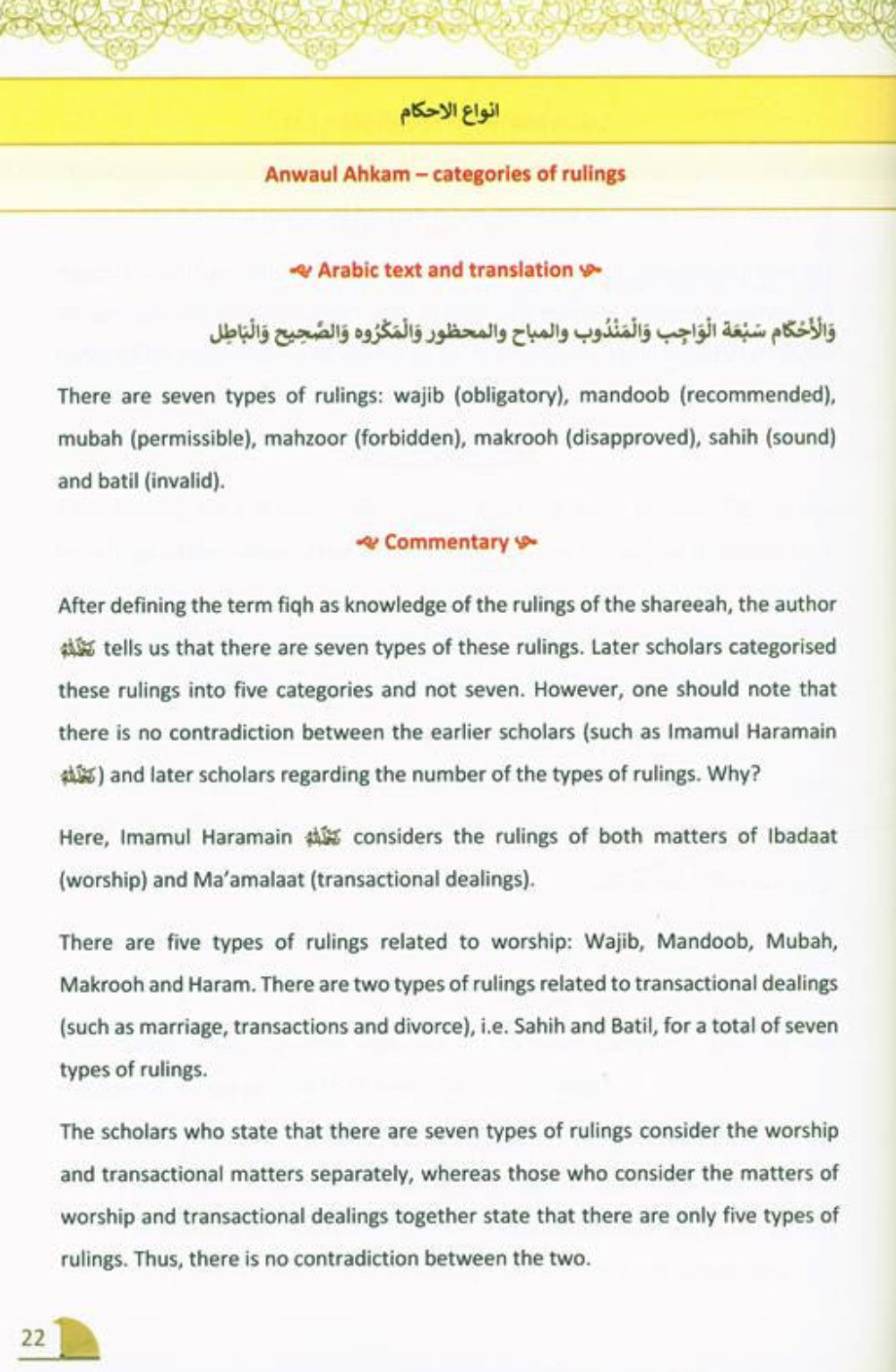
انواع الاحكام
Anwaul Ahkam - categories of rulings
Arabic text and translation
وَالْأَحْكامِ سَبْعَة الْوَاجِب وَالْمَنْدُوب والمباح والمحظور وَالْمَكْرُوه وَالصَّحِيحَ وَالْبَاطِل
There are seven types of rulings: wajib (obligatory), mandoob (recommended), mubah (permissible), mahzoor (forbidden), makrooh (disapproved), sahih (sound) and batil (invalid).
Commentary
After defining the term fiqh as knowledge of the rulings of the shareeah, the author
tells us that there are seven types of these rulings. Later scholars categorised these rulings into five categories and not seven. However, one should note that there is no contradiction between the earlier scholars (such as Imamul Haramain *) and later scholars regarding the number of the types of rulings. Why?
Here, Imamul Haramain
considers the rulings of both matters of Ibadaat
(worship) and Ma'amalaat (transactional dealings).
There are five types of rulings related to worship: Wajib, Mandoob, Mubah, Makrooh and Haram. There are two types of rulings related to transactional dealings (such as marriage, transactions and divorce), i.e. Sahih and Batil, for a total of seven types of rulings.
The scholars who state that there are seven types of rulings consider the worship and transactional matters separately, whereas those who consider the matters of worship and transactional dealings together state that there are only five types of rulings. Thus, there is no contradiction between the two.