


النبي محمد: قدوة حسنة للأقليات المسلمة - إرشاد إسلامي
النبي محمد: قدوة حسنة للأقليات المسلمة - إرشاد إسلامي
Publisher:
Kube Publishing
Author:
الدكتور محمد ياسين خان
Language:
إنجليزي
Binding:
غلاف ورقي
Pages: 230
Size: 15 × 21 سم
لم نتمكن من تحميل توفر الاستلام


محتوى قابل للطي
وصف كتاب إسلامي
النبي محمد: قدوة الأقليات المسلمة هي سيرة إسلامية متعمقة بقلم محمد ياسين مظهر صديقي تدرس حياة النبي محمد صلى الله عليه وسلم من منظور فريد وعملي - مع التركيز على الدروس والتوجيهات للمسلمين الذين يعيشون كأقلية داخل مجتمعات غير مسلمة.
من المؤلف:
الناشر
Kube Publishing
مؤلف
- الدكتور محمد ياسين خان
الشحن والتوصيل
نقوم بشحن الطلبات مباشرة من مستودعاتنا في المملكة المتحدة والولايات المتحدة الأمريكية، ونقدم خيارات شحن متعددة لتناسب احتياجاتك. نحن نشحن بفخر إلى جميع أنحاء العالم.
عمليات التسليم في المملكة المتحدة (من مستودع المملكة المتحدة):
يصل الشحن القياسي عادةً في غضون 3-4 أيام عمل. يستغرق التسليم السريع 2-3 أيام عمل. نهدف إلى شحن الطلبات في نفس اليوم أو يوم العمل التالي، مع توفر خيارات التوصيل في اليوم التالي حيثما ينطبق ذلك.
عمليات التسليم في الولايات المتحدة الأمريكية (من مستودع الولايات المتحدة الأمريكية):
تصل الطلبات عادةً في غضون 4-7 أيام عمل.
أوروبا (يتم الشحن من المملكة المتحدة):
يستغرق التسليم القياسي حوالي 6-10 أيام عمل، مع توفر خدمات الشحن السريع في غضون 3-5 أيام عمل.
كندا:
الوقت المقدر للتسليم هو 5-10 أيام عمل.
الشحن في جميع أنحاء العالم:
تصل الطلبات الدولية بشكل عام في غضون 5-20 يوم عمل، اعتمادًا على الوجهة وطريقة الشحن المختارة.
للحصول على جداول زمنية دقيقة للتسليم بناءً على موقعك، يرجى الاتصال بنا عبر البريد الإلكتروني وسيقدم فريقنا معلومات مفصلة ومخصصة لعنوانك.
صفحات العينة - المحتوى
Page:01
The PROPHET MUHAMMAD
A ROLE MODEL for MUSLIM
MINORITIES
Muhammad Yasin Mazhar Siddiqi
THE ISLAMIC FOUNDATION
Page:02
VIII THE PROPHET MUHAMMAD: A ROLE MODEL FOR MUSLIM MINORITIES
It must be however, stated that in the same period Muslims led their lives as a minority in many countries. They were under the domination of the adherents of other faiths. After only one and a half centuries of the Abbasid rule, decline and disintegration had set in the Muslim polity. The regions far away from the seat of the Caliphate were constantly exposed to incursion and even defeat. At the fall of the Umayyad Caliphate of Andalusia in the fifth/eleventh century Muslims had lost their dominant position at large. They stood divided and sub-divided and as a subjugated people. By the middle of the thirteenth century CE most of the Muslim lands in the West, particularly Andalusia and Sicily were under non-Muslim rules reducing Muslims to a helpless minority. In some countries and regions Muslim empires, no doubt, flourished. Yet Islam as a faith was no longer ascendant, notwithstanding the political power and rulership enjoyed by Muslims.
Even during this period of trial, loss and subjugation both the 'ulama' and the generality of Muslims did not give up their claim to power and rule. Notwithstanding their enviable mental faculties and original thinking, the 'ulama' and writers persisted in projecting Islam as a dominant, ruling force. This naturally intoxicated the Muslim masses with illusions about their supremacy. Their thoughts and deeds were dictated by their nostalgic memories about their rule and their glorious accomplishments in the past. Their writings fed the public only on the stories of their political power and domination. It greatly pleased the commoners who dreamt of their return to power. Both the 'ulama' and the general public failed to take the ground realities in their stride.
During this period of decline substantial additions were made to the Islamic legacy of sciences and other branches of learning. Some of the achievements recorded in this period are historic and unique. All their disciplines were considerably enriched ranging from tafsir, hadith and fiqh studies to history, scholasticism, philosophy and other fields of social sciences, arts and sciences. However, these advancements rested on old canons of knowledge. The methodology and line of argumentation adopted in the Middle
Page:03
CONTENTS
Transliteration Table
Preface vii
1. Pluralistic Society of Makkah I
2. Evolution of the Muslim Minority in Makkah
3. The Muslim Community of Abyssinia
4. Formation of the Muslim Ummah in the Makkan Period
5. The Defence System and the Right to Defend
6. Defence Agreement
7. Muslim Minorities After the Formation of the Islamic State
Conclusion
Bibliography
Notes
Index
Page:04
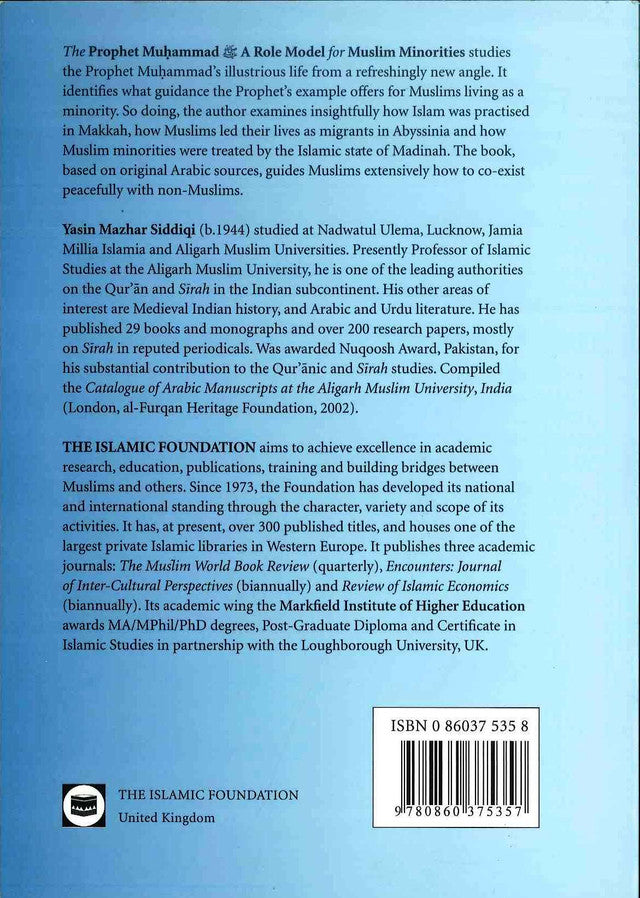
The Prophet Muhammad A Role Model for Muslim Minorities studies the Prophet Muhammad's illustrious life from a refreshingly new angle. It identifies what guidance the Prophet's example offers for Muslims living as a minority. So doing, the author examines insightfully how Islam was practised in Makkah, how Muslims led their lives as migrants in Abyssinia and how Muslim minorities were treated by the Islamic state of Madinah. The book, based on original Arabic sources, guides Muslims extensively how to co-exist peacefully with non-Muslims.
Yasin Mazhar Siddiqi (b.1944) studied at Nadwatul Ulema, Lucknow, Jamia Millia Islamia and Aligarh Muslim Universities. Presently Professor of Islamic Studies at the Aligarh Muslim University, he is one of the leading authorities on the Qur'an and Sirah in the Indian subcontinent. His other areas of interest are Medieval Indian history, and Arabic and Urdu literature. He has published 29 books and monographs and over 200 research papers, mostly on Sirah in reputed periodicals. Was awarded Nuqoosh Award, Pakistan, for his substantial contribution to the Qur'anic and Sirah studies. Compiled the Catalogue of Arabic Manuscripts at the Aligarh Muslim University, India (London, al-Furqan Heritage Foundation, 2002).
THE ISLAMIC FOUNDATION aims to achieve excellence in academic research, education, publications, training and building bridges between Muslims and others. Since 1973, the Foundation has developed its national and international standing through the character, variety and scope of its activities. It has, at present, over 300 published titles, and houses one of the largest private Islamic libraries in Western Europe. It publishes three academic journals: The Muslim World Book Review (quarterly), Encounters: Journal of Inter-Cultural Perspectives (biannually) and Review of Islamic Economics (biannually). Its academic wing the Markfield Institute of Higher Education awards MA/MPhil/PhD degrees, Post-Graduate Diploma and Certificate in Islamic Studies in partnership with the Loughborough University, UK.
من هو الدكتور محمد ياسين خان؟
الدكتور محمد ياسين خان طبيب عامّ مرموق، يقيم في بيشاور، باكستان. يحمل شهادة بكالوريوس الطب والجراحة، ويتمتع بخبرة واسعة في مجال الرعاية الصحية غير الجراحية، مُركّزًا على تقديم علاج مُخصّص للمرضى من جميع الفئات العمرية.