


The Fruit of the Grammatical Disagreement and Its Effect – Arabic Grammar & Linguistics Study | Dr. Muhammad Fazil Salih Samirai
The Fruit of the Grammatical Disagreement and Its Effect – Arabic Grammar & Linguistics Study | Dr. Muhammad Fazil Salih Samirai
Publisher:
Dar Ibn Katheer
Author:
الدكتور محمد فاضل صالح السامرائي
Language:
العربية
Binding:
غلاف مقوى
Pages: 182
Size: ١٨×٢٥ سم
لم نتمكن من تحميل توفر الاستلام


محتوى قابل للطي
وصف كتاب إسلامي
The Fruit of the Grammatical Disagreement and Its Effect – Arabic Grammar & Linguistics Study | Dr. Muhammad Fazil Salih Samirai
The Fruit of the Grammatical Disagreement and Its Effect is a scholarly Arabic book that examines grammatical disagreements among classical Arabic grammarians and their influence on meaning, interpretation, and linguistic analysis. It is an important resource for advanced students of Arabic language and Islamic studies.
From Author:
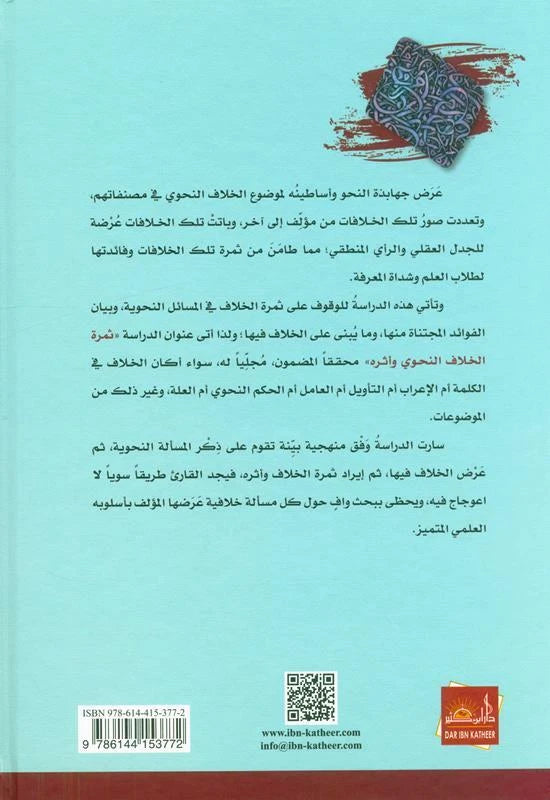
عرض جهابذة النحو وأساطينه لموضوع الخلاف النحوي في مصنفاتهم
وتعددت صور تلك الخلافات من مؤلّف إلى آخر، وباتت تلك الخلافات عُرضة للجدل العقلي والرأي المنطقي مما طامَنَ من ثمرة تلك الخلافات وفائدتها لطلاب العلم وشداة المعرفة
وتأتي هذه الدراسة للوقوف على ثمرة الخلاف في المسائل النحوية، وبيان الفوائد المجتناة منها وما يُبنى على الخلاف فيها ؛ ولذا أتى عنوان الدراسة ثمرة الخلاف النحوي وأثره محققاً المضمون، مُجلّياً له، سواء أكان الخلاف في الكلمة أم الإعراب أم التأويل أم العامل أم الحكم النحوي أم العلة، وغير ذلك من
الموضوعات.
سارت الدراسة وفق منهجية بيّنة تقوم على ذكر المسألة النحوية، ثم
عرض الخلاف فيها، ثم إيراد ثمرة الخلاف وأثره، فيجد القارئ طريقاً سوياً لا اعوجاج فيه، ويحظى ببحث واف حول كل مسألة خلافية عرضها المؤلف بأسلوبه
العلمي المتميز.
Page no:01
Dr. Muhammad Fadhil Salih Al-Samarrai
The Fruit of Grammatical Dispute and its Impact
Dar Ibn Kathir
page no:02Table of Contents
Introduction
Disputed issues that have no fruit in the dispute over them, including:
The dispute among grammarians regarding inflection (I'rab), is it a principle or a derivative in nouns and verbs?
The dispute regarding the imperative verb, is it indeclinable (Mabni) or declinable (Mu'rab)? The dispute over the reason for the indeclinability of "Al-aan" (now).
The dispute regarding the pronoun "Anta" (you).
The dispute regarding the pronouns "Huwa" (he) and "Hiya" (she). The dispute regarding the pronoun "Iyyaka" (you).
The dispute regarding the Lam (prefix) attached to the Mubtada' (subject), is it the Lam of Ibtida' (initiation) or the Lam of...?
Page no:03
Disputed issues that have no fruit in the dispute over them
We mentioned in the introduction that not all disputed issues have an impact or a benefit to be gained from the dispute over them. For there are many grammatical issues that grammarians have disagreed upon, blackening many pages of their books by setting out their opinions and evidence in order to favor one opinion over another, but we may not harvest any fruit from the dispute over them. Examples of this include the dispute among grammarians regarding inflection (I'rab), is it a principle or a derivative in nouns and verbs?
(1)
It is well known that inflection, according to the Basrans, is a principle in nouns and a derivative in verbs; for the principle in the verb, according to them, is indeclinability. Their argument for this is that the noun accepts various meanings with a single form, namely: agency (Fa'iliyyah), objectivity (Maf'uliyyah), and genitive construction (Idafa). Were it not for inflection, these meanings would not be known from the form. An example of this is when you say: "(Ma ahsana Zaidan!)" (How good Zaid is!) - by putting Zaid in the accusative (Nasb), you are expressing admiration. If you say: "(Ma ahsanu Zaidun?)" (How is Zaid?) - by putting Zaid in the nominative (Raf'), you are questioning. If you say: "(Ma ahsanu Zaidin)" (Zaid is not good) - by putting Zaid in the genitive (Jarr), you are negating. Were it not for inflection, ambiguity would occur, as if you said "(Ma ahsana Zaid)", it could be interpreted in several ways, and ambiguity would arise.
(2)
(1) Ham' al-Hawami' by Al-Suyuti 1/44, and see Al-Ashbah wal-Naza'ir by Al-Suyuti 3/325, and Sharh Ibn Aqil 1/59.
(2) See Ham' al-Hawami' 1/44.
Page no:04
The dispute in grammatical terminology and its impact
Grammarians may disagree on grammatical terminology, in the sense that each group's view of the term differs from the other's view, and this disagreement may have an impact on the meaning. An example of this is that the "Maf'ul lahu" (object for which) or "Maf'ul li-ajlihi" is a Basran term, which they define as that which expresses a justification from verbal nouns (Masadir) under specific conditions, such as His saying Almighty: ﴿...They put their fingers in their ears against the thunderclaps in fear of death...﴾ [Al-Baqarah: 19] (1).
It is stated in "Al-Kitab": "This is a chapter on what is accusative from verbal nouns because it is an excuse for the occurrence of the matter, so it is accusative because it is done for it and because it is an explanation of why the preceding part happened? It is not an adjective for what precedes it, nor is it part of it... This is like your saying: 'I did that out of fear of evil', 'I did that out of fear of so-and-so', and 'the storing of (so-and-so)'. The poet, Hatim bin Abdullah Al-Ta'i, said: 'And I forgive the insult of the noble out of his stored virtue, and I overlook the abuse of the mean out of generosity...' And 'I did that for the sake of such and such'. All of this is accusative because it is a 'Maf'ul lahu' (object for which), as if it were said: 'Why did you do such and such?' And he said: 'For such and such'. But when the Lam (preposition) was dropped, what preceded it acted upon it" (2).
Al-Zajjaj and the Kufans believe that what grammarians call 'Maf'ul lahu' is actually a...
Page no:05
The presentation of the masters and authorities of grammar of the subject of grammatical dispute in their works
The forms of these disputes varied from one author to another, and these disputes became subject to intellectual debate and logical opinion, which diminished the fruit of these disputes and their benefit for students of knowledge and seekers of learning.
This study comes to address the fruit of the dispute in grammatical issues, and to clarify the benefits gained from them and what is built upon the dispute over them. Thus, the title of the study came as "The Fruit of Grammatical Dispute and its Impact," fulfilling the content and clarifying it, whether the dispute was in the word, inflection, interpretation, the governing agent (Amil), the grammatical ruling, the cause, or other subjects.
The study proceeded according to a clear methodology based on stating the grammatical issue, then presenting the dispute over it, then stating the fruit of the dispute and its impact, so that the reader finds a straight path without crookedness, and obtains a comprehensive research on every disputed issue presented by the author in his distinguished scientific style.
الناشر
Dar Ibn Katheer
مؤلف
- الدكتور محمد فاضل صالح السامرائي
الشحن والتوصيل
نقوم بشحن الطلبات مباشرة من مستودعاتنا في المملكة المتحدة والولايات المتحدة الأمريكية، ونقدم خيارات شحن متعددة لتناسب احتياجاتك. نحن نشحن بفخر إلى جميع أنحاء العالم.
عمليات التسليم في المملكة المتحدة (من مستودع المملكة المتحدة):
يصل الشحن القياسي عادةً في غضون 3-4 أيام عمل. يستغرق التسليم السريع 2-3 أيام عمل. نهدف إلى شحن الطلبات في نفس اليوم أو يوم العمل التالي، مع توفر خيارات التوصيل في اليوم التالي حيثما ينطبق ذلك.
عمليات التسليم في الولايات المتحدة الأمريكية (من مستودع الولايات المتحدة الأمريكية):
تصل الطلبات عادةً في غضون 4-7 أيام عمل.
أوروبا (يتم الشحن من المملكة المتحدة):
يستغرق التسليم القياسي حوالي 6-10 أيام عمل، مع توفر خدمات الشحن السريع في غضون 3-5 أيام عمل.
كندا:
الوقت المقدر للتسليم هو 5-10 أيام عمل.
الشحن في جميع أنحاء العالم:
تصل الطلبات الدولية بشكل عام في غضون 5-20 يوم عمل، اعتمادًا على الوجهة وطريقة الشحن المختارة.
للحصول على جداول زمنية دقيقة للتسليم بناءً على موقعك، يرجى الاتصال بنا عبر البريد الإلكتروني وسيقدم فريقنا معلومات مفصلة ومخصصة لعنوانك.
صفحات العينة - المحتوى
Page no:01
Dr. Muhammad Fadhil Salih Al-Samarrai
The Fruit of Grammatical Dispute and its Impact
Dar Ibn Kathir
page no:02Table of Contents
Introduction
Disputed issues that have no fruit in the dispute over them, including:
The dispute among grammarians regarding inflection (I'rab), is it a principle or a derivative in nouns and verbs?
The dispute regarding the imperative verb, is it indeclinable (Mabni) or declinable (Mu'rab)? The dispute over the reason for the indeclinability of "Al-aan" (now).
The dispute regarding the pronoun "Anta" (you).
The dispute regarding the pronouns "Huwa" (he) and "Hiya" (she). The dispute regarding the pronoun "Iyyaka" (you).
The dispute regarding the Lam (prefix) attached to the Mubtada' (subject), is it the Lam of Ibtida' (initiation) or the Lam of...?
Page no:03
Disputed issues that have no fruit in the dispute over them
We mentioned in the introduction that not all disputed issues have an impact or a benefit to be gained from the dispute over them. For there are many grammatical issues that grammarians have disagreed upon, blackening many pages of their books by setting out their opinions and evidence in order to favor one opinion over another, but we may not harvest any fruit from the dispute over them. Examples of this include the dispute among grammarians regarding inflection (I'rab), is it a principle or a derivative in nouns and verbs?
(1)
It is well known that inflection, according to the Basrans, is a principle in nouns and a derivative in verbs; for the principle in the verb, according to them, is indeclinability. Their argument for this is that the noun accepts various meanings with a single form, namely: agency (Fa'iliyyah), objectivity (Maf'uliyyah), and genitive construction (Idafa). Were it not for inflection, these meanings would not be known from the form. An example of this is when you say: "(Ma ahsana Zaidan!)" (How good Zaid is!) - by putting Zaid in the accusative (Nasb), you are expressing admiration. If you say: "(Ma ahsanu Zaidun?)" (How is Zaid?) - by putting Zaid in the nominative (Raf'), you are questioning. If you say: "(Ma ahsanu Zaidin)" (Zaid is not good) - by putting Zaid in the genitive (Jarr), you are negating. Were it not for inflection, ambiguity would occur, as if you said "(Ma ahsana Zaid)", it could be interpreted in several ways, and ambiguity would arise.
(2)
(1) Ham' al-Hawami' by Al-Suyuti 1/44, and see Al-Ashbah wal-Naza'ir by Al-Suyuti 3/325, and Sharh Ibn Aqil 1/59.
(2) See Ham' al-Hawami' 1/44.
Page no:04
The dispute in grammatical terminology and its impact
Grammarians may disagree on grammatical terminology, in the sense that each group's view of the term differs from the other's view, and this disagreement may have an impact on the meaning. An example of this is that the "Maf'ul lahu" (object for which) or "Maf'ul li-ajlihi" is a Basran term, which they define as that which expresses a justification from verbal nouns (Masadir) under specific conditions, such as His saying Almighty: ﴿...They put their fingers in their ears against the thunderclaps in fear of death...﴾ [Al-Baqarah: 19] (1).
It is stated in "Al-Kitab": "This is a chapter on what is accusative from verbal nouns because it is an excuse for the occurrence of the matter, so it is accusative because it is done for it and because it is an explanation of why the preceding part happened? It is not an adjective for what precedes it, nor is it part of it... This is like your saying: 'I did that out of fear of evil', 'I did that out of fear of so-and-so', and 'the storing of (so-and-so)'. The poet, Hatim bin Abdullah Al-Ta'i, said: 'And I forgive the insult of the noble out of his stored virtue, and I overlook the abuse of the mean out of generosity...' And 'I did that for the sake of such and such'. All of this is accusative because it is a 'Maf'ul lahu' (object for which), as if it were said: 'Why did you do such and such?' And he said: 'For such and such'. But when the Lam (preposition) was dropped, what preceded it acted upon it" (2).
Al-Zajjaj and the Kufans believe that what grammarians call 'Maf'ul lahu' is actually a...
Page no:05
The presentation of the masters and authorities of grammar of the subject of grammatical dispute in their works
The forms of these disputes varied from one author to another, and these disputes became subject to intellectual debate and logical opinion, which diminished the fruit of these disputes and their benefit for students of knowledge and seekers of learning.
This study comes to address the fruit of the dispute in grammatical issues, and to clarify the benefits gained from them and what is built upon the dispute over them. Thus, the title of the study came as "The Fruit of Grammatical Dispute and its Impact," fulfilling the content and clarifying it, whether the dispute was in the word, inflection, interpretation, the governing agent (Amil), the grammatical ruling, the cause, or other subjects.
The study proceeded according to a clear methodology based on stating the grammatical issue, then presenting the dispute over it, then stating the fruit of the dispute and its impact, so that the reader finds a straight path without crookedness, and obtains a comprehensive research on every disputed issue presented by the author in his distinguished scientific style.
من هو Dr Muhammad Fazil Saalih Samirai؟
Dr Muhammad Fazil Saalih Samirai is an Islamic author and Arabic language scholar known for his work on Arabic grammar and educational Islamic studies. He is associated with academic and linguistic writings that simplify Arabic grammar concepts for students and learners of the Arabic language.
One of his known works is:
Grammar Hajj (الحج النحوية) — an Arabic grammar-focused educational book published by Dar Ibn Kathir
and available through Islamic bookstores.