


The Clear and Most Manifest Word by Abd-al-Aziz Al-Rajihi | Dawah & Islamic Guidance
The Clear and Most Manifest Word by Abd-al-Aziz Al-Rajihi | Dawah & Islamic Guidance
Publisher:
Al-Ihsan Publications
Author:
Abd-al-aziz Ibn Abdullah Al-rajihi
Language:
English
Binding:
Paper back
Pages: 240
Size: 6.0 x 9.0 x 0.5 in
لم نتمكن من تحميل توفر الاستلام

محتوى قابل للطي
وصف كتاب إسلامي
The Clear and Most Manifest Word by Abd-al-Aziz Al-Rajihi | Dawah & Islamic Guidance
The Clear and Most Manifest Word on Calling to Allah, Enjoining Good, & Forbidding Evil by Shaykh Abd-al-Aziz Ibn Abdullah Al-Rajihi examines the important Islamic duty of inviting people to Allah, encouraging good deeds, and discouraging wrongdoing. This book explains the significance of these principles in Muslim life and their role in promoting obedience to Allah and His Messenger.
Understanding Dawah and Enjoining Good
The book discusses why calling to Allah and encouraging righteous conduct are essential responsibilities in Islam. It explores the consequences of neglecting these duties and highlights the importance of helping individuals and communities uphold Islamic values through knowledge, sincere advice, and responsible conduct.
A Resource for Islamic Studies
With 240 pages in a practical paperback format, this English-language book is suitable for readers studying Dawah, Islamic guidance, and Muslim responsibilities. It can support personal study and serve as a useful addition to a library focused on Islamic teachings, religious obligations, and community wellbeing.
From Author:
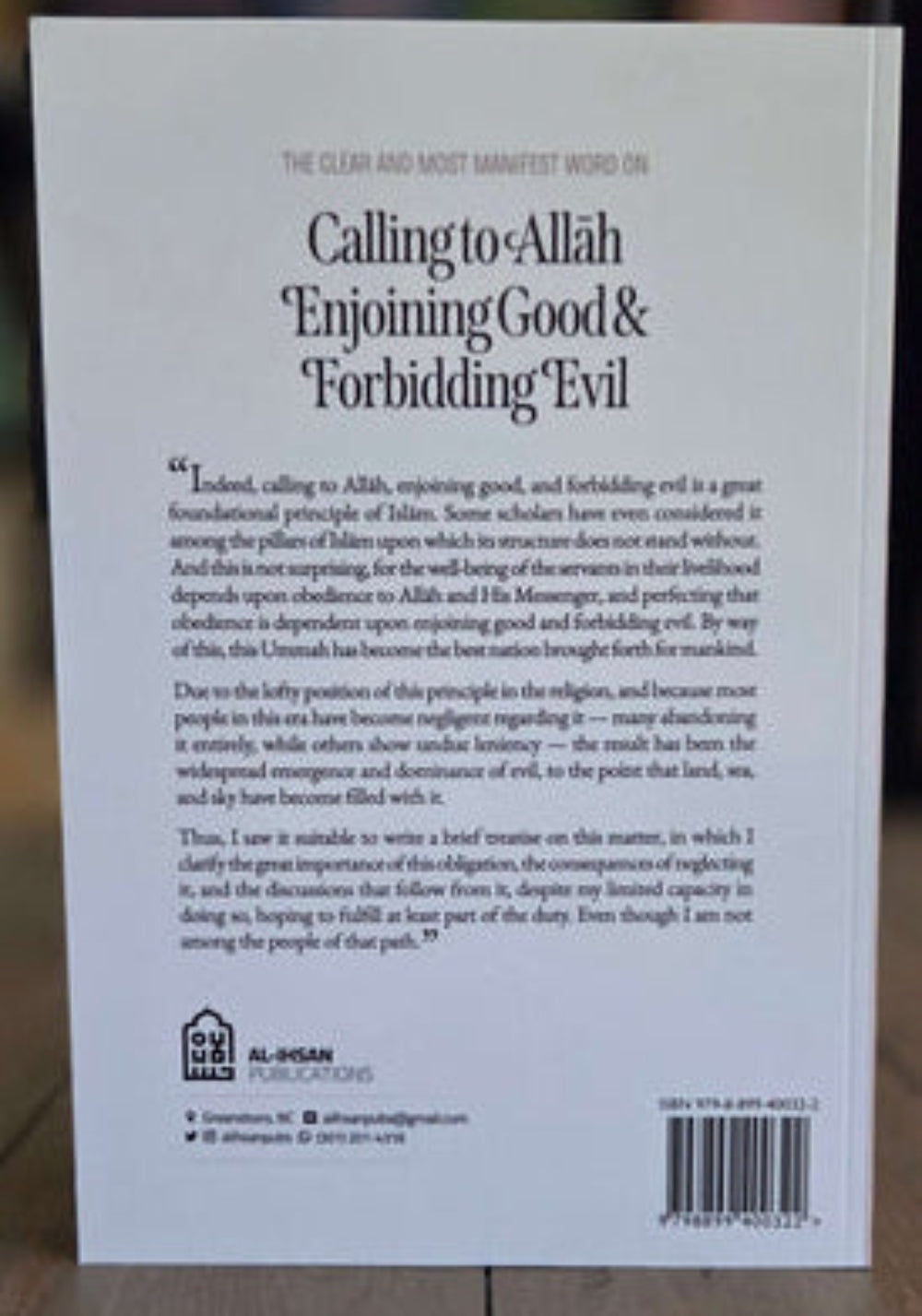
Indeed, calling to Allāh, enjoining good, and forbidding evil is a great foundational principle of Islām. Some scholars have even considered it among the pillars of Islām upon which its structure does not stand without. And this is not surprising, for the well-being of the servants in their livelihood depends upon obedience to Allāh and His Messenger, and perfecting that obedience is dependent upon enjoining good and forbidding evil. By way of this, this Ummah has become the best nation brought forth for mankind.
Due to the lofty position of this principle in the religion, and because most people in this era have become negligent regarding it — many abandoning it entirely, while others show undue leniency — the result has been the widespread emergence and dominance of evil, to the point that land, sea, and sky have become filled with it.
Thus, I saw it suitable to write a brief treatise on this matter, in which I clarify the great importance of this obligation, the consequences of neglecting it, and the discussions that follow from it, despite my limited capacity in doing so, hoping to fulfill at least part of the duty. Even though I am not among the people of that path.
Page:01
• THE CLEAR AND MOST MANIFEST WORD ON →
Calling to Allah Enjoining Good& Forbidding Evil
SHAYKH ABDUL AZIZ AR-RĀJIḤĪ
Page:02
THE CLEAR AND MOST MANIFEST WORD ON
Calling to Allah Enjoining Good & Forbidding Evil
"Indeed, calling to Allah, enjoining good, and forbidding evil is a great
foundational principle of Islam. Some scholars have even considered it among the pillars of Islam upon which its structure does not stand without. And this is not surprising, for the well-being of the servants in their livelihood depends upon obedience to Allah and His Messenger, and perfecting that obedience is dependent upon enjoining good and forbidding evil. By way of this, this Ummah has become the best nation brought forth for mankind. Due to the lofty position of this principle in the religion, and because most people in this era have become negligent regarding it—many abandoning it entirely, while others show undue leniency - the result has been the widespread emergence and dominance of evil, to the point that land, sea, and sky have become filled with it.
Thus, I saw it suitable to write a brief treatise on this matter, in which I clarify the great importance of this obligation, the consequences of neglecting it, and the discussions that follow from it, despite my limited capacity in doing so, hoping to fulfill at least part of the duty. Even though I am not among the people of that path."
Page:03
The Clear and Most Manifest Statement Regarding Calling to Allah Commanding Good and Forbidding Evil
Table of Contents
BRIEF BIOGRAPHY OF THE AUTHOR
Shaykh Abdul Aziz bin Abdullah bin
Abdur Rahman ar-Rajihi...
The Opening Sermon of the Treatise.. Introduction.
CHAPTER ONE
On Performing the Duty of Enjoining Good
and Forbidding Evil......
SECTION ONE
Refuted Misconceptions - Part 1
Refuted Misconceptions - Part 2.
SECTION TWO
The Ruling on Abandoning Enjoining the
Good and Forbidding the Evil Despite Having the Ability to Do So.
SECTION THREE
On the Conditions for the One Who
Online island forbids the Evil.. Book
Undertakes the Call to Allah, Enjoins the Good,
The Harms Resulting from the Absence of
These Three Traits in Enjoining the Good and Forbidding the Evil
Examples of the Good (al-Ma'ruf) that the
The Ruling on Enjoining Good and Forbidding Evil.
One Who Enjoins and Calls to Allah Commands:
Examples of widespread evil acts in Islamic societies that the one who enjoins good must forbid and warn against
The Role of the Hisbah Officer in Islām.
Proofs for the Obligation of Enjoining Good
and Forbidding Evil.
Conditions for the Obligation of Enjoining Good
CHAPTER TWO
Matters to Be Observed in Enjoining What Is Right and Forbidding What Is Wrong...
and Forbidding Evil
Conditions that must be adhered to regarding
SECTION ONE
actions that must be rejected
On the Method of Denouncing
Page:04
The Clear and Most Manifest Statement Regarding Calling to Allah Commanding Good and Forbidding Evil
Method of Denunciation (How to Forbid Evil).
A Caution Regarding Entering Upon the
Emir or Ruler for the Purpose of Denunciation or Admonition:
SECTION TWO
The Levels of Forbidding Evil.
Important Note: Forbidding Evil with the Heart Is Never Lifted from Anyone
CONCLUSION
FIRST
The Danger of Flattery (Mudahanah) in the Religion of Allah
SECOND
The Difference Between Diplomacy (Mudārāh)
Online Island Flattery (Mudahanah).. Book
SECTION THREE
The Two Levels of Changing Evil and the
Two Paths of Calling to Allah.
Note: For Those Who Follow the Path of
Harshness and Severity
CHAPTER THREE
The Circumstances in Which the Obligation of Enjoining Good and Forbidding Evil Is Dropped
THIRD
The Wisdom Behind the Legislation of Enjoining Good and Forbidding Evil.
FOURTH
The Corruption That Results from Abandoning Enjoining Good and Forbidding Evil
FIFTH
Motivations Behind Enjoining Good
and Forbidding Evil.
Conclusion.
THE FIRST SITUATION
When There Is No Acceptance or Benefit from It.
THE SECOND SITUATION
That Enjoining Good or Forbidding Evil Leads to a Greater Harm Than the Evil Being Addressed
THE THIRD SITUATION
Inability or Fear of Harm
Page:05
The Clear and Most Manifest Statement Regarding Calling to Allah Commanding Good and Forbidding Evil
The Opening Sermon of the Treatise
In the Name of Allah, the Most Gracious, the Most Mercifuline
"Say: This is my way; I invite unto Allah with sure knowledge, I and whosoever follows me" [Surah Yusuf: 108]
To proceed:
Indeed, calling to Allah, enjoining good, and forbidding evil is a great foundational principle of Islam. Some scholars have even considered it among the pillars of Islam upon which its structure does not stand without. And this is not surprising, for the well-being of the servants in their livelihood depends upon obedience to Allah and His Messenger, and perfecting that obedience is dependent upon enjoining good and forbidding evil. By way of this, this Ummah has become the best nation brought forth for mankind.
Island the lofty position of this principle in the religion, and because
Il praise is due to Allah, the Lord of all creation. We praise Him,Book A "ek istis help, ask His forgiveness, and seek His guidance. He
commands justice, excellence, and giving to relatives. He forbids immorality, wrongdoing, and oppression as an admonition from Him, the Exalted, to His servants so that they may take heed. May blessings and peace be upon His servant and Messenger, our Prophet Muḥammad, the best of those who call to the path of his Lord with wisdom and good preaching, upon insight. He enjoins good and forbids evil, and he patiently bears what befalls him, seeking the Face of Allah, fulfilling the mission of his Lord, conveying the trust, advising creation, and guiding them. May blessings and peace also be upon his family, his companions, and those who follow him in advising creation, calling them to Allah, commanding them with good, and forbidding them from evil. They are the ones of whom Allāh says:
قُلْ هَذِهِ سَبِيلِي أَدْعُوا إِلَى اللَّهِ عَلَى بَصِيرَةٍ أَنَا وَ مَنِ اتَّبَعَنِي
Due to many
most people in this era have become negligent regarding it abandoning it entirely, while others show undue leniency — the result has been the widespread emergence and dominance of evil, to the point that land, sea, and sky have become filled with it.
Thus, I saw it suitable to write a brief treatise on this matter, in which I clarify the great importance of this obligation, the consequences of neglecting it, and the discussions that follow from it, despite my limited capacity in doing so, hoping to fulfill at least part of the duty. Even though I am not among the people of that path.
I have arranged the treatise into an introduction, three chapters, and a conclusion.
The Introduction Includes:
1. The linguistic meaning of ma'ruf (good) and munkar (evil).
الناشر
Al-Ihsan Publications
مؤلف
- Abd-al-aziz Ibn Abdullah Al-rajihi
الشحن والتوصيل
نقوم بشحن الطلبات مباشرة من مستودعاتنا في المملكة المتحدة والولايات المتحدة الأمريكية، ونقدم خيارات شحن متعددة لتناسب احتياجاتك. نحن نشحن بفخر إلى جميع أنحاء العالم.
عمليات التسليم في المملكة المتحدة (من مستودع المملكة المتحدة):
يصل الشحن القياسي عادةً في غضون 3-4 أيام عمل. يستغرق التسليم السريع 2-3 أيام عمل. نهدف إلى شحن الطلبات في نفس اليوم أو يوم العمل التالي، مع توفر خيارات التوصيل في اليوم التالي حيثما ينطبق ذلك.
عمليات التسليم في الولايات المتحدة الأمريكية (من مستودع الولايات المتحدة الأمريكية):
تصل الطلبات عادةً في غضون 4-7 أيام عمل.
أوروبا (يتم الشحن من المملكة المتحدة):
يستغرق التسليم القياسي حوالي 6-10 أيام عمل، مع توفر خدمات الشحن السريع في غضون 3-5 أيام عمل.
كندا:
الوقت المقدر للتسليم هو 5-10 أيام عمل.
الشحن في جميع أنحاء العالم:
تصل الطلبات الدولية بشكل عام في غضون 5-20 يوم عمل، اعتمادًا على الوجهة وطريقة الشحن المختارة.
للحصول على جداول زمنية دقيقة للتسليم بناءً على موقعك، يرجى الاتصال بنا عبر البريد الإلكتروني وسيقدم فريقنا معلومات مفصلة ومخصصة لعنوانك.
صفحات العينة - المحتوى
Page:01
• THE CLEAR AND MOST MANIFEST WORD ON →
Calling to Allah Enjoining Good& Forbidding Evil
SHAYKH ABDUL AZIZ AR-RĀJIḤĪ
Page:02
THE CLEAR AND MOST MANIFEST WORD ON
Calling to Allah Enjoining Good & Forbidding Evil
"Indeed, calling to Allah, enjoining good, and forbidding evil is a great
foundational principle of Islam. Some scholars have even considered it among the pillars of Islam upon which its structure does not stand without. And this is not surprising, for the well-being of the servants in their livelihood depends upon obedience to Allah and His Messenger, and perfecting that obedience is dependent upon enjoining good and forbidding evil. By way of this, this Ummah has become the best nation brought forth for mankind. Due to the lofty position of this principle in the religion, and because most people in this era have become negligent regarding it—many abandoning it entirely, while others show undue leniency - the result has been the widespread emergence and dominance of evil, to the point that land, sea, and sky have become filled with it.
Thus, I saw it suitable to write a brief treatise on this matter, in which I clarify the great importance of this obligation, the consequences of neglecting it, and the discussions that follow from it, despite my limited capacity in doing so, hoping to fulfill at least part of the duty. Even though I am not among the people of that path."
Page:03
The Clear and Most Manifest Statement Regarding Calling to Allah Commanding Good and Forbidding Evil
Table of Contents
BRIEF BIOGRAPHY OF THE AUTHOR
Shaykh Abdul Aziz bin Abdullah bin
Abdur Rahman ar-Rajihi...
The Opening Sermon of the Treatise.. Introduction.
CHAPTER ONE
On Performing the Duty of Enjoining Good
and Forbidding Evil......
SECTION ONE
Refuted Misconceptions - Part 1
Refuted Misconceptions - Part 2.
SECTION TWO
The Ruling on Abandoning Enjoining the
Good and Forbidding the Evil Despite Having the Ability to Do So.
SECTION THREE
On the Conditions for the One Who
Online island forbids the Evil.. Book
Undertakes the Call to Allah, Enjoins the Good,
The Harms Resulting from the Absence of
These Three Traits in Enjoining the Good and Forbidding the Evil
Examples of the Good (al-Ma'ruf) that the
The Ruling on Enjoining Good and Forbidding Evil.
One Who Enjoins and Calls to Allah Commands:
Examples of widespread evil acts in Islamic societies that the one who enjoins good must forbid and warn against
The Role of the Hisbah Officer in Islām.
Proofs for the Obligation of Enjoining Good
and Forbidding Evil.
Conditions for the Obligation of Enjoining Good
CHAPTER TWO
Matters to Be Observed in Enjoining What Is Right and Forbidding What Is Wrong...
and Forbidding Evil
Conditions that must be adhered to regarding
SECTION ONE
actions that must be rejected
On the Method of Denouncing
Page:04
The Clear and Most Manifest Statement Regarding Calling to Allah Commanding Good and Forbidding Evil
Method of Denunciation (How to Forbid Evil).
A Caution Regarding Entering Upon the
Emir or Ruler for the Purpose of Denunciation or Admonition:
SECTION TWO
The Levels of Forbidding Evil.
Important Note: Forbidding Evil with the Heart Is Never Lifted from Anyone
CONCLUSION
FIRST
The Danger of Flattery (Mudahanah) in the Religion of Allah
SECOND
The Difference Between Diplomacy (Mudārāh)
Online Island Flattery (Mudahanah).. Book
SECTION THREE
The Two Levels of Changing Evil and the
Two Paths of Calling to Allah.
Note: For Those Who Follow the Path of
Harshness and Severity
CHAPTER THREE
The Circumstances in Which the Obligation of Enjoining Good and Forbidding Evil Is Dropped
THIRD
The Wisdom Behind the Legislation of Enjoining Good and Forbidding Evil.
FOURTH
The Corruption That Results from Abandoning Enjoining Good and Forbidding Evil
FIFTH
Motivations Behind Enjoining Good
and Forbidding Evil.
Conclusion.
THE FIRST SITUATION
When There Is No Acceptance or Benefit from It.
THE SECOND SITUATION
That Enjoining Good or Forbidding Evil Leads to a Greater Harm Than the Evil Being Addressed
THE THIRD SITUATION
Inability or Fear of Harm
Page:05
The Clear and Most Manifest Statement Regarding Calling to Allah Commanding Good and Forbidding Evil
The Opening Sermon of the Treatise
In the Name of Allah, the Most Gracious, the Most Mercifuline
"Say: This is my way; I invite unto Allah with sure knowledge, I and whosoever follows me" [Surah Yusuf: 108]
To proceed:
Indeed, calling to Allah, enjoining good, and forbidding evil is a great foundational principle of Islam. Some scholars have even considered it among the pillars of Islam upon which its structure does not stand without. And this is not surprising, for the well-being of the servants in their livelihood depends upon obedience to Allah and His Messenger, and perfecting that obedience is dependent upon enjoining good and forbidding evil. By way of this, this Ummah has become the best nation brought forth for mankind.
Island the lofty position of this principle in the religion, and because
Il praise is due to Allah, the Lord of all creation. We praise Him,Book A "ek istis help, ask His forgiveness, and seek His guidance. He
commands justice, excellence, and giving to relatives. He forbids immorality, wrongdoing, and oppression as an admonition from Him, the Exalted, to His servants so that they may take heed. May blessings and peace be upon His servant and Messenger, our Prophet Muḥammad, the best of those who call to the path of his Lord with wisdom and good preaching, upon insight. He enjoins good and forbids evil, and he patiently bears what befalls him, seeking the Face of Allah, fulfilling the mission of his Lord, conveying the trust, advising creation, and guiding them. May blessings and peace also be upon his family, his companions, and those who follow him in advising creation, calling them to Allah, commanding them with good, and forbidding them from evil. They are the ones of whom Allāh says:
قُلْ هَذِهِ سَبِيلِي أَدْعُوا إِلَى اللَّهِ عَلَى بَصِيرَةٍ أَنَا وَ مَنِ اتَّبَعَنِي
Due to many
most people in this era have become negligent regarding it abandoning it entirely, while others show undue leniency — the result has been the widespread emergence and dominance of evil, to the point that land, sea, and sky have become filled with it.
Thus, I saw it suitable to write a brief treatise on this matter, in which I clarify the great importance of this obligation, the consequences of neglecting it, and the discussions that follow from it, despite my limited capacity in doing so, hoping to fulfill at least part of the duty. Even though I am not among the people of that path.
I have arranged the treatise into an introduction, three chapters, and a conclusion.
The Introduction Includes:
1. The linguistic meaning of ma'ruf (good) and munkar (evil).
من هو Abd-al-aziz Ibn Abdullah Al-rajihi؟
Shaykh Abdul-Aziz Ibn Abdullah Al-Rajihi (عبد العزيز بن عبد الله الراجحي) is a prominent Saudi Islamic scholar, Hadith specialist, author, and teacher. Born in Al-Bukayriyah in the Al-Qassim region of Saudi Arabia around 1941, he studied at Imam Muhammad ibn Saud Islamic University in Riyadh, graduating from the College of Sharia and later pursuing advanced studies in Islamic jurisprudence. He studied under renowned scholars, including Shaykh Abdul-Aziz Ibn Baz and Shaykh Abdullah Ibn Humaid, and taught in the Department of Aqeedah at Imam Muhammad ibn Saud Islamic University.