


Taking Into Account the Position in the Quranic Expression – Arabic Quranic Linguistics & Balaghah Study
Taking Into Account the Position in the Quranic Expression – Arabic Quranic Linguistics & Balaghah Study
Publisher:
Dar Ibn Katheer
Author:
الدكتور محمد فاضل صالح السامرائي
Language:
العربية
Binding:
غلاف مقوى
Pages: 199
Size: 23×18 سم
لم نتمكن من تحميل توفر الاستلام


محتوى قابل للطي
وصف كتاب إسلامي
Taking Into Account the Position in the Quranic Expression – Arabic Quranic Linguistics & Balaghah Study
Taking Into Account the Position in the Quranic Expression is a specialized Arabic study that examines how the Quran uses precise wording, structure, emphasis, and context to convey deep meanings and unmatched eloquence. The book highlights the miraculous linguistic beauty of the Quran through detailed rhetorical analysis.
From Author:
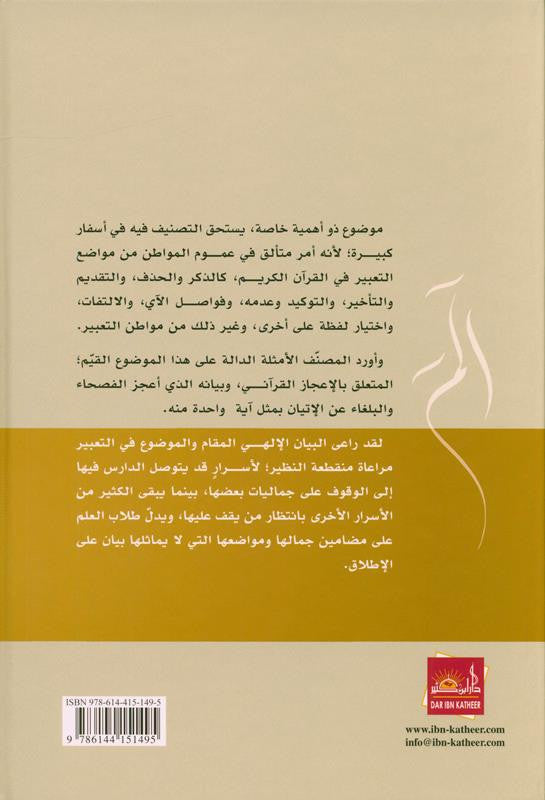
موضوع ذو أهمية خاصة، يستحق التصنيف فيه في أسفار كبيرة؛ لأنه أمر متألق في عموم المواطن من مواضع
التعبير في القرآن الكريم، كالذكر والحذف، والتقديم والتأخير والتوكيد ،وعدمه وفواصل الآي، والالتفات واختيار لفظة على أخرى، وغير ذلك من مواطن التعبير. وأورد المصنف الأمثلة الدالة على هذا الموضوع القيم؛ المتعلق بالإعجاز القرآني، وبيانه الذي أعجز الفصحاء والبلغاء عن الإتيان بمثل آية واحدة منه
لقد راعى البيان الإلهي المقام والموضوع في التعبير مراعاة منقطعة النظير؛ لأسرار قد يتوصل الدارس فيها إلى الوقوف على جماليات بعضها بينما يبقى الكثير من الأسرار الأخرى بانتظار من يقف عليها، ويدل طلاب العلم على مضامين جمالها ومواضعها التي لا يماثلها بيان على
Page no:01
Dr. Fadhil Salih Al-Samarrai
Observing the Context in Qur'anic Expression
Dar Ibn Kathir
Page no:02
Observing the Context in Qur'anic Expression
Regarding Mentioning and Omitting
The Holy Qur'an observes the context in expression, both in mentioning and omitting. As is known, the Qur'an observes the context when mentioning an expression, and we have provided examples for this in our discussion of Qur'anic expression.
It may also observe the context by omitting an expression that one might expect to be mentioned in its sequence. Mentioning can be general, as we have mentioned, for example, in the usage of "parents" (al-walidayn and al-abawayn)(1), as well as in the usage of "wind" (rih and riyah), "eyes" (a'yun and 'uyun), and so on.
Observing the context may also take the form of omission, where something is not mentioned even when it is thought it might be; all of this is for a reason. If it is mentioned, it is for a matter necessitated by the context, and if it is not mentioned, it is for a matter necessitated by the situation.
Examples of observing the context in mentioning and omitting include the following:
1. When eternity is mentioned for the people of Paradise, it is only mentioned in the plural form (khaledin - eternally abiding). Eternity is never mentioned for them in the singular; it is never said (khaledan - eternally abiding).
(1) See (On the Path of Rhetorical Exegesis) Vol. 2 - Exegesis of Surah Luqman.
Page no:03
Subject
Index
Introduction
Observing the Context in Qur'anic Expression in Mentioning and Omitting. 1 - Mentioning eternity for the people of Paradise and the people of Hell 2 - Mentioning the spouses of believers and the Houris - Mentioning the world of the unseen and the world of the manifest 4 - From Surah Al-Baqarah - Verse 110 5 - From Surah Al-Baqarah - Verse 172 6 - From Surah Al-Imran - Verse 14 7 - From Surah An-Nisa - Verse 75.
- From Surah An-Nisa - Verses 117, 118
9 - From Surah An-Nisa - Verse 162
....
10 - From Surah Al-An'am - Verses 48, 49 11 - From Surah Al-A'raf - Verse 43 12 - From Surah Yunus - Verse 31.
Page
Page no:04
Surah Muhammad, also called Surah Al-Qital (Fighting)
91
It is stated in (At-Tahrir wa At-Tanwir): "The meaning is: with this clarification, Allah explains to people their conditions, so they do not remain in heedfulness of their own affairs, veiled from realizing their true essence by the veil of habit, so that the evil may not be mixed with the good, and so that they may have insight into their affairs."
{So when you meet those who disbelieve, strike [their] necks until, when you have inflicted slaughter upon them, then secure their bonds, and either confer favor afterwards or ransom [them] until the war lays down its burdens. That [is the command]. And if Allah had willed, He could have taken vengeance upon them [Himself], but [He ordered armed struggle] to test some of you by others. And those who are killed in the cause of Allah - never will He waste their deeds. He will guide them and amend their condition. And admit them to Paradise, which He has made known to them.} [Muhammad: 4-6].
Three expressions were mentioned in the Holy Qur'an regarding meeting those who disbelieve in war:
The first: His saying, the Almighty, in Surah Al-Anfal: {O you who have believed, when you meet those who disbelieve advancing [in battle], do not turn to them your backs [in flight]. And whoever turns his back to them on such a day, unless swerving [as a strategy] for war or joining [another] company, has certainly returned with anger [upon him] from Allah, and his refuge is Hell - and wretched is the destination.} [Al-Anfal: 15-16].
The second: His saying, the Almighty, also in Surah Al-Anfal: {O you who have believed, when you encounter a company [standing firm], stand firm and remember Allah much that you may be successful. And obey Allah and His Messenger, and do not dispute and [thus] lose courage and [then] your strength would depart; and be patient. Indeed, Allah is with the patient.} [Al-Anfal]
Page no:05
A subject of special importance, worthy of being compiled in large volumes; because it is a matter that shines in most instances of expression in the Holy Qur'an, such as mentioning and omission, precedence and postponement, emphasis and lack thereof, verse endings, shifting focus, choosing one word over another, and other aspects of expression. The author has provided examples indicating this valuable subject; related to the Qur'anic inimitability, and its eloquence which rendered the eloquent and the masters of rhetoric unable to produce the likes of a single verse from it.
The Divine Eloquence has observed the context and the subject in expression with unparalleled care; for secrets that the student may arrive at, uncovering the aesthetics of some, while many other secrets remain waiting for someone to encounter them, and guide students of knowledge to their beautiful contents and their places, which no other eloquence can equal at all.
ISBN 978-614-415-149-5
9 786144 151495
الناشر
Dar Ibn Katheer
مؤلف
- الدكتور محمد فاضل صالح السامرائي
الشحن والتوصيل
نقوم بشحن الطلبات مباشرة من مستودعاتنا في المملكة المتحدة والولايات المتحدة الأمريكية، ونقدم خيارات شحن متعددة لتناسب احتياجاتك. نحن نشحن بفخر إلى جميع أنحاء العالم.
عمليات التسليم في المملكة المتحدة (من مستودع المملكة المتحدة):
يصل الشحن القياسي عادةً في غضون 3-4 أيام عمل. يستغرق التسليم السريع 2-3 أيام عمل. نهدف إلى شحن الطلبات في نفس اليوم أو يوم العمل التالي، مع توفر خيارات التوصيل في اليوم التالي حيثما ينطبق ذلك.
عمليات التسليم في الولايات المتحدة الأمريكية (من مستودع الولايات المتحدة الأمريكية):
تصل الطلبات عادةً في غضون 4-7 أيام عمل.
أوروبا (يتم الشحن من المملكة المتحدة):
يستغرق التسليم القياسي حوالي 6-10 أيام عمل، مع توفر خدمات الشحن السريع في غضون 3-5 أيام عمل.
كندا:
الوقت المقدر للتسليم هو 5-10 أيام عمل.
الشحن في جميع أنحاء العالم:
تصل الطلبات الدولية بشكل عام في غضون 5-20 يوم عمل، اعتمادًا على الوجهة وطريقة الشحن المختارة.
للحصول على جداول زمنية دقيقة للتسليم بناءً على موقعك، يرجى الاتصال بنا عبر البريد الإلكتروني وسيقدم فريقنا معلومات مفصلة ومخصصة لعنوانك.
صفحات العينة - المحتوى
Page no:01
Dr. Fadhil Salih Al-Samarrai
Observing the Context in Qur'anic Expression
Dar Ibn Kathir
Page no:02
Observing the Context in Qur'anic Expression
Regarding Mentioning and Omitting
The Holy Qur'an observes the context in expression, both in mentioning and omitting. As is known, the Qur'an observes the context when mentioning an expression, and we have provided examples for this in our discussion of Qur'anic expression.
It may also observe the context by omitting an expression that one might expect to be mentioned in its sequence. Mentioning can be general, as we have mentioned, for example, in the usage of "parents" (al-walidayn and al-abawayn)(1), as well as in the usage of "wind" (rih and riyah), "eyes" (a'yun and 'uyun), and so on.
Observing the context may also take the form of omission, where something is not mentioned even when it is thought it might be; all of this is for a reason. If it is mentioned, it is for a matter necessitated by the context, and if it is not mentioned, it is for a matter necessitated by the situation.
Examples of observing the context in mentioning and omitting include the following:
1. When eternity is mentioned for the people of Paradise, it is only mentioned in the plural form (khaledin - eternally abiding). Eternity is never mentioned for them in the singular; it is never said (khaledan - eternally abiding).
(1) See (On the Path of Rhetorical Exegesis) Vol. 2 - Exegesis of Surah Luqman.
Page no:03
Subject
Index
Introduction
Observing the Context in Qur'anic Expression in Mentioning and Omitting. 1 - Mentioning eternity for the people of Paradise and the people of Hell 2 - Mentioning the spouses of believers and the Houris - Mentioning the world of the unseen and the world of the manifest 4 - From Surah Al-Baqarah - Verse 110 5 - From Surah Al-Baqarah - Verse 172 6 - From Surah Al-Imran - Verse 14 7 - From Surah An-Nisa - Verse 75.
- From Surah An-Nisa - Verses 117, 118
9 - From Surah An-Nisa - Verse 162
....
10 - From Surah Al-An'am - Verses 48, 49 11 - From Surah Al-A'raf - Verse 43 12 - From Surah Yunus - Verse 31.
Page
Page no:04
Surah Muhammad, also called Surah Al-Qital (Fighting)
91
It is stated in (At-Tahrir wa At-Tanwir): "The meaning is: with this clarification, Allah explains to people their conditions, so they do not remain in heedfulness of their own affairs, veiled from realizing their true essence by the veil of habit, so that the evil may not be mixed with the good, and so that they may have insight into their affairs."
{So when you meet those who disbelieve, strike [their] necks until, when you have inflicted slaughter upon them, then secure their bonds, and either confer favor afterwards or ransom [them] until the war lays down its burdens. That [is the command]. And if Allah had willed, He could have taken vengeance upon them [Himself], but [He ordered armed struggle] to test some of you by others. And those who are killed in the cause of Allah - never will He waste their deeds. He will guide them and amend their condition. And admit them to Paradise, which He has made known to them.} [Muhammad: 4-6].
Three expressions were mentioned in the Holy Qur'an regarding meeting those who disbelieve in war:
The first: His saying, the Almighty, in Surah Al-Anfal: {O you who have believed, when you meet those who disbelieve advancing [in battle], do not turn to them your backs [in flight]. And whoever turns his back to them on such a day, unless swerving [as a strategy] for war or joining [another] company, has certainly returned with anger [upon him] from Allah, and his refuge is Hell - and wretched is the destination.} [Al-Anfal: 15-16].
The second: His saying, the Almighty, also in Surah Al-Anfal: {O you who have believed, when you encounter a company [standing firm], stand firm and remember Allah much that you may be successful. And obey Allah and His Messenger, and do not dispute and [thus] lose courage and [then] your strength would depart; and be patient. Indeed, Allah is with the patient.} [Al-Anfal]
Page no:05
A subject of special importance, worthy of being compiled in large volumes; because it is a matter that shines in most instances of expression in the Holy Qur'an, such as mentioning and omission, precedence and postponement, emphasis and lack thereof, verse endings, shifting focus, choosing one word over another, and other aspects of expression. The author has provided examples indicating this valuable subject; related to the Qur'anic inimitability, and its eloquence which rendered the eloquent and the masters of rhetoric unable to produce the likes of a single verse from it.
The Divine Eloquence has observed the context and the subject in expression with unparalleled care; for secrets that the student may arrive at, uncovering the aesthetics of some, while many other secrets remain waiting for someone to encounter them, and guide students of knowledge to their beautiful contents and their places, which no other eloquence can equal at all.
ISBN 978-614-415-149-5
9 786144 151495
من هو Dr Muhammad Fazil Saalih Samirai؟
Dr Muhammad Fazil Saalih Samirai is an Islamic author and Arabic language scholar known for his work on Arabic grammar and educational Islamic studies. He is associated with academic and linguistic writings that simplify Arabic grammar concepts for students and learners of the Arabic language.
One of his known works is:
Grammar Hajj (الحج النحوية) — an Arabic grammar-focused educational book published by Dar Ibn Kathir
and available through Islamic bookstores.