


supplications and Invocations صحيح الادعية والاذكار-Authentic Islamic Duas & Adhkar-Arabic
supplications and Invocations صحيح الادعية والاذكار-Authentic Islamic Duas & Adhkar-Arabic
Publisher:
Dar Al-Kotob Al-Ilmiyah
Author:
المبارك أبو الفضل السلفي
Language:
عربي
Binding:
غلاف مقوى
Pages: 160
Size: 17×23 سم
لم نتمكن من تحميل توفر الاستلام


محتوى قابل للطي
وصف كتاب إسلامي
مجموعة الأدعية والأذكار (صحيح الأدعية والأذكار) هي مجموعة مختارة بعناية من الأدعية والأذكار الإسلامية الأصيلة، مستقاة من أعمال عالم الحديث الجليل الشيخ ناصر الدين الألباني (رحمه الله). يجمع هذا الكتاب المكون من 160 صفحة بغلاف مقوى، والذي نشرته دار الكتب العلمية، مجموعة متنوعة من الأدعية والأذكار حول مواضيع ومناسبات مختلفة، مما يتيح للمسلمين تعميق صلتهم بالله من خلال الذكر والدعاء الذي علمه النبي ﷺ. بتركيزه على المصادر الموثوقة ومحتوى الأدعية العملية، يعد هذا الكتاب مثاليًا للطلاب والعلماء والقراء اليوميين الذين يسعون لإثراء حياتهم الروحية بالصلوات والأذكار اليومية الأصيلة.
من المؤلف:
هذا الكتاب من تأليف أبي الفضل السلفي، مستندًا بشكل كبير إلى الأعمال والمجموعات الموثقة لعالم الحديث البارز الشيخ ناصر الدين الألباني (رحمه الله)، المعروف بتدقيقه الشديد للأدعية والأذكار. يقدم المؤلف مجموعة تعكس بأمانة الأدعية والأذكار المتجذرة في سنة النبي ﷺ.
Page 01
Supplications and Dhikr
Selected from the books of the scholar Nasir al-Din al-Albani
May Allah the Almighty have mercy on him
Collected and arranged by
Al-Mubarak Abu al-Fadl al-Salafi
New edition, colored
Dar Al-Kotb Al-ilmiyah.
DKi
Dar Al-Kotb Al-ilmiyah
Page 02
Table of Contents
Introduction
Supplication (Dua) in language and terminology. Tasbih and Dhikr.
The virtue of Dhikr.
The virtue of Tasbih.
The virtue of seeking forgiveness (Istighfar).
The virtue of supplication and encouragement towards it.
Etiquette of supplication.
Acceptance of supplication.
Hadiths on Dhikr and its virtue, and the virtue of Tasbih, Tahmid, and Tahlil. Encouragement toward supplication and Istighfar.
Supplication using His Greatest Name and the Beautiful Names of Allah the Almighty.
Morning, evening, daily, and various times' Dhikr.
Dhikr of Wudu (ablution).
The virtue of Adhan, the Dhikr heard upon hearing the Mu'adhdhin, the Iqamah, and the supplication between the Adhan and the Iqamah.
The manner of the Prophet's (peace be upon him) recitation in prayers.
The Qunut supplication in Witr and after it.
The Qunut supplication in the five prayers for calamities. Dhikr for entering and leaving the mosque.
Dhikr for the opening of the prayer (Istiftah).
Dhikr of seeking refuge (Isti'adha) and the Fatiha, their virtues, the manner of reciting the Fatiha, and saying "Ameen" behind the Imam, and reciting it aloud.
Dhikr of bowing (Ruku') and prostration (Sujud).
Supplications during and after prayer, the Tashahhud supplication, and sending blessings upon the Prophet afterward.
Page 03
Table of Contents
Repelling the whispers of Satan during prayer by seeking refuge and spitting to the left.
Manner of counting Tasbih. Virtue of reading the Quran, its manner, and recommended Dhikr during and after completing it.
What to do if one sees a dream they dislike.
Chapter on Duha prayer.
Supplication for Istikhara prayer.
The virtue of Dhikr and supplication during an eclipse.
The virtue of sending blessings upon the Prophet (peace be upon him).
Supplication for one who receives a guest.
Dhikr of fasting and breaking the fast (Iftar).
Dhikr for rain seeking (Istisqa), rain, thunder, and wind.
Dhikr upon seeing the crescent moon and the moon.
What to say upon hearing a rooster crowing, a donkey braying, or a dog barking.
The greeting (Salam), its manner, etiquette, and virtue.
Etiquette of seeking permission and what is said during it.
What a servant says when leaving their house and entering it. What a servant says when entering and exiting the restroom.
Supplication when wearing a new garment. Dhikr and supplications related to travel.
Dhikr and supplications for the rituals of Hajj, Umrah, and the two Eids.
What is said when meeting the enemy or a person in authority. Supplications for death, funeral, burial, and visiting graves. Dhikr of gatherings and their expiation.
Supplication for the expiation of a gathering. Dhikr for sneezing and yawning.
Dhikr for the sermon and marriage.
Dhikr for birth and Aqiqah.
The most beloved names to Allah the Almighty and the most hated, and changing a name to a better one.
Supplication for one suffering pain in their body.
The virtue of visiting the sick and supplicating for them. Supplication upon seeing those afflicted.
What to say if one considers something an evil omen.
Page 04
The Virtue of Dhikr
Allah the Almighty says: (Therefore remember Me, I will remember you, and be grateful to Me and do not deny Me.) [Al-Baqarah: Verse 152].
And Allah the Almighty says: (O you who have believed, remember Allah with much remembrance. And exalt Him morning and afternoon. It is He who confers blessing upon you, and His angels [ask Him to do so] that He may bring you out from darkness into the light. And ever is He, to the believers, Merciful. Their greeting the day they meet Him will be, "Peace." And He has prepared for them a noble reward.) [Al-Ahzab: Verses 41-44].
And Allah the Almighty says: (And keep yourself patient [by being] with those who call upon their Lord in the morning and the evening, seeking His countenance. And let not your eyes pass beyond them, desiring adornments of the worldly life, and do not obey one whose heart We have made heedless of Our remembrance and who follows his desire and whose affair is ever [in] neglect.) [Al-Kahf: Verse 28].
And Allah the Almighty says: (And whoever turns away from My remembrance - indeed, he will have a depressed life, and We will gather him on the Day of Resurrection blind.) [Ta-Ha: Verse 124].
And Allah the Almighty says: (And whoever is blinded from remembrance of the Most Merciful - We appoint for him a devil, and he is to him a companion.) [Az-Zukhruf: Verse 36].
And the Messenger of Allah (peace be upon him) said: Allah the Almighty says: I am with My servant as long as he remembers Me and his lips move with Me. (Narrated by Imam Ahmad, Ibn Majah, and Al-Hakim from Abu Hurairah, may Allah be pleased with him). And the Prophet said: Allah the Almighty says: I am as My servant expects Me to be, and I am with him if he remembers Me; if he remembers Me within himself, I remember him within Myself; and if he remembers Me in a gathering, I remember him in a gathering better than that; if he draws near to Me by a span, I draw near to him by a cubit; and if he draws near to Me by a cubit, I draw near to him by an arm's length; and if he comes to Me walking, I go to him running. (Narrated by Ahmad, Al-Bukhari, Muslim, At-Tirmidhi, An-Nasa'i, and Ibn Majah from Abu Hurairah, may Allah be pleased with him).
Page 06
Authentic Supplications and Dhikr
Morning, evening, daily, and various times' Dhikr
- On the authority of Abdullah bin Mas'ud (may Allah be pleased with him), he said: The Messenger of Allah (peace be upon him), when evening came, would say: "We have entered the evening and so has the dominion of Allah; praise be to Allah. There is no god but Allah alone, with no partner; to Him belongs the dominion and to Him is the praise, and He is over all things capable. My Lord, I ask You for the best of what is in this night and the best of what follows it, and I seek refuge in You from the evil of what is in this night and the evil of what follows it. My Lord, I seek refuge in You from laziness and the evils of old age. My Lord, I seek refuge in You from punishment in the Fire and punishment in the grave." And when morning came, he would also say: "We have entered the morning and so has the dominion..." (Mukhtasar Muslim: 1894).
18 - On the authority of Abu Hurairah (may Allah be pleased with him), he said: The Prophet (peace be upon him) used to teach his companions, saying: "When one of you wakes up in the morning, let him say: 'O Allah, by You we enter the morning, and by You we enter the evening, and by You we live, and by You we die, and to You is the resurrection.' And when he enters the evening, let him say: 'O Allah, by You we enter the evening, and by You we enter the morning, and by You we live, and by You we die, and to You is the return.'" (As-Silsilah As-Sahihah: 262).
19 - On the authority of Shaddad bin Aws (may Allah be pleased with him), from the Prophet (peace be upon him), he said: "The master of seeking forgiveness is: 'O Allah, You are my Lord, there is no god but You. You created me, and I am Your servant, and I am upon Your covenant and Your promise as much as I can. I seek refuge in You from the evil of what I have done. I acknowledge Your favor upon me, and I acknowledge my sin, so forgive me, for no one forgives sins but You.' Whoever says this during the day with firm belief in it and dies on that same day before evening, he is from the people of Paradise, and whoever says it at night with firm belief in it and dies before morning, he is from the people of Paradise." (Mukhtasar Al-Bukhari: 242).
20 - On the authority of Anas bin Malik (may Allah be pleased with him), he said: The Messenger of Allah (peace be upon him) said to Fatimah (may Allah be pleased with her): "What prevents you from listening to what I advise you to do? That you say when you wake up..."
Page 07
Authentic Supplications and Dhikr
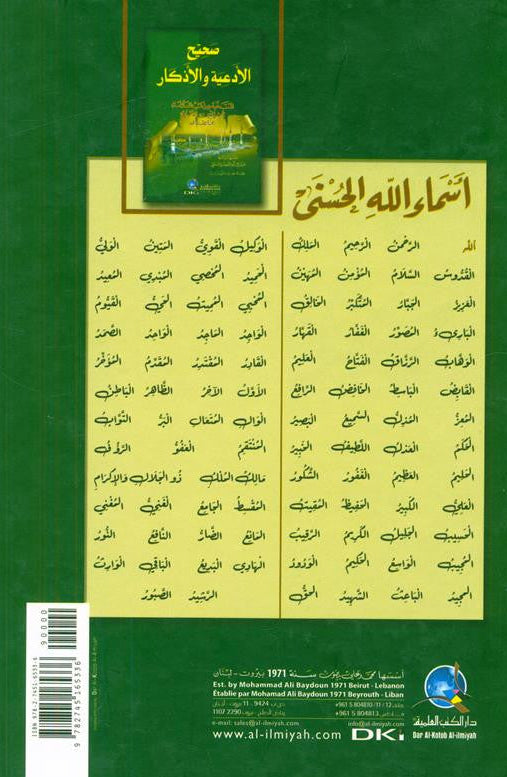
The Beautiful Names of Allah
Allah, The Protector, The Most Gracious, The Most Merciful, The King, The Disposer of Affairs, The Strong, The Firm, The Holy, The Peace, The Guardian of Faith, ... [List continues] ... The Most High, The Great, The Preserver, ... The All-Hearing, The All-Seeing, The Governor, The Exalted, The Kind, The Pardoner, The All-Knowing, The Great, The Forgiving, The Appreciative, ... Allah, the King, Possessor of Majesty and Honor, The High, The Great, The Protector, ... The All-Hearing, The All-Seeing, ... The Light, The Guide, The Originator, The Everlasting, The Inheritor, ... The Glorious, The Resurrector, The Witness, ... The Right-Minded, The Patient.
Finished as of June 1971, Beirut.
الناشر
Dar Al-Kotob Al-Ilmiyah
مؤلف
- المبارك أبو الفضل السلفي
الشحن والتوصيل
نقوم بشحن الطلبات مباشرة من مستودعاتنا في المملكة المتحدة والولايات المتحدة الأمريكية، ونقدم خيارات شحن متعددة لتناسب احتياجاتك. نحن نشحن بفخر إلى جميع أنحاء العالم.
عمليات التسليم في المملكة المتحدة (من مستودع المملكة المتحدة):
يصل الشحن القياسي عادةً في غضون 3-4 أيام عمل. يستغرق التسليم السريع 2-3 أيام عمل. نهدف إلى شحن الطلبات في نفس اليوم أو يوم العمل التالي، مع توفر خيارات التوصيل في اليوم التالي حيثما ينطبق ذلك.
عمليات التسليم في الولايات المتحدة الأمريكية (من مستودع الولايات المتحدة الأمريكية):
تصل الطلبات عادةً في غضون 4-7 أيام عمل.
أوروبا (يتم الشحن من المملكة المتحدة):
يستغرق التسليم القياسي حوالي 6-10 أيام عمل، مع توفر خدمات الشحن السريع في غضون 3-5 أيام عمل.
كندا:
الوقت المقدر للتسليم هو 5-10 أيام عمل.
الشحن في جميع أنحاء العالم:
تصل الطلبات الدولية بشكل عام في غضون 5-20 يوم عمل، اعتمادًا على الوجهة وطريقة الشحن المختارة.
للحصول على جداول زمنية دقيقة للتسليم بناءً على موقعك، يرجى الاتصال بنا عبر البريد الإلكتروني وسيقدم فريقنا معلومات مفصلة ومخصصة لعنوانك.
صفحات العينة - المحتوى
Page 01
Supplications and Dhikr
Selected from the books of the scholar Nasir al-Din al-Albani
May Allah the Almighty have mercy on him
Collected and arranged by
Al-Mubarak Abu al-Fadl al-Salafi
New edition, colored
Dar Al-Kotb Al-ilmiyah.
DKi
Dar Al-Kotb Al-ilmiyah
Page 02
Table of Contents
Introduction
Supplication (Dua) in language and terminology. Tasbih and Dhikr.
The virtue of Dhikr.
The virtue of Tasbih.
The virtue of seeking forgiveness (Istighfar).
The virtue of supplication and encouragement towards it.
Etiquette of supplication.
Acceptance of supplication.
Hadiths on Dhikr and its virtue, and the virtue of Tasbih, Tahmid, and Tahlil. Encouragement toward supplication and Istighfar.
Supplication using His Greatest Name and the Beautiful Names of Allah the Almighty.
Morning, evening, daily, and various times' Dhikr.
Dhikr of Wudu (ablution).
The virtue of Adhan, the Dhikr heard upon hearing the Mu'adhdhin, the Iqamah, and the supplication between the Adhan and the Iqamah.
The manner of the Prophet's (peace be upon him) recitation in prayers.
The Qunut supplication in Witr and after it.
The Qunut supplication in the five prayers for calamities. Dhikr for entering and leaving the mosque.
Dhikr for the opening of the prayer (Istiftah).
Dhikr of seeking refuge (Isti'adha) and the Fatiha, their virtues, the manner of reciting the Fatiha, and saying "Ameen" behind the Imam, and reciting it aloud.
Dhikr of bowing (Ruku') and prostration (Sujud).
Supplications during and after prayer, the Tashahhud supplication, and sending blessings upon the Prophet afterward.
Page 03
Table of Contents
Repelling the whispers of Satan during prayer by seeking refuge and spitting to the left.
Manner of counting Tasbih. Virtue of reading the Quran, its manner, and recommended Dhikr during and after completing it.
What to do if one sees a dream they dislike.
Chapter on Duha prayer.
Supplication for Istikhara prayer.
The virtue of Dhikr and supplication during an eclipse.
The virtue of sending blessings upon the Prophet (peace be upon him).
Supplication for one who receives a guest.
Dhikr of fasting and breaking the fast (Iftar).
Dhikr for rain seeking (Istisqa), rain, thunder, and wind.
Dhikr upon seeing the crescent moon and the moon.
What to say upon hearing a rooster crowing, a donkey braying, or a dog barking.
The greeting (Salam), its manner, etiquette, and virtue.
Etiquette of seeking permission and what is said during it.
What a servant says when leaving their house and entering it. What a servant says when entering and exiting the restroom.
Supplication when wearing a new garment. Dhikr and supplications related to travel.
Dhikr and supplications for the rituals of Hajj, Umrah, and the two Eids.
What is said when meeting the enemy or a person in authority. Supplications for death, funeral, burial, and visiting graves. Dhikr of gatherings and their expiation.
Supplication for the expiation of a gathering. Dhikr for sneezing and yawning.
Dhikr for the sermon and marriage.
Dhikr for birth and Aqiqah.
The most beloved names to Allah the Almighty and the most hated, and changing a name to a better one.
Supplication for one suffering pain in their body.
The virtue of visiting the sick and supplicating for them. Supplication upon seeing those afflicted.
What to say if one considers something an evil omen.
Page 04
The Virtue of Dhikr
Allah the Almighty says: (Therefore remember Me, I will remember you, and be grateful to Me and do not deny Me.) [Al-Baqarah: Verse 152].
And Allah the Almighty says: (O you who have believed, remember Allah with much remembrance. And exalt Him morning and afternoon. It is He who confers blessing upon you, and His angels [ask Him to do so] that He may bring you out from darkness into the light. And ever is He, to the believers, Merciful. Their greeting the day they meet Him will be, "Peace." And He has prepared for them a noble reward.) [Al-Ahzab: Verses 41-44].
And Allah the Almighty says: (And keep yourself patient [by being] with those who call upon their Lord in the morning and the evening, seeking His countenance. And let not your eyes pass beyond them, desiring adornments of the worldly life, and do not obey one whose heart We have made heedless of Our remembrance and who follows his desire and whose affair is ever [in] neglect.) [Al-Kahf: Verse 28].
And Allah the Almighty says: (And whoever turns away from My remembrance - indeed, he will have a depressed life, and We will gather him on the Day of Resurrection blind.) [Ta-Ha: Verse 124].
And Allah the Almighty says: (And whoever is blinded from remembrance of the Most Merciful - We appoint for him a devil, and he is to him a companion.) [Az-Zukhruf: Verse 36].
And the Messenger of Allah (peace be upon him) said: Allah the Almighty says: I am with My servant as long as he remembers Me and his lips move with Me. (Narrated by Imam Ahmad, Ibn Majah, and Al-Hakim from Abu Hurairah, may Allah be pleased with him). And the Prophet said: Allah the Almighty says: I am as My servant expects Me to be, and I am with him if he remembers Me; if he remembers Me within himself, I remember him within Myself; and if he remembers Me in a gathering, I remember him in a gathering better than that; if he draws near to Me by a span, I draw near to him by a cubit; and if he draws near to Me by a cubit, I draw near to him by an arm's length; and if he comes to Me walking, I go to him running. (Narrated by Ahmad, Al-Bukhari, Muslim, At-Tirmidhi, An-Nasa'i, and Ibn Majah from Abu Hurairah, may Allah be pleased with him).
Page 06
Authentic Supplications and Dhikr
Morning, evening, daily, and various times' Dhikr
- On the authority of Abdullah bin Mas'ud (may Allah be pleased with him), he said: The Messenger of Allah (peace be upon him), when evening came, would say: "We have entered the evening and so has the dominion of Allah; praise be to Allah. There is no god but Allah alone, with no partner; to Him belongs the dominion and to Him is the praise, and He is over all things capable. My Lord, I ask You for the best of what is in this night and the best of what follows it, and I seek refuge in You from the evil of what is in this night and the evil of what follows it. My Lord, I seek refuge in You from laziness and the evils of old age. My Lord, I seek refuge in You from punishment in the Fire and punishment in the grave." And when morning came, he would also say: "We have entered the morning and so has the dominion..." (Mukhtasar Muslim: 1894).
18 - On the authority of Abu Hurairah (may Allah be pleased with him), he said: The Prophet (peace be upon him) used to teach his companions, saying: "When one of you wakes up in the morning, let him say: 'O Allah, by You we enter the morning, and by You we enter the evening, and by You we live, and by You we die, and to You is the resurrection.' And when he enters the evening, let him say: 'O Allah, by You we enter the evening, and by You we enter the morning, and by You we live, and by You we die, and to You is the return.'" (As-Silsilah As-Sahihah: 262).
19 - On the authority of Shaddad bin Aws (may Allah be pleased with him), from the Prophet (peace be upon him), he said: "The master of seeking forgiveness is: 'O Allah, You are my Lord, there is no god but You. You created me, and I am Your servant, and I am upon Your covenant and Your promise as much as I can. I seek refuge in You from the evil of what I have done. I acknowledge Your favor upon me, and I acknowledge my sin, so forgive me, for no one forgives sins but You.' Whoever says this during the day with firm belief in it and dies on that same day before evening, he is from the people of Paradise, and whoever says it at night with firm belief in it and dies before morning, he is from the people of Paradise." (Mukhtasar Al-Bukhari: 242).
20 - On the authority of Anas bin Malik (may Allah be pleased with him), he said: The Messenger of Allah (peace be upon him) said to Fatimah (may Allah be pleased with her): "What prevents you from listening to what I advise you to do? That you say when you wake up..."
Page 07
Authentic Supplications and Dhikr
The Beautiful Names of Allah
Allah, The Protector, The Most Gracious, The Most Merciful, The King, The Disposer of Affairs, The Strong, The Firm, The Holy, The Peace, The Guardian of Faith, ... [List continues] ... The Most High, The Great, The Preserver, ... The All-Hearing, The All-Seeing, The Governor, The Exalted, The Kind, The Pardoner, The All-Knowing, The Great, The Forgiving, The Appreciative, ... Allah, the King, Possessor of Majesty and Honor, The High, The Great, The Protector, ... The All-Hearing, The All-Seeing, ... The Light, The Guide, The Originator, The Everlasting, The Inheritor, ... The Glorious, The Resurrector, The Witness, ... The Right-Minded, The Patient.
Finished as of June 1971, Beirut.
من هو Al mubarak Abu Al fadl al salafi؟
Compiler Al-Mubarak Abu Al-Fadl al-Salafi is recognized for assembling authentic duʿāʾ (supplications) and adhkār (remembrances) from the Sunnah, offering an accessible Arabic resource for strengthening everyday spiritual practice.