


Shura Is An Islamic Obligation – Islamic Governance & Consultation Book by Ali Muhammad Sallaabi
Shura Is An Islamic Obligation – Islamic Governance & Consultation Book by Ali Muhammad Sallaabi
Publisher:
Dar Ibn Katheer
Author:
علي محمد الصلابي
Language:
العربية
Binding:
غلاف ورقي
Pages: 208
Size: ١٧x٢٤ سم
لم نتمكن من تحميل توفر الاستلام


محتوى قابل للطي
وصف كتاب إسلامي
Shura Is An Islamic Obligation – Islamic Governance & Consultation Book by Ali Muhammad Sallaabi
An insightful Islamic book explaining the importance of Shura (consultation) in Islam according to the Qur’an and Sunnah. A valuable resource for understanding Islamic governance, leadership, and community decision-making. Inspired by authentic Islamic teachings on consultation and unity.
From Author:
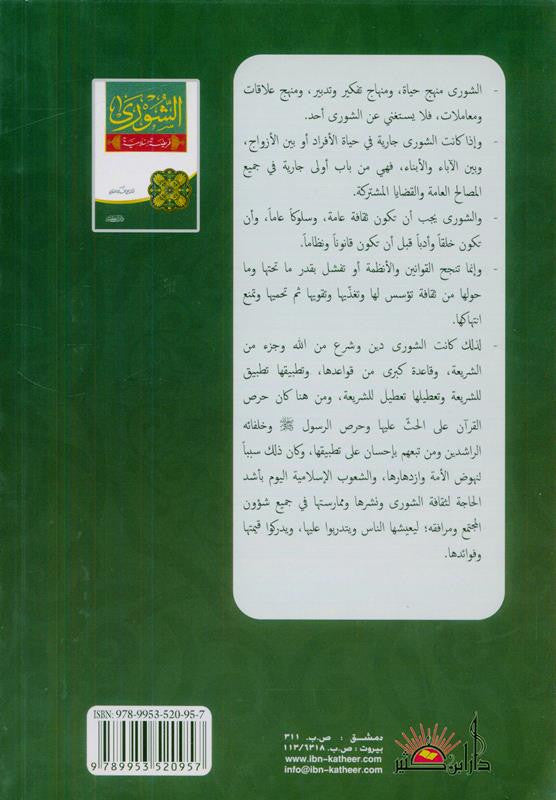
الشورى منهج حياة، ومنهاج تفكير وتدبير، ومنهج . ومعاملات، فلا يستغني عن الشورى أحد
علاقات
وإذا كانت الشورى جارية في حياة الأفراد أو بين الأزواج وبين الآباء والأبناء، فهي من باب أولى جارية في جميع المصالح العامة والقضايا المشتركة.
والشورى يجب أن تكون ثقافة عامة، وسلوكاً عاماً، وأن
تكون خلقاً وأدباً قبل أن تكون قانوناً ونظاماً.
وإنما تنجح القوانين والأنظمة أو تفشل بقدر ما تحتها وما ثقافة تؤسس لها وتغذيها وتقويها ثم تحميها وتمنع
حولها من
انتباكها.
لذلك كانت الشورى دين وشرع من الله وجزء من الشريعة وقاعدة كبرى من قواعدها، وتطبيقها تطبيق للشريعة وتعطيلها تعطيل للشريعة، ومن هنا كان حرص القرآن على الحثّ عليها وحرص الرسول وخلفائه الراشدين ومن تبعهم بإحسان على تطبيقها، وكان ذلك سبباً النهوض الأمة وازدهارها، والشعوب الإسلامية اليوم بأشد الحاجة لثقافة الشورى ونشرها وممارستها في جميع شؤون المجتمع ومرافقه: ليعيشها الناس ويتدربوا عليها، ويدركوا قيمتها
الشورى
Page no:01
In the Name of Allah, the Most Gracious, the Most Merciful
Introduction
Praise be to Allah, we praise Him, seek His help, and seek His forgiveness. We seek refuge in Allah from the evils of our own selves and from our bad deeds. Whoever Allah guides, none can misguide, and whoever He leaves astray, none can guide. I bear witness that there is no god but Allah, alone with no partner, and I bear witness that Muhammad is His servant and messenger. The Almighty says: "O you who have believed, fear Allah as He should be feared and do not die except as Muslims [in submission to Him]." [Al-Imran: 102]. He also says: "O mankind, fear your Lord, who created you from one soul and created from it its mate and dispersed from both of them many men and women. And fear Allah, through whom you ask one another, and the wombs. Indeed Allah is ever, over you, an Observer." [An-Nisa: 1]. He also says: "O you who have believed, fear Allah and speak words of appropriate justice. He will [then] amend for you your deeds and forgive you your sins. And whoever obeys Allah and His Messenger has certainly attained a great attainment." [Al-Ahzab: 70-71]. O Lord, Yours is the praise as befits the majesty of Your Face and the greatness of Your dominion. Yours is the praise until You are pleased, yours is the praise if You are pleased, and yours is the praise after You are pleased.
6
To proceed: My brother, Dr. Saif al-Islam Muammar Gaddafi, asked me to provide a study of the noble Quranic verses that spoke about Shura (consultation). Through dialogue, the idea of the research developed until it included the historical practice of the value of Shura in the history of the Islamic nation and its intellectual dimensions, and thus this book came to be.
Shura is a human value practiced by groups, tribes, peoples, and nations throughout their long history, each in its own way, culture, belief, customs, and traditions, whether in the Siberian plains, African jungles, the Arabian Peninsula desert, Asian plateaus, European meadows, or other vast lands of Allah. However, Islam added a devotional dimension to it, made it one of the high human values and one of the major objectives of this religion, and attached a reward to acting upon it and a punishment for neglecting it.
Page no:02
Chapter Five:
Shura in the Era of Omar Al-Farooq, may Allah be pleased with him
A - The Allegiance (Bay'ah) of Omar ibn al-Khattab, may Allah be pleased with him:
When Abu Bakr’s illness became severe, he gathered the people and said: "What you see has befallen me, and I do not think I will survive this. Allah has released you from your allegiance to me, dissolved my tie over you, and returned your affair to you, so appoint over yourselves whomever you like; for if you appoint someone while I am still alive, it is more likely that you will not differ after me."
(1)
The companions, may Allah be pleased with them, consulted one another, each trying to push the responsibility away from himself and seeking it for his brother, as he saw in him righteousness and competence. Therefore, they returned to him and said: "We have seen your opinion, O Caliph of the Messenger of Allah." He said: "Give me time so I may look for Allah, His religion, and His servants." Abu Bakr called Abdul Rahman ibn Awf and said to him: "Tell me about Omar ibn al-Khattab."
He said to him: "You do not ask me about a matter except that you are more knowledgeable than me."
Abu Bakr said: "Even so."
Abdul Rahman said: "By Allah, he is better than your opinion of him."
Then he called Uthman ibn Affan and asked him about that. Uthman said: "O Allah, my knowledge of him is that his inner self is better than his outer self, and there is no one like him among us."
Abu Bakr said: "May Allah have mercy on you, by Allah, if I had left him, I would not have bypassed you."
Then he called Usayd ibn Hudayr and said the same to him. Usayd said: "O Allah, I know him to be the best after you. He is satisfied for what is right and angered by what is wrong; what he conceals is better than what he reveals, and no one will take over this affair who is stronger for it than him."
Page no:03
Chapter One:
Shura in the Holy Quran
1 - In the Beginning, there was Shura
It is customary for scholars and writers, when speaking about Shura and its legal evidence, to focus on the two noble verses from Surah Ash-Shura and Surah Al-Imran, and they are indeed central verses to the subject. I will - with Allah’s help - mention and explain them, but I will make them the conclusion, not the beginning (1).
I begin with His saying, the Almighty: "And [mention, O Muhammad], when your Lord said to the angels, 'Indeed, I will make upon the earth a successive authority.' They said, 'Will You place upon it one who causes corruption therein and sheds blood, while we declare Your praise and sanctify You?' Allah said, 'Indeed, I know that which you do not know.' And He taught Adam the names - all of them. Then He showed them to the angels and said, 'Inform Me of the names of these, if you are truthful.' They said, 'Exalted are You; we have no knowledge except what You have taught us. Indeed, it is You who is the Knowing, the Wise.'" [Al-Baqarah: 30-32]. This dialogue contains a form of consultation—consultation that was intended to be at the beginning of creation to be a guide for the children of Adam since the first creation (2), and to be like consultation with the angels as an honor to them, thus being teaching in the form of honoring, not consultation in matters, and to alert the angels to the subtle and hidden wisdom of creating Adam, as the commentators mentioned (3).
So, Shura is the first social tradition established by Allah for His creation and His servants to follow and be guided by.
It is also inferred from this event that Shura is prescribed even in tangible issues.
(1) Shura in the Battle of Construction, Dr. Ahmad Al-Raysuni, p. (15). (2) Source: Ibid, p. (15).
(3) At-Tahrir wat-Tanwir by Muhammad al-Tahir ibn Ashur, p. (16).
Page no:04
Shura is a way of life, a method of thinking and management, and a method of relationships. No one can dispense with Shura.
If Shura is applied in the lives of individuals, or between spouses, or between parents and children, then it is all the more applicable to all public interests and common issues.
Shura must be a general culture, a general behavior, and must be a character and etiquette before it is a law and a system.
Laws and systems only succeed or fail to the extent of the culture that underlies them, establishes them, nourishes them, strengthens them, and then protects them and prevents them from being violated.
Therefore, Shura was a religion and a law from Allah, a part of the Sharia, and a major foundation of its principles. Applying it is an application of the Sharia, and disabling it is a disabling of the Sharia. Hence the Quran's keenness to encourage it, and the keenness of the Messenger, his Rightly Guided Caliphs, and those who followed them in righteousness to apply it. This was a reason for the rise and prosperity of the nation. The Islamic peoples today are in dire need of the culture of Shura, its dissemination, and its practice in all matters and facilities of society: so that people live it, train in it, and realize its value.
Shura
الناشر
Dar Ibn Katheer
مؤلف
- علي محمد الصلابي
الشحن والتوصيل
نقوم بشحن الطلبات مباشرة من مستودعاتنا في المملكة المتحدة والولايات المتحدة الأمريكية، ونقدم خيارات شحن متعددة لتناسب احتياجاتك. نحن نشحن بفخر إلى جميع أنحاء العالم.
عمليات التسليم في المملكة المتحدة (من مستودع المملكة المتحدة):
يصل الشحن القياسي عادةً في غضون 3-4 أيام عمل. يستغرق التسليم السريع 2-3 أيام عمل. نهدف إلى شحن الطلبات في نفس اليوم أو يوم العمل التالي، مع توفر خيارات التوصيل في اليوم التالي حيثما ينطبق ذلك.
عمليات التسليم في الولايات المتحدة الأمريكية (من مستودع الولايات المتحدة الأمريكية):
تصل الطلبات عادةً في غضون 4-7 أيام عمل.
أوروبا (يتم الشحن من المملكة المتحدة):
يستغرق التسليم القياسي حوالي 6-10 أيام عمل، مع توفر خدمات الشحن السريع في غضون 3-5 أيام عمل.
كندا:
الوقت المقدر للتسليم هو 5-10 أيام عمل.
الشحن في جميع أنحاء العالم:
تصل الطلبات الدولية بشكل عام في غضون 5-20 يوم عمل، اعتمادًا على الوجهة وطريقة الشحن المختارة.
للحصول على جداول زمنية دقيقة للتسليم بناءً على موقعك، يرجى الاتصال بنا عبر البريد الإلكتروني وسيقدم فريقنا معلومات مفصلة ومخصصة لعنوانك.
صفحات العينة - المحتوى
Page no:01
In the Name of Allah, the Most Gracious, the Most Merciful
Introduction
Praise be to Allah, we praise Him, seek His help, and seek His forgiveness. We seek refuge in Allah from the evils of our own selves and from our bad deeds. Whoever Allah guides, none can misguide, and whoever He leaves astray, none can guide. I bear witness that there is no god but Allah, alone with no partner, and I bear witness that Muhammad is His servant and messenger. The Almighty says: "O you who have believed, fear Allah as He should be feared and do not die except as Muslims [in submission to Him]." [Al-Imran: 102]. He also says: "O mankind, fear your Lord, who created you from one soul and created from it its mate and dispersed from both of them many men and women. And fear Allah, through whom you ask one another, and the wombs. Indeed Allah is ever, over you, an Observer." [An-Nisa: 1]. He also says: "O you who have believed, fear Allah and speak words of appropriate justice. He will [then] amend for you your deeds and forgive you your sins. And whoever obeys Allah and His Messenger has certainly attained a great attainment." [Al-Ahzab: 70-71]. O Lord, Yours is the praise as befits the majesty of Your Face and the greatness of Your dominion. Yours is the praise until You are pleased, yours is the praise if You are pleased, and yours is the praise after You are pleased.
6
To proceed: My brother, Dr. Saif al-Islam Muammar Gaddafi, asked me to provide a study of the noble Quranic verses that spoke about Shura (consultation). Through dialogue, the idea of the research developed until it included the historical practice of the value of Shura in the history of the Islamic nation and its intellectual dimensions, and thus this book came to be.
Shura is a human value practiced by groups, tribes, peoples, and nations throughout their long history, each in its own way, culture, belief, customs, and traditions, whether in the Siberian plains, African jungles, the Arabian Peninsula desert, Asian plateaus, European meadows, or other vast lands of Allah. However, Islam added a devotional dimension to it, made it one of the high human values and one of the major objectives of this religion, and attached a reward to acting upon it and a punishment for neglecting it.
Page no:02
Chapter Five:
Shura in the Era of Omar Al-Farooq, may Allah be pleased with him
A - The Allegiance (Bay'ah) of Omar ibn al-Khattab, may Allah be pleased with him:
When Abu Bakr’s illness became severe, he gathered the people and said: "What you see has befallen me, and I do not think I will survive this. Allah has released you from your allegiance to me, dissolved my tie over you, and returned your affair to you, so appoint over yourselves whomever you like; for if you appoint someone while I am still alive, it is more likely that you will not differ after me."
(1)
The companions, may Allah be pleased with them, consulted one another, each trying to push the responsibility away from himself and seeking it for his brother, as he saw in him righteousness and competence. Therefore, they returned to him and said: "We have seen your opinion, O Caliph of the Messenger of Allah." He said: "Give me time so I may look for Allah, His religion, and His servants." Abu Bakr called Abdul Rahman ibn Awf and said to him: "Tell me about Omar ibn al-Khattab."
He said to him: "You do not ask me about a matter except that you are more knowledgeable than me."
Abu Bakr said: "Even so."
Abdul Rahman said: "By Allah, he is better than your opinion of him."
Then he called Uthman ibn Affan and asked him about that. Uthman said: "O Allah, my knowledge of him is that his inner self is better than his outer self, and there is no one like him among us."
Abu Bakr said: "May Allah have mercy on you, by Allah, if I had left him, I would not have bypassed you."
Then he called Usayd ibn Hudayr and said the same to him. Usayd said: "O Allah, I know him to be the best after you. He is satisfied for what is right and angered by what is wrong; what he conceals is better than what he reveals, and no one will take over this affair who is stronger for it than him."
Page no:03
Chapter One:
Shura in the Holy Quran
1 - In the Beginning, there was Shura
It is customary for scholars and writers, when speaking about Shura and its legal evidence, to focus on the two noble verses from Surah Ash-Shura and Surah Al-Imran, and they are indeed central verses to the subject. I will - with Allah’s help - mention and explain them, but I will make them the conclusion, not the beginning (1).
I begin with His saying, the Almighty: "And [mention, O Muhammad], when your Lord said to the angels, 'Indeed, I will make upon the earth a successive authority.' They said, 'Will You place upon it one who causes corruption therein and sheds blood, while we declare Your praise and sanctify You?' Allah said, 'Indeed, I know that which you do not know.' And He taught Adam the names - all of them. Then He showed them to the angels and said, 'Inform Me of the names of these, if you are truthful.' They said, 'Exalted are You; we have no knowledge except what You have taught us. Indeed, it is You who is the Knowing, the Wise.'" [Al-Baqarah: 30-32]. This dialogue contains a form of consultation—consultation that was intended to be at the beginning of creation to be a guide for the children of Adam since the first creation (2), and to be like consultation with the angels as an honor to them, thus being teaching in the form of honoring, not consultation in matters, and to alert the angels to the subtle and hidden wisdom of creating Adam, as the commentators mentioned (3).
So, Shura is the first social tradition established by Allah for His creation and His servants to follow and be guided by.
It is also inferred from this event that Shura is prescribed even in tangible issues.
(1) Shura in the Battle of Construction, Dr. Ahmad Al-Raysuni, p. (15). (2) Source: Ibid, p. (15).
(3) At-Tahrir wat-Tanwir by Muhammad al-Tahir ibn Ashur, p. (16).
Page no:04
Shura is a way of life, a method of thinking and management, and a method of relationships. No one can dispense with Shura.
If Shura is applied in the lives of individuals, or between spouses, or between parents and children, then it is all the more applicable to all public interests and common issues.
Shura must be a general culture, a general behavior, and must be a character and etiquette before it is a law and a system.
Laws and systems only succeed or fail to the extent of the culture that underlies them, establishes them, nourishes them, strengthens them, and then protects them and prevents them from being violated.
Therefore, Shura was a religion and a law from Allah, a part of the Sharia, and a major foundation of its principles. Applying it is an application of the Sharia, and disabling it is a disabling of the Sharia. Hence the Quran's keenness to encourage it, and the keenness of the Messenger, his Rightly Guided Caliphs, and those who followed them in righteousness to apply it. This was a reason for the rise and prosperity of the nation. The Islamic peoples today are in dire need of the culture of Shura, its dissemination, and its practice in all matters and facilities of society: so that people live it, train in it, and realize its value.
Shura
من هو Ali Muhammad Sallaabi؟
Ali Muhammad al-Sallabi is a renowned Islamic scholar, historian, and author known for his authentic writings on Islamic history, biographies of the Prophets, Khulafa, and Muslim leaders. His books are widely appreciated for their research-based content, simple style, and strong references from the Qur’an and Sunnah.