


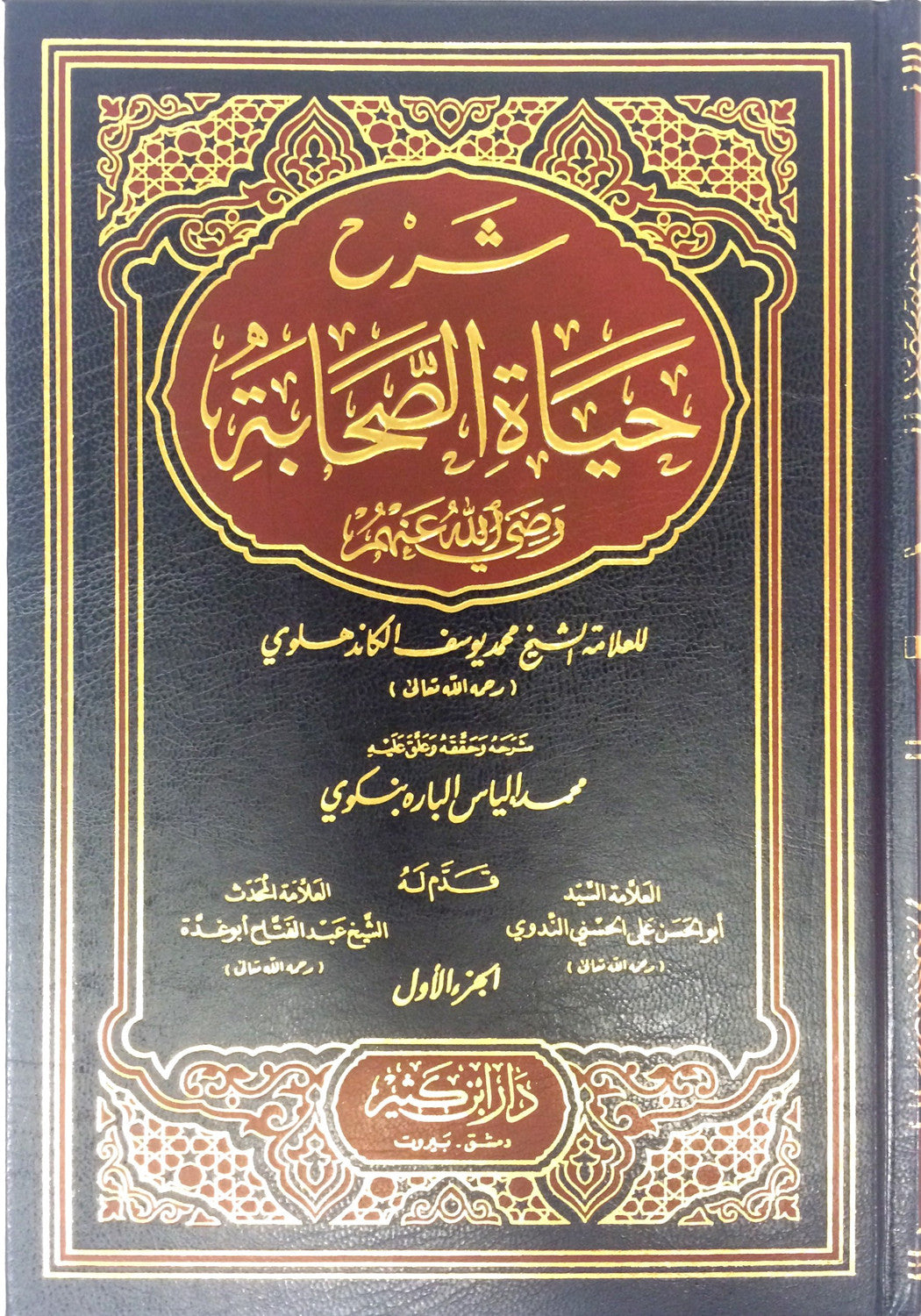
شرح حياة الصحابة - مجموعة من 4 مجلدات | مجموعة السيرة النبوية للصحابة
شرح حياة الصحابة - مجموعة من 4 مجلدات | مجموعة السيرة النبوية للصحابة
Publisher:
Dar Ibn Katheer
Author:
العلامة الشيخ محمد الكندهلوي
Language:
العربية
Binding:
غلاف مقوى
Pages: 2500
Size: 17×24 سم
لم نتمكن من تحميل توفر الاستلام


محتوى قابل للطي
وصف كتاب إسلامي
شرح حياة الصحابة (باللغة العربية) – مجموعة من 4 مجلدات | سلسلة السير الذاتية الإسلامية لحياة الصحابة
شرح حياة الصحابة (باللغة العربية) في 4 مجلدات، هو مجموعة سيرة ذاتية إسلامية مفصلة تركز على حياة الصحابة رضي الله عنهم وتضحياتهم وعبادتهم وأخلاقهم وكفاحهم. تم تجميع هذا العمل من الروايات الإسلامية الموثوقة، ويُعد مصدراً قيماً لفهم شخصية وتفاني أصحاب النبي محمد ﷺ.
من المؤلف:
المجلد الأول
يقدم هذا المجلد الحياة النبيلة للصحابة رضي الله عنهم، مسلطاً الضوء على إيمانهم وتضحياتهم وعبادتهم وتفانيهم القوي للإسلام. ويوضح كيف دعم الصحابة النبي محمد ﷺ في الأيام الأولى للإسلام وأصبحوا قدوة للأمة الإسلامية.
المجلد الثاني
يركز هذا المجلد على الهجرة وكفاح وصبر وشجاعة الصحابة رضي الله عنهم في نشر الإسلام. ويحتوي على قصص ملهمة عن التضحية والأخوة والتفاني التي عززت أسس المجتمع المسلم.
المجلد الثالث
يناقش هذا المجلد عبادة وأخلاق وشخصية وأسلوب الحياة اليومي لصحابة النبي محمد ﷺ. ويسلط الضوء على إخلاصهم وتواضعهم ومحبتهم لله والتزامهم باتباع السنة في كل جانب من جوانب الحياة.
المجلد الرابع
يغطي هذا المجلد الأخير إنجازات وقيادة وجهود الدعوة والإرث الخالد للصحابة رضي الله عنهم. ويقدم دروساً قيمة ودافعاً روحياً للمسلمين لاتباع نهج الصحابة الصالحين وتعزيز ارتباطهم بالإسلام.
Page no:01
Kandhlawi Kandhlawi Kandhlawi Kandhlawi
Mufreh
Hayat al-Sahaba (The Lives of the Companions)
Page no:02
Foreword to the Book
In the name of Allah, the Most Gracious, the Most Merciful
(1)
Book Foreword
By His Eminence Sheikh Sayyid
Abul Hasan Ali al-Hasani al-Nadwi
All praise is due to Allah, Lord of the worlds, and peace and blessings be upon our master Muhammad, the Seal of the Prophets, and upon his family and all his companions, and upon those who follow them in righteousness until the Day of Judgment.
To proceed:
Indeed, the Prophetic biography, the biographies of the Companions, and their history are among the strongest sources of spiritual strength and religious sentiment. This Ummah and religious movements continue to draw the torch of faith from them and use them to ignite the hearths of hearts—hearts that are quick to be extinguished and dimmed in the gusts of material winds and storms. If they are extinguished, this Ummah loses its strength, distinction, and influence, becoming a lifeless corpse that life carries on its shoulders.
It is the history of men to whom the call of Islam came, so they believed in it, and their hearts affirmed it. When they were called to Allah and His Messenger, their only words were: "Our Lord, indeed we have heard a caller calling to faith, [saying], 'Believe in your Lord,' and we have believed." They placed their hands in the hand of the Messenger (peace be upon him). Their own souls, wealth, and kin became trivial to them, and they found bitterness and adversity sweet for the sake of the call to Allah. Their certainty reached their hearts and dominated their souls and minds, and from them emanated the wonders of faith in the unseen and love for Allah and the Messenger.
(1) Written by His Eminence the Sheikh for the first edition, published in Hyderabad, India.
page no: 03
Sources and References
Sources and References
The books that were reviewed during my annotation of "Hayat al-Sahaba," including books of Hadith, Tafsir (exegesis), history, biography, books on Gharib al-Hadith (uncommon terminology), linguistics, and others, are as follows:
From the books of Tafsir:
(1) Tafsir, by Ibn Kathir.
(2) Ruh al-Ma'ani. (3) Tafsir al-Mazhari.
(4) Tafsir Bayan al-Qur'an.
(5) Tafsir al-Jalalayn, with its footnotes and the commentary of al-Sawi.
(6) Madarik al-Tanzil.
(7) Al-Durr al-Manthur.
(8) Tafsir al-Baydawi.
(9) Safwat al-Tafasir.
(10) Aysar al-Tafasir.
(11) Kitab al-Tashil li-'Ulum al-Tanzil.
(12) Mukhtasar Tafsir Ibn Kathir.
(13) Jami' al-Bayan fi Tafsir al-Qur'an, by al-Tabari.
(14) Fath al-Qadir, by al-Shawkani, and other reliable commentaries and their footnotes.
From the books of Hadith:
(1) The Six Authentic Books (Al-Sihah al-Sittah).
Page no: 04
Qur'anic Verses on Obeying Allah and His Messenger
51
(If you should believe in Allah and the Last Day; that is the best [way] and best in result) (1) And the Almighty said: (The only statement of the [true] believers when they are called to Allah and His Messenger to judge between them is that they say, "We hear and we obey." And those are the successful. And whoever obeys Allah and His Messenger and fears Allah and is conscious of Him - it is those who are the attainers.) (2) And the Almighty said: (Say, "Obey Allah and obey the Messenger; but if you turn away - then upon him is that [duty] with which he has been charged, and upon you is that with which you have been charged. And if you obey him, you will be [rightly] guided. And there is not upon the Messenger except the clear notification." Allah has promised those who have believed among you and done righteous deeds that He will surely grant them succession [to authority] upon the earth just as He granted it to those before them and that He will surely establish for them [therein] their religion which He has preferred for them and that He will surely substitute for them, after their fear, security, [for] they worship Me, not associating anything with Me. But whoever disbelieves after that - then those are the defiantly disobedient. And establish prayer and give zakah and obey the Messenger - that you may receive mercy.) (3) And he said...
(1) [Surah An-Nisa: 59]. (Obey Allah and obey the Messenger) The verb is repeated even though the obedience to the Messenger (peace be upon him) is coupled with the obedience to Allah the Almighty, out of concern for the status of the Almighty, to dispel the illusion that what is not in the Qur'an need not be followed, and to signal that he has an independence in obedience not established for anyone else; hence, it was not repeated for those in authority. Bayan al-Qur'an (And those in authority among you). Ibn Abbas said: Meaning the people of jurisprudence and religion. Mujahid and Ata said the same. The apparent meaning - and Allah knows best - is that it is general for all those in authority, from rulers to scholars. On the authority of Abdullah bin Umar from the Messenger of Allah (peace be upon him), he said: "Listening and obeying is incumbent upon a Muslim in what he likes and dislikes, as long as he is not commanded to commit a sin. If he is commanded to commit a sin, then there is no listening and no obedience." Narrated by Abu Dawud. On the authority of Ubadah bin al-Samit, he said: "We pledged allegiance to the Messenger of Allah (peace be upon him) to listen and obey in our ease and our hardship, in our activities and our distaste, and when others are preferred over us, and that we shall not dispute the matter with its people." He said: "Unless you see clear disbelief (Kufr Bawwah) regarding which you have proof from Allah." Narrated by Bukhari and Muslim. On the authority of Abu Hurairah, the Prophet (peace be upon him) said: "Rulers will come after me; the righteous will rule you with their righteousness and the wicked with their wickedness. So listen to them and obey them in everything that conforms to the truth, and pray behind them. If they do good, it is for you and them, and if they do evil, it is for you and against them." Narrated by Ibn Jarir. (And if you disagree over anything, refer it to Allah and the Messenger). This is a general address to the rulers and the subjects. Whenever a dispute occurs in any matter of religion or worldly life, it is mandatory to refer it back to the Book of Allah and the Sunnah of His Messenger. Whatever they judge must be accepted, whether it is sweet or bitter. His saying (If you believe in Allah and the Last Day) implies that faith requires submission to the judgment of Allah and His Messenger, and it indicates that referring disputed matters to other than Sharia is a blemish on the believer's faith. (And best in result) Best in consequence; because the interpretation (Ta'wil) of a thing is what it leads to in the end. (2) [Surah An-Nur: 51-52]. (And is conscious of Him) The meaning is to fear His punishment by following His commands and ending His prohibitions and maintaining His rulings and limits. Al-Mazhari. Al-A'zami said: His saying (And is conscious of Him) - with the sukun on the Qaf and kasrah on the Ha' in our recitation (i.e., Imam Hafs from Imam Asim, may Allah have mercy on them both). In another recitation - with a kasrah on the Qaf and a sukun on the Ha'. There are other recitations. See Hashiyat al-Jamal. (3) [Surah An-Nur: 54-56]. (But if you turn away) Meaning, turn away from obedience. (Upon him is that [duty] with which he has been charged) of conveying =
Page no: 05
By the eminent scholar Sheikh Muhammad Yusuf al-Kandhlawi
(May Allah Almighty have mercy on him)
Annotated, verified, and commented on by
Muhammad Ilyas al-Barahiskwi
Introduced by the eminent scholar Sayyid
Abul Hasan Ali al-Hasani al-Nadwi
(May Allah Almighty have mercy on him)
With the introduction by the eminent scholar
Sheikh Abdul Fattah Abu Ghuddah
(May Allah Almighty have mercy on him)
Volume One
Dar al-Turath
Damascus. Beirut
الناشر
Dar Ibn Katheer
مؤلف
- العلامة الشيخ محمد الكندهلوي
الشحن والتوصيل
نقوم بشحن الطلبات مباشرة من مستودعاتنا في المملكة المتحدة والولايات المتحدة الأمريكية، ونقدم خيارات شحن متعددة لتناسب احتياجاتك. نحن نشحن بفخر إلى جميع أنحاء العالم.
عمليات التسليم في المملكة المتحدة (من مستودع المملكة المتحدة):
يصل الشحن القياسي عادةً في غضون 3-4 أيام عمل. يستغرق التسليم السريع 2-3 أيام عمل. نهدف إلى شحن الطلبات في نفس اليوم أو يوم العمل التالي، مع توفر خيارات التوصيل في اليوم التالي حيثما ينطبق ذلك.
عمليات التسليم في الولايات المتحدة الأمريكية (من مستودع الولايات المتحدة الأمريكية):
تصل الطلبات عادةً في غضون 4-7 أيام عمل.
أوروبا (يتم الشحن من المملكة المتحدة):
يستغرق التسليم القياسي حوالي 6-10 أيام عمل، مع توفر خدمات الشحن السريع في غضون 3-5 أيام عمل.
كندا:
الوقت المقدر للتسليم هو 5-10 أيام عمل.
الشحن في جميع أنحاء العالم:
تصل الطلبات الدولية بشكل عام في غضون 5-20 يوم عمل، اعتمادًا على الوجهة وطريقة الشحن المختارة.
للحصول على جداول زمنية دقيقة للتسليم بناءً على موقعك، يرجى الاتصال بنا عبر البريد الإلكتروني وسيقدم فريقنا معلومات مفصلة ومخصصة لعنوانك.
صفحات العينة - المحتوى
Page no:01
Kandhlawi Kandhlawi Kandhlawi Kandhlawi
Mufreh
Hayat al-Sahaba (The Lives of the Companions)
Page no:02
Foreword to the Book
In the name of Allah, the Most Gracious, the Most Merciful
(1)
Book Foreword
By His Eminence Sheikh Sayyid
Abul Hasan Ali al-Hasani al-Nadwi
All praise is due to Allah, Lord of the worlds, and peace and blessings be upon our master Muhammad, the Seal of the Prophets, and upon his family and all his companions, and upon those who follow them in righteousness until the Day of Judgment.
To proceed:
Indeed, the Prophetic biography, the biographies of the Companions, and their history are among the strongest sources of spiritual strength and religious sentiment. This Ummah and religious movements continue to draw the torch of faith from them and use them to ignite the hearths of hearts—hearts that are quick to be extinguished and dimmed in the gusts of material winds and storms. If they are extinguished, this Ummah loses its strength, distinction, and influence, becoming a lifeless corpse that life carries on its shoulders.
It is the history of men to whom the call of Islam came, so they believed in it, and their hearts affirmed it. When they were called to Allah and His Messenger, their only words were: "Our Lord, indeed we have heard a caller calling to faith, [saying], 'Believe in your Lord,' and we have believed." They placed their hands in the hand of the Messenger (peace be upon him). Their own souls, wealth, and kin became trivial to them, and they found bitterness and adversity sweet for the sake of the call to Allah. Their certainty reached their hearts and dominated their souls and minds, and from them emanated the wonders of faith in the unseen and love for Allah and the Messenger.
(1) Written by His Eminence the Sheikh for the first edition, published in Hyderabad, India.
page no: 03
Sources and References
Sources and References
The books that were reviewed during my annotation of "Hayat al-Sahaba," including books of Hadith, Tafsir (exegesis), history, biography, books on Gharib al-Hadith (uncommon terminology), linguistics, and others, are as follows:
From the books of Tafsir:
(1) Tafsir, by Ibn Kathir.
(2) Ruh al-Ma'ani. (3) Tafsir al-Mazhari.
(4) Tafsir Bayan al-Qur'an.
(5) Tafsir al-Jalalayn, with its footnotes and the commentary of al-Sawi.
(6) Madarik al-Tanzil.
(7) Al-Durr al-Manthur.
(8) Tafsir al-Baydawi.
(9) Safwat al-Tafasir.
(10) Aysar al-Tafasir.
(11) Kitab al-Tashil li-'Ulum al-Tanzil.
(12) Mukhtasar Tafsir Ibn Kathir.
(13) Jami' al-Bayan fi Tafsir al-Qur'an, by al-Tabari.
(14) Fath al-Qadir, by al-Shawkani, and other reliable commentaries and their footnotes.
From the books of Hadith:
(1) The Six Authentic Books (Al-Sihah al-Sittah).
Page no: 04
Qur'anic Verses on Obeying Allah and His Messenger
51
(If you should believe in Allah and the Last Day; that is the best [way] and best in result) (1) And the Almighty said: (The only statement of the [true] believers when they are called to Allah and His Messenger to judge between them is that they say, "We hear and we obey." And those are the successful. And whoever obeys Allah and His Messenger and fears Allah and is conscious of Him - it is those who are the attainers.) (2) And the Almighty said: (Say, "Obey Allah and obey the Messenger; but if you turn away - then upon him is that [duty] with which he has been charged, and upon you is that with which you have been charged. And if you obey him, you will be [rightly] guided. And there is not upon the Messenger except the clear notification." Allah has promised those who have believed among you and done righteous deeds that He will surely grant them succession [to authority] upon the earth just as He granted it to those before them and that He will surely establish for them [therein] their religion which He has preferred for them and that He will surely substitute for them, after their fear, security, [for] they worship Me, not associating anything with Me. But whoever disbelieves after that - then those are the defiantly disobedient. And establish prayer and give zakah and obey the Messenger - that you may receive mercy.) (3) And he said...
(1) [Surah An-Nisa: 59]. (Obey Allah and obey the Messenger) The verb is repeated even though the obedience to the Messenger (peace be upon him) is coupled with the obedience to Allah the Almighty, out of concern for the status of the Almighty, to dispel the illusion that what is not in the Qur'an need not be followed, and to signal that he has an independence in obedience not established for anyone else; hence, it was not repeated for those in authority. Bayan al-Qur'an (And those in authority among you). Ibn Abbas said: Meaning the people of jurisprudence and religion. Mujahid and Ata said the same. The apparent meaning - and Allah knows best - is that it is general for all those in authority, from rulers to scholars. On the authority of Abdullah bin Umar from the Messenger of Allah (peace be upon him), he said: "Listening and obeying is incumbent upon a Muslim in what he likes and dislikes, as long as he is not commanded to commit a sin. If he is commanded to commit a sin, then there is no listening and no obedience." Narrated by Abu Dawud. On the authority of Ubadah bin al-Samit, he said: "We pledged allegiance to the Messenger of Allah (peace be upon him) to listen and obey in our ease and our hardship, in our activities and our distaste, and when others are preferred over us, and that we shall not dispute the matter with its people." He said: "Unless you see clear disbelief (Kufr Bawwah) regarding which you have proof from Allah." Narrated by Bukhari and Muslim. On the authority of Abu Hurairah, the Prophet (peace be upon him) said: "Rulers will come after me; the righteous will rule you with their righteousness and the wicked with their wickedness. So listen to them and obey them in everything that conforms to the truth, and pray behind them. If they do good, it is for you and them, and if they do evil, it is for you and against them." Narrated by Ibn Jarir. (And if you disagree over anything, refer it to Allah and the Messenger). This is a general address to the rulers and the subjects. Whenever a dispute occurs in any matter of religion or worldly life, it is mandatory to refer it back to the Book of Allah and the Sunnah of His Messenger. Whatever they judge must be accepted, whether it is sweet or bitter. His saying (If you believe in Allah and the Last Day) implies that faith requires submission to the judgment of Allah and His Messenger, and it indicates that referring disputed matters to other than Sharia is a blemish on the believer's faith. (And best in result) Best in consequence; because the interpretation (Ta'wil) of a thing is what it leads to in the end. (2) [Surah An-Nur: 51-52]. (And is conscious of Him) The meaning is to fear His punishment by following His commands and ending His prohibitions and maintaining His rulings and limits. Al-Mazhari. Al-A'zami said: His saying (And is conscious of Him) - with the sukun on the Qaf and kasrah on the Ha' in our recitation (i.e., Imam Hafs from Imam Asim, may Allah have mercy on them both). In another recitation - with a kasrah on the Qaf and a sukun on the Ha'. There are other recitations. See Hashiyat al-Jamal. (3) [Surah An-Nur: 54-56]. (But if you turn away) Meaning, turn away from obedience. (Upon him is that [duty] with which he has been charged) of conveying =
Page no: 05
By the eminent scholar Sheikh Muhammad Yusuf al-Kandhlawi
(May Allah Almighty have mercy on him)
Annotated, verified, and commented on by
Muhammad Ilyas al-Barahiskwi
Introduced by the eminent scholar Sayyid
Abul Hasan Ali al-Hasani al-Nadwi
(May Allah Almighty have mercy on him)
With the introduction by the eminent scholar
Sheikh Abdul Fattah Abu Ghuddah
(May Allah Almighty have mercy on him)
Volume One
Dar al-Turath
Damascus. Beirut
من هو Allama Shaikh Muhammad Al-Khandalwi؟
Shaykh Muhammad Yusuf Al-Kandhlawi was a respected Islamic scholar and historian known for his deep research into the lives of the Sahaba. His writings inspire Muslims to follow the example of the righteous companions through authentic historical accounts and spiritual lessons.